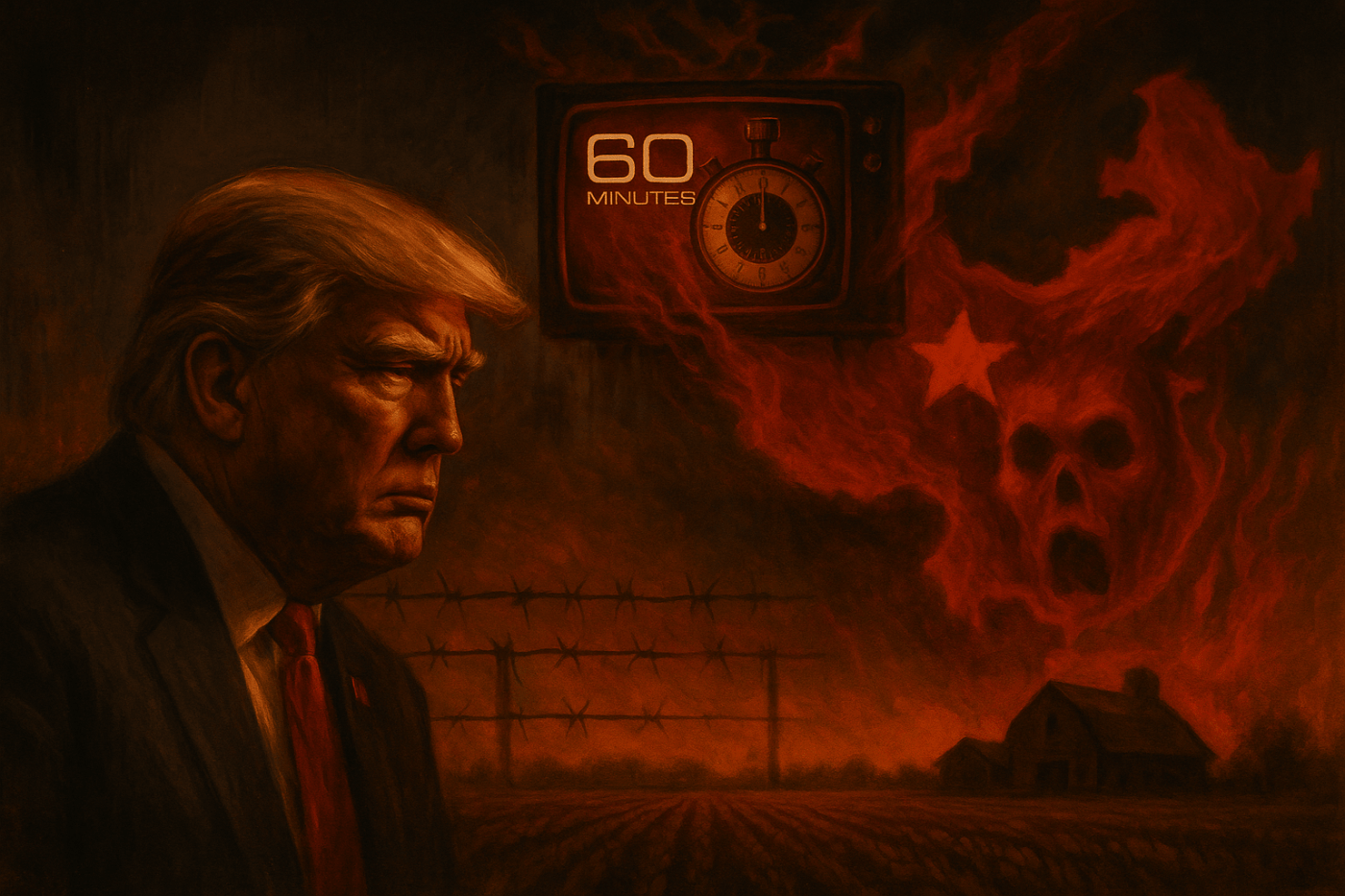
This essay excavates the CBS 60 Minutes report on Chinese farmland ownership as a case study in imperial propaganda. By transforming minor land deals into an imagined national-security crisis, the Trump regime and its media partners manufacture consent for domestic militarization, racial scapegoating, and the consolidation of technofascist power at home.
By Prince Kapone | Weaponized Information | October 14, 2025
The Manufacture of Fear as Policy
On October 12, 2025, CBS News published a 60 Minutes Overtime feature titled “How China Could Use U.S. Farmland to Attack America.” Written by Brit McCandless Farmer, the segment claims that Chinese companies purchasing farmland near U.S. military bases could enable espionage or even a future strike. It cites former Trump administration official David Feith, who warns that these acquisitions represent “an entirely new way of war,” invoking drones, cyberattacks, and crypto-mining as potential weapons hidden in plain sight. The piece concludes by endorsing new federal and state restrictions on foreign land ownership, presenting the Trump regime’s policy as common-sense defense against Chinese aggression. But beneath the patriotic framing and expert authority, the story recycles a much older script—where fear replaces evidence and empire disguises its own crimes behind the mirror of national security.
It begins, as imperial propaganda often does, with a headline that reads like an alarm bell: “How China Could Use U.S. Farmland to Attack America.” No evidence, no balance, no context—just a premise offered as a panic. From the first line, the reader is conscripted into a national-security thriller disguised as journalism. The story breathes the old air of McCarthyism, yet it wears the new skin of digital-age paranoia: a handful of Chinese land purchases transformed into the opening act of World War III.
Brit McCandless Farmer, a veteran of the corporate news assembly line, plays her part well. She doesn’t investigate; she narrates. The story flows not from discovery but from deference— to former State Department official David Feith, to the anonymous “intelligence community,” to the invisible architecture of authority that defines what the American public is allowed to fear. Feith is introduced as a “former national security official,” as if that alone endows him with a monopoly on truth. His speculation—uttered with the gravity of insider knowledge—becomes the spine of the piece, while the journalist merely echoes the chorus.
The language of the article is pure choreography. Each paragraph raises the temperature a few degrees. What begins as concern—“China owns land near U.S. military bases”—becomes foreboding:
“access to buildings, warehouses, or even a shipping container could be used to do enormous damage.” By the midpoint, we’re already deep into the apocalypse: drones, nuclear bombers, crypto mines, and “a new way of war.” It’s less reportage than scriptwriting, designed to make the audience’s pulse race rather than their minds question. Suspense replaces substance; emotion substitutes for evidence.
What makes this propaganda particularly effective is its cadence of authority. Feith’s titles and affiliations are repeated like liturgy—former State Department official, National Security Council, Trump administration—each invocation a signal that thinking is no longer necessary. The presence of unnamed “intelligence officials” seals the illusion of consensus. There is no dissenting voice, no challenge, no Chinese perspective—only a single, reverberating echo chamber of official anxiety. The reader is not informed; they are recruited.
The timeline is another sleight of hand. Past incidents and speculative futures collapse into one continuous emergency. The 2023 North Dakota corn mill controversy, the 2024 crypto mine order, and the imagined future “crisis or conflict with China” are fused together, creating an unbroken sense of siege. Time itself becomes an instrument of manipulation: yesterday’s rumor is today’s danger and tomorrow’s justification for militarization. Everything, always, is on the verge of war.
The moral architecture of the story is painfully familiar. On one side stands the vigilant protector—the U.S. government, framed as the eternal guardian of freedom. On the other stands the faceless infiltrator—“China,” depicted not as a complex nation of workers and farmers but as a singular plotting mind, a shadow without body or people. There are no quotes from Chinese individuals, no facts about specific companies, no data—only the abstraction of an omnipotent menace. It is Orientalism repackaged for the 21st century, where the dragon is replaced by a data server.
By the end, the script completes its arc: Feith warns that “China is preparing to fight and defeat the United States military in a war.” It’s the kind of statement that needs no verification because it fulfills its only function—fear. The reader, now fully conditioned, mistakes repetition for truth. The circle closes: anxiety produces policy, policy produces headlines, and the headlines regenerate anxiety. CBS presents this cycle as journalism, but it is really a form of ideological irrigation— feeding the fields of paranoia so that the crop of militarism can grow tall once again.
Here, beneath the veneer of neutral reporting, we witness the same old machinery of empire humming along: a story that begins with a whisper of insecurity and ends with the thunder of war drums. This is not news—it is the soft launch of consent.
Facts Buried Beneath Fear: Extraction and Contextualization
Strip away the patriotic panic, and the numbers tell a far different story. The CBS report itself concedes that foreign entities collectively own about 45 million acres of U.S. agricultural land barely three and a half percent of the total. Of that, Chinese nationals hold roughly 277 000 acres, or less than one percent. That’s the entire basis for the claim that “China could use U.S. farmland to attack America.” A handful of private business transactions are inflated into a theater of war. Two examples—the blocked North Dakota corn mill in 2023 and a cryptocurrency mine in Wyoming ordered sold in 2024—are treated as proof of a master plan rather than as isolated zoning disputes. It’s hysteria disguised as analysis.
Omitted from this picture is the true scale of global land consolidation by U.S. capital. While Chinese investors hold a statistical speck of soil, firms linked to the United States appear prominently among the top global land grabbers: GRAIN’s dataset of large-scale farmland acquisitions shows U.S. agribusiness and investment funds repeatedly acting as major actors in cross-border deals. Inside the United States, the USDA’s Agricultural Foreign Investment Disclosure Act (AFIDA) report confirms that foreign entities collectively own nearly 45 million acres of agricultural land—about 3.5 percent of all privately held farmland. Among these, Canadian investors hold roughly 31 percent of all foreign-owned acreage, followed by groups from the Netherlands, Italy, and others. These facts were just a phone call away. Instead, CBS opted for fear over context, converting marginal statistics into existential threats while leaving the real structure of capital accumulation untouched.
Beyond the nation’s borders, the double standard is blinding. U.S.-linked agribusiness and infrastructure firms operate freely across Africa, including Uganda and Kenya, where foreign-owned plantations and infrastructure projects often overlap with areas of foreign military presence, yet no one in Washington calls that proximity a “security threat.”
Meanwhile, the Congressional Research Service documents that the United States maintains hundreds of overseas military installations spanning more than 80 countries and territories—a global network of bases that dwarfs any other nation’s foreign footprint. If owning land near a base constitutes subversion, then the United States is the most subversive power on Earth.
The most glaring omission, however, is that the real land grab threatening Americans is domestic. While CBS warns of “foreign infiltration,” U.S. billionaires and asset-management firms have already consolidated a continental empire. Bill Gates alone owns nearly 270 000 acres — almost the entire sum attributed to China. BlackRock and Vanguard — the same financiers behind Paramount Global, CBS’s parent company — now rank among the largest farmland investors in North America while simultaneously holding major stakes in Raytheon, Lockheed Martin, and Northrop Grumman. Their portfolios bind the dinner table to the drone factory, turning food production into an auxiliary of the war economy. This is the real national-security threat: a military-industrial-agricultural complex whose pursuit of profit starves workers at home while arming conquest abroad.
Meanwhile, the same government that cries espionage has turned its arsenal against its own people. The National Security Agency was already exposed for conducting warrantless mass surveillance on virtually every U.S. citizen, a dragnet that never ended—only evolved through AI integration, biometric tracking, and predictive policing. Now, under the Trump 2.0 regime, National Guard units have been deployed into major U.S. cities under the banner of “public order,” but internally framed as militarized “war zones” for “domestic stabilization.” Trump has officially designated leftist and anti-fascist organizations under the Antifa banner as “domestic terrorists,” a move condemned by civil rights groups as a pretext for mass surveillance, infiltration, and suppression of political dissent. During a closed-door meeting with hundreds of generals at Quantico, Trump referred to these urban deployments as “training grounds” for the National Guard and private contractors, giving them “free rein” to test new crowd-control technologies, drones, and AI-based policing on U.S. civilians. These are not isolated policies—they are the laboratory conditions of a domestic counterinsurgency state in formation. It is not Beijing but Washington that now treats its citizens as an occupied population. What CBS paints as a hypothetical danger from foreign ownership is already a lived military reality under homegrown technofascism.
Even the new “foreign-ownership bans” now spreading across 29 states are not safeguards — they are revivals of the early-twentieth-century Alien Land Laws, which once targeted Japanese and Chinese farmers. The racial paranoia remains; only the rhetoric has been updated. Legal and civil-rights organizations have warned that these new laws echo the same exclusionary logic, disproportionately targeting Asian and immigrant communities. The policy class knows that these bills will not keep Wall Street from buying farmland through shell corporations. They are designed to redirect public anger away from the corporations and toward a foreign scapegoat.
All of this unfolds against a collapsing unipolar order. As BRICS+ expansion, the Belt and Road Initiative, and South-South trade erode U.S. supremacy, fear becomes the final export. Washington’s ruling class uses the specter of China to justify new industrial-military subsidies, while agribusiness and security lobbies cash in on “homeland protection” contracts. The propaganda of panic sustains the profits of power. When land, logistics, and lethal supply chains merge under one financial command, the republic is no longer fed—it is managed. That is the danger CBS cannot name because it is owned by it.
The Empire’s Mirror: Fear, Ownership, and the Politics of Projection
Every propaganda campaign tells us less about its target than about the system that produces it. When CBS warns that Chinese farmland threatens America’s safety, it reveals not a Chinese plan but an American panic. The empire is spooked by its own reflection. The techniques it once exported—economic penetration, technological espionage, territorial control—now haunt its imagination when practiced by others. The hysteria over a few acres of Chinese-owned soil is the empire’s way of looking in the mirror and refusing to recognize itself.
For over a century, the United States has used land as a weapon of domination. Through corporations like Cargill, Bechtel, and Monsanto, it has seized, leased, or privatized millions of acres across Latin America, Africa, and Asia. In Kenya, American agribusiness operates comfortably within sight of military installations hosting AFRICOM operations. In the Philippines, U.S. defense contractors build near naval bases while Filipino workers are told it’s “partnership.” If a Kenyan or Filipino official were to call that proximity a security threat, Western pundits would laugh them off as “anti-investment populists.” But when the geography is reversed—when Chinese companies invest near American bases—the laughter turns to alarm. Virtue, it seems, is a privilege of power.
This double standard is not hypocrisy; it is ideology. Empire defines its actions as universal and others’ as subversive. When U.S. companies buy land abroad, they bring “development.” When non-Western countries do the same, they bring “infiltration.” The moral logic is colonial: the white glove of capital always represents civilization, while the brown or red hand represents deceit. That is why mainstream media never asks whether America itself might be the infiltrator, the occupier, the global landlord. To do so would mean confessing that the very “rules-based order” it defends was built on a foundation of theft and occupation.
Beneath the moral theater lies the harder truth: the U.S. ruling class can no longer sustain its dominance through production or consent. Financialization has hollowed out its economy, leaving a superstructure of speculation and surveillance. It no longer builds so much as it monitors, manipulates, and militarizes. Unable to promise prosperity, it offers protection—against migrants, against China, against the very shadows it casts on the wall. The CBS narrative is part of that protection racket. It sells fear to a population exhausted by stagnation and betrayal, redirecting working-class anger from Wall Street to an imagined foreign menace. The anxiety of decline is repackaged as patriotic vigilance.
Meanwhile, the same “new way of war” that Feith attributes to China is already being perfected in the streets of America. The Trump regime’s National Guard deployments, armed with drones, AI crowd control, and biometric tracking, are test runs in domestic pacification. What CBS presents as a hypothetical external danger is already an internal experiment. The farmland panic is a smokescreen for the digital garrison rising within the homeland. The U.S. state fears Chinese land ownership not because it endangers security, but because it reminds the empire of its own fragility—its dependence on debt, its decaying legitimacy, its growing need to rule by fear.
Historically, this script has played many times. Every phase of U.S. contraction produces a new enemy to reforge national unity: Native nations during the frontier era, the “Yellow Peril” during the rise of industrial competition, the “Red Menace” of the Cold War, and the “Islamic Terrorist” after 9/11. Each bogeyman reflects a shifting anxiety of power losing its grip. China’s rise now fills that role, symbolizing the return of the colonized to history. What the West calls aggression is often the Global South demanding the right to exist on its own terms. That defiance threatens not America’s safety but its mythology—the belief that it alone is destined to lead.
From the standpoint of the global working class and peasantry, the contradiction is not between Chinese and American investors but between those who work the land and those who own it. Capital—whether Western or Eastern—treats the earth as collateral. But there is a difference in trajectory: where the West secures control through war and sanctions, the emerging multipolar world builds through infrastructure, trade, and shared development. It is this alternative path—one less dependent on extraction and more oriented toward sovereignty—that imperial media must discredit at all costs.
Thus, the “Chinese farmland threat” is not a revelation but a ritual. Its purpose is to maintain the psychological boundaries of empire: to make the American public afraid of the very world that is freeing itself from U.S. domination. Behind every accusation of espionage lies a confession of decline. The empire that once surveyed the planet now surveys its own people, preparing them for austerity, obedience, and endless mobilization against invisible enemies.
Look closely, and the narrative turns inside out. What CBS presents as defense is in fact projection: the empire accusing others of the crimes it commits daily. The farmland panic is not about soil—it is about control: of territory, of truth, of the collective imagination. When fear becomes the final currency of power, propaganda is not a mistake—it is policy.
From Fear to Freedom: Building the Counter-Power of the Earth
The story ends where the struggle begins. Once we expose the propaganda for what it is—a mirror reflecting the empire’s own crimes—we face a new question: what do we build in its place? The farmland scare is only one front in a wider war of ideas, a campaign designed to keep the working classes divided, the colonized nations isolated, and the multipolar world contained. To counter it, we must weave together the living forces already resisting dispossession—from the tenant unions of the Global North to the landless movements of the Global South. The antidote to fear is not faith in reform but the organization of the oppressed.
Across the planet, farmers, workers, and communities are already pushing back against the very forces that manufactured the “China threat.” In Brazil, the Movimento dos Trabalhadores Rurais Sem Terra—the Landless Workers’ Movement—occupies unused estates to feed the poor and challenge agribusiness monopolies. In Africa, the Pan-African Farmers’ Organization and Kenya’s No Land No Peace coalition fight the seizure of communal lands by foreign corporations, whether American, European, or Chinese. In Asia, Indian farmers have waged mass strikes against neoliberal agricultural reforms, while Filipino and Indonesian peasants build cooperatives to defend their soil from speculation. These are not isolated acts—they are nodes of a global class front taking shape beneath the noise of empire.
Within the imperial core itself, similar tremors can be felt. The Black Farmers United coalition, Indigenous land defenders, and the National Family Farm Coalition have begun linking racial justice, food sovereignty, and environmental survival into one coherent struggle. Urban tenants’ unions, from Detroit to Oakland, are learning that housing speculation and farmland privatization are two faces of the same system. Each act of community defense, each worker-owned farm, each reclaimed neighborhood is a small crack in the concrete of monopoly capitalism. Together, they form the embryo of a new mode of production—one based on cooperation rather than coercion.
The same logic applies to the digital sphere. The surveillance systems now deployed against protesters in Chicago or São Paulo are built by the same corporations that monitor farmers in Malawi and factory workers in Vietnam. Tech workers and farmers share an enemy they rarely name: the infrastructure of control. Linking campaigns like Fight for the Future, which battles digital surveillance, with agrarian movements such as La Via Campesina transforms scattered protests into a unified front against enclosure—whether of data or of land. The struggle for privacy and the struggle for food are, at their root, struggles for autonomy.
The immediate tasks are clear. First, unmask the domestic front of empire. Every National Guard deployment, every “foreign-ownership” scare, every AI policing contract is not about security but social control. Workers and communities must treat them as fronts of class struggle, not bipartisan policy. Second, fuse rural and urban organizing. The same corporations buying up Iowa farmland speculate on evicting tenants in Philadelphia. The same hedge funds that corner wheat futures own social media platforms that harvest human attention. Third, internationalize solidarity. The peasant in Chiapas, the coder in Berlin, the longshoreman in Durban—they are all participants in the same supply chain of exploitation. The walls of nationality are paper thin when pierced by capital.
Finally, deepen political education. Propaganda thrives where history is forgotten. By tracing the line that runs from the Alien Land Laws of 1913 to today’s anti-China hysteria, from COINTELPRO to predictive policing, we arm ourselves with the knowledge that every new witch hunt is built on the bones of the old. The goal is not to memorize slogans but to understand systems—how imperialism reproduces itself through media, how capital turns fear into discipline, and how we can reverse that current.
These are not utopian dreams; they are living movements. The BRICS Peoples Forum, ALBA Movements, and the Tricontinental Institute are already articulating the principles of a new internationalism grounded in sovereignty and ecological justice. The task of those inside the imperial core is not to lead them but to join them—to disarm the empire from within. That means refusing its wars, sabotaging its propaganda, and redirecting our labor, science, and creativity toward liberation.
The world that CBS fears—a world where the land serves the people instead of the market, where nations act as equals, where technology obeys humanity—is not a dystopia. It is the beginning of a new civilization waiting to be born. The question is not whether it can happen, but whether we will have the courage to stand with it. The soil of the future is already under our feet; we need only reclaim it.
 Weaponized Information
Leave a comment