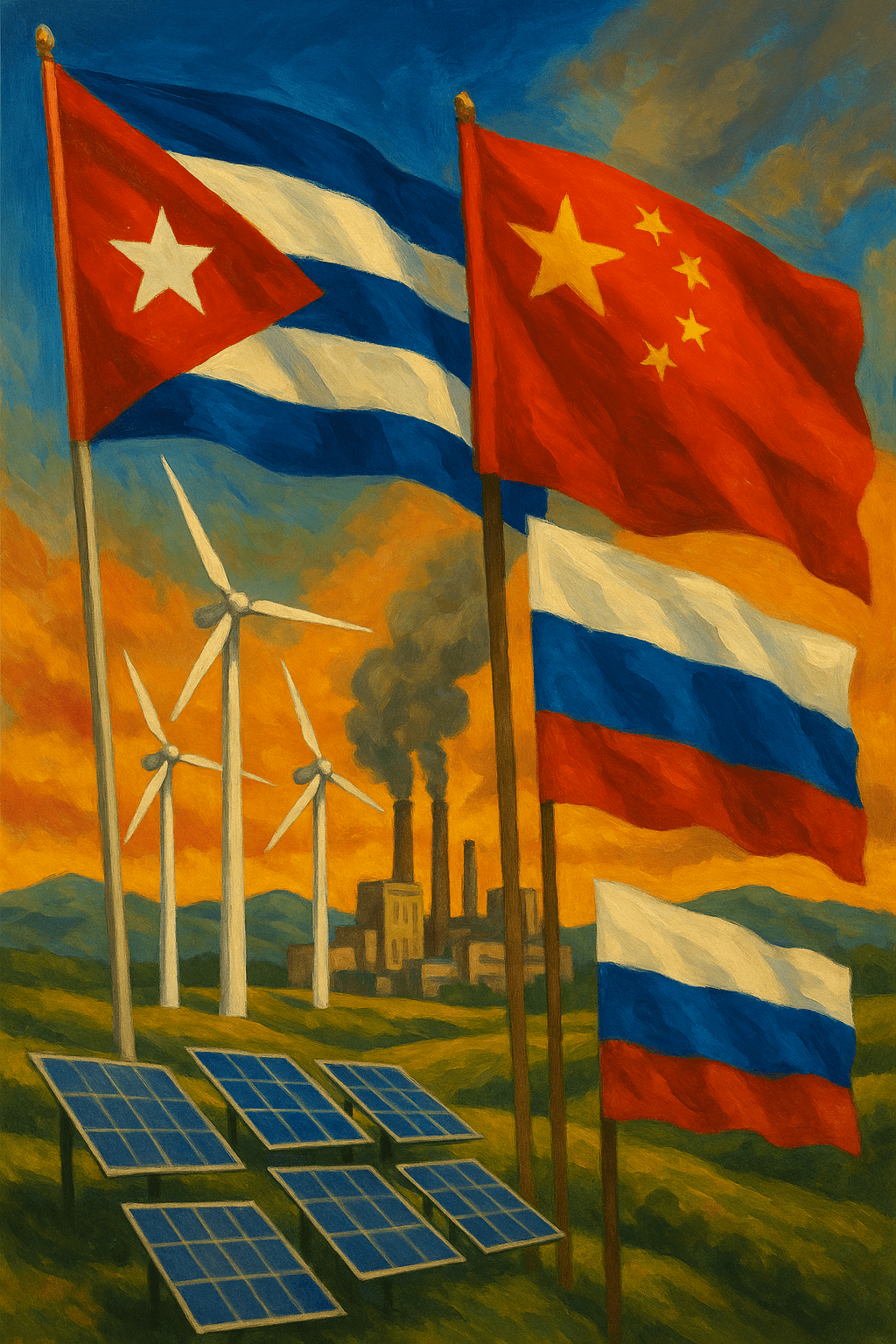
How multipolar solidarity with Russia, China, and the Global South keeps Cuba’s vision alive under the chokehold of U.S. hyper-imperialism.
By Prince Kapone | Weaponized Information | October 2, 2025
Planning Against the Blockade of Empire
History has never allowed Cuba the luxury of neutrality. Since 1959, every attempt to build a sovereign society on the island has been met with the iron fist of imperialism. Where Cuba declared health, education, and dignity as rights, Washington answered with sabotage, invasion, and blockade. Where Cubans stitched together their survival through international solidarity, the U.S. countered with sanctions designed to strangle the island’s lifelines.
Into this terrain enters the Plan Nacional de Desarrollo Económico y Social hasta 2030 (PNDES 2030) — not as a technocrat’s blueprint, but as a battlefield document drafted under siege. It is Cuba’s horizon for sovereignty: six strategic axes that aim to modernize infrastructure, rewire the energy system, strengthen science and technology, ensure environmental resilience, and, above all, defend human development as the center of national planning.
But this horizon is plotted in the shadow of hyper-imperialism. The U.S. blockade, tightened through extraterritorial sanctions and financial blacklisting, is not just bilateral punishment — it is the architecture of domination extended across the entire capitalist world system. Hyper-imperialism ensures that Cuba cannot access credit from Western banks, cannot trade freely in global markets, and cannot modernize its productive base without finding cracks in the empire’s walls. This is the same system that weaponizes food, fuel, and medicine against the poor in order to enforce obedience.
PNDES 2030 is thus both a developmental plan and an act of defiance. It says: Cuba will not wait for Washington’s permission to imagine the future. It will plan in long horizons even when the present is starved of resources. It will plot renewable energy parks while forced to import oil on emergency terms. It will train scientists and build research labs while U.S. sanctions attempt to isolate Cuban medicine from global circuits. And it will declare, against the logic of imperial suffocation, that sovereignty is not negotiable.
The question, then, is not whether Cuba can dream of 2030. It is whether the dream can be realized under the siege of hyper-imperialism — and what forms of multipolar solidarity can carve out the material breathing space for this horizon to move from paper to practice.
The Architecture of the 2030 Plan
The Plan Nacional de Desarrollo Económico y Social hasta 2030 is not simply a list of targets to impress international donors. It is the skeleton of a future Cuba, organized around six axes that together form a comprehensive counter-proposal to the logic of imperial dependency. Each axis is a declaration: we will modernize without surrender, innovate without selling our sovereignty, and develop while centering human life, not profit.
The first axis, institutionality and macroeconomy, addresses the machinery of governance itself. Cuba knows that a besieged economy cannot afford disorder. The plan demands stronger institutions, greater fiscal stability, and a state capable of steering development against the headwinds of sanctions. This is not neoliberal “state reform” designed to weaken sovereignty, but socialist modernization to fortify it.
The second axis, productive transformation and international insertion, sets the goal of breaking Cuba’s vulnerability to a few export commodities. It envisions an economy driven by biopharma, renewable energy, information technology, and sustainable agriculture. It calls for Cuba to re-enter global trade on multipolar terms, linking with partners who respect sovereignty rather than enforcing subjugation.
The third axis, infrastructure, confronts the island’s most visible scars: a grid prone to blackouts, ports strained by sanctions, transportation systems running on outdated equipment. Here the plan demands renewal — electricity plants modernized, logistics streamlined, and telecommunications expanded — so that the material base of daily life ceases to be defined by scarcity and breakdown.
The fourth axis, science, technology, and innovation, reaffirms a truth the Cuban Revolution has always known: knowledge is power. From biotechnology to digital networks, Cuba has punched above its weight through human capital. PNDES 2030 seeks to systematize this advantage, embedding research and innovation directly into the productive economy, so that Cuban science does not just heal the sick but also feeds the nation’s industrial future.
The fifth axis, resources and environment, recognizes that Cuba is on the frontline of climate catastrophe. Hurricanes, rising seas, and droughts are not abstractions but recurring traumas. The plan insists on resilience: renewable energy, sustainable agriculture, environmental protection, and disaster risk reduction. This is Cuba refusing to trade survival for short-term profit.
Finally, the sixth axis, human development, equity, and social justice, is the soul of the plan. Where neoliberal strategies make inequality a feature, Cuba makes justice a principle. The plan centers healthcare, education, housing, and regional balance, declaring that development without equity is not development at all.
Taken together, these six axes outline more than a policy framework. They articulate a worldview: that a small island, besieged and denied access to global finance, can still imagine a horizon where sovereignty, justice, and sustainability coexist. Yet, here lies the contradiction that runs through every page of PNDES 2030: the vision is coherent, but the resources to realize it are systematically blocked by hyper-imperialism. To bridge this gap, Cuba turns toward solidarity, and it is here that Russia and China enter the stage.
Russian Solidarity – Stabilizing the Foundations
If Cuba’s 2030 horizon is to be more than words on paper, it must first secure the material ground on which that horizon rests. No plan can survive rolling blackouts, paralyzed logistics, or an empty granary. Here, Russian solidarity steps in — not as charity, but as the renewal of a long strategic partnership between two nations that have both faced the full blast of imperial siege.
Energy is the first line of defense. In 2023 Moscow extended €1.2 billion in credit to refurbish Cuba’s thermal plants at Máximo Gómez and East Havana, a commitment that means more than new turbines: it means light in classrooms, stability for hospitals, and relief for families weary of daily outages. Alongside this, Russian oil and diesel shipments have kept the grid from collapse, while wheat donations have fed Cuban households when the blockade sought to starve them. In a system where the U.S. weaponizes electricity and bread, these flows are acts of defiance.
The partnership goes further. Russia has pledged nearly $1 billion in investments by 2030, spanning electricity generation, agriculture, and infrastructure. At the heart of this lies the Mariel logistics hub — a joint venture that would transform Cuba into a gateway for Russian trade with Latin America. This is not just about containers and cranes; it is about repositioning Cuba within Eurasian and Latin American supply chains, reducing its dependence on hostile markets and tightening its links with multipolar partners.
Each of these projects plugs directly into the axes of the 2030 Plan. Infrastructure renewal (Axis 3) is advanced through power plant modernizations and logistics investments. Macroeconomic stability (Axis 1) is reinforced by concessional credits that relieve Cuba’s fiscal stranglehold. Productive transformation and international insertion (Axis 2) are strengthened by agricultural cooperation and trade integration beyond Washington’s orbit.
Russia’s role, then, is to stabilize Cuba’s foundations: to provide fuel against darkness, grain against hunger, credits against insolvency, and logistics against isolation. It is solidarity in the hardest sense of the word — solidarity measured in barrels, ships, and megawatts. And it is this stability that allows Cuba to turn toward the horizon of transformation, where China enters with the tools of energy transition and technological renewal.
Chinese Solidarity – Powering the Transition
Where Russia shores up the foundations, China supplies the engine of transformation. If Cuba’s 2030 Plan is to move beyond survival, it must leap into a new energy system, a new technological base, and a new circuit of global trade. This is where Beijing’s solidarity has already moved from declarations to construction sites.
Cuba has pledged to source nearly a quarter of its electricity from renewables by 2030, and China is building the backbone of that transition. Over fifty solar parks are now under construction, with the aim of delivering 1,000 megawatts of solar capacity by 2025 and 2,000 megawatts by 2028. In a country where blackouts have been weaponized by blockade, each solar panel is not just a kilowatt-hour but a line of defense against imperial siege. This is the material translation of PNDES Axis 5 — environmental resilience and resource sovereignty.
But China’s role extends beyond energy. Through the Belt and Road Initiative, Cuba has become part of a web of infrastructure, telecommunications, and scientific projects that plug the island into multipolar circuits of exchange. Huawei and ZTE have already provided key components of Cuba’s digital backbone. Joint laboratories in biotechnology and medical research fuse Cuban expertise with Chinese investment, ensuring that Cuba’s famed biopharma sector — itself a jewel of revolutionary science — can thrive even under sanctions. These initiatives directly advance Axis 4 of the PNDES: science, technology, and innovation as drivers of development.
Politically, Beijing has locked arms with Havana in global arenas. The 2025 Joint Declaration between China and Cuba committed both nations to accelerate cooperation across sectors and to secure Cuba’s entry into BRICS+ circuits and eventual access to the New Development Bank. This responds directly to Axis 2 of the PNDES — international insertion — by breaking Cuba’s isolation from Western-dominated finance and opening doors to alternative capital flows.
Taken together, Chinese solidarity provides the forward momentum of Cuba’s 2030 horizon: renewable energy for a sustainable base, digital infrastructure for productive transformation, scientific collaboration for innovation, and diplomatic support for global integration. Where Russia stabilizes, China accelerates. Where Moscow delivers oil to keep the lights on, Beijing delivers solar fields to make sure the lights stay on in the future.
This duality — Russia as stabilizer, China as transformer — reveals the multipolar dialectic that sustains Cuba’s sovereignty under hyper-imperialism. But beyond bilateral ties, Cuba’s plan depends on embedding itself in a broader fabric of Global South solidarity — CELAC, ALBA, the G-77, NAM, and BRICS — a dense web of cooperation that defies isolation.
Multipolar Pathways – BRICS and the Global South Web of Solidarity
Cuba’s survival has never been the product of bilateral ties alone. What has kept the Revolution alive is a dense fabric of internationalism, woven across continents by those who refuse to kneel before empire. If the Plan Nacional de Desarrollo Económico y Social hasta 2030 is to become reality, it will not rest only on Russian fuel or Chinese solar panels. It must be anchored in the broader architecture of multipolar solidarity — a counter-order that spans Latin America, Africa, Asia, and beyond.
BRICS+ and the New Development Bank represent the most visible pole of this architecture. By pressing for Cuba’s effective integration into BRICS circuits, Beijing and Moscow have cracked open a path toward development finance outside the IMF’s iron cage. Access to NDB loans or swaps would undercut the embargo’s financial chokehold and give Havana room to fund its infrastructure, energy, and innovation priorities without submitting to imperial dictates.
But Cuba’s strength also lies in its regional networks. The Community of Latin American and Caribbean States (CELAC) excludes the U.S. and Canada, asserting Latin America’s right to determine its own future. Within CELAC, Cuba is not isolated but embraced as part of a continental project of autonomy. Likewise, the Bolivarian Alliance for the Peoples of Our America (ALBA) has provided frameworks for solidarity trade, medical brigades, and education programs — living proof that cooperation can be organized around human need, not profit margins.
On the global stage, Havana’s leadership in the G-77 + China has amplified the collective voice of the Global South. In 2023, Cuba chaired the group and declared the demand for a new international economic order, one that refuses the dictatorship of Western finance. In the Non-Aligned Movement (NAM), Cuba’s role has been historic and enduring: from the Tricontinental Conference of 1966 to today’s diplomatic battles, Havana has been a vanguard in the struggle to carve out sovereignty in a world of empires.
This web of institutions is not ornamental. It provides Cuba with political cover, diplomatic recognition, cooperative frameworks, and in some cases direct material aid. Together with BRICS, CELAC, ALBA, the G-77, and NAM, Cuba embeds its 2030 horizon in a global movement that insists another world is possible. Hyper-imperialism seeks to isolate the island; multipolar solidarity re-inserts it into a network of resistance and cooperation.
In this way, the 2030 Plan is not merely a Cuban document. It is a node in the broader battle of the Global South to break the stranglehold of hyper-imperialism and to reclaim planning, sovereignty, and justice as the principles of development.
Contradictions in the Struggle
No development plan unfolds on a blank canvas. Cuba’s 2030 horizon is painted on a battlefield where every advance is contested, every gain precarious. Hyper-imperialism does not sit idle as Cuba builds solar parks with Chinese engineers or erects a logistics hub with Russian capital. It retaliates. And it is here, in the interplay of vision and sabotage, solidarity and vulnerability, that the contradictions of Cuba’s 2030 Plan sharpen into focus.
The first contradiction is the constant threat of retaliation from the U.S. empire. Sanctions can be tightened, shipping lanes pressured, financial transactions frozen at the click of a button in Washington. Every concession Cuba wins through BRICS or CELAC risks provoking counter-measures designed to isolate it further. The blockade is not static but adaptive, recalibrating to choke off new arteries of survival.
The second contradiction lies in Cuba’s own implementation capacity. Even with credits from Moscow and infrastructure from Beijing, the island must modernize its governance, streamline its bureaucracy, and train cadres to manage complex projects under siege. A thermal plant can be financed from abroad, but its efficiency depends on domestic management. A solar park can be erected, but without stable grid integration and skilled technicians, it risks underperformance. Planning under blockade demands not only resources but also administrative precision.
The third contradiction is the risk of dependency. Multipolar solidarity can be a lifeline, but it can also become a crutch if not carefully managed. The task for Havana is to balance solidarity with sovereignty: to accept aid, investment, and credits without sliding into new forms of dependency. Cuba’s tradition of internationalism — exporting doctors, sending teachers, contributing to global struggles — remains its shield against becoming a passive recipient. Sovereignty is not preserved by gratitude alone but by maintaining reciprocal contributions to the global South.
The fourth contradiction is climate vulnerability. Hurricanes, droughts, and rising seas can shred infrastructure as quickly as it is built. Every solar field is exposed to storms, every port vulnerable to flooding. Hyper-imperialism weaponizes finance; climate change weaponizes nature itself. Together they form a pincer against Cuba’s developmental horizon, demanding a constant reinvestment in resilience.
These contradictions do not negate the 2030 Plan. They define the terrain on which it must be fought. To realize its horizon, Cuba must navigate between external blockade and internal capacity, between solidarity and sovereignty, between climate catastrophe and ecological resilience. In this struggle, success is not guaranteed, but neither is surrender inevitable. The very existence of the plan — drafted, debated, and defended under siege — is itself a declaration that Cuba will continue to plan, to resist, and to imagine a future beyond hyper-imperialism.
Conclusion – Cuba’s 2030 as a Beacon of Anti-Imperialist Sovereignty
The Plan Nacional de Desarrollo Económico y Social hasta 2030 is more than a roadmap for one small island. It is a declaration that sovereignty can be planned, that dignity can be organized, and that socialism can chart horizons even under the suffocating weight of hyper-imperialism. In a world where empire insists that there is no alternative to dependency, Cuba insists on imagining the alternative in concrete terms: megawatts of renewable energy, miles of modernized infrastructure, laboratories of innovation, and communities where health and education are non-negotiable rights.
What gives this horizon its possibility is not empire’s approval but multipolar solidarity. Russia stabilizes the foundations — fuel, grain, credit, logistics. China powers the transition — solar fields, digital networks, science, and finance. And around them, Cuba is woven into a dense fabric of South–South cooperation: CELAC’s regional sovereignty, ALBA’s solidarity trade and social programs, the G-77’s collective voice for a new economic order, and the Non-Aligned Movement’s enduring shield against domination. Together, these structures provide the breathing space that hyper-imperialism seeks to deny.
The contradictions are real: sanctions that tighten, bureaucracies that strain, storms that devastate, dependencies that threaten. But Cuba’s answer has never been capitulation. It has been resistance. It has been planning in long horizons even when the present is starved of resources. It has been internationalism, offering doctors to Africa and Latin America while itself under blockade. The 2030 Plan continues this legacy, declaring that development and sovereignty are inseparable, and that justice, not profit, is the measure of progress.
If Cuba succeeds, it will not only vindicate the Revolution’s defiance but also light a path for the entire Global South. It will show that multipolar solidarity can carve cracks in the walls of hyper-imperialism, that small nations can plan their futures on their own terms, and that socialism remains not only possible but necessary. Against the empire’s death grip, Cuba offers a living example: a beacon of anti-imperialist sovereignty, charting its course to 2030 with the world watching.
 Weaponized Information
Leave a comment