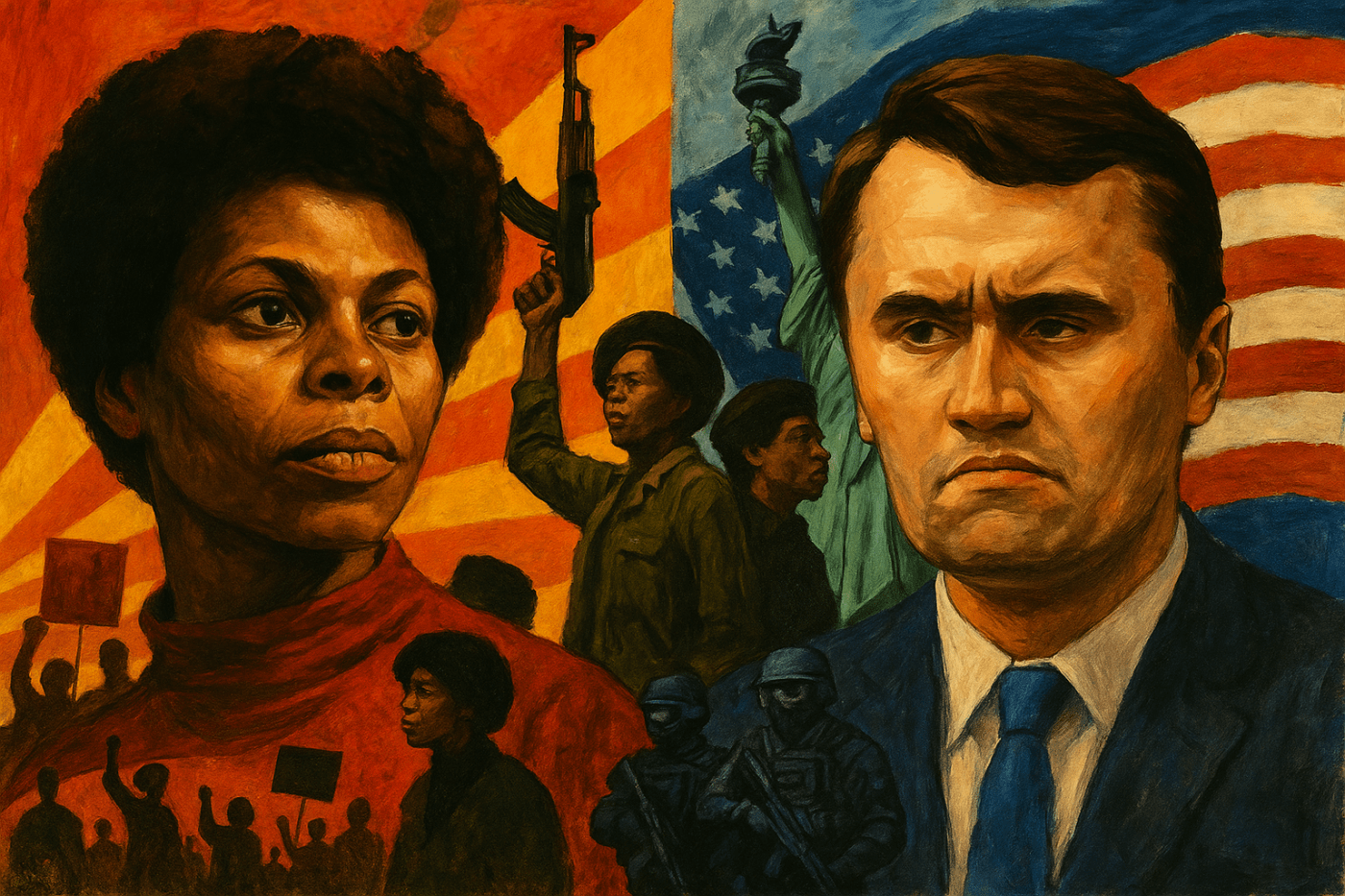
One died free in exile, a symbol of liberation; the other died at home, a symbol of reaction. Their lives and deaths mirror the split soul of America, caught between empire and freedom.
By Prince Kapone | Weaponized Information | September 26, 2025
Death as a Mirror of Empire
In September 2025, two deaths shook the American political landscape, though in radically different ways. Assata Shakur, the exiled revolutionary who spent decades in Cuba after escaping the clutches of U.S. prisons, passed away in Havana at the age of seventy-eight. Just two weeks before (on my birthday, I might add), Charlie Kirk, the rising star of settler reaction and champion of the new technofascist order, was gunned down on American soil. To look at how each of these lives ended—and more importantly, how their deaths are remembered—is to look into the cracked mirror of the United States itself. Each death reflects not just the life of the individual but the orientation of an entire system and the class forces it serves.
Assata’s death is marked quietly, reverently, by those who recognize her as a survivor of empire’s war against Black liberation. For the oppressed, she is canonized as a freedom fighter, a living witness that survival is itself a revolutionary act. For the empire, however, she remains unmentionable—either erased from public record or recalled only as the specter of “terrorism” that once escaped their cages. In stark contrast, Kirk’s assassination is immediately staged as a national trauma. His name is etched into the pantheon of “free speech martyrs,” his death broadcast with wall-to-wall coverage, mobilized to justify new measures of repression. The same media that ignored Assata for decades transforms Kirk into a saint of settler grievance overnight.
This juxtaposition is no accident. It is a microcosm of America: one life elevated to reinforce the legitimacy of empire, the other silenced to deny the legitimacy of resistance. Assata’s death reveals what the ruling class fears most—the endurance of revolutionary memory, the persistence of clarity that refuses to be broken. Kirk’s death reveals what the ruling class desires most—the opportunity to sanctify reaction and mobilize its base around fear, vengeance, and loyalty to the system. Together, these two departures tell us more about the crisis of the United States than any think tank report or presidential speech could. They expose a nation split between the myths it feeds its settlers and the truths it cannot bury.
Assata’s Life and Legacy
Assata Shakur was born JoAnne Chesimard in 1947, a Black girl raised between the streets of New York and the segregated South, where the American dream already revealed itself as a nightmare. She came of age at the height of the civil rights movement, when polite appeals for justice were met with fire hoses, dogs, and bullets. For her, the answer was not patience but power. That search for freedom carried her into the orbit of the Black Panther Party, where she joined comrades feeding children before school, teaching political education, organizing tenants, and defending communities from the police who treated Black neighborhoods as occupied territory. The Panthers, and later the Black Liberation Army, gave form to her understanding that liberation meant more than a slogan—it meant transforming daily life and being willing to fight for it.
The state recognized this threat long before the liberal left did. The FBI’s COINTELPRO program targeted Assata and her comrades with the same intensity it used against Malcolm X and Martin Luther King Jr. Raids, surveillance, infiltration, and assassination were the tools of empire. On May 2, 1973, Assata’s car was stopped on the New Jersey Turnpike. Zayd Malik Shakur was killed, Sundiata Acoli captured, and Assata herself shot, dragged by her hair, beaten, and tortured as police asked whether she was dead yet. Her trials that followed were grotesque performances of justice: all-white juries, hostile judges, fabricated evidence. Convicted in 1977, she was locked away in men’s prisons under conditions designed to break her. Yet in 1979, comrades broke her free, and she found sanctuary in Cuba, a nation that had the courage to defy Washington and protect her life.
Exile did not silence her. From Havana, Assata gave the world her autobiography, a testimony of survival and clarity that remains one of the sharpest indictments of U.S. democracy. She spoke of the colonial nature of the American project, the role of racism and capitalism as twin engines of exploitation, and the necessity of Black self-determination. She rejected the false promises of reform and insisted on the revolutionary duty to fight for freedom by any means necessary. She also spoke as a woman, insisting that the liberation of Black women was not a side issue but central to the liberation of the people. Her life stitched together the lessons of Harriet Tubman, Malcolm X, and Amílcar Cabral, while giving voice to a new generation of fighters.
Assata’s legacy is not only in what she wrote but in how she lived: uncompromising, disciplined, rooted in the people. She did not bend to empire’s courts, prisons, or propaganda. She endured, escaped, and carried her politics into exile without apology. That is why she is mourned as a mother and a comrade, canonized as a martyr of national liberation. And that is why, even in death, the ruling class cannot speak her name without venom. Her very survival was an indictment of their system. Now, in her passing, she joins the pantheon of her ancestors whose lives remind us that freedom is never given—it is seized, defended, and lived.
Charlie Kirk as Martyr of Settler Reaction
If Assata Shakur embodied the defiance of the colonized, Charlie Kirk embodied the grievance of the colonizer. He built his career by channeling the resentments of the Euro-Amerikan base into a movement against imagined enemies—immigrants, Black radicals, queer people, students who dared question empire. He waved the banner of “free speech,” which in his mouth meant the freedom to reproduce settler-colonial ideology without consequence. He was not an outsider to the system but its loyal apprentice, molding a generation into defenders of the very order that exploits them. In life, Kirk was not persecuted by the state; he was courted by it, amplified, protected, and groomed as a cultural weapon of technofascism.
Central to Kirk’s creed was an uncompromising devotion to the Second Amendment. He preached that the right to bear arms was the ultimate safeguard against government tyranny, a sacred inheritance of settler liberty. Yet history makes the hypocrisy plain. When the Black Panthers, including Assata, exercised that very same right to defend their communities from colonial violence and police terror, they were criminalized, hunted, and killed. Assata herself was convicted for defending her own life against forces intent on murdering her, as later confirmed by COINTELPRO files and the long record of state assassinations. If Kirk and his ilk were consistent, they would have upheld her case as the clearest affirmation of why the Second Amendment exists. Instead, their principle dissolved the moment Black people claimed it. In America, the right to bear arms belongs to settlers; when the colonized dare exercise it, it ceases to be a right and becomes treason.
The irony is cruel. Kirk was assassinated with a gun, his death transformed into a state-sponsored spectacle of martyrdom. Assata was accused of using a gun in the struggle for freedom, branded a cop-killer, and forced into exile—yet she died free and at peace in Cuba, honored by revolutionaries worldwide. These contradictions reveal the core truth: the settler order sanctifies violence when it serves empire and condemns it when it threatens empire. Kirk’s “martyrdom” becomes a rallying cry for repression; Assata’s self-defense is erased as criminality. The double standard is not a flaw but the logic of settler colonialism itself.
Thus Kirk is canonized not as a fighter for liberty but as a guardian of empire, a martyr of reaction whose death is mobilized to expand surveillance, censorship, and repression. His name will be etched into the pantheon of settler saints, defended by police cordons and national mourning. Assata’s name, meanwhile, will continue to circulate as a weapon of the oppressed, whispered in prisons, shouted in protests, studied in freedom schools. One life celebrated to sanctify the order; the other demonized to delegitimize resistance. In Kirk and Assata, we see how empire manufactures its saints and how the people remember their own.
Two Martyrs, Two Americas
Assata Shakur and Charlie Kirk embody not just two individuals, but two nations locked in permanent contradiction. Kirk represents the settler-colonial nation, born of stolen land, enslaved labor, and a covenant of whiteness that grants rights only to those within its ranks. His canonization as a martyr shows us how that nation defines freedom: the unrestrained right to reproduce settler power, even in crisis. Assata, by contrast, represents the colonized African nation within the United States, a people whose very survival has always been treated as a crime. Her life and death testify to another definition of freedom—self-determination, dignity, and liberation from the structures of colonial domination.
When Kirk is mourned as a national tragedy, it is the settler nation mourning itself, shoring up loyalty to a system in decline. When Assata is mourned, it is the colonized nation remembering one of its fiercest daughters, canonizing her as proof that empire can be defied. These parallel rituals of memory are not about individuals alone; they are about nations in conflict, two Americas inhabiting the same territory but living in entirely different historical realities. One claims liberty but thrives on domination. The other fights for liberation but is branded criminal for asserting its right to exist.
This national contradiction has always defined the United States. From the beginning, the settler project could not coexist with the survival of the Indigenous and African nations it enslaved, dispossessed, and policed. Kirk’s America insists that the settler covenant must remain the core of the republic. Assata’s America insists that the colonized will not disappear, that their liberation is inseparable from the fall of empire. These are not two “sides of a debate” within one democracy—they are two nations at war inside the same borders.
To recognize this is to strip away the liberal myth of one America forever wrestling with its contradictions. There have always been two Americas: one built on conquest and another struggling to be free from it. Charlie Kirk and Assata Shakur, in their lives and in their deaths, bring this contradiction into sharp focus. One nation sanctifies reaction as liberty; the other embodies liberation as rebellion. Their stories remind us that the struggle is not over ideas alone but over which nation will define the future.
Class Struggle Inside the Colonial Contradiction
The clash of nations within the United States takes its sharpest form in the lives of workers. On one side stands the Euro-Amerikan working class, tied to the settler nation, exploited by capital yet privileged in relation to the colonized. On the other side stands the Black working class, whose exploitation is intensified by racial domination, whose communities are policed like occupied zones, and whose very existence is treated as a threat. Here the colonial contradiction reveals its true face: two working classes inhabiting the same territory but living fundamentally different realities.
The Euro-Amerikan working class has historically aligned itself with the settler project. It has won land, wages, and status by siding with the ruling class against the colonized. Even its most militant struggles—strikes, union drives, leftist movements—have too often demanded inclusion within empire rather than its dismantling. Charlie Kirk’s canonization speaks directly to this history: his martyrdom resonates because he embodied the grievances of a class that feels its privileges eroding but refuses to question their colonial foundation. In him, the settler working class sees not only a fallen leader but a mirror of its own fears.
For the Black working class, the equation has always been different. Exploited as laborers and oppressed as a colonized nation, their struggles for wages, housing, or dignity cannot be separated from the fight against colonial domination. This is what Assata Shakur made clear. Her life showed that to be Black and working class in America is to face not only exploitation but national oppression, enforced at gunpoint by police, prisons, and counterinsurgency. Every demand for survival becomes a demand for liberation.
This dialectic between two working classes has shaped the entire history of the United States. When white workers turn inward, defending their privileges, the Black working class is isolated and crushed by the combined weight of capital, state, and settler labor. When white radicals attempt solidarity without breaking from whiteness, their unity collapses under pressure. Genuine solidarity only emerges when segments of the Euro-Amerikan working class rupture with the settler project altogether, joining the colonized in a shared fight against empire. These moments have been rare but real, and they point to the possibility of a future where the colonial contradiction is resolved through revolution rather than repression.
The dual martyrdom of Assata and Kirk illuminates this struggle with painful clarity. Kirk’s canonization shows us a white working class still bound to its settler covenant. Assata’s legacy shows us a Black working class whose resistance is inseparable from national liberation. To ignore this contradiction is to misread America itself. To confront it is to recognize that the battle lines of the future run not only between rulers and ruled but between the settler nation and the colonized nation struggling to be free.
Revolutionary Legacy for the Present
Assata Shakur’s story is not a relic of the 1970s—it is a manual for survival in the present. The empire that once stalked her with COINTELPRO now arms itself with predictive policing, biometric surveillance, and algorithmic censorship. What she faced in raids, infiltrations, and frame-ups has been digitized, scaled, and normalized. We call this technofascism: the fusion of corporate technology with the repressive state, designed to discipline the colonized, pacify the working class, and suffocate dissent before it can take root. If COINTELPRO was the prototype, technofascism is the fully integrated system. Assata’s endurance under the first model teaches us how to endure under the second.
Her lessons remain urgent. She showed that political clarity is the first weapon: naming the enemy as a settler-colonial empire, not a malfunctioning democracy. She showed that discipline is the second: living the struggle as a way of life, not as a performance. She showed that community defense is the third: feeding children, teaching history, and arming neighborhoods against both hunger and police terror. And she showed that internationalism is the fourth: seeing Harlem not as an isolated ghetto but as part of a global battlefield stretching from South Africa to Palestine to Cuba. These were not abstractions but strategies of survival, hammered out under fire.
Today, the oppressed face the same enemy with new weapons. Fentanyl replaces heroin, prisons metastasize into privatized surveillance networks, and propaganda merges with the algorithmic chokehold of corporate media. The ruling class still deploys drugs, cages, and lies as instruments of counterinsurgency—only now with greater reach and efficiency. To survive this onslaught, we need Assata’s praxis: clarity that cuts through liberal illusions, discipline that resists cooptation, defense that protects communities in material ways, and internationalism that binds us to the global fight against imperialism.
In this sense, Assata’s death is not the closing of a chapter but the opening of a challenge. If she could survive bullets, torture, prison, and exile without breaking, what excuse do we have under technofascism? To honor her legacy is not to recite her words as slogans but to live them as strategy. She showed that empire can be resisted, that fugitives of oppression can become free people, and that solidarity across borders can sustain life even against the world’s strongest empire. Her life is a compass for the present, pointing us toward a politics rooted not in settler illusions but in the living struggle of the colonized.
Assata Lives, Empire Dies
The deaths of Assata Shakur and Charlie Kirk, arriving so close together, reveal the anatomy of America more clearly than any textbook. One life spent serving empire, another life spent defying it. One canonized as a saint of settler liberty, the other demonized as a terrorist but cherished as a freedom fighter. One remembered through the state’s orchestrated mourning, the other remembered through the whispered songs and clenched fists of the oppressed. Two martyrs, two Americas—each embodying a future: one of fascism, the other of liberation.
Assata’s passing does not mark defeat. She escaped empire’s prisons, built a life in defiance, and died free in a country that stood against U.S. domination. Her memory belongs to the people who resist, not the institutions that tried to kill her. She is immortalizied among the pantheon of revolutionary heroes now; one who will always live wherever the oppressed refuse to bow. Kirk’s death, by contrast, is already being weaponized to harden the technofascist order, to justify surveillance, repression, and loyalty oaths to the very empire devouring the planet. His martyrdom strengthens the chains; Assata’s martyrdom sharpens the blade to cut them.
To carry Assata forward is to refuse the myths of empire. It is to understand that liberty in America has never been universal, that rights are rationed by race and nation, that the settler project thrives only through the subjugation of the colonized. It is to see through the hypocrisy that mourns Kirk as a fallen patriot while erasing Assata as a criminal. It is to live her lesson: that freedom is not begged for but fought for, that survival itself is an act of resistance, and that internationalism is the heartbeat of liberation.
Empire dies not in a single blow but in the accumulation of defiance. Assata’s life was one long defiance, and her death is not an end but a call. We honor her not by mourning alone, but by continuing the struggle she embodied. We strip away the sanctification of reaction by exposing its hypocrisies, its double standards, its lies. Two martyrs stand before us as symbols of two paths. The ruling class would have us choose Kirk’s America—settler liberty chained to empire. Assata points us toward another world, one built on the ruins of colonial domination. The choice is ours. Assata lives. Empire dies.
 Weaponized Information
Leave a comment