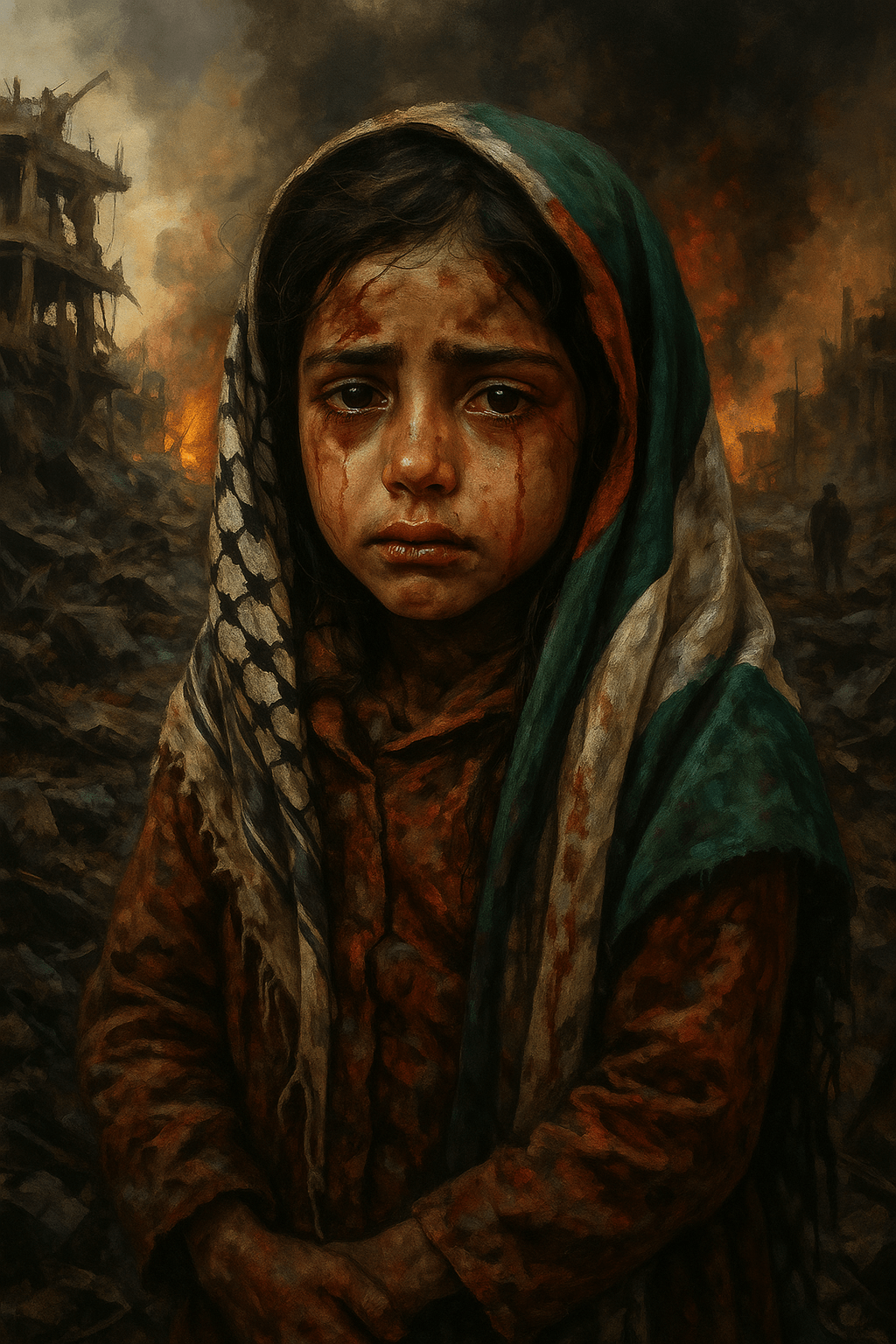
A UN commission stripped away every alibi. Gaza’s destruction is genocide — Israel guilty, empire complicit, Palestine entitled to justice.
By Prince Kapone | Weaponized Information | September 16, 2025
When the Law Names the Crime
For nearly two years the world has watched Gaza burn. Whole families erased in seconds, hospitals reduced to smoking rubble, mothers burying children in mass graves dug with bare hands. These are not images that require expert commentary to shock the conscience. Yet in the field of international law, recognition is not driven by conscience but by evidence, categories, and definitions. That is why the United Nations Independent International Commission of Inquiry, mandated since 2021 to investigate violations across Palestine and Israel, released a 16 September 2025 report with the blunt title Legal analysis of the conduct of Israel in Gaza pursuant to the Convention on the Prevention and Punishment of the Crime of Genocide. Its findings matter because they translate catastrophe into legal indictment (pp. 2–3).
The Commission confines itself deliberately. It does not sprawl across decades, nor does it cover every territory under occupation. Instead, it examines Gaza, between 7 October 2023 and 31 July 2025, through the lens of the Genocide Convention. Its task is to evaluate state responsibility, not individual criminal guilt — a distinction that shifts the weight onto Israel as a State and onto every other State bound by obligations of prevention and punishment (pp. 4–5). The South Africa v. Israel case before the International Court of Justice is noted as the forum where final responsibility will be adjudicated, but the Commission’s duty is to supply the evidence and legal reasoning that point unmistakably in that direction (pp. 4–5).
Into this frame, the Commission inserts the cold standard it applies in all investigations: “reasonable grounds to conclude.” No rhetoric, no moral appeals, just a legal threshold met when facts show more than speculation but less than courtroom certainty. And within this frame, it spells out the peremptory nature of the prohibition of genocide. Genocide is jus cogens, a norm from which no derogation is permitted; the obligation to prevent and punish binds all States erga omnes (“Towards All”). The instant a serious risk is known, the duty to act crystallizes. To fail is not to stay neutral but to breach international law (pp. 5–6).
In that sense, the introduction is not throat-clearing; it is a legal drumroll. The Commission lays down the categories of genocide — killing members of the group, causing serious bodily or mental harm, deliberately inflicting destructive conditions of life, imposing measures intended to prevent births, and the forcible transfer of children — and confirms that Palestinians constitute a protected group under international law (pp. 7–8). It then signals the path: to examine whether Israel’s conduct in Gaza falls into these categories, and whether intent to destroy the group in whole or in part can be reasonably inferred.
Our task in Weaponized Information is not to polish the UN’s language but to weaponize its meaning. When a Commission of Inquiry, bound to cautious standards, recognizes multiple acts of genocide, the time for hedging ends. This report is a legal dagger placed in the hands of movements worldwide. It compels us to act, to organize, to prosecute, to blockade the flow of arms and money that sustain destruction. The law has named the crime. The only question left is whether the world will continue to be complicit, or whether the people will force States to meet their obligations.
Killing Members of the Group
The Genocide Convention begins with the simplest act to prove: killing. In Gaza, this act is not speculative but documented in forensic detail. Between 7 October 2023 and 31 July 2025, Israel’s assault killed 60,199 Palestinians, including 18,430 children and 9,735 women. Life expectancy in Gaza collapsed from 75.5 years in 2022 to 40.5 years in 2023 — a fall of nearly 35 years in a single calendar year, a demographic collapse unprecedented outside the register of extermination (pp. 7–8).
The means of killing were systematic. Israeli forces unleashed unguided bombs and artillery into some of the most densely populated neighborhoods on earth. A military spokesperson described the approach as “maximum damage.” The Commission notes that in less than a week, Israel dropped more ordnance on Gaza than the United States dropped on Afghanistan in an entire year (pp. 8–9). Civilian homes, high-rise apartment blocks, and entire neighborhoods were leveled, often with entire families still inside.
Civilians were struck even when following evacuation orders. On 13 October 2023, along Salah al-Din Street in Gaza City, a convoy of vehicles heading south under white flags was hit by shelling near the Eslem petrol station. Witnesses described over 200 civilians — mostly women and children — targeted with sustained projectiles. Survivors recounted bodies strewn across the road, a deliberate attack on those who had complied with orders to flee (p. 9).
Hospitals and healthcare facilities were also turned into killing grounds. Between 7 October 2023 and 30 July 2024, Israel carried out 498 attacks on healthcare sites in Gaza, killing at least 747 people inside, including women in labor and children under care. The Commission concluded that patients died not only from direct strikes but from the absence of medical care when facilities were bombed into nonfunctionality (pp. 9–10).
One of the most emblematic cases was the Faris Gas Station massacre in Tal al-Hawa on 29 January 2024. Five children were killed when Israeli forces shelled the Hamada family’s car, including 15-year-old Layan Hamada and her six-year-old cousin Hind Rajab. Hind survived the initial attack and called the Palestine Red Crescent Society (PRCS), pleading for help while trapped among the bodies of her relatives. Shots were heard during the call before the line went dead. PRCS attempted rescue, but Israeli forces fired on ambulances dispatched to her location. Hind was confirmed alive until the evening but died after being denied evacuation. The Commission highlights this case as proof that Israeli forces intentionally targeted children even when their location and condition were known (pp. 9–10).
Killings extended into the sphere of humanitarian relief. At Gaza Humanitarian Foundation (GHF) food distribution points in Rafah, children were shot with sniper and quadcopter fire. Doctors testified to treating a one-and-a-half-year-old killed by a bullet to the chest while in her mother’s arms, and a 13-year-old girl shot in the chest on another day. UNRWA’s Commissioner-General denounced the mechanism as “a death-trap, costing more lives than it saves. Food is weaponized, and Palestinians are dehumanized, without consequence” (p. 11).
Protected persons — those explicitly shielded under international law — were also eliminated in mass. As of April 2025, 1,400 healthcare workers had been killed. Between October 2023 and March 2025, at least 408 aid workers and 330 UNRWA staff were killed. By March 2025, the Committee to Protect Journalists recorded at least 170 journalists killed in Gaza. These figures demonstrate that the institutions tasked with saving lives and documenting crimes were themselves systematically destroyed (p. 11).
Even ceasefires provided no reprieve. On 18 March 2025, during a declared truce, Israel launched airstrikes across Gaza without warning, killing more than 404 Palestinians and injuring over 562 in a single night. At least 170 children and 80 women were among the dead, making it one of the bloodiest days since 7 October 2023. Doctors reported children shot by snipers and quadcopters while searching for firewood or standing alone, with nearby adults left untouched — proof of deliberate targeting (p. 11).
The assault reached grotesque clarity in March 2025, when PRCS ambulances were attacked in Rafah. At 03:49 on 23 March, a convoy of ambulances responding to a civilian emergency came under direct fire. Survivors testified that Israeli forces fired repeatedly at clearly marked medical vehicles with sirens and lights active. Subsequent attacks killed more paramedics, and mass graves later revealed the remains of first responders and aid workers buried by bulldozers alongside their vehicles. The Commission concluded this was a coordinated execution of medical personnel, not an accident of war (pp. 12–14).
By the end of this catalogue, the Commission’s conclusion is unequivocal: the actus reus (“Guilty Act”) and mens rea (“Guilty Mind”) of genocide under Article II(a) — killing members of the group — are established. The killings were not random but systemic: bombardment of homes and hospitals, executions of medics and aid workers, sniper fire on children, massacres during ceasefire, and the silencing of those who tried to rescue or report. In its legal judgment, these killings amount to the intentional destruction of Palestinians as a group, carried out through the mass annihilation of civilian life (pp. 15–16).
Causing Serious Bodily or Mental Harm
Genocide is not only measured in corpses. It is also inscribed in the broken bodies of the living and the scarred minds of survivors. The Commission documents that by 30 July 2025, 146,269 Palestinians in Gaza had been physically injured by Israeli military operations, with 77,908 recorded as early as May 2024 (p. 17). Thousands of children are now amputees: between January and May 2024, the World Health Organization estimated between 3,105 and 4,050 amputations, and UNICEF confirmed that at least 609 children were maimed in just two weeks following a ceasefire collapse in March 2025 (p. 17). Gaza has become home to what OCHA called “the largest cohort of child amputees in modern history” (p. 17). Behind each number lies a child like the 14-year-old girl whose bombing injuries required her leg to be amputated, or the three-year-old boy who lost both legs in an UNRWA school strike (p. 18).
The landscape itself has been weaponized against survival. UNOSAT reported that by December 2024, Israeli operations had destroyed 60,368 structures and created 50.7 million tonnes of debris—enough to take 21 years to clear (p. 17). UNEP warned that dust clouds laced with asbestos, industrial waste, and unexploded ordnance would poison the lungs of Palestinians for generations (pp. 17–18). Doctors described waves of asthma, chronic cough, and long-term cancers that will outlive the war. In this way, the earth itself becomes an accomplice in slow violence, turning every breath into an injury.
Hospitals, already shattered by bombardment, became sites where long-term harm accumulated. Between 7 October 2023 and 11 June 2025, Israel carried out 735 strikes that directly interfered with health services, killing 917 people and injuring 1,411 (p. 18). Medical professionals testified that children were treated for sniper wounds, quadcopter fire, and explosive shrapnel, injuries that demanded amputations and left permanent disabilities. The Commission received reports of over 475 children left with life-long impairments in a single month of 2024, some needing as many as twelve surgeries before adulthood (pp. 18–19).
The war reached into the most intimate domain: reproduction. In December 2023, Israeli forces destroyed the Al-Basma IVF clinic, annihilating around 4,000 embryos and 1,000 sperm samples stored inside (p. 19). For many families, these samples represented their only hope of future children. The Commission found that the attack inflicted both “deep existential and moral dilemmas” and measurable psychological trauma, compounding grief with the forced loss of reproductive potential. Beyond this act, Israel targeted maternity wards and maternal health facilities, producing widespread miscarriages, premature births, and the systematic denial of care to pregnant and lactating women (pp. 22–23).
Displacement itself became a factory of trauma. The Commission reports that between October 2023 and June 2025, over 1.9 million Palestinians—nearly the entire population of Gaza—were displaced, many as often as 19 times (pp. 19–20). Families were forced to flee without food, shelter, or water, enduring sniper fire and bombardments even in so-called “safe zones.” Medical witnesses confirmed that children subjected to repeated evacuations developed acute symptoms of post-traumatic stress: flashbacks, nightmares, and sudden screaming fits (pp. 23–24). The Commission found that this repeated uprooting was calculated to maximize helplessness, not incidental to combat.
Torture and humiliation deepened the injury. Detainees—including children—were blindfolded, shackled, stripped, beaten, and denied food and medical care (pp. 20–21). Some were subjected to electric shocks, dog attacks, and stress positions for hours. Boys as young as 13 reported being forced to kneel naked, threatened with sexual violence, and confined in solitary. Women detainees described repeated strip searches during menstruation, being photographed naked, groped, raped, and mocked for their gender and ethnicity (pp. 21–22). The Commission concluded that these acts were not isolated abuses but systematic policies of degrading treatment (pp. 22–23).
The psychological wreckage is staggering. UNICEF estimated in June 2024 that almost all of Gaza’s 1.2 million children required mental health and psychosocial support (p. 25). A UN Women report in September 2024 found that the war had taken a “tremendous toll on mental health,” with 75 percent of women surveyed reporting they felt depressed, nervous, or plagued by nightmares (p. 23). The Commission stressed that the mental harm was amplified by the constant fear of bombardment, the demolition of homes, starvation, and the killing of family members, creating an atmosphere where normal and constructive life became impossible (pp. 23–24).
The Commission’s conclusion is clear: Israel’s military operations intentionally inflicted serious bodily and mental harm on Palestinians in Gaza. The extent of injuries, the deliberate destruction of reproductive infrastructure, the systematic torture and sexual violence in detention, and the mass psychological trauma of displacement all converge on a single legal finding. The actus reus and mens rea of Article II(b) of the Genocide Convention—“causing serious bodily or mental harm to members of the group”—are established (pp. 25–26).
Inflicting Conditions of Life Calculated to Destroy the Group
Genocide is not only a matter of bombs and bullets. It can also be carried out by choking a people’s access to food, water, medicine, shelter, and education until life itself becomes impossible. The Commission devotes a major section of its report to documenting how Israel has deliberately engineered such conditions in Gaza, finding that the actus reus and mens rea of Article II(c) of the Genocide Convention are established (pp. 44–46).
The picture is stark. From March to May 2025, Israel imposed the longest period of total siege since the beginning of the war, preventing all humanitarian aid from entering Gaza (p. 37). Prime Minister Netanyahu openly declared that the entry of goods and supplies was halted, and Israeli officials admitted the purpose was to exert pressure on Hamas (p. 37). The result: food, fuel, medicine, and shelter equipment were cut off, and electricity to Gaza’s power plants was stopped on 9 March, plunging over 600,000 people back into thirst and darkness (p. 37). Six of Gaza’s 22 bakeries closed the same week for lack of cooking gas; by the end of March, all 25 WFP-supported bakeries had collapsed, leaving no bread to sell (p. 38).
Humanitarian agencies described the siege in biblical terms. The UN Secretary-General warned on 10 March 2025 that Gaza’s lifeline was “threatened” as no lifesaving aid was permitted to enter (p. 38). The International Committee of the Red Cross called the conditions “hell on earth” (p. 39). By May 2025, the World Food Programme declared that one in four people in Gaza faced extreme hunger, with over 2.3 million already food insecure and famine scenarios playing out in the north (p. 39). On 22 August, the IPC Famine Review Committee confirmed that famine was “currently occurring” in parts of Gaza (p. 40). The Commission leaves no ambiguity: this is not accidental famine, but a man-made blockade designed to destroy a population.
The destruction of Gaza’s education system further compounded the conditions of annihilation. Schools had long served as shelters for displaced families and as fragile nodes of safety. Israel’s systematic targeting of educational facilities displaced thousands and deprived Palestinians of stability, hope, and the possibility of a future. The Commission emphasizes that these attacks were not incidental but deliberate acts calculated to erase Palestinian identity and cripple the group’s survival as a people (p. 46).
Women and children bore the brunt. Since October 2023, Palestinian women were forced to give birth in unsafe, unsanitary conditions, with medical professionals unable to provide basic obstetric care (p. 41). By early 2024, nearly 60,000 pregnant women were malnourished and dehydrated (p. 41), while UNFPA estimated that 42,000 pregnant women faced crisis levels of hunger by October (p. 41). At the same time, UNICEF reported in December 2023 that 130,000 children under two were not receiving critical life-saving feeding, and by early 2024 one in three children in the north were “wasted” from acute malnutrition (pp. 42–43). Doctors told the Commission that the essence of childhood in Gaza was being destroyed (p. 43).
The Commission’s legal analysis is blunt: deliberate deprivation of resources indispensable for survival—food, water, electricity, medical supplies, housing, and education—constitutes the underlying act of genocide under Article II(c). It is not necessary for every child to die of hunger before the law recognizes genocidal intent. What matters is that conditions were knowingly and deliberately created to bring about the physical destruction of Palestinians in whole or in part (pp. 44–45). In plain terms, Israel has weaponized starvation, thirst, disease, homelessness, and despair as instruments of annihilation.
To call this “security policy” is obscene. The Commission has documented a sustained campaign to make Gaza uninhabitable, a place where survival itself is criminalized. And when international bodies from the ICJ to the Security Council warned Israel to allow humanitarian access, Israel ignored them (p. 45). In doing so, it exposed not only its own genocidal intent but the complicity of every State that continues to ship weapons, technology, and diplomatic cover to this machinery of destruction. Genocide is not just committed in Gaza; it is enabled in Washington, London, Berlin, and every capital that chooses profit and empire over humanity.
Imposing Measures Intended to Prevent Births
Genocide is not only about killing the living; it is also about strangling the possibility of life itself. The Convention recognizes this under Article II(d): imposing measures intended to prevent births within the group. The Commission applies this standard directly to Gaza, showing how Israel’s attacks on reproductive health care and fertility services have targeted the biological continuity of Palestinians as a people (pp. 47–48).
The findings are devastating. Approximately 545,000 women and girls of reproductive age have been denied proper maternal care in Gaza since October 2023. Major maternity wards in Shifa Hospital and Nasser Medical Complex were repeatedly bombed into inoperability, while others—such as Emirati Maternity Hospital, Awdah Hospital, and Sahabah Hospital—were directly attacked or forced to close. Even when some maternity services increased in mid-2025, staff shortages, destroyed infrastructure, and constant siege conditions meant that pregnant women could not reach them (p. 47).
The clearest case comes from the destruction of Gaza’s largest fertility clinic, Al-Basma IVF. In December 2023, Israeli forces shelled the facility, igniting its nitrogen tanks and obliterating 4,000 embryos and 1,000 sperm samples and eggs stored for future conception. The Commission confirms the clinic was a standalone, clearly marked civilian medical site, with no credible evidence of military use. Witnesses described the attack as deliberate, and satellite imagery shows the IVF center bore the brunt of the strike compared to surrounding buildings. The Commission concludes Israel intentionally destroyed Gaza’s only fertility laboratory to prevent Palestinian births (pp. 47–48).
The consequences reach across generations. Experts testified that the attack eliminated the possibility of children who would have been born from those thousands of specimens, erasing family bloodlines and futures. The Commission stresses that under international law, it is irrelevant whether actual births were prevented; what matters is that the measures were imposed with intent to prevent them. On this basis, the Commission rules that Israel’s destruction of the Al-Basma IVF clinic and systematic assaults on maternal care constitute genocidal acts under Article II(d) of the Genocide Convention (pp. 47–48).
What this reveals is chilling: Israel is not only killing Palestinians in the present but actively dismantling their capacity to reproduce as a people. Bombing maternity wards, starving pregnant women, and obliterating fertility clinics cannot be justified as “collateral damage.” These are deliberate strategies of elimination, aimed not only at the bodies of the living but at the very possibility of Palestinian existence in the future. The Commission’s finding here is one of the most damning: Israel is using war not just to destroy lives, but to sever the continuity of life itself.
Genocidal Intent: Pattern of Conduct and Targeted Harms
The Commission begins its analysis of genocidal intent by clarifying the legal standard: genocide requires dolus specialis, the specific intent to destroy a protected group in whole or in part. Intent may be inferred from the pattern of conduct, the scale of atrocities, and the public statements of responsible officials (pp. 48–49). With this framework, the report examines Israel’s conduct in Gaza and finds that the convergence of words and deeds demonstrates an unmistakable purpose to annihilate Palestinians as a group.
Israel’s leaders provided the most direct evidence. Prime Minister Netanyahu repeatedly invoked the biblical injunction to “remember Amalek,” a reference understood in Jewish and Zionist military culture as a command to eradicate an enemy entirely, including children and infants (pp. 50–51). Defense Minister Gallant declared on 9 October 2023 that Israel was imposing a “complete siege” on Gaza and described Palestinians as “human animals” (p. 65). The following day he told Israeli forces, “We will eliminate everything” (p. 65). President Herzog, speaking on 13 October, announced that “it’s an entire nation out there that is responsible. This rhetoric of civilians not aware, not involved, it’s absolutely not true” (pp. 65–66). The Commission concludes that these were not stray remarks but public and repeated statements by the highest authorities of state, voiced in the midst of military operations, and that they reveal intent to target Palestinians as a group.
The pattern of conduct mirrors these words. Israel imposed total siege conditions on Gaza, halting food, water, electricity, fuel, and medicine. The Commission notes that on 9 March 2025 Israel cut all power to Gaza’s main plant, depriving 600,000 people of clean water and sanitation (p. 37). By May 2025 the World Food Programme reported one in four Gazans facing extreme hunger, with famine scenarios unfolding in the north (p. 39). On 22 August, the IPC Famine Review Committee confirmed famine was “currently occurring” in parts of Gaza (p. 40). The Commission stresses that these measures were not the incidental byproducts of conflict but deliberate policies to starve the population (pp. 55–57, 59).
Healthcare was systematically dismantled. Between October 2023 and mid-2025, hospitals and clinics were besieged, bombed, and stripped of fuel and supplies. Ambulances were targeted and medical personnel killed or detained (pp. 59–60). By June 2025 only a handful of facilities remained partly functional, leaving tens of thousands to die untreated. In December 2023, Israeli forces struck Gaza’s only fertility center, Al-Basma IVF, destroying approximately 4,000 embryos and 1,000 reproductive samples. The Commission verified that the clinic was a clearly marked civilian facility with no military use, and concluded that the attack was an intentional measure to prevent births within the group (p. 60).
The violence extended to the most intimate level of the body. The Commission received corroborated testimonies of widespread sexual and gender-based violence: detainees raped, subjected to sexualized torture, forced nudity, and harassment. Men described being beaten until they vomited and lost consciousness; women reported strip searches during menstruation, groping, and assaults. Families spoke of their loved ones degraded while soldiers circulated images online. These were not isolated acts but part of a systematic policy of humiliation and dehumanization, reinforcing the conclusion of genocidal intent (pp. 61–62).
Children were a particular focus of destruction. By July 2025 nearly one third of the 60,199 Palestinians killed were minors (p. 7). Medical professionals reported a stream of sniper and drone head wounds in children, while UN agencies confirmed cases of children shot while carrying white flags, bombed in designated “safe zones,” and killed during evacuations (pp. 62–63). Doctors testified that children frequently arrived with gunshot wounds to the skull or chest, many left permanently disabled or amputated without anesthesia due to supply shortages. The Commission concludes that such patterns cannot be explained as accidental; they represent deliberate policies to destroy the generational future of Palestinians in Gaza (pp. 62–63).
Taken together—leaders invoking Amalek and labeling Palestinians “human animals,” policies of starvation and siege even after ICJ orders, destruction of hospitals and fertility clinics, systematic sexual violence, and the repeated targeting of children—the evidence demonstrates genocidal intent. The Commission finds reasonable grounds to conclude that Israel’s authorities and security forces are committing genocide in Gaza with the specific purpose of destroying Palestinians in whole or in part (pp. 48–63).
Direct and Public Incitement to Commit Genocide
Genocide is not only committed with bombs and bullets; it can also be prepared with words. The Genocide Convention recognizes “direct and public incitement” as a punishable act in itself. It does not matter whether the incitement succeeds in provoking a massacre — the very act of urging extermination marks the crime. As we’ve already seen, the Commission’s report documents how leading Israeli officials crossed this threshold repeatedly, speaking not as fringe agitators but as the highest representatives of the State: the Prime Minister, the President, and the Defense Minister (pp. 63–64).
On 9 October 2023, Defense Minister Yoav Gallant announced a “complete siege” on Gaza, declaring that Israel was fighting “human animals” and must “act accordingly.” The following day, he told soldiers that “we will eliminate everything,” adding that Gaza would not return to what it was and that “we will reach all places.” Such rhetoric, delivered in the context of starvation sieges and indiscriminate bombardment, cannot be read as metaphor. It was an explicit call to destroy Palestinians as a people under the cover of military operations (p. 65).
President Isaac Herzog, in an address on 13 October 2023, stated that “it’s an entire nation out there that is responsible.” His message was unambiguous: every Palestinian in Gaza, civilian or not, bore responsibility and could be treated as a target. Though he later issued clarifications, the Commission emphasizes that the original statement directly incited Israeli forces to treat the population as collectively guilty, thereby authorizing collective punishment and exterminatory violence (pp. 65–66).
Prime Minister Netanyahu, meanwhile, repeatedly invoked the biblical story of Amalek, telling soldiers, “Remember what Amalek has done to you… we will not rest until light overcomes darkness.” This reference — familiar in Zionist military and religious culture — carries the command to annihilate an enemy entirely, “man and woman, child and infant, ox and sheep, camel and donkey.” Its use in the midst of genocidal siege and bombardment was not accidental flourish but a deliberate incitement to total destruction, one that soldiers echoed on the ground, writing slogans such as “Destroy Gaza” on watchtowers and equipment (pp. 65–66).
The Commission concludes that these statements — Gallant’s call to eliminate everything, Herzog’s declaration that all civilians are responsible, Netanyahu’s Amalek invocation — together establish direct and public incitement to commit genocide. Delivered by those holding the highest offices of State, in the midst of ongoing siege and slaughter, they cannot be excused as misstatements or hyperbole. They formed part of the genocidal machinery itself, weaponizing language to authorize extermination. As such, the actus reus and mens rea of Article III(c) of the Genocide Convention are fully established (p. 66).
Legal Consequences: State Responsibility and International Obligations
Having established that Israel’s conduct in Gaza constitutes genocide, the Commission turns to the question of State responsibility under international law. Article I of the Genocide Convention obliges every State not only to refrain from committing genocide but also to prevent and punish it (p. 66). This obligation attaches directly to Israel as a party to the Convention. The Commission emphasizes that State responsibility is distinct from individual criminal liability: it is not contingent on the conviction of particular officials but arises from the acts of State organs, whether military, political, or administrative (pp. 66–67).
In Israel’s case, the evidence shows that political and military leaders—including Netanyahu, Gallant, and Herzog—possess the specific intent to commit genocide and that the armed forces executed operations under their authority (p. 67). The Minister of Defence controls daily military actions, while the government determines overall strategy. Thus, genocidal acts carried out by the Israel Defense Forces are attributable to the State itself (p. 67). The Commission concludes that Israel bears responsibility for killing members of the Palestinian group, inflicting serious bodily and mental harm, imposing destructive conditions of life, and preventing births, all acts enumerated in Article II of the Convention (p. 68).
Israel also bears responsibility for failing to prevent and punish genocide. The Commission found no evidence of genuine investigations or prosecutions into crimes committed by its forces; on the contrary, officials frequently justified or encouraged such actions (p. 68). Under established jurisprudence from the ICJ in Bosnia v. Serbia, a State is liable when it “manifestly fails” to employ available means to deter genocide. By January 2024, Israel was formally on notice of a serious risk of genocide through the South Africa v. Israel case at the International Court of Justice (p. 68). From that moment, its obligation to prevent was triggered, yet it escalated its campaign instead.
The ICJ’s provisional measures in January and May 2024 reiterated the urgent risk of irreparable prejudice to Palestinian rights, ordering Israel to halt actions that could destroy the group in whole or in part (pp. 69–70). Israel defied these orders, continuing its military operations, siege, and displacement policies. The Commission stresses that this defiance compounds State responsibility and underscores Israel’s ongoing breach of international law (pp. 69–70).
Responsibility does not stop at Israel’s borders. All States party to the Convention have obligations erga omnes—owed to the international community as a whole—to prevent genocide wherever it occurs (p. 69). This means halting arms transfers and military assistance that contribute to the commission of genocidal acts, refusing to recognize as lawful operations that violate peremptory norms, and cooperating to bring perpetrators to justice (p. 70). The Commission specifies that States must fully implement ICJ orders, ensure accountability, and end material support that enables genocide in Gaza (pp. 69–70).
The consequences are stark: Israel stands responsible under international law for genocide, while third States face responsibility if they fail to act to prevent, punish, or if they aid and abet the crime. The law is clear, the obligations binding, and the breaches undeniable. What remains is the political will of States—and the mobilization of people everywhere—to enforce what the law already demands.
Final Findings and Duties Imposed
The Commission closes by reaffirming its core judgment: Israel has committed, continues to commit, and has failed to prevent or punish genocide against the Palestinian people in Gaza since 7 October 2023 (p. 71). While its formal analysis is restricted to Gaza, it warns that the same genocidal logic extends across the occupied Palestinian territory, including the West Bank and East Jerusalem, where repression is embedded in a project of removal and replacement. This wider context underscores that what is unfolding in Gaza is not an aberration of war but the crystallization of decades of settler-colonial domination (p. 71).
On the legal elements, the Commission concludes that Israeli authorities and security forces have carried out the enumerated acts of genocide: killing members of the group; inflicting serious bodily and mental harm; deliberately imposing conditions of life aimed at physical destruction; and preventing births (p. 71). It finds that senior officials—Herzog, Netanyahu, Gallant, and others—have incited genocide, that the State has failed to act against such incitement, and that the pattern of conduct leaves no plausible inference other than genocidal intent (pp. 71–72). As a result, the Commission determines that Israel, as a State, bears full legal responsibility under the Genocide Convention.
The recommendations are stark. To Israel, the Commission demands an immediate end to genocidal acts in Gaza, full compliance with ICJ provisional measures, a permanent ceasefire, and unhindered humanitarian access. It calls for the cessation of starvation policies, unimpeded delivery of aid, medical evacuation, and accountability for those who incited or carried out the crime (pp. 71–72). Israel must allow investigators entry, grant access to international agencies, and prosecute its own officials and commanders complicit in genocide (p. 72).
To other States, the obligations are equally clear. The Commission stresses that every State party to the Convention must employ all means available to prevent genocide in Gaza. This includes halting arms transfers, cutting off material support, prosecuting individuals and corporations under their jurisdiction who aid or abet the crime, and cooperating with international accountability mechanisms (p. 72). States cannot claim neutrality; the duty to prevent is universal and immediate.
Finally, the Commission directs recommendations to the Prosecutor of the International Criminal Court. It urges the examination of genocide charges in the ongoing Palestine investigation, the amendment of existing arrest warrants, and the pursuit of additional warrants for officials identified as bearing the greatest responsibility for international crimes in the occupied Palestinian territory (p. 72).
In sum, the conclusions and recommendations bring the report full circle: Israel stands guilty of genocide; its leaders guilty of incitement; the international community guilty if it fails to act. The law is unambiguous, the findings conclusive, and the obligations binding. What remains is enforcement—and with it, the question of whether the international system will uphold its own most fundamental prohibition.
From Legal Text to Weapon in Struggle
The Commission has done what it was mandated to do: sift through evidence, apply the Genocide Convention, and render judgment in careful prose. On its own terms, the report is devastating. It strips away excuses and confirms that Israel’s destruction of Gaza is not “tragic excess” or “fog of war” but genocide. Yet what matters most is not the formality of its paragraphs, but how movements seize them. For us, law is not an abstract arena; it is another battlefield. Weaponized Information begins here: translating sterile language into a sharpened tool for the oppressed.
In the age of technofascism, the ruling class has perfected its ability to normalize atrocity through spectacle. U.S. and European media recycle every official talking point, Big Tech platforms censor resistance voices, and imperial governments launder genocide as “security operations.” Against this machinery, the Commission’s report cracks open a breach. It names the crime the empire refuses to name. It obligates every State to prevent and punish. And in doing so, it provides leverage for movements—from the streets of New York to the camps of Rafah, from student occupations to dockworker blockades—to force their governments into compliance or expose them as complicit.
This is where the Weaponized Information framework matters. Facts alone never win. They must be wrenched from the pages of officialdom and re-embedded in the living struggles of people. This report is not an end; it is ammunition. Every conclusion on genocidal acts, every citation of international law, every line naming Israeli officials as perpetrators—these are not just findings, they are instruments. They can be hammered into campaigns to cut arms shipments, into arguments that shatter the silence of parliaments, into indictments that reverberate in the court of global public opinion.
At the same time, the report exposes the limits of the “rules-based order.” The very States most obligated to act—the U.S., Germany, Britain—are the ones bankrolling and arming the genocide. The contradiction is stark: international law exists, but in the hands of empire it is a tool of selectivity, invoked against enemies and ignored for allies. The Commission, by naming Israel’s crime, has inadvertently named the hypocrisy of the entire system. This contradiction can be weaponized: not to plead for empire’s conscience, but to prove its bankruptcy and to rally the oppressed toward a new order grounded in multipolar solidarity and anti-imperialist struggle.
Weaponized Information insists that propaganda and counter-propaganda are not side skirmishes; they are the terrain of modern warfare. Israel and its backers fight with bombs, but also with narratives. This report is a counter-narrative forged in the cautious chambers of Geneva, but its true power emerges when it is carried by workers, students, prisoners, refugees, and militants who recognize it as a legal dagger in their hands. It makes clear: the world has no legal or moral cover to pretend ignorance. Every day of inaction is complicity. Every shipment of weapons, every silence in the face of starvation, is itself a breach of law.
The task now is not to wait for courts to deliver justice but to force the issue in practice. Boycotts, strikes, blockades, occupations, solidarity brigades, digital sabotage—all are means by which people can translate law into lived power. In this sense, the Commission’s report is not the final word on genocide in Gaza. It is the opening brief for the prosecution of empire itself. It names the crime. It hands us the evidence. And it dares us to wield it, not in sterile debate, but in struggle for a world where law is not written by the victors of conquest, but by the liberated themselves.
 Weaponized Information
Leave a comment