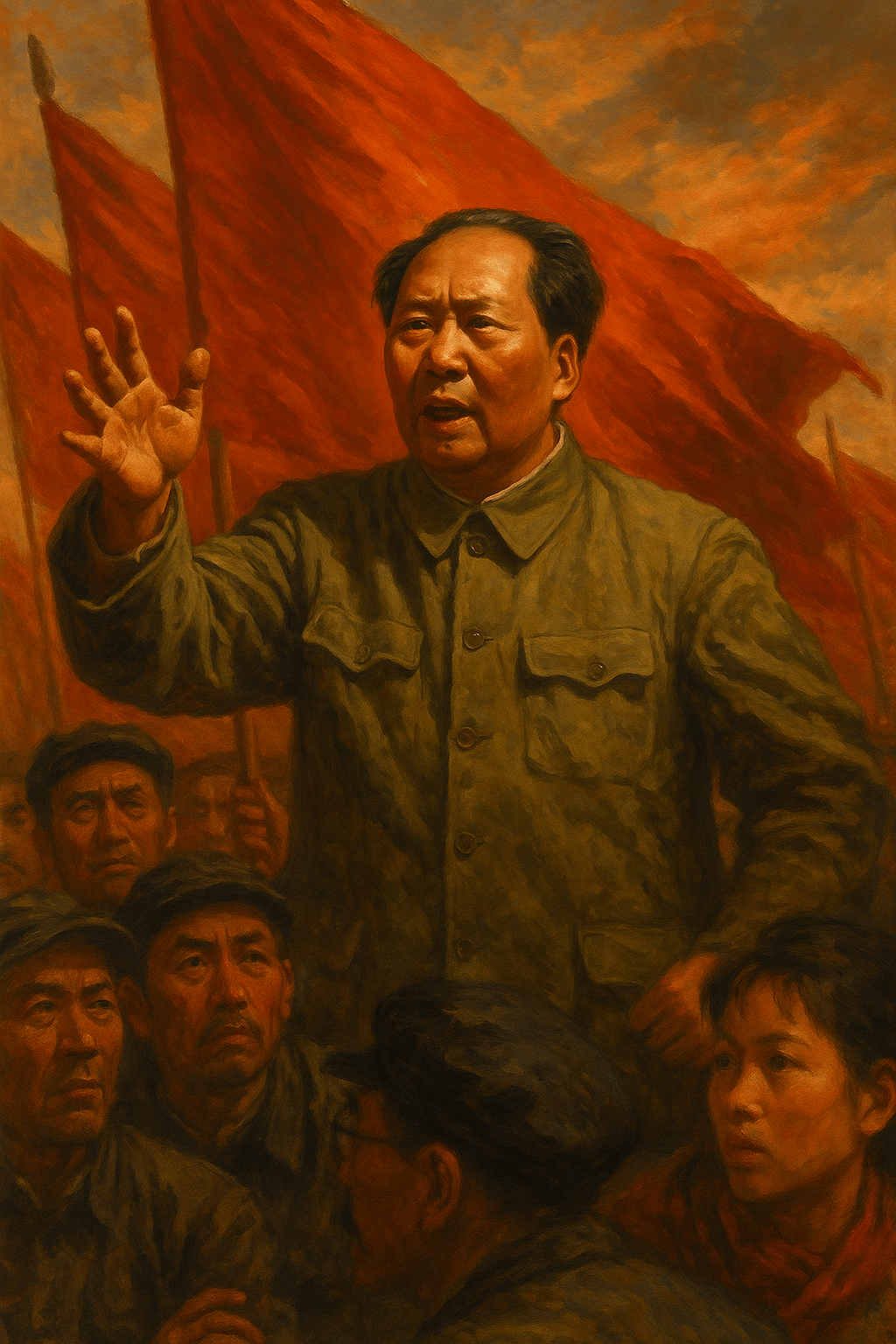
In March 1958, weeks after issuing his Sixty Points on Working Methods in Nanning, Mao gathered Party leaders at Chengtu. If Nanning warned against bureaucratic drift in the wake of victory, Chengtu waged ideological war against dogmatism, empty boasting, and the paralysis of thought. Here Mao demanded investigation over imitation, mass critique over silence, and dialectical daring over rigid formulas. His lessons speak not only to 1958 but to us: revolutions live by thought in motion—or die by habit and rot.
Weaponized Statecraft Series | Mao in Chengtu, 1958
By Prince Kapone | Weaponized Information | September 13, 2025
A Meeting Before the Leap
In March 1958, just weeks after laying down the Sixty Points on Working Methods in Nanning, Mao gathered the Party’s provincial and municipal leaders in Chengtu. The timing was deliberate. The first Five-Year Plan—drafted with heavy Soviet input—had run its course. Khrushchev’s de-Stalinization campaign was shaking the socialist camp, unsettling comrades everywhere. At home, the Hundred Flowers had been pruned by the Anti-Rightist campaign, leaving wounds and silences that still lingered. And yet, despite these contradictions—or because of them—the Party was preparing to launch what would soon be called the Great Leap Forward. Chengtu was not a routine conference. It was Mao forcing the revolution to stop and think before it leapt.
Where the Sixty Points had sounded the alarm against bureaucratic drift—reminding cadres that victory was not rest but a new beginning—Chengtu pressed further. If Nanning had been about methods of working, Chengtu was about methods of thinking. Mao’s aim was to inoculate the Party against the creeping disease of dogmatism: the substitution of formula for analysis, of ritual for reality, of obedience for creativity. Socialist construction, he insisted, could not be shipped in crates or installed like a factory line. It had to be hammered out of China’s own contradictions, with Chinese hands, under Chinese skies.
The danger, Mao warned, was that mental paralysis could undo the revolution faster than any imperialist gunboat. He told the assembled cadres that a Party which governs by reciting formulas instead of investigating reality will choke itself to death. Truth, he insisted, had to be discovered through practice, not imported from authority. It was this demand—to free the Chinese revolution from the comfort of prefabricated answers—that set the stage for his first target at Chengtu: the habit of confusing internationalism with mimicry.
We should not read these talks as abstract philosophy. They were spoken into the ears of officials who controlled provinces, cities, factories, and fields—men and women whose decisions would determine whether the next leap would uplift the masses or collapse under fantasy. Mao’s challenge to them was simple but ruthless: think for yourselves, investigate reality, dare to create. The future of socialism in China depended on it. And in that demand, sharpened at Chengtu, lies a lesson that echoes all the way to our present: revolutions die not only from bullets but from brain rot. The greatest betrayal is not defeat in battle—it is surrender to the comfort of ready-made answers.
Internationalism Without Imitation
In the first years after liberation, Soviet “codes and conventions” arrived in China with the weight of scripture. Banking systems, planning methods, educational grading, even dietary rules about how many eggs a worker should eat—each was received not as reference but as law. Cadres recited Russian formulas with a reverence that bordered on superstition. The danger was obvious to Mao: a revolution that copies another’s path without question is not practicing internationalism but parodying it, reducing socialism to a cargo cult where foreign packages are worshipped without asking if they fit the soil.
Mao’s reply at Chengtu was a sharp reversal. He drew a clear line: yes, we must learn from the Soviet Union; no, we must never obey it like subjects to a master. His hinge was simple and devastating: learn, don’t import. The essence of proletarian internationalism was not repetition but enrichment—drawing lessons through comparison, testing them against China’s own contradictions. “To import Soviet codes and conventions inflexibly,” he warned, “is to lack the creative spirit.” What looked like fidelity to socialism was in truth betrayal of its essence. Revolution is not recitation; it is creation out of local struggle.
This was not just rhetoric aimed at manners; it was aimed at breaking habits that hollowed the Party. Copying Soviet templates had produced officials who could parrot but not lead, who could quote Marxist categories yet fail to read a single Chinese village or factory. Mao demanded rupture, not adjustment: a living method of investigation, comparison, and invention in place of lifeless obedience. The Soviet Union could be a comrade, but never a crutch.
In cutting through mimicry, Mao also confronted two illusions at once. To the rightists who whispered that China should give up on socialism, he showed that socialism demanded creativity, not retreat. To the leftist dogmatists who clung to Moscow’s every word as gospel, he showed that quoting abroad without testing at home was metaphysics, not Marxism. Truth was not a matter of geography or prestige; it was a matter of practice. A revolution would be judged by its ability to transform its own soil, not by how closely it resembled another’s map. That was Mao’s lesson at Chengtu: solidarity without subservience, internationalism without imitation, socialism with a Chinese face forged in the furnace of Chinese struggle.
Dogmatism with Chinese Characteristics
Once Mao had cut down the worship of Soviet codes, he turned to a deeper infection: China’s own tradition of dogmatism. This was no imported disease. The Party had already paid the price for it in the early 1930s, when a clique of “Twenty-Eight and a Half Bolsheviks” tried to force Moscow’s formulas onto Chinese soil. They declared the democratic revolution already socialist in miniature, branded rich peasants as landlords, and ordered premature assaults on cities. The result was disaster—isolated bases, massacred units, and even landlords raising their own guerrillas against the Red Army. Dogma in China had never been just words; it had filled graveyards.
At Chengtu, Mao refused to let this history repeat. He did not reject theory, but he demolished its misuse. Marxism was a living science, not a book of spells. To apply categories without investigation was laziness; to launch insurrections in unripe conditions was suicide. Dogmatism was not loyalty to Marxism—it was the betrayal of its method. With biting irony, Mao called it “dogmatism with Chinese characteristics,” exposing the habit of dressing up obedience as orthodoxy, mistaking submission for fidelity.
His message to the assembled leaders was merciless: a correct line cannot be handed down like scripture. It must be fought out in struggle with incorrect ones, tested in villages, communes, and workshops, proven in practice and corrected in error. Quoting without inquiry, copying without investigation, was not Marxism but metaphysics. The only way to keep socialism alive was to smash the reflex of bowing to formulas. At Chengtu, Mao drove the point home: banishing dogmatism was not betrayal—it was the only path to revolution’s survival.
Planning, Numbers, and Reality
In the years of the First Five-Year Plan, numbers themselves had been treated as talismans. Soviet engineers brought not only machines and blueprints but also tables, ratios, and procedures that quickly became scripture. Many Chinese cadres, unsure of their own judgment, clung to these forms like charms. Reports glistened with figures but concealed the truth: bumper harvests on paper, empty granaries in the villages. Mao mocked the absurdity with barbed stories—schools grading children by Moscow’s scale without asking what Chinese students needed, health campaigns prescribing diets by the book rather than by the body. Even eggs and chickens, he said, had become matters of ideological loyalty.
Mao’s rebuke was not aimed at science but at superstition. Planning without investigation was witchcraft, not socialism. Statistics meant nothing if they did not serve the people. “Learning should be combined with creativity,” he told the cadres. Numbers had to be tested against crops in the fields, shifts in the factory, lives in the villages. Soviet tables might guide, but they could never substitute for inquiry into China’s contradictions. A plan stamped from abroad was not revolutionary; only a plan that transformed conditions for the masses deserved that name. Mao’s hammer blow at Chengtu was clear: when numbers float free of reality, they stop being science and start being sorcery.
Leadership, Truth, and the “Cult” Question
In 1958 Stalin’s ghost still stalked the socialist camp. Two years earlier Khrushchev’s thunderous denunciation had toppled statues and unsettled faith, throwing comrades everywhere into confusion. Was leadership to be worshipped as sacred or reviled as tyranny? The question hung like smoke in the hall at Chengtu.
Mao’s response was disarming in its simplicity: the cult was not the issue, truth was. “The question,” he said, “is not whether there should be a cult of the individual, but whether the individual concerned represents the truth.” Reverence had to be earned in struggle, not conferred by ritual. A leader’s worth was measured not in applause or denunciation but in whether their line held up in practice.
Opportunists inside the Party seized on the anti-Stalin campaign for cover, parading as enlightened critics while ducking their own accountability. They smashed icons to polish their names. Mao cut through the theater: breaking a statue does not make you a revolutionary any more than quoting Marx makes you a dialectician. Truth is not decided by fashion, it is decided in results.
Mao’s principle was sharp and unforgiving: individuals matter only when they embody the correct line confirmed in struggle. Collective leadership cannot excuse evasion; individual authority cannot excuse tyranny. The unity of both lies in practice. Anything else—worship without critique or demolition without analysis—is poison. Leadership, Mao insisted, is not a shrine and not a bonfire. It is responsibility, and its only test is reality itself.
Mass Line, Critique From Below, and the Right to Speak
After dissecting the question of leadership, Mao turned to how the Party itself could stay alive. His answer was not mystery or ceremony but weapons of speech: big-character posters pasted on walls, the “great airing of views” and “great blooming” of ideas, and the building of provincial journals to carry debate beyond Beijing. These were not cosmetic slogans; they were tools to cut through the crust of bureaucracy, to keep criticism flowing like oxygen through the system.
The principle was plain: politics had to be centralized, but initiative had to be decentralized. The line from the center gave unity, but life itself had to come from below. Without the clash of different views at every level, the Party would smother its own vitality. Mao was not preaching disorder for its own sake—he was demanding a disciplined circulation of ideas, a system where the masses could correct the leadership instead of being suffocated by it.
The urgency was real. Across the countryside, peasants already showed their resistance. When absurd quotas were imposed, some hid grain, others staged small protests, others quietly found ways to survive against the paper miracles conjured by officials. Mao did not treat this friction as sabotage. He wanted it heard, amplified, and transmitted upward. The masses were not obstacles to socialist construction—they were the only compass by which it could be steered.
“Without democracy,” Mao warned, “it is impossible for the people to have enthusiasm.” The slogan was not sentimental; it was strategic. A revolution that demands sacrifice while silencing its base breeds resentment, not commitment. A Party that denies the people’s right to speak cuts itself off from the very wellspring of its legitimacy. For Mao, enthusiasm was not a mood to be stirred at rallies but the fuel of socialist transformation itself, and it could only be produced through democratic participation.
Yet Mao also knew the obstacles. Big-character posters could be torn down, provincial journals buried, criticism smothered in the offices of those it targeted. The machinery of the Party was in the grip of figures like Liu Shaoqi and Deng Xiaoping, whose control over publication and personnel allowed them to filter out dissent. Mao saw clearly that tools for critique meant nothing if those who most needed criticism controlled the channels.
Hence his conclusion: the Party’s survival depended on institutionalizing the mass line, on guaranteeing that critique from below could not be silenced from above. A Party closed to criticism becomes a bureaucracy; a bureaucracy deaf to the masses becomes a ruling class; and a ruling class that hides from the people prepares its own overthrow. At Chengtu, Mao placed the question before his comrades without disguise: either the Party learns from the people or it rots into an oppressor. The right to speak was not an ornament of socialism—it was its condition of life.
Dialectics as the Operating System
If the mass line was the bloodstream of the revolution, Mao insisted that dialectics had to be its nervous system. The Party could not stumble forward on straight lines or rigid formulas; it had to think in motion, in contradictions, in cycles of struggle and unity. “Unity, struggle, unity again” was not a phrase to be recited at rallies but the pulse of socialist life itself. Waves crest and fall, consolidation follows advance, contradictions sharpen and resolve—this was the living rhythm Mao demanded cadres learn to feel.
His method was concrete. Mao called for a deliberate cycle: advance boldly, then pause every two months for comparative reviews, rectify what had failed, consolidate what had worked, and only then surge forward again. Quarterly checks, on-site contrasts of communes and workshops, collective comparison of results—this was dialectics translated into procedures. Cadres were not to act as ledger clerks defending figures but as dialecticians able to read when speed was necessary and when rest was survival.
What Mao was attacking at Chengtu was metaphysics masquerading as discipline. Too many leaders feared contradiction, treating it as embarrassment rather than as the engine of development. Too many confused unity with silence, imagining that disagreement was a threat instead of the raw material of synthesis. Mao’s verdict was stark: a revolution that tries to move in straight lines will only end up walking in circles. Think dialectically or perish—that was the lesson he drove into his comrades at Chengtu.
Targets Without Boasting
By early 1958, the scramble for reputations had become a fever. Provinces were competing with each other in miraculous claims—grain yields multiplied by fantasy, slogans boasting that China would catch Britain in “four, five, eight” years. Mao saw the sickness for what it was: a dangerous inflation of targets that looked like boldness but was actually vanity. On March 10 at Chengtu, he named it a “force-10 typhoon” of exaggeration, warning that empty reports could not feed a hungry belly.
Mao’s line was not to extinguish ambition but to discipline it. Experiments, yes; daring, yes; but truth first. Investigate before you publish, test before you boast, let results speak before the headline. Enthusiasm detached from practice was not revolutionary—it was theater. “We must have concrete measures,” he told the cadres, reminding them that a target is not a trophy but a weapon. It only matters if it changes reality. Anything else is bravado, and bravado is revisionism in disguise.
Error as Raw Material
Where timid officials saw mistakes as disasters to be hidden, Mao treated them as the raw material of progress. “The correct line is formed in the struggle with the incorrect line,” he reminded the Chengtu gathering. Truth was not handed down from on high but carved out of contradiction. To fear errors was to fear learning itself. Disorder, far from being the enemy of socialism, could serve as its midwife.
Mao demanded a culture of iteration: investigate, experiment, compare, rectify, repeat. A failed commune, a botched harvest, a misapplied slogan—none of these were excuses for retreat. They were lessons to be generalized, opportunities to sharpen judgment. Better a hundred small errors confessed and corrected than one colossal lie that blinds the entire movement. Covering up failures with paper victories was more lethal than the failures themselves.
This was not indulgence for carelessness. Mao pressed for fewer and smaller errors by insisting on careful investigation and honest reporting. His guardrail was simple: make mistakes early and small, so they can be corrected before they harden into revisionism. Perfection was an illusion; socialism was a workshop, not a cathedral. Its strength lay not in being flawless but in its capacity to admit, confront, and correct. At Chengtu, Mao transformed error from a source of shame into a weapon of survival.
Long Horizons, Changing Forms
Having wrestled with dogma, numbers, leadership, mass critique, dialectics, targets, and error, Mao urged his comrades to lift their eyes from the immediate harvest to the distant horizon. At Chengtu he spoke of changes that reached beyond grain tallies and work points: the family as an economic unit dissolving, distribution shifting from wages to need, social forms taken as eternal giving way under the pressure of socialism. These were not utopian flights but provocations—meant to jolt cadres out of bureaucratic narrowness and remind them that the revolution’s task was nothing less than the remaking of daily life.
His sharpest blow was against what he called the “slave mentality”—the deference to professors, foreign authorities, and inherited categories that paralyzed creative thought. To govern by ritual, to obey received truths, was to shackle the revolution to yesterday. Mao demanded that cadres not simply follow the line but dare to think beyond it, to imagine social relations not yet born. For him, Marxism was not a doctrine of permanence but a science of transformation, a method for seeing the mutable where others saw the fixed.
This was pedagogy as much as politics. Mao was training revolutionaries to treat every institution as provisional, every form as contingent, every category as subject to change. Socialism was not the end but the bridge; communism lay on the far shore, and to cling to present forms as eternal was already to betray the future. Governing without imagination was not prudence but cowardice, and it guaranteed paralysis. The revolution demanded leaders who could not only manage the day’s output but also glimpse tomorrow’s relations.
At Chengtu, Mao’s provocation was stark: if you cannot imagine a world beyond the present, you are already serving the past. A revolution without vision is mere administration, a bureaucracy in red clothes. What socialism required was not just managers of production but dreamers disciplined by practice. To fail at that was not caution but betrayal. To succeed was to give the revolution its horizon.
Synthesis for 2025: Against Templates, For Creative Revolution
Mao’s Chengtu intervention was not a lecture about harvest quotas or statistical procedures. It was a battle to keep the revolution alive by refusing to let thought ossify into formula. He warned against copying Soviet codes without reflection, against worshipping names without testing them in practice, against boasting of paper miracles without substance, and against hiding errors instead of learning from them. He insisted that the Party breathe through the mass line, think in dialectical cycles, and dare to imagine horizons beyond the present. For Mao, the gravest danger after victory was not defeat by the enemy but paralysis by habit.
That lesson is not trapped in 1958. Today’s movements in the capitalist core wrestle with the same temptations Mao diagnosed: copying tactics from abroad without regard to local conditions, mistaking online slogans for investigation, treating NGO “best practices” like scripture, elevating leaders until they collapse under worship, or destroying them in ritual cancellations as if that alone produced truth. Movements inflate their own reputations with headlines and targets while neglecting the hard, unglamorous work of organizing. Worst of all, errors are hidden for fear of embarrassment, instead of being studied as raw material for correction.
To take Mao’s intervention seriously is to rebuild our discipline. Investigate before slogans. Publish truth before miracles. Measure leaders not by rhetoric but by results. Institutionalize criticism from below so every would-be bureaucrat feels its edge. And think in rhythms—advance, consolidate, advance again—rather than in endless emergencies or endless retreats. The dialectic is not decoration; it is the operating system of revolution itself.
The revolution we need in 2025 cannot be imported, borrowed, or performed for applause. It must be forged, corrected, and fought for in the furnace of living struggle. That was Mao’s wager at Chengtu, and it remains ours today. Against templates, against dogma, against the false comfort of ready-made answers: the only road forward is the dangerous, disciplined, and joyous path of creative revolution.
 Weaponized Information
Leave a comment