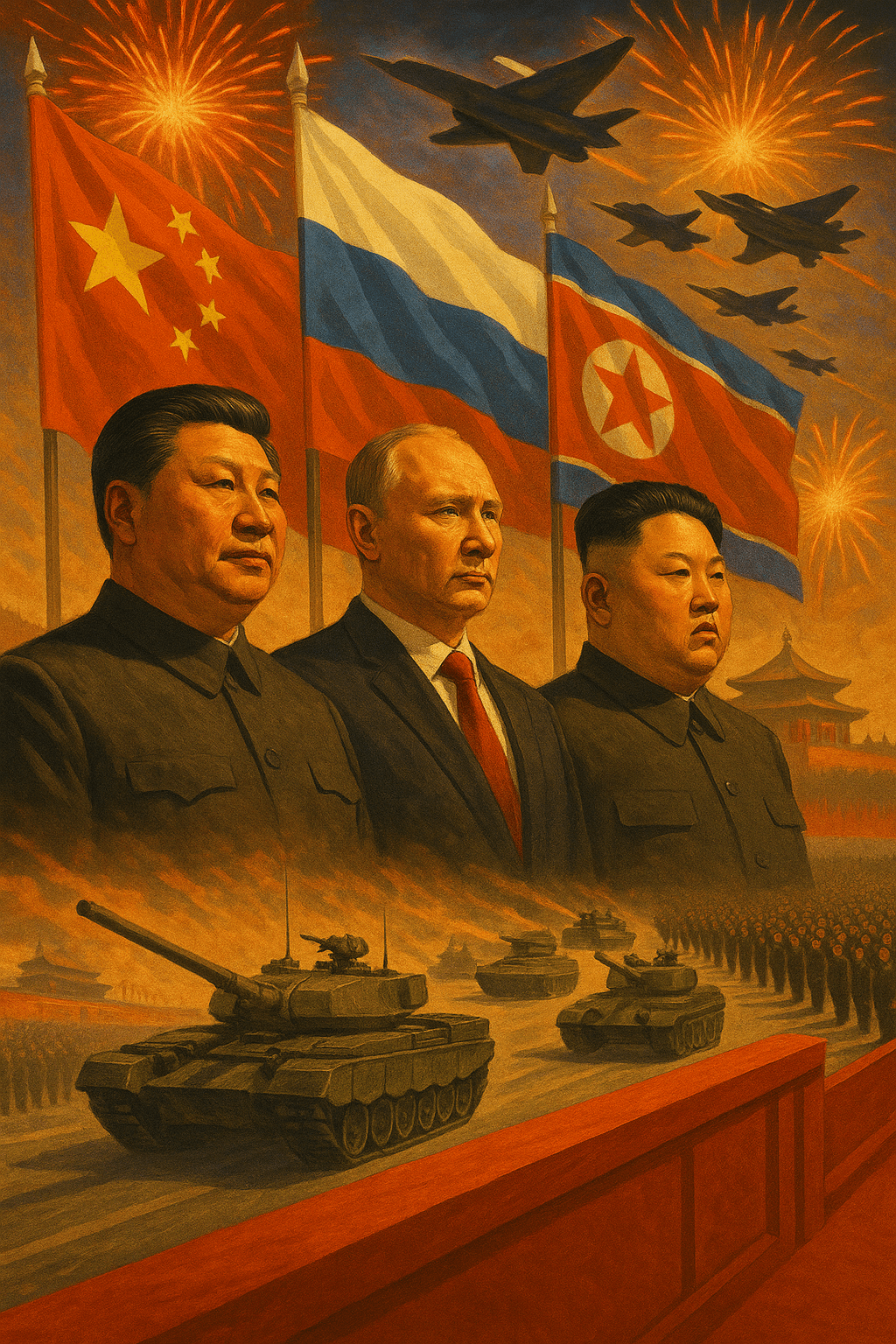
Western pundits shriek at the sight of three leaders on a Beijing stage. But beneath the flags and fireworks lies the truth: Russia, China, and the DPRK are not improvising—they are building. Energy arteries, trade corridors, sanctions-proof circuits, and shared sovereignty are welding into the backbone of a new world order. What the empire calls menace, the colonized call possibility.
By Prince Kapone | Weaponized Information | September 5, 2025
The Parade that Terrified the Empire
On September 3, 2025, the grandstands in Beijing were filled with the ghosts of history and the promises of tomorrow. Xi Jinping, Vladimir Putin, and Kim Jong Un sat side by side as China commemorated the 80th anniversary of victory in the War of Resistance Against Japanese Aggression and the defeat of fascism worldwide. It was a spectacle of steel and memory, tanks rolling and jets streaking overhead, but the real thunderclap was not the hardware. It was the seating arrangement. The imperialist press from Washington to Brussels erupted into a frenzy of headlines, predicting a new “axis of authoritarians,” a replay of the Cold War with darker hues. The hysteria said less about the men on the reviewing stand than about the panic in the citadels of finance and power that have grown accustomed to monopoly.
Strip away the rhetoric and the photo spreads, and you see the deeper story: Beijing was not just putting on a parade. It was staging a declaration of multipolar sovereignty, with Russia and the DPRK flanking China as co-equal partners in a new configuration of world order. For the first time, the tripartite alliance revealed itself in full view of the world stage—not whispered in communiqués, not confined to trade statistics or quiet border deals, but performed before cameras and crowds. What the West dismissed as optics was, in truth, strategy made visible: the binding of three states into a public kernel of the multipolar world system.
That’s why the outrage in New York and London was so shrill. The empire knows that when Xi, Putin, and Kim meet in Beijing and then sit for a trilateral summit, they are not just commemorating history—they are weaponizing history against the present monopoly of power. The parade became a theater of memory and defiance, reminding the world that it was these nations, not Washington, who bore the brunt of fascism’s defeat. Now they invoke that legacy to challenge the neocolonial fascism of today: the sanctions, the tariffs, the wars, and the financial sieges. It is not nostalgia; it is continuity. The symbolism was electric because it made plain what the West has tried to deny—that the future of global order is no longer decided in the Pentagon or the City of London, but in the convergence of sovereignties willing to refuse imperial command.
The capitalist media would rather scream “rogues” and “tyrants” than confront the truth: China, Russia, and the DPRK are assembling the architecture of a different world. That architecture is not abstract—it is pipelines welded, bridges rising, currencies exchanged beyond the dollar’s chokehold. The parade was only the curtain-raiser. The meeting afterward, behind closed doors but telegraphed through joint statements, was the real performance. In the spectacle of three leaders seated together, the empire saw its own eclipse. In the symbolism of solidarity, the colonized saw the shape of possibility.
The Wiring of a New World
To call the Xi–Putin–Kim meeting symbolic is to miss the real current humming beneath it. What is emerging between Beijing, Moscow, and Pyongyang is not just diplomacy—it is circuitry. It is the construction of an alternative operating system for global life, hardwired in trade ledgers, energy grids, and military treaties. The West calls it an “axis.” In truth, it is an architecture.
Look at the design: China anchors the scaffolding with its factories, banks, and the ideological frame of “equal and orderly multipolarization.” Russia plugs in the energy arteries, the Arctic corridors, the pipelines that run against the grain of NATO’s sanctions maps. The DPRK, written off by imperial analysts as a hermit, contributes the hard-earned craft of survival under siege, a sanctions-resistant society and economy that has turned blockade into a science. Together they are soldering an order where the dollar is not sovereign, where the U.S. Navy cannot police every shipping lane, and where sovereignty is not a phrase but a practice.
The joint projects are multiplying. At the Shanghai Cooperation Organisation summit on the eve of Beijing’s parade, the conversation wasn’t about vague ideals—it was about the mechanics of a new system. China laid out the hardware of multipolarity—banks, payments, rules of exchange. Russia proposed SCO bonds and shared settlement platforms, welding Moscow’s resources into Beijing’s circuits. The Kremlin’s transcript spelled it out in black and white: nuclear cooperation, digital healthcare, lunar missions, agricultural pilot zones. And Chinese coverage framed it as the inevitable march toward multipolar governance.
This isn’t the vocabulary of the Cold War. It’s the lexicon of rewiring. Finance ministries now talk of ruble–yuan settlements, customs officials lay out shared agricultural zones in the Amur basin, and scientists draft agreements to strap Russian instruments onto Chinese spacecraft. The DPRK’s inclusion shifts the gear: ports like Rajin and bridges over the Tumen River become testbeds for sanctions-proof corridors, while its technicians contribute missile telemetry, cyber expertise, and mining deals that anchor the alliance in material resources as much as in politics.
To the empire, it looks like a threat because it is one. Not a threat to humanity, but a threat to monopoly. The tripartite alliance is a declaration that the empire no longer controls the valves of trade, the lines of code, the rules of finance. It is an unfinished but undeniable wiring of a world where the colonized, the besieged, and the sanctioned refuse to wait for permission to breathe.
China’s Scaffolding: Factories, Finance, and the Frame of Multipolarity
If the triad is a body, China is the skeleton—the scaffolding upon which everything else attaches and grows. Beijing provides the industrial depth, the logistical networks, and the governance doctrines that give the alliance shape. This is not charity or nostalgia. It is strategy: securing its own sovereignty by weaving together partners who share a refusal to bend before the whip of empire.
Trade volumes tell the story without adjectives. Russia–China trade smashed records in 2024, surging past $240 billion, with 95% of transactions settled in rubles and yuan. The meaning is simple: Washington’s financial blockades no longer apply to the majority of commerce between the world’s largest country and its most populous. The Central Bank clerk in New York can no longer stop the flow. Meanwhile, China–DPRK trade climbed back to pre-pandemic levels by 2024, driven by food, fuel, and machinery exports in exchange for minerals and manufactured goods. Beijing’s ports at Dandong, Dalian, and Hunchun are the lifelines that keep Pyongyang supplied, while also channeling its coal, seafood, and labor into the circuits of the wider alliance.
Infrastructure is the other half of the story. The long-delayed Yalu River bridge at Dandong is set to open fully, expanding the throughput of trucks and rail between China and North Korea. On the Russian side, the Tongjiang–Nizhneleninskoye rail bridge moved 5.4 million tons in 2024, a conveyor belt of coal, grain, and containers into the Chinese interior. And in the Far East, new cross-border passenger links like the Blagoveshchensk–Heihe cable car are transforming militarized rivers into everyday lifelines of workers, students, and families. China is not just receiving goods—it is reformatting its borderlands into a mesh of shared arteries with its northern neighbors.
The ideological superstructure matters as much as the hardware. The announcement of Xi Jinping’s Global Governance Initiative, combined with his previous global initiatives, provide the vocabulary through which multipolarity presents itself as legitimate, equal, and orderly. At the SCO summit preceding the Beijing parade, Xi explicitly cast the bloc as an alternative governance platform, one that does not rely on coercive alliances or military bases but on connectivity, settlement systems, and non-interference. This is how China transforms its economic weight into a conceptual frame, giving partners like Russia and the DPRK an ideological shield against the charge of being “pariahs.”
Even in the field of science and space, China is the integrator. Among the 22 agreements signed after the SCO Summit included Russia’s Lunar Dust Monitor joining China’s Chang’e-7 mission, and memoranda on building joint pilot zones for agriculture and digital healthcare. These may look technocratic, but they are actually the blueprint of integration—where laboratories, farms, and clinics across three countries operate in shared ecosystems beyond Western oversight.
To the West, China’s role looks like domination. To the alliance, it looks like structure. Beijing offers scale, financing, and ideological cover—but not as a unipolar substitute for Washington. Rather, it offers a scaffold that Russia’s resources and the DPRK’s resilience can latch onto, producing something no empire has ever managed: a system of survival and growth that does not require submission.
Russia’s Frontline Pivot: Resources, Routes, and the Military Spine
Where China provides the scaffold, Russia supplies the muscle and marrow. Its role in the tripartite alliance is forged in the collision between Western sanctions and the immensity of Eurasian geography. Russia’s particular contribution is simple to describe yet world-shaking in consequence: it turns its pipelines, ports, and armies toward the East, transforming punishment into partnership.
The numbers show the pivot. We noted Russia–China trade hit record highs in 2024, surpassing $240 billion, with over 95% of transactions settled in rubles and yuan. This is not the rhetoric of “de-dollarization”; it is the reality of invoices immune to U.S. Treasury freezes. In gas and oil, Power of Siberia pumped 31 bcm eastward in 2024, while Power of Siberia-2 now carries binding contracts for another 50 bcm through Mongolia. What Europe forfeited in panic, China secured in permanence.
Beyond energy, Russia repurposes its geography as connective tissue. Shipping on the Northern Sea Route broke records with 97 voyages in 2024, and Chinese carriers launched an 18-day Arctic express from Asia to Europe.
This is not simply trade — it is the Arctic becoming a multipolar artery. As one of the eight Arctic powers, Russia provides China with the only viable pathway into Arctic shipping, mining, and governance structures. Beijing can aspire to be a “Polar Great Power,” but without Moscow’s partnership those ambitions remain paper. Now, under sanctions and siege, Moscow turns necessity into leverage: it gives China and potentially even the DPRK indirect access to the polar frontier, where NATO once imagined itself uncontested. The alliance is not just building bridges and pipelines southward — it is extending its reach north, into the ice, into the sea lanes, into the mineral vaults of the future.
Beyond physical infrastructure, Russia supplies the alliance with invisible arteries of finance. Secreted from Western oversight is the “China Track”—a netting payment system designed by sanctioned Russian banks in alliance with Chinese counterparts to settle trade without SWIFT or Western intermediaries. Developed under the guidance of both Putin and Xi, it uses intermediaries in “friendly jurisdictions” to mask and offset payments internally—lowering costs, increasing speed, and shielding them from U.S. secondary sanctions.
On its southern frontier, Moscow is welding connections with Pyongyang into permanence. Construction began in 2025 on an 850-meter road bridge over the Tumen River, finalizing plans from Putin’s 2024 visit, while rail at Tumangang–Khasan surged and coal exports through Rajin reached their highest in years. Each shipment of coal or grain is another hole punched in the sanctions wall. And the political architecture matches the material: the DPRK–Russia Comprehensive Strategic Partnership treaty of June 2024 codifies mutual defense obligations, while Moscow’s UN veto ended the sanctions monitoring panel, giving Pyongyang diplomatic oxygen to match its physical corridors.
Russia’s armies and arsenals are the third dimension of its role. Its direct experience of industrial war in Ukraine—artillery, drones, and electronic warfare—provides the alliance with tested doctrine and technology. The DPRK has reportedly dispatched munitions and even units to the Russian front, gaining live combat experience in return. Meanwhile, joint drills with China in the Sea of Japan and the Pacific signal that Moscow is no longer just a European actor—it is a Pacific one, anchoring the tripartite alliance in both theaters of global conflict.
Strip away the think-tank chatter, and you see Russia’s particularity clearly: it supplies the raw weight—energy, land, and military power—that anchors the alliance against external shock. Where China offers structure and the DPRK offers resilience, Russia provides the heavy ballast that makes the vessel seaworthy. It turns geography into leverage and sanctions into scaffolding for a world the West cannot command.
DPRK’s Resilient Edge: Minerals, Science, and the School of Siege Survival
If China supplies the skeleton and Russia the muscle, then the DPRK is the scar tissue—toughened by decades of siege, resistant where others would break, and capable of healing into new forms. Its contribution to the tripartite alliance is not measured in raw tonnage or GDP, but in hard-won skills: survival under blockade, ingenuity in science and technology, and mineral reserves that make it an underground superpower.
The DPRK sits on an estimated $6–10 trillion in untapped mineral wealth, including some of the world’s largest deposits of rare earths, magnesite, tungsten, and uranium. Coal exports through Rajin and Rason surged in 2025, showing how sanctions walls become sieves when demand is high enough. For Russia, these minerals mean fuel and steel; for China, they mean inputs for high-tech manufacturing; for Pyongyang, they mean leverage that cannot be erased by a banker’s keystroke.
Indigenous science and technology are the DPRK’s other arsenal. The launch of reconnaissance satellites, the testing of solid-fuel ICBMs, and the development of offensive cyber capabilities demonstrate a domestic scientific base that rivals far larger economies. Joint military drills with Russia and China, including the July 2023 Korean War armistice parade flanked by Russian and Chinese delegations, signal how this capacity is integrated into alliance structures. Reports of North Korean units deployed to Russia’s war in Ukraine suggest the exchange is not theoretical but lived: munitions for Moscow, combat experience for Pyongyang.
But perhaps the DPRK’s most valuable contribution is its mastery of sanctions evasion. For decades, Pyongyang has survived what Bolton once called the “maximum pressure dream”—complete financial and commercial isolation. In that crucible, it developed sophisticated techniques: false-flag shipping registries, ship-to-ship transfers on the high seas, using front and shell companies in places like Southeast Asia and Africa—including “as little as two persons and a fax machine brokering missile sales”—and generates hard currency through barter, mineral, and arms trade, amounting to about $100 million annually from Africa alone. What was once a desperate tactic has become an exportable skill set. Russia’s “shadow fleet” of oil tankers looks eerily likeDPRK playbooks from the 2000s, while China’s quiet tolerance of barter and swaps across the Yalu echoes the same methods. In a world where sanctions are Washington’s favorite weapon, Pyongyang offers its allies the manual for fighting back.
Domestic transformation reinforces this resilience. A growing middle class, visible in the proliferation of cell phones, private consumption, and domestic tourism, has created a base of internal demand less dependent on foreign inputs. Projects like the Wonsan-Kalma Beach Resort serve both to absorb excess liquidity and to provide state-managed leisure that binds citizens to the regime. These shifts are not Western-style consumerism but a strategic recalibration of socialism under siege: build internally, consume internally, survive externally.
In short, the DPRK’s role in the alliance is not redundancy but specialization. It supplies raw minerals, hardened science, and the lived knowledge of how to turn sanctions into smuggling routes and blockades into barter chains. Where Russia brings mass and China brings scale, the DPRK brings cunning—the guerilla tactics of statecraft that turn a world designed to starve it into a workshop for multipolar survival.
The Imperialist Counter-Pole: How Sanctions, Tariffs, and Threats Forged the Triad
The West looks at the handshake between Xi, Putin, and Kim and sees menace; what it refuses to see is its own reflection. This tripartite alliance did not emerge in a vacuum. It was sculpted, blow by blow, by decades of imperial siege: sanctions stacked like bricks, tariffs wielded like cudgels, and military threats brandished as routine. Each act of coercion meant to isolate instead compressed three sovereign states into solidarity.
The record is plain. The imperialist triad—Washington, Brussels, and Tokyo—has imposed over 26,000 sanctions on Russia since 2014, making it the most-sanctioned country in modern history. Yet the ruble did not collapse; instead, Moscow turned east, selling crude to China and India at discounts and rerouting trade through the Eurasian landmass. For the DPRK, sanctions were perpetual, policed until Russia’s 2024 UN veto torpedoed the monitoring regime. Every attempt to cut Pyongyang off only deepened its ingenuity in sanctions evasion, as we have seen. China itself has been battered by Trump’s new tariff waves, at least temporarily choking electronics and EV supply chains. What was intended as economic asphyxiation produced instead a common lung.
Military pressure played its role as well. The U.S. rings China with bases from Okinawa to Guam, stages trilateral drills with Seoul and Tokyo, and floats carrier groups through the Taiwan Strait. NATO expansion pressed Russia’s western flank, while on the Korean peninsula, U.S. nuclear-capable bombers patrol overhead. Each exercise, each provocation, each threat—rather than breaking wills—tightened bonds. Hence, the DPRK–Russia mutual defense treaty was signed; now, China and Russia have unveiled new joint frameworks for global governance, with Kim Jong Un seated beside them at Victory Day.
Financial warfare completed the picture. Washington froze $300 billion in Russian reserves, weaponized SWIFT, and threatened secondary sanctions on Chinese firms. But the result was not submission—it was invention: 95% of China–Russia trade now runs in yuan and rubles, while Pyongyang barters coal for oil and swaps arms for grain. The dollar was not dethroned in speeches; it was bypassed in practice, ledger by ledger, contract by contract.
In short, the imperialist system generated its own negation. By trying to choke Russia’s arteries, it opened new veins eastward. By besieging the DPRK, it honed skills in sanctions evasion now shared with allies. By waging tariff war on China, it compelled Beijing to double down on multipolar institutions and south–south linkages. Trump’s tariffs, Biden’s sanctions, NATO’s expansion—all were meant as shackles. Instead, they became welding rods, fusing together an alliance that stood, visibly and unapologetically, at Beijing’s Victory Day.
From Siege to Synthesis: The Triad as the Core of a New Generality
The ceremony in Beijing was more than pageantry. When Xi, Putin, and Kim stood shoulder to shoulder, they declared not merely survival, but construction. What the West mistakes as desperation is in fact synthesis: three distinct trajectories, forged in different furnaces, converging into a common architecture of multipolarity. Each brings its particularity—China the scale and planning, Russia the resources and strategic depth, the DPRK the resilience and cunning of siege survival. Together, they form not a fragile convenience, but a union of strengths.
This is not “bandwagoning” in the language of think tanks, nor a “marriage of convenience” in the vocabulary of punditry. It is a dialectical response to empire’s own logic. The U.S. and its allies built a world order on coercion, tariffs, sanctions, and bombs. That order compelled its antagonists into relation, forced complementarity where rivalry once lingered, and hardened alliances where distrust had been. The imperialist bloc forged the hammer; the multipolar triad became the anvil that does not break.
For Beijing, the alliance stabilizes its rear, secures energy and raw inputs, and links infrastructure from the Amur to the Arctic. For Moscow, it reorients lifelines eastward, transforming sanctions into opportunity and geography into leverage. For Pyongyang, it validates its decades of sacrifice, turning isolation into skill and siege into exportable expertise. Each element alone would bend under the weight of U.S. pressure; together they bend the world-system itself, opening new routes, currencies, and institutions that escape Washington’s grasp.
The higher synthesis lies here: this is no longer reaction to imperial blows, but affirmation of another horizon. When China names “equal and orderly multipolarization,” when Russia speaks of “civilizational sovereignty,” when the DPRK insists that sanctions cannot suffocate, they are not issuing parallel slogans. They are inscribing a collective grammar of sovereignty, solidarity, and survival. It is not utopia; contradictions remain, interests diverge, history weighs heavy. But it is nonetheless a rupture—the beginning of a world no longer managed from one capital, no longer beholden to one empire’s rules.
In Beijing’s Victory Day parade, the tanks and flags were symbols, yes—but the deeper symbol was in the seating. Three leaders, once divided by ideology, distrust, and history, now visible to the entire planet as a pole of their own. That is the meaning the West cannot name: not just resistance, but construction; not just endurance, but direction. From the particular strengths of each state emerges a new generality—a multipolar core, forged in siege, sharpened by survival, and now poised to redraw the world.
 Weaponized Information
Leave a comment