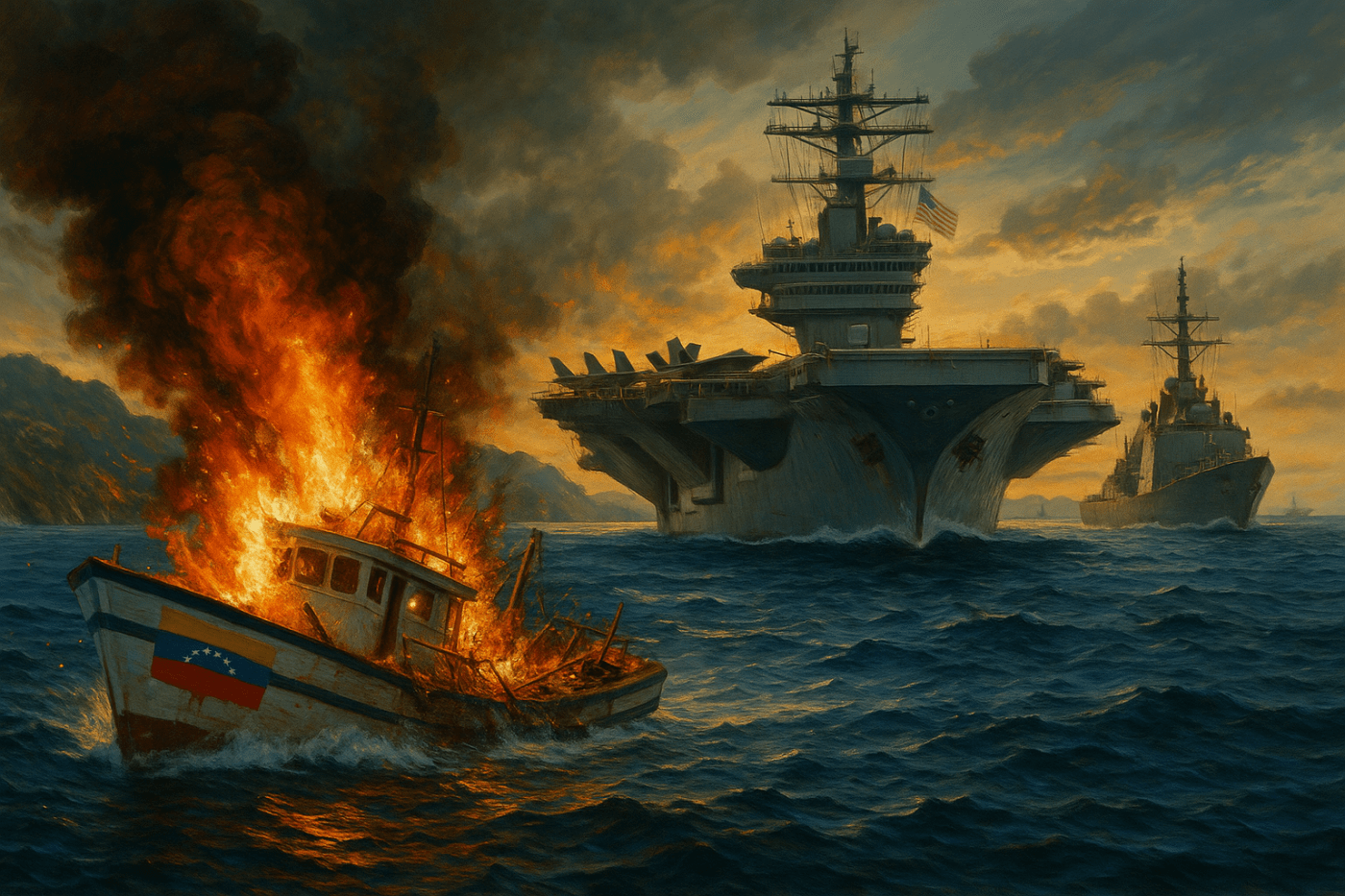
Washington bombed a Venezuelan boat and rolled warships into the Caribbean, calling it counternarcotics. In truth, it’s a war for oil, sovereignty, and the future of multipolarity. Behind the headlines lies the Monroe Doctrine reborn. The stakes are nothing less than empire’s survival versus a people’s right to be free.
By Prince Kapone | Weaponized Information | September 4, 2025
The Story Beneath the Story
The BBC piece—“What is Trump’s goal as US bombs ‘Venezuela drugs boat’ and deploys warships?”—wears the mask of neutrality, but a close read shows it is nothing of the sort. From the very first line, the stage is set like a Hollywood drama: U.S. destroyers cut across the Caribbean, Trump announces a deadly strike, and the question posed is not whether this violence is legitimate, but what the commander-in-chief has planned for his next act. The audience is being trained to see U.S. aggression as ordinary police work, not as the escalation of war.
Trump’s words are served up like gospel. He points to a video and swears there are “bags of drugs all over the boat.” The reporters don’t ask for proof, don’t check the evidence—they simply repeat it, as if the presidential mouth were a reliable forensic lab. And when he brands the dead as “narcoterrorists,” the label is parroted without question, fusing every American nightmare—gangs, drugs, terror—into a single word meant to erase their humanity. The BBC doesn’t challenge the theater; it plays the role of chorus, chanting back the emperor’s lines.
Notice how the tone shifts when the subject turns to Venezuela. Maduro “denies” accusations, the militia is painted as “wildly inflated” and “barely trained,” all without a shred of sourcing. The United States is given the dignity of certainty, Venezuela is given the sneer of disbelief. This is not reporting—it’s an old colonial trick: one side speaks as fact, the other only ever “claims.”
The experts who appear in the article all come from the same choir. A U.S. defense secretary talking tough on Fox News, a former intelligence officer speculating about “precise missions,” an academic who politely compares the build-up to “gunboat diplomacy.” These voices don’t question the premise; they reinforce it. They are there to decorate the narrative with authority, like professors and generals hanging garlands on the war machine.
Even when danger slips through, it’s wrapped in cotton. An analyst mentions the “risk of escalation at sea,” but the line is dropped quickly, treated like a throwaway aside. Legal questions are mentioned in passing, with no detail, no sharp edges. The reader is left with the impression that maybe there are quibbles, but nothing to stop the show from going on. This is how critique is neutralized: gesture at it, then move along before anyone thinks too hard.
What’s missing is as loud as what’s written. No voices from the men who were killed, no independent verification of who they were, no context for why Venezuela is even in Washington’s crosshairs. Caracas is allowed only to “react,” never to explain. The boundaries of knowledge are drawn so the only actors with agency are the White House and the Pentagon. Everyone else exists as shadow.
When you strip the language down, you see what’s really happening. This is not journalism, it is a script. America acts, Venezuela responds, and the reader is instructed to see the violence as normal, even necessary. The sleight of hand is not clumsy; it is polished. By repetition, by omission, by double standards, war is dressed up as law enforcement. The BBC tells us it is holding a mirror to reality, but it is really holding a mask over empire’s face.
Restoring the Record the Empire Erased
The BBC piece admits to very little: Trump ordered a strike on what he called a Venezuelan “drug boat,” killing eleven people. U.S. officials claimed the victims were “narco-terrorists.” The article concedes that this strike was paired with a naval build-up not seen since 1965—guided missile destroyers, the Iwo Jima amphibious group, a nuclear submarine, P-8 surveillance aircraft, and 4,500 troops. It notes Washington has posted a $50 million bounty on President Nicolás Maduro, and even quotes an academic who likens the build-up to old-fashioned “gunboat diplomacy.” That is the narrow picture it allows. Everything else—the backbone of the story—is stripped away.
What the BBC hides is decisive. For two decades Washington has waged economic war on Venezuela through a sprawling sanctions architecture. Since 2005, these sanctions have expanded from travel bans on individuals to a full blockade of the country’s financial system, oil exports, gold production, and central bank. Under Trump’s first term, executive orders froze the assets of PdVSA, Venezuela’s state oil company, and cut the country off from U.S. financial markets. Licenses allowing Chevron to operate were turned on and off like a switch, depending on whether Washington wanted to squeeze or entice Caracas. A 2021 report by the U.S. Government Accountability Office itself admitted these measures impeded humanitarian relief, but the siege has only grown more severe. These sanctions form the real backdrop to every confrontation in the Caribbean.
The BBC also omits the political reality: Venezuela’s July 2024 elections were declared free and fair by international monitors from across the Global South and by observers invited into the country. Nicolás Maduro won, and the people defended their sovereignty at the ballot box despite years of external pressure. Observers on the ground affirmed the process. What the United States and its allies could not achieve through coups and guarimbas, they attempted to delegitimize through refusal of recognition. The BBC echoes that silence, never acknowledging that monitors on the ground affirmed the process. To admit this would undercut the entire regime-change narrative.
Meanwhile, official U.S. doctrine lays bare the strategy that polite journalists pretend is invisible. In its 2025 posture statement to Congress, the U.S. Southern Command named Venezuela, Cuba, and Nicaragua alongside China and Russia as “malign actors.” The statement pledged to protect U.S. control over strategic chokepoints like the Panama Canal and the Strait of Magellan, to disrupt Chinese and Russian influence, and to “expose, deter, and degrade” regional governments that resist U.S. dictates. These are not the words of counter-narcotics policing—they are the blueprint of imperial domination. Yet the BBC never cites them.
Even the pretext of narcotics collapses under scrutiny. A 2023 United Nations report confirmed that the main cocaine routes to the United States run through the Pacific, not the Caribbean. Washington knows this, yet chose to bomb a boat in Caribbean waters and release edited footage to the world. If the real aim were interdiction, the Pacific would be the theater. The Caribbean was chosen because it offers a stage for intimidation—a spectacle of missiles and destroyers projected at Venezuela’s shores. The BBC repeated Trump’s line about “bags of drugs all over the boat” without independent evidence, turning propaganda into headline fact.
Oil, too, is absent from the BBC’s telling, though it explains everything. Venezuela holds the largest proven reserves on Earth. For decades, Washington has attempted to bend this wealth to its interests, seizing CITGO in the U.S., weaponizing Chevron’s licenses, and punishing countries that dare to import Venezuelan crude. In April 2025, Trump imposed a 25 percent tariff on any country that bought Venezuelan oil, effectively threatening sanctions-by-tariff against the entire world. The BBC reduces this to “confusion” about U.S. goals, but the truth is clear: oil is the lever of coercion, just as sanctions are the cudgel.
Place the facts together and the contradictions stand exposed. Washington claims to fight drugs, but chooses the wrong theater and deploys a navy more suited for war than interdiction. It claims to defend democracy, while sanctioning and attempting to overthrow a government whose elections were validated by international observers. It speaks of humanitarian concern, while sanctions starve the economy and block medicine. The BBC drains these contradictions from its narrative, leaving behind a hollow police drama: narco-terrorists neutralized, the empire keeping seas safe. But the reality, once restored, is that this is not law enforcement. It is militarized imperialism dressed up as drug control, a rehearsal of the Monroe Doctrine under the cover of counter-narcotics.
Empire in Crisis, Sovereignty Under Siege
When you stack the facts side by side, the mask slips and the real story surfaces. The United States is not fighting “narco-terrorists” in the Caribbean—it is fighting the long war to reassert dominance over a region it still calls its “backyard.” The spectacle of destroyers, amphibious groups, and submarines sailing south is not about drug interdiction. It is the language of imperial force projection in a time of imperial decline. A system that once strutted across the world stage now relies on intimidation in its own hemisphere to prove it still holds the whip.
Venezuela sits at the heart of this offensive for a reason. It embodies what Washington cannot allow: anti-imperialist sovereignty. A government that asserts the right to use its oil for the needs of its people, that allies with China, Russia, and Iran in a multipolar project, that insists elections are decided in Caracas rather than in Washington—that is intolerable to the empire. By branding Venezuela as a narco-state, by labeling gangs as terrorist groups, the U.S. constructs the alibi for aggression. It is cognitive warfare in motion: a vocabulary designed to make sovereignty itself look like crime.
This is not new, but it is sharpened. The blockade of Venezuelan banks and oil revenues is not an accident; it is part of the global sanctions architecture—a financial stranglehold that turns entire nations into hostages. The Chevron licenses that flicker on and off are instruments of financial piracy, using the promise of limited relief as leverage to dictate terms. When Trump slaps a 25 percent tariff on any country that dares to buy Venezuelan oil, that is not trade policy—it is hyper-imperial blackmail, an attempt to turn the whole world into enforcers of Washington’s siege.
The naval deployment shows the other face of this strategy: militarized imperialism. The choice to use destroyers instead of Coast Guard cutters, to send Marines instead of customs officers, is not about efficiency—it is about spectacle. The point is not stopping a boat; it is reminding the hemisphere who carries the “big stick.” The Pentagon’s own posture statements admit as much, naming Venezuela alongside China and Russia as “malign actors” and pledging to secure the Panama Canal and regional chokepoints. These are not the words of counternarcotics. They are the blueprint of imperial recalibration.
Step back and you see the larger pattern: a crisis of imperialism. The United States cannot sustain its unipolar supremacy; China is its main trading partner, Russia refuses containment, and the Global South is building institutions like BRICS+ that sidestep Washington’s grip. In response, the U.S. lashes out where it still feels strong—Latin America. Here it rehearses the Monroe Doctrine, hoping to reassert control and intimidate the world into believing its decline is not real. But every strike, every sanction, every blockade testifies to the opposite. Only a system in decay needs such spasmodic displays of violence to prove it still matters.
From the standpoint of the global working classes, of the colonized, and of those in the North who refuse to side with empire, the story is clear. Venezuela is not a threat because of drugs. It is a threat because it refuses subordination, because it links arms with others building a multipolar order, because it shows that even under siege a nation can fight for dignity. The empire’s narrative reduces this to crime and terror. The real narrative is of a people defending sovereignty against a decaying system that survives only by coercion. That is the truth buried beneath the propaganda headline.
From Solidarity to Struggle: Turning Exposure into Action
Once the fog of propaganda clears, we are left with the urgent task of moving from analysis to action. The empire has shown its hand: sanctions that choke a nation’s lifeline, naval deployments dressed up as counternarcotics, and a blockade disguised as democracy promotion. These are not abstract debates. They are chains around the lives of millions. If we in the North simply read and nod, we become spectators to our own government’s crimes. The point is to join the currents of struggle that are already fighting back.
Across the Americas, solidarity networks have kept the fire alive. Groups like the Sanctions Kill Coalition, the Black Alliance for Peace, and the Venezuela Solidarity Network are exposing how economic warfare works and building campaigns to end it. These aren’t polite petitions to Washington—they are direct challenges to the global sanctions architecture that strangles food, medicine, and development. Joining them means standing with Venezuelans who resist daily the attempt to turn sovereignty into starvation.
Others are on the frontlines of dismantling the empire’s favorite alibi: the so-called “war on drugs.” Witness for Peace Solidarity Collective, School of the Americas Watch, and grassroots networks across Latin America know that the drug war has always been a cover for militarized imperialism. They link the dots between police killings in U.S. cities and helicopter raids in Colombia, between mass incarceration at home and military bases abroad. To fight the drug war narrative is to fight the very justification for Trump’s new gunboat diplomacy.
Broader anti-war and anti-imperialist formations are also carrying the weight. The Tricontinental Institute, the International People’s Assembly, and BRICS People’s Forum have all advanced campaigns for multipolarity and anti-imperialist sovereignty. Their research, organizing, and mass education work make clear that Venezuela is not alone—it is part of a continental and global project to shake off U.S. domination. When we strengthen these spaces, we chip away at the isolation the empire counts on.
This is not charity. It is joint struggle. Workers in the North live under the same militarized economy that funds destroyers in the Caribbean while gutting schools and hospitals at home. Every dollar spent policing Venezuela is stolen from our wages, our communities, our future. To fight alongside Latin America is to fight for ourselves—to weaken the war machine that treats us all as collateral.
The path forward is clear. Link arms with the campaigns already in motion: defend Venezuela’s right to chart its own path, demand an end to sanctions and blockades, expose the drug war for the imperial fraud it is, and resist the militarization of our hemisphere. Organize teach-ins with solidarity networks, pressure unions and community organizations to take a stand, build pressure against the banks and corporations that profit from sanctions, and join delegations that witness Venezuela’s reality firsthand. Every act of solidarity chips away at the empire’s lie that it acts in our name.
The BBC headline wanted us confused—was this about drugs, crime, or terror? But the story beneath the story is simple: empire in decay is lashing out, and Venezuela is standing tall. Our task is just as simple: refuse to be complicit, and turn solidarity into struggle. The seas of the Caribbean are not Washington’s playground, and Latin America is not its backyard. It is time we make that truth echo from Caracas to Chicago, from Havana to Harlem.
 Weaponized Information
Leave a comment