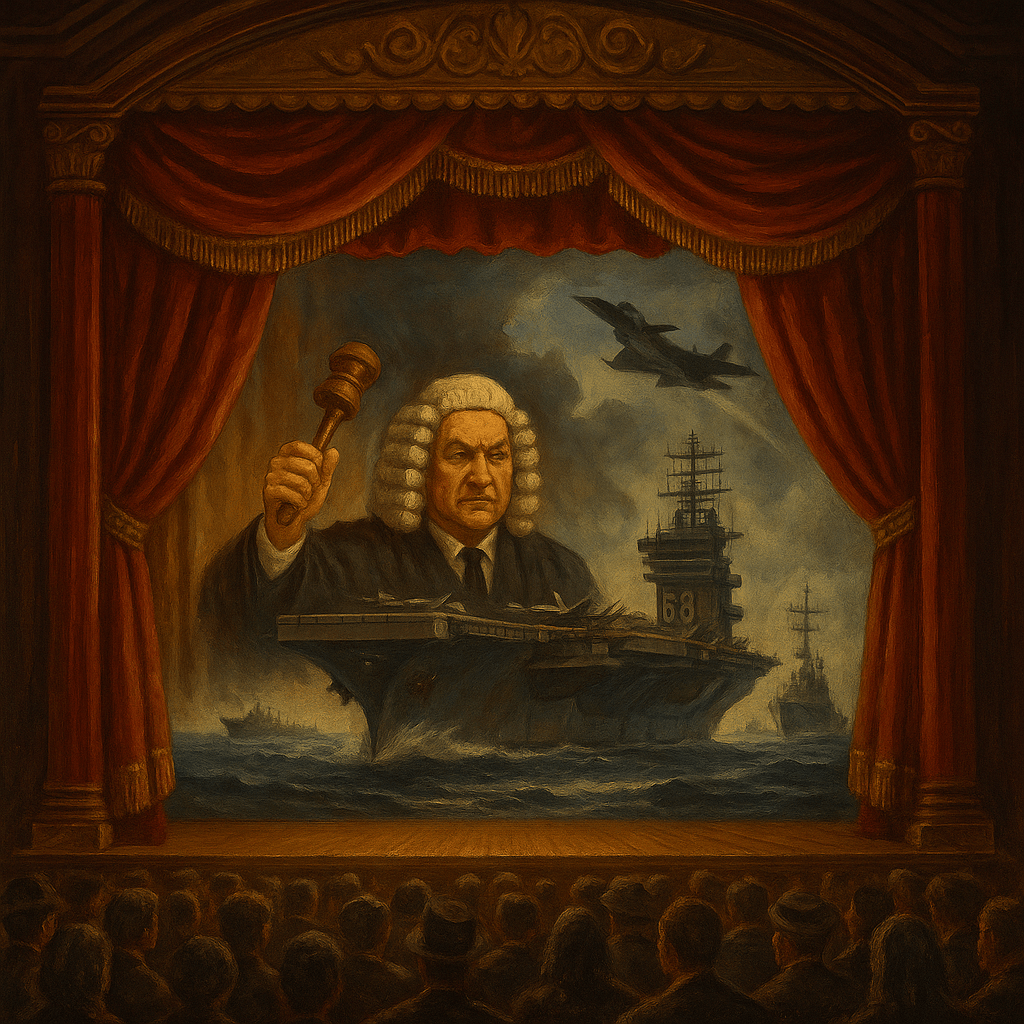
The headlines paint China as the aggressor, but the real performance is Washington disguising coercion as law. The facts expose a history of colonial cartography, militarized bases, and trade arteries patrolled by empire. Reframed through the eyes of the global proletariat, “freedom of navigation” is revealed as freedom of coercion. From fisherfolk flotillas to multipolar alliances, resistance is already in motion—our task is to join it.
By Prince Kapone | Weaponized Information | August 26, 2025
Drowning in an Ocean of Imperial Lies
On August 26, 2025, the Eurasian Times ran a piece by Sumit Ahlawat, dressed in the respectable tone of international reporting, titled “China Challenges U.S. Navy’s ‘Gunboat Diplomacy’; Questions Legal Basis Of American South China Sea FONOPs”. The headline alone does the heavy lifting: present Washington’s naval bullying as a matter of “freedom,” portray Beijing’s challenge as an act of aggression, and let the reader assume that somewhere in between lies “the law.” It is a neat trick, one that makes empire look like a referee instead of the fighter with its boot on everyone’s neck.
Ahlawat himself is not an outlier in this world of stenography for power. His career moves through the usual stations of Indian corporate media—Press Trust of India, Times Now, Zee News, Economic Times, Microsoft News—before settling in the Eurasian Times. This is not the résumé of a dissident. It is the record of a journalist shaped by institutions whose business is to rehearse the priorities of the ruling class, whether in Delhi or Washington. To expect him to write against the grain of empire would be like expecting a banker to campaign against interest.
The outlet itself positions as “non-Western,” with just enough exotic varnish to appeal to readers tired of CNN and the BBC. Yet peel back the branding and you find an English-language publication whose function is not to decolonize the narrative but to graft Indian nationalist interests onto the larger Indo-Pacific agenda of the United States. It occupies that comfortable zone of “independent” media where anti-China rhetoric meets polite distance from open imperial fanfare. In other words: it is a subcontractor in the ideological supply chain.
Predictably, the piece leans on the usual chorus of amplifiers. Think tanks like the Asia Maritime Transparency Initiative—born in the lap of Washington’s war bureaucracy—and the Lowy Institute in Australia provide the citations. These are not neutral observers. They are the intellectual battalions of empire, manufacturing the language in which coercion becomes “freedom,” and invasion is rebranded as “navigation.” When their findings are repeated in a news article, the effect is to launder policy papers into common sense.
This is where the mechanics of propaganda show their teeth. The article frames U.S. naval operations as “routine,” a word that belongs to coffee breaks and train schedules, not carrier strike groups. It ignores the long history of Washington’s freedom-of-navigation missions against weaker nations, presenting the clash as if it began only when China entered the picture. It relies on the emotional tug of “stability” and “order,” as though the permanent presence of U.S. warships thousands of miles from home is the natural order of things. It slips in selective legal jargon, conveniently omitting the small fact that Washington itself refuses to ratify the very treaty it wields against others. And when it mentions Chinese vessels off Hawaii, it presents a false equivalence: one side docks itself in the Pacific like a landlord; the other sails by, and suddenly the two are equals.
Underneath it all sits the oldest Orientalist trick in the book: portray China as destabilizing, unruly, dangerous—while portraying the U.S. as the sober custodian of international law. It is the same story told for centuries, now with new uniforms and acronyms. This is not journalism. It is stagecraft, a theater of legal illusions where the actors play their lines and the empire directs the scene. Our task is not to admire the costumes but to strip away the curtain and expose the machinery at work.
Extracting the Facts Beneath the Waves
The Eurasian Times article reports that the China Institute for Marine Affairs under Beijing’s Ministry of Natural Resources issued its first Legal Assessment of the United States’ ‘Freedom of Navigation’, declaring that Washington’s operations amount to “gunboat diplomacy” and lack a foundation in international law. It highlights the hypocrisy that the United States has never ratified the United Nations Convention on the Law of the Sea (UNCLOS) while wielding it as justification. It notes that the Freedom of Navigation program, initially directed against states such as Vietnam, Malaysia, and the Philippines, shifted its focus toward China after 2007. The article recalls that Washington asserted navigational “rights” even against allies, such as in India’s exclusive economic zone in 2021. It also acknowledges that China conducted operations off Hawaii in 2018 and entered Australia’s EEZ in 2023. Finally, it cites the Lowy Institute, which concedes that U.S. actions are provocative but technically legal under prevailing interpretations of maritime law.
Yet these facts, standing alone, tell only part of the story. The U.S. Freedom of Navigation Program was created in 1979 under the Carter administration as a Cold War tool to enforce naval supremacy, not to defend neutral commons. The overlapping claims in the South China Sea are the sediment of imperial cartography, rooted in treaties like the 1898 Treaty of Paris, when Spain sold the Philippines to the United States and drew maritime boundaries that still haunt the region. The sea itself carries $3.4 trillion in annual trade, making it one of the busiest arteries of global capitalism. The U.S. enforces its reach through a dense lattice of militarization, including permanent bases in Guam and Japan, rotational deployments in Singapore, and revived access agreements in the Philippines. Meanwhile, regional states are pursuing alternatives: ASEAN’s Code of Conduct negotiations seek to resolve disputes multilaterally—deliberately excluding Washington’s hand.
This deeper excavation is sharpened when cross-referenced with our own archive. “Steel and Saltwater” traced how the law of the sea itself was forged through European gunboat diplomacy and sanctified by treaties that erased indigenous maritime histories. “China and the U.S.: Naval Power, Propaganda, and the Battle for Maritime Sovereignty” dissected Western propaganda logics that portray China’s navy as simultaneously threatening and incompetent, masking its fundamentally defensive posture. “War Games Down Under” revealed how Talisman Sabre embeds logistical integration across the Pacific, rehearsing empire’s supply lines under the guise of drills. And “Locking Down the Chain” detailed how Korea has been transformed into a logistics hub where technofascist command systems integrate the U.S. war machine into the digital fabric of the first island chain. Taken together, these investigations show that the South China Sea is not about navigation rights—it is the living continuation of colonial cartography and imperial control.
The omissions in the Eurasian Times piece are therefore not accidents. They erase the colonial inheritance of today’s disputes, downplay the sheer weight of global trade, conceal the imperial lattice of bases and drills, and sidestep the regional drive for self-determined solutions. What appears as sterile legal wrangling is, in reality, the struggle of entire peoples for sovereignty, survival, and the right to live free of the empire’s gunboats. Restoring this missing context shifts the narrative from Washington’s legal theatrics to the lived reality of Global South resistance against a centuries-long maritime occupation.
Freedom of Navigation or Freedom of Coercion?
Strip away the headlines and the staged neutrality, and what stands revealed in the South China Sea is not an abstract debate about maritime law but a textbook case of imperial crisis management. The United States dresses its carrier groups in the language of law, but the reality is far more blunt: a system of coercion designed to preserve the last vestiges of a fading supremacy. This is the essence of Hyper-Imperialism—a decadent stage of empire where spasmodic displays of force, selective invocations of treaties, and theatrical posturing substitute for genuine authority. Washington insists on sailing warships thousands of miles from its own shores while refusing to ratify the very treaty it brandishes. That is not law; that is desperation.
To understand these operations as “routine” is to miss their deeper architecture. Every so-called Freedom of Navigation Operation is a moving part in the Forward Containment Architecture: the network of bases, runways, ports, missile hubs, and logistical nodes stretching from Guam to Okinawa to the Philippines to Australia. This is not navigation—it is encirclement, a lattice of force designed to squeeze and discipline the region into permanent submission. The carrier groups and destroyers are only the surface expression. Beneath them lies the entire imperial scaffolding of Pacific command, a structure built not to safeguard freedom but to guarantee obedience.
Against this backdrop, China’s legal challenge to U.S. operations can be understood not simply as courtroom jousting, but as a further step toward Anti-Imperialist Sovereignty. For fisherfolk in the Philippines, for coastal communities in Vietnam, for nations across ASEAN, sovereignty is not an abstract principle—it is the right to fish without harassment, to trade without blockades, to live without foreign fleets patrolling their horizons. Beijing’s report punctures the façade of legality to expose the empire’s double standards. Whatever one thinks of China’s own maritime maneuvers, the broader thrust is clear: the right to define regional order belongs to those who live in the region, not to the empire that militarized it.
The contradictions pile high. Washington invokes UNCLOS while refusing to join it. It accuses others of destabilization while constructing the most aggressive military network the Pacific has ever seen. It lectures on law even as it sails into allies’ waters to assert unilateral privilege. These are not the habits of a confident hegemon; they are the reflexes of a system in decline. This is the Crisis of Imperialism—the moment when the rhetoric of order can no longer mask the reality of chaos. The empire sails further, shouts louder, and bullies harder precisely because it feels the ground shifting under its keel.
From the standpoint of the global proletariat and peasantry, the stakes could not be clearer. The sea is not a chessboard; it is a lifeline. It feeds millions, carries the trade that sustains everyday survival, and connects communities across the Global South. When U.S. warships enforce “freedom,” they are in fact enforcing the freedom of Wall Street and Silicon Valley to dictate the flow of goods, data, and capital. For the colonized nations, the fight is existential: either submit to sovereignty theater scripted in Washington, or reclaim the substance of sovereignty on their own terms. For socialist and multipolar forces in both North and South, the task is to recognize the South China Sea for what it is: a frontline in the broader struggle to dismantle hyper-imperialism, to break apart the forward containment lattice, and to advance a world where the seas are navigated by need, not by empire’s decree.
Mobilize the Lifeline: Solidarity and Strategy from Global North to Global South
The fissures we’ve unearthed in the empire’s maritime fiction are not abstractions—they are points of organized resistance already pulsating from South Asia to Europe. In the Philippines, the civilian-led coalition Atin Ito (This Is Ours) has taken to the waters, deploying flotillas and delivering vital supplies under the Philippine coast guard’s watch to fishermen and soldiers at Scarborough Shoal—an act they rightly called a “major victory” in May 2024. Across the archipelago, the Fisherfolk Movement of the Philippines (Kilusang Mangingisda ng Pilipinas) has long fought for livelihood, ecological justice, and regional fisherfolk solidarity, organizing fluvial parades to register opposition to trade liberalization and corporate extraction.
Look beyond Southeast Asia and you’ll find other embers of resistance. In Europe, there are grassroots peace coalitions and international solidarity networks—like those aligned with the East Timor and Indonesia Action Network (ETAN)—that, while rooted in the struggle for Timorese self-determination, carry forward a tradition of supporting maritime sovereignty and anti-imperialist solidarity across Asia and Oceania. Even in South Asia, regional bodies like the Indian Ocean Rim Association (IORA) are carving out spaces for cooperative maritime security that transcend the dictates of empire—advancing nontraditional, multilateral frameworks for fisherfolk, environmental protection, and shared safety at sea.
These are not isolated acts but nodes in a growing web of resistance targeting the very contradictions we’ve exposed: the hypocrisy of Freedom of Navigation, the denial of UNCLOS sovereignty, and the imperial lattice of bases and drills denying communities the right to fish, trade, and live in peace.
From this existing ground, we can orient a strategy rooted in solidarity, not pity—organizing that grows, not imposed campaigns. Here are tactics braided into what communities and movements have already built:
- Extend Atin Ito’s civilian flotilla model — From the Philippines to fisher-groups in Vietnam, Malaysia, and Indonesia, support similar civilian navigations that deliver supplies and assert sovereignty in contested waters. Shared logistical planning, international observer accompaniment, and media solidarity can help scale these missions as living symbols of anti-imperialist resistance.
- Deepen transnational fisherfolk alliances — Connect the Fisherfolk Movement of the Philippines with peer organizations across Southeast Asia and South Asia, fostering shared campaigns around IUU fishing, maritime demarcation, and food sovereignty. Such networks can launch coordinated “Days of Protest at Sea”—global-led fluvial demonstrations in multiple ports timed against imperial FONOPs.
- Build Global North–South solidarity circuits — Engage groups like ETAN and allied NGOs in mounting public campaigns against think tanks and academic institutions that help repackage naval coercion as “freedom.” Host solidarity flotilla screenings, speaking tours with fisherfolk leaders, and letter-writing drives to delegitimize the lawfare that props up empire.
- Support regional cooperative architectures — Encourage IORA’s maritime security dialogue to incorporate fisherfolk voices and climate-resilient community strategies. Push for new IORA working groups dedicated to “Maritime People Power,” ensuring sovereignty discussions aren’t dominated by defense ministries but anchored in ecological justice and food sovereignty.
We’re not inventing a playbook from scratch—we’re amplifying what’s already moving beneath the radar and transforming it into strategy. The task before us is to weave these efforts into a constellation of resistance. Fisherfolk patrols, international solidarity ships, shared campaigns for legal sovereignty—we can stitch these into a maritime movement that derails hyper-imperialism and flows with the tides of anti-imperialist sovereignty.
 Weaponized Information
Leave a comment