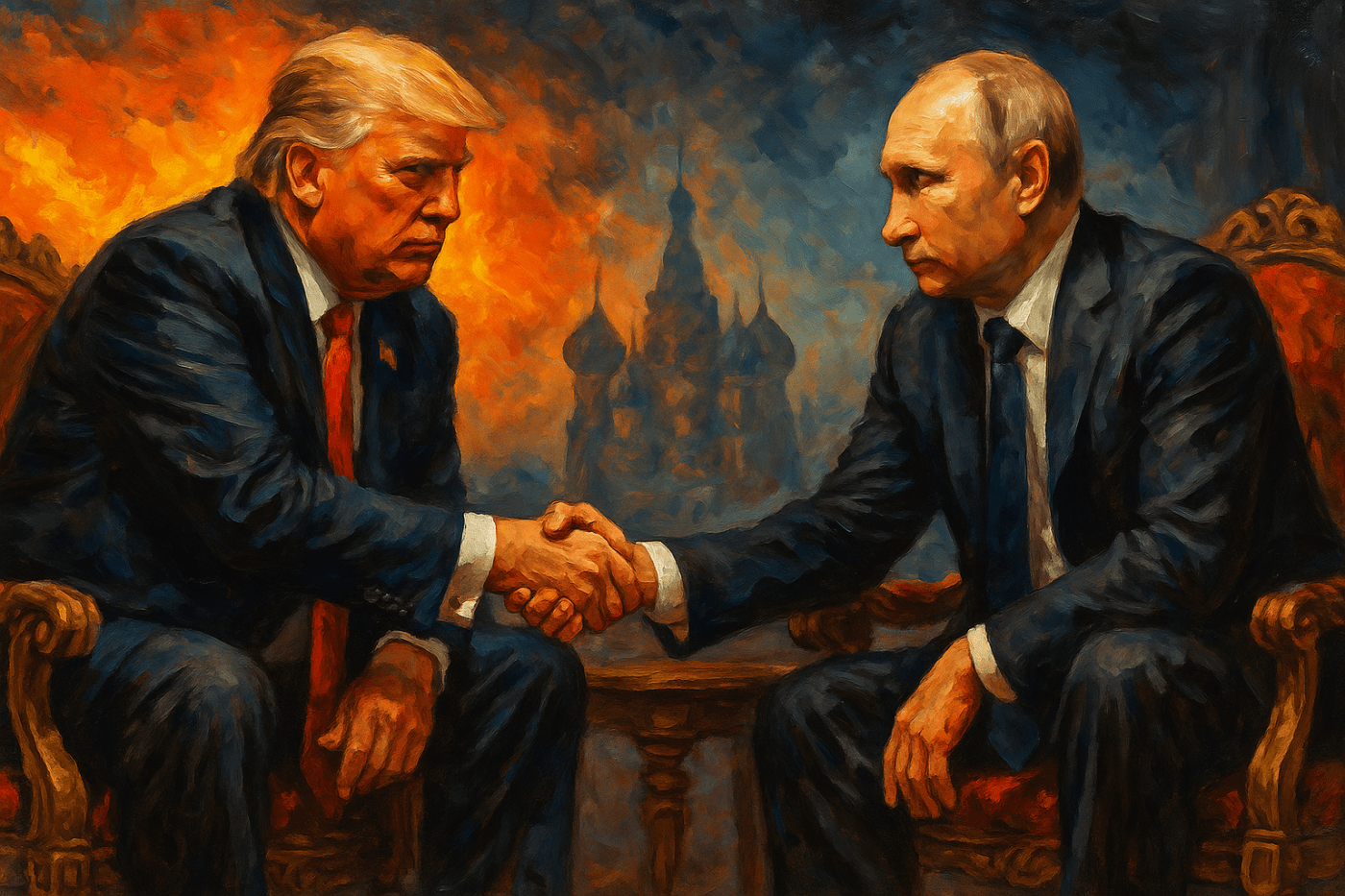
Behind the photo-ops lies a desperate bid to split Russia from multipolarity and contain China.
By Weaponized Information | August 16, 2025
The Summit of Shadows: Excavating Axios’ Narrative Machine
The target under excavation is “Putin made maximalist claims to Ukrainian territory in Trump summit: Sources”, published by Axios on August 16, 2025 and written by Barak Ravid and Dave Lawler. In this piece, the outlet reports that during a summit with Trump, Putin supposedly laid out terms for peace in Ukraine that involved Ukraine withdrawing from certain territories, while Trump briefed Zelensky and European leaders and floated the possibility of a trilateral summit. The narrative unfolds as though Axios were offering its readers a transparent window into the inner workings of high diplomacy, while in reality what they serve up is a carefully staged script where anonymous whispers masquerade as revelation.
Axios, as ever, plays its assigned role within the imperial press corps: laundering the voices of U.S. officials and think tank operatives into a story that pretends to be neutral, yet is soaked in ideology. Ravid and Lawler are not scribes of the people but stenographers of the state, rewarded for their proximity to “sources briefed on the call.” The beneficiaries are obvious: the U.S. foreign policy establishment and its European junior partners, who demand that every mention of Russia be filtered through the lens of aggression, obstinacy, and “maximalist demands.” The amplifiers are the usual chorus—NATO, EU leadership, and Beltway operatives—whose talking points reverberate as though they were facts, while the voices of the working class, the colonized, and even the wider Global South are struck from the record entirely.
What Axios delivers is not reportage but narrative engineering. The article leans heavily on framing tricks: every Russian statement is branded “demand,” “claim,” or “maximalist,” while U.S. and European positions are cast as pragmatic, restrained, and forward-looking. This asymmetry isn’t an accident; it is a device. The language is chosen to criminalize one party while sanitizing the other. The absences are just as telling—there is no acknowledgment of how negotiations might appear from outside the Western bubble, no space for alternative interpretations, no consideration of the material forces driving each actor. Silence, in this article, is weaponized as much as the words on the page.
Emotion is smuggled in through subtle cues. Readers are nudged to sympathize with Trump and his European counterparts who appear beleaguered by Putin’s “conditions.” Putin is presented less as a negotiator and more as an obstinate villain, a figure who must be “handled.” This cartoonish construction, repeated with minor variations, is meant to tap into the collective memory of Western audiences conditioned to view Russia as a perpetual aggressor. In the same breath, Trump is made to appear statesmanlike simply by relaying information—a deliberate inflation of stature for a man who, in reality, is neither author nor architect of global power but a functionary of it.
The piece operates like a psychological operation in miniature. The heavy reliance on anonymous sourcing allows the narrative to float free of accountability, while the repetition of certain words—“demands,” “concessions,” “unlikely breakthrough”—creates a rhythm that seeps into the reader’s perception. It is not analysis; it is a spell. The suggestion that Putin might even countenance China as a guarantor is framed as intrigue, a way to stoke suspicion and anxiety, while the deeper implications are left for readers to imagine, guided by the Western script of threat and menace.
Underlying all of this is a civilizational trope dressed up as diplomacy: the West as responsible custodian of order, Russia as disruptive barbarian. This is the same old tale with new costumes. Legitimacy is never interrogated; it is assumed. The United States and Europe appear automatically entitled to set terms, host summits, and dictate conditions, while Russia’s role is framed as aberrant, presumptuous, even dangerous. By default, the imperial position is coded as “reasonable.” That is how consent is manufactured—not by outright lies, but by narrative scaffolding so consistent that the reader cannot see beyond its frame.
Stripping Down the Claims
Axios lays out the “facts” of the Trump–Putin summit like pre-packaged junk food: bland, hollow, and stripped of substance. We’re told that Putin demanded Ukraine vacate Donetsk and Luhansk and freeze front lines in Kherson and Zaporizhzhia—a gambit that even mainstream outlets documented. Moscow already holds most of these regions. He dangled patches of Sumy and Kharkiv—if only the U.S. rubber-stamp his conquests—and floated China as a guarantor of Ukraine’s security. Trump, grinning like a carnival barker, declared it “great” and pitched a three-way meeting. Reported, yes—but interrogated? Not on Axios’s menu.
But the bones are bare. NATO’s boastful march east? Silent. Yet declassified archives confirm that Western leaders in 1990 gave Gorbachev assurances that NATO would not move eastward—though limited to East Germany—not a broader commitment across Eastern Europe as shown by declassified memos. That frame—call it diplomatic bribery—is scrubbed from Axios’s narrative.
Merkel’s own words could dismantle that fairytale: Minsk 2014 wasn’t about peace—it was about buying time for Kyiv to rearm, she later admitted in no uncertain terms. But Axios pretends the statement never existed. Donetsk and Luhansk’s self-governance since Kyiv’s violent backlash? From Axios’s perspective, pure fiction.
The West’s role in militarizing Ukraine? Vaporized. Since 2014, NATO trainers, weapons, and cash have poured in, turning Kyiv into a forward outpost. Reuters lays it out plainly. Chopping out that history? That’s not journalism—it’s empire washing its own hands.
Meanwhile, Europe’s hostility to Russia isn’t thawing—it’s deepening. EU, UK, and NATO aren’t opening paths to peace—they’re doubling down. Analysts warn Europe must move from sidelines to battlelines, as rearmament surges and unity coalesces behind Ukraine as documented by FT. Sound prudent? No. Sounds like excavation of old wounds.
Trump, meanwhile, is betting on bold chaos. He openly mused about a “reverse Nixon” approach—splitting Russia from China to fracture their alignment as explored in The Atlantic. Machiavellian—or just desperate? It’s a play, in a wounded empire’s script.
And then there are the sanctions—industrial-grade. The EU’s 18th package slashed the oil price cap to $47.60 per barrel, targeted Russia’s energy and financial lifeblood, and hit over 105 shadow-fleet vessels as reported by Reuters. This is economic warfare, not window dressing.
Russia didn’t just endure—it recalibrated. Moscow pivoted hard south and east. Across Africa, it’s reviving Cold War ties; in Latin America, it’s brokering pipelines and arms deals; in Asia, it’s reshaping narratives—all part of a “multipolar gambit” to erode Western domination analysis makes clear.
Stitch those truths—NATO’s broken promises, Europe’s rearmament, Western militarization, sanctions that bite, and Russia’s global pivot—back into the frame, and Axios’s cartoon pops. This isn’t two strongmen jousting. It’s a sprawling act of empire collapsing and evolving. Mask off: the hunger for control is systemic—and unstoppable.
When Empire Stumbles, Multipolarity Advances
Once the smoke of propaganda clears, the outline becomes obvious: the United States is trapped in a crisis of imperialism. Its long attempt to dominate Eurasia—through NATO expansion, through the weaponization of sanctions, through hybrid war dressed up as “democracy promotion”—has backfired. Far from breaking Russia, it has deepened Moscow’s orientation toward Beijing, strengthened BRICS+, and quickened the shift toward multipolarity. The colonial contradiction—the centuries-old practice of looting nations, repressing their sovereignty, and redrawing their borders at will—has come back to haunt the empire itself. Washington cannot admit this openly, so its media build fantasies of leverage it no longer possesses.
What Axios pretends is a magnanimous Trump “deal” is really an act of imperialist recalibration. Unable to win on the battlefield, and facing the erosion of its economic chokeholds, the U.S. ruling class seeks to cut losses and repackage retreat as statesmanship. The carrot on offer is Ukraine: concede ground there in exchange for Russia’s defection from its alliance with China and withdrawal from BRICS+. In other words, Washington is not bargaining for peace—it is bargaining for survival. But there is no sign that Moscow is about to abandon its path. Russia’s whole strategy since 2022 has been one of multipolar recalibration, leveraging hostility from the West to solidify new partnerships across Asia, Africa, and Latin America.
And here lies the fundamental asymmetry that Axios conceals. The U.S. can only dangle sticks and carrots drawn from its collapsing sanctions architecture, promising recognition here or threatening punishment there. Russia, by contrast, holds material leverage: it commands the battlefield in Ukraine, it has energy markets re-routed toward Asia, it has diplomatic cover from BRICS and the Global South. Trump cannot dictate terms because Washington has no real power to dictate anymore. All that is left is theater—the performance of toughness, the posture of strength—while the strategic balance keeps tilting away from the unipolar world.
Russia’s position is not that of an empire trading away spoils, but of a state forging anti-imperialist sovereignty. In the face of sanctions, coups, and blockades, it has doubled down on its right to self-determination and its right to choose alliances beyond the Western orbit. That is why the suggestion of China as guarantor matters so much. It signals that even European security—the jewel of NATO’s crown—may no longer be the private property of Washington and Brussels. A multipolar peace is on the table, and it is the empire, not Russia, that finds itself cornered by history.
This reframing puts the lie to the narrative of a reckless Putin dragging the world into chaos. In reality, it is Washington that has thrown the world into chaos by refusing to accept limits, by insisting on absolute supremacy even as its grip slips. The so-called “peace process” is not about Ukraine’s sovereignty—it is about the empire’s desperation to peel Russia away from China, to break the backbone of the BRICS project, to preserve a vanishing unipolarity. That effort has failed. The facts on the ground, and the alliances in formation, make it clear: Russia has more to gain from multipolar solidarity than from cutting deals with a declining hegemon.
For the global working class and the colonized peoples, this moment is instructive. It shows that empire can be forced into concessions, not by sweet words or appeals to international law, but by the hard power of resistance, solidarity, and recalibration. It shows that hyper-imperialism—with all its sanctions, coups, media hysteria, and proxy wars—is not invincible. And it shows that when multipolarity advances, new cracks open in the armor of domination. The task for revolutionaries in the Global North is not to cheer for Trump’s “deals,” but to seize upon this weakening of empire to build movements that refuse its logic altogether. History is not written in Axios headlines; it is written in the struggle of peoples who refuse to kneel.
Turning the Fault Lines Into Frontlines
If Part I showed us the propaganda, Part II the buried facts, and Part III the larger imperial context, then Part IV must be a call to act. The so-called “peace summit” is not peace at all—it is preparation for a new Cold War, aimed squarely at Russia, China, and the entire multipolar movement that refuses U.S. domination. The working class, the colonized nations, the BRICS bloc, and socialist revolutionaries across the Global North have no choice but to answer this escalation with organization, clarity, and struggle. Because what Axios politely calls “recalibration” is really Washington plotting to tighten the chains of empire, and if we leave those chains unchallenged, they will bind us all.
The resistance is already alive. Across Africa and Latin America, governments and popular movements are rejecting IMF austerity, dollar hegemony, and NATO’s endless wars. In Europe, dockworkers have blocked arms shipments to Israel, and farmers are revolting against an economy rigged for the benefit of corporate monopolies. In the U.S. itself, rank-and-file workers—from auto plants to Amazon warehouses—are fighting for dignity against billionaire bosses who bankroll imperial wars abroad. These are not scattered sparks but pieces of the same fire: the refusal of the world’s majority to die quietly for the survival of a collapsing empire.
The multipolar project gives these struggles an anchor. BRICS+ has opened a path toward new trade, new currencies, and new forms of South-South cooperation. Russia and China are not merely defending themselves; they are helping to create space for the rest of the Global South to breathe. The task for us, in the heart of empire, is to link our fights for higher wages, for housing, for climate survival, to this global refusal of imperial domination. Every strike against a corporation tied to military production, every blockade of weapons shipments, every solidarity campaign with Palestine, Cuba, Venezuela, or the Donbas is a strike against the machinery of a new Cold War.
Concrete tactics grow directly from this contradiction. Workers in logistics can choke the supply lines of war by refusing to handle weapons shipments, as they have in Italy, Greece, and South Africa. Students can organize teach-ins and occupations to expose how universities are entangled with military contractors and Big Tech’s war machine. Journalists, artists, and guerrilla intellectuals can shatter the manufactured consent of imperialist media by spreading counter-narratives rooted in the struggles of the colonized. Farmers and land defenders can link their fights against agribusiness and ecological destruction to the larger war against imperial extraction. None of this is charity; it is self-defense against a system that treats the whole planet as its battlefield.
We should also recognize and amplify the organizations already fighting this fight: the No Cold War network, anti-NATO coalitions across Europe, Pan-African socialist movements resisting AFRICOM, Indigenous land defenders battling settler-colonial pacification in the Americas, and socialist formations in the U.S. that dare to speak against empire in the belly of the beast. These forces point the way toward a united front—not of empty slogans, but of coordinated campaigns that exploit the fractures in imperial power and expand the space for multipolarity to advance.
The task ahead is not modest. It is to transform the cracks in empire’s armor into openings for revolutionary rupture. That means refusing to let Trump or Biden—or any other manager of empire—sell us on Cold War fairy tales. It means building ties of solidarity that make sanctions unenforceable, coups impossible, and wars unwinnable. It means seizing this moment of imperial decay to demand more than survival: to demand a future organized around justice, sovereignty, and socialism. The new Cold War can be stopped—not by diplomats shuffling papers, but by workers, peasants, and colonized peoples turning every workplace, every street, and every port into a frontline against empire.
 Weaponized Information
Leave a comment