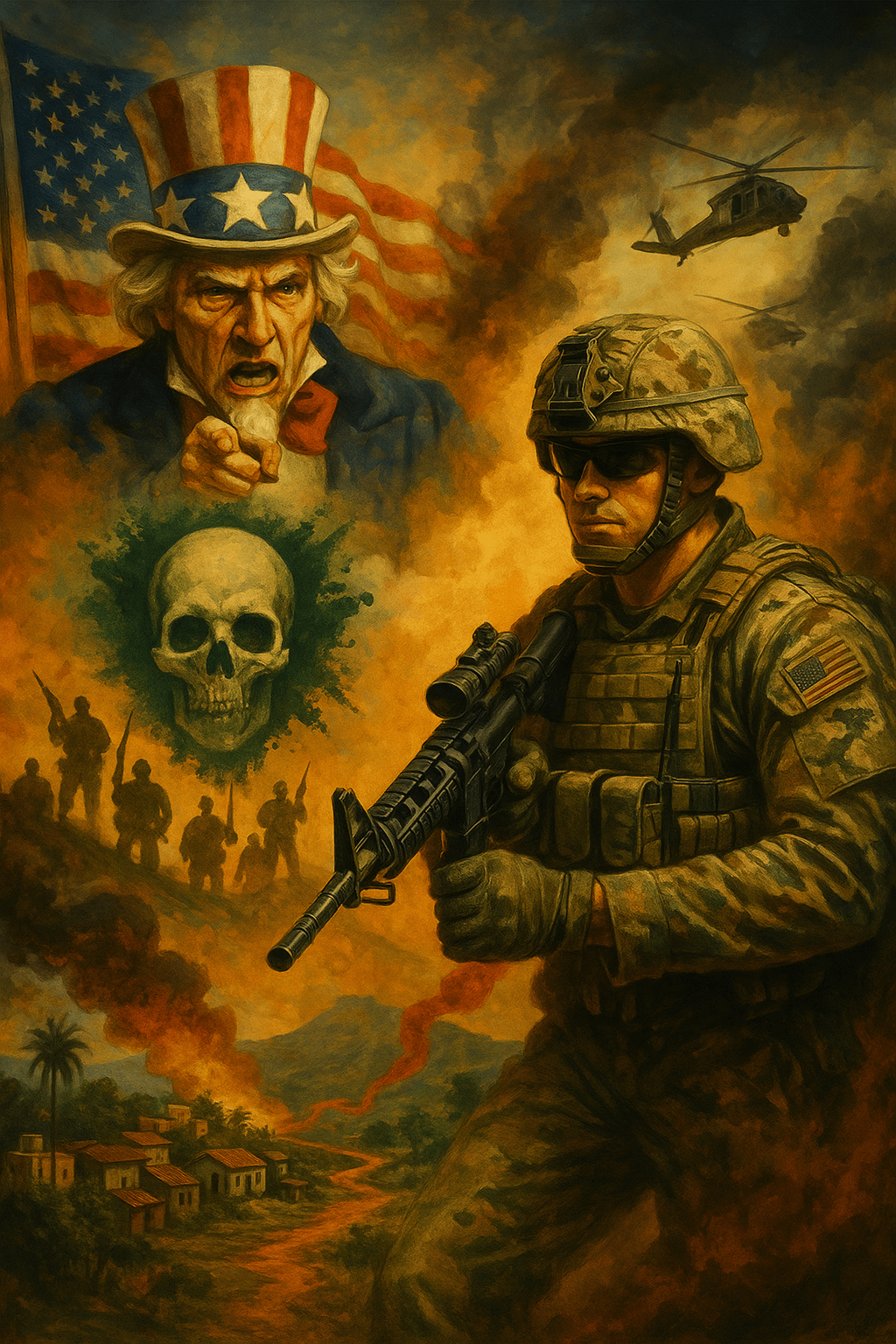
Behind the rhetoric of “fighting cartels” lies a blueprint for military intervention, economic siege, and the reassertion of U.S. imperial control over the Americas.
By Prince Kapone | Weaponized Information | August 9, 2025
Turning the “War on Drugs” into a War on Nations
When an imperial mouthpiece like Deutsche Welle runs a headline announcing that the U.S. president is “eyeing military action” against Latin American cartels, you can almost hear the drumbeat of inevitability. The first paragraph calls it “directing the Pentagon to prepare military plans,” a phrase that quietly shifts the reader from speculation to preparation. The article—dressed in the neutral grey suit of “just reporting the facts”—isn’t really about what’s happening. It’s about what the audience must be trained to accept. The reader is walked, not rushed, from “reports” to “plans,” from “designations” to “operations,” like a slow parade past a line of well-rehearsed talking points. By the time the last quote drops, the idea of U.S. troops crossing another border doesn’t feel like aggression—it feels like housekeeping.
The choreography is textbook. The piece opens with Trump’s vow to “wage war” on drug cartels, immediately reinforced by a quote from the White House spokesperson that his “top priority is protecting the homeland.” This is framing through authority: official voices set the stage, infusing the policy with legitimacy before a single question is asked. Then comes the moral urgency—fentanyl “flooding” American communities—an emotive image designed to trigger fear and demand action. Paired with the notion of “foreign terrorist organizations,” the framing shifts the cartels from criminals to combatants, inviting a military solution as the logical next step.
The enemy is sketched in sharp, faceless strokes: “Mexico’s Sinaloa Cartel,” “Venezuela’s Tren de Aragua,” “the Cartel of the Suns.” The friend is implied: the United States, calm and rational, unburdened by any reflection on its own role in the drug trade or the violence saturating the hemisphere. In this narrative, geography is moralized—danger exists “out there,” safety “over here”—and U.S. power is the bridge that must cross the gap.
Absence is as important as presence. There is no space for the historical roots of the so-called drug crisis, no mention of economic conditions, no examination of the U.S.’s own demand for narcotics, nor of its documented involvement in drug trafficking. The omission is political: by holding the camera steady on podiums and press releases, DW crops out the long shadows of history and imperial policy. In the absence of those shadows, the light seems natural, the set unconstructed.
Then there’s the diction: “coordinate with foreign partners” instead of “deploy troops to a sovereign nation.” “Treat as a national security issue” instead of “declare a new war in Latin America.” These phrases function like anesthetics, numbing the sharp edge of militarism so the audience can swallow it without gagging. It’s not the crass propaganda of a wartime poster—it’s the polite, plausible variety that slides easily into the evening news cycle.
Even the performance of “balance” is carefully staged. Mexican President Claudia Sheinbaum is quoted rejecting any invasion—“our sovereignty is not for sale”—but the framing treats this as a minor procedural disagreement, not a direct challenge to U.S. legitimacy. Her objection is given space, then quickly folded back into the same arc of inevitability. The empire’s right to act is never in question; only the manner of its action is.
By the end, the reader is left with a neatly packaged morality play: on one side, a fortress under siege; on the other, shadowy networks of criminality. The narrative has done its work—the debate is no longer whether armed intervention should happen, but how, when, and with which “partners” at the table. What looked like news was, in truth, an audition for the war to come.
From Narco-Terror to Imperial Pretext: The Architecture Behind the Headlines
The clean, press-friendly language of the article hides a long, tangled history in which the United States has used narcotics policy not to protect people, but to project power. The facts embedded in the DW piece are straightforward enough: the Trump administration has ordered the Pentagon to prepare military plans against Latin American cartels designated as “foreign terrorist organizations,” including Mexico’s Sinaloa Cartel and Venezuela’s Tren de Aragua. Potential measures on the table range from special forces operations and strike options to intelligence coordination with “partners.” The official line is one of national security and public health—fentanyl as the latest enemy at the gates.
But to understand what this means in practice, we have to situate it within a broader architecture of U.S. intervention in the hemisphere. The legal shift from “drug traffickers” to “terrorist organizations” is not a minor semantic change—it expands the operational toolkit. An FTO label triggers the 18 U.S.C. §2339B “material support” regime, immigration bars and related consequences outlined by the State Department’s FTO framework and EO 13224 financial sanctions, and broader sanctions authorities under the International Emergency Economic Powers Act. In parallel, the administration’s policy discussion has explicitly included military strike options while building out interagency and partner “coordination” structures.
That history is drenched in hypocrisy. In the 1980s, while Reagan officials were thundering about the dangers of cocaine, the CIA was implicated by its own Inspector General in connections to Contra-linked traffickers; the Justice Department also reviewed the controversy in a special report. Investigative reporting—most famously Gary Webb’s Dark Alliance—and the U.S. Senate’s “Kerry Committee” findings documented “substantial evidence” of drug smuggling by the CIA and Contra-linked actors and U.S. funds reaching traffickers. The drugs served as a form of chemical counterinsurgency at home, and a revenue stream for counterrevolution abroad.
Internationally, anti-narcotics operations have consistently been deployed against political movements and governments that challenge U.S. interests. Plan Colombia fused counter-drug and counterinsurgency missions, targeting not only cartels but also insurgents and rural movements; the conflict has contributed to millions of internally displaced people. In Mexico, the Mérida Initiative bound security forces to U.S. intelligence structures even as violence soared; Congress’ own researchers note homicide rates tripled from 2007 to 2023 despite Mérida.
Alongside direct military operations, Washington has refined a parallel strategy: lawfare. Across Latin America, judicial systems have been weaponized to sideline or remove leaders aligned with anti-imperialist or redistributive politics. In Paraguay, Fernando Lugo was ousted via an “express impeachment” in 2012. In Brazil, Lula da Silva’s convictions were annulled in 2021 and the UN rights office later found due-process violations in his case (OHCHR). Peru’s Pedro Castillo was removed and jailed in 2022. Ecuador’s Rafael Correa has lived in exile in Belgium after a 2020 in-absentia conviction. These campaigns intersect with U.S. agencies: Venezuela and Bolivia, for example, expelled the DEA in 2008 amid accusations of political meddling (which Washington denied).
Overlaying it all is the machinery of economic warfare. Cuba, Venezuela, and Nicaragua are locked under escalating U.S. sanctions regimes—denying access to finance, blocking trade, and freezing assets. In Venezuela, sanctions targeting the oil sector—e.g., the 2019 PDVSA designation—have been criticized by a UN Special Rapporteur for severe humanitarian impacts (OHCHR). In Cuba, Washington has escalated pressure on the island’s medical brigades and urged countries to end such contracts as alleged “trafficking.” These measures help generate the very instability later used to justify intervention.
The current “narco-terror” designations slot seamlessly into this established playbook. They create a legal bridge between the War on Drugs, the War on Terror, and hemispheric regime-change strategies. U.S. Southern Command already treats Latin America as a unified strategic theater, where counter-narcotics missions sit inside great-power competition with China and Russia—explicit in the 2025 posture statement to Congress. In that light, the Pentagon’s new plans are not an isolated response to fentanyl—they are another instrument in the imperial toolkit, calibrated for the next round of pressure on states and movements that refuse to fall in line.
From the Colonial Contradiction to Imperialist Recalibration
Latin America’s present reality cannot be grasped without starting from its original wound: the colonial contradiction. Centuries of conquest, land theft, and racialized plunder built the foundations of the capitalist world system, slotting the region into an imperial division of labor designed to extract its gold, silver, sugar, oil, copper, soy, and now lithium for the enrichment of distant metropoles. Even after formal independence, the pattern persisted—refined through debt bondage, structural adjustment, and the modern corporate-state nexus that keeps Latin America in a state of chronic underdevelopment or outright maldevelopment. This is not a historical relic. It is the scaffolding of today’s global economy.
Within this architecture, neocolonial extraction is not a bug in the system—it is the system. From the World Bank’s “development” loans to IMF austerity diktats, from transnational agribusiness monopolizing arable land to financial piracy draining national reserves, the region remains locked into a position of subordination. These mechanisms strip away sovereignty under the guise of “integration” and “cooperation,” masking the fact that the very structures of global capitalism were engineered to keep Latin America producing cheap commodities and importing expensive technology. This is the everyday violence of imperialism, administered through contracts, courts, and trade regimes rather than conquistador swords.
And yet, the crisis of imperialism has opened cracks in this edifice. U.S. unipolar dominance is fraying, its economic supremacy challenged, its legitimacy hemorrhaging across the Global South. Following the unwavering example of Cuba’s defiance, a growing bloc of Latin American nations has begun a process of multipolar recalibration—delinking as much as possible from the capitalist-imperialist world order and reorienting toward the emerging poles of power spearheaded by China, Russia, India, Brazil, and others. For Venezuela, Nicaragua, and to a growing extent Bolivia, this shift has not been cosmetic. It has involved building new trade corridors outside the dollar system, forging military and technological partnerships independent of Washington, and reclaiming strategic resources under popular control. These are not yet revolutionary ruptures everywhere, but they are movements toward them, and in some cases—Caracas and Managua most of all—the break has been substantive and sustained.
For U.S. imperialism, this is intolerable. Its answer has been an imperialist recalibration of its own: reasserting control over its so-called “backyard” through the full spectrum of hybrid warfare. Economic blockades are tightened under the bland label of “sanctions.” Lawfare is deployed to criminalize popular leaders, from Lugo in Paraguay to Lula in Brazil, from Correa in Ecuador to Castillo in Peru. Counterinsurgency programs are embedded into police forces, military commands, and intelligence services, ensuring that campesino organizations, Indigenous movements, and militant labor unions are treated as internal enemies. When soft-power sabotage fails, the military option is never far behind—now dressed up in the garb of “counter-narcotics” or “anti-terrorism.”
This is where the current “war on cartels” rhetoric slots neatly into the pattern. The narrative pretends to be about fentanyl, about public safety, about “protecting the homeland.” But to the colonized eye, it is the same old playbook. It is counterinsurgency through chemical warfare—criminalizing and destroying targeted and surplus populations at home, destabilizing insurgent-prone rural areas abroad, and keeping billions in drug profits cycling through Western banks and covert operations. The CIA/Contra era was not an aberration; it was the template. The cartel is simply the updated villain in a script whose true antagonist is any movement that threatens U.S. control over the hemisphere’s political economy.
By reframing the so-called “cartel war” within the long arc of the colonial contradiction, the mask slips. What we see is not a moral crusade against crime, but a strategic effort to preempt the spread of multipolar recalibration and forestall any possibility of revolutionary rupture. Every sanction, every extradition demand, every “joint operation” is a message to the rest of the region: you may have your elections, your flags, your constitutions, but sovereignty will remain theater unless it aligns with the interests of the empire. And when theater is not enough, the boots will follow.
From Solidarity in Words to Solidarity in Action
The hour demands more than sympathy tweets and hollow resolutions. As Washington dresses up its next phase of intervention under the threadbare cloak of a “war on cartels,” the working class, the colonized nations, and the multipolar and revolutionary socialist forces of the global North face a stark choice: either remain spectators while a new imperial offensive ravages Latin America, or move with deliberate speed into material solidarity and coordinated political action. This is not an abstract appeal—it is a call to link arms with the colonized working class, Indigenous nations, campesinos, and the multipolar and revolutionary socialist forces of the South who are already in motion, already fighting for the land, for sovereignty, and for a future free of imperial domination.
Across Latin America, the battle lines are clear. The ALBA Movements coordinate grassroots forces from the Andes to the Caribbean against neoliberal plunder. Brazil’s Movimiento Sin Tierra (MST) mobilizes landless workers in pitched struggle against agribusiness monopolies. In Ecuador, the CONAIE Indigenous federation resists extractivism and IMF austerity. Venezuela’s PSUV and the communal movement defend the Bolivarian Revolution against sanctions and sabotage. Nicaragua’s FSLN builds popular power in defiance of economic siege. In Mexico, the Zapatistas hold autonomous ground against militarization and neoliberal enclosures. Regionally, CELAC works to deepen integration and diplomacy independent of Washington’s control.
In the United States, there are already points of entry for those ready to break from the comfort of imperial complicity. The Black Alliance for Peace stands firmly against U.S. militarism in the Americas and demands an end to the occupation of Haiti. CODEPINK organizes women-led campaigns against sanctions and intervention. The Alliance for Global Justice maintains active ties with Venezuelan, Nicaraguan, and other Latin American movements. The International Committee for Peace, Justice and Dignity defends political prisoners and anti-imperialist struggles. The Task Force on the Americas links U.S. communities with Latin American social movements. School of the Americas Watch confronts the very machinery that trains Latin American militaries in repression.
These are not just allies—they are bridges. By connecting with them, by building study groups, solidarity brigades, direct material aid networks, political education projects, and coordinated actions, the working class of the North can begin to break its isolation from the global struggle. Solidarity means treating Latin America’s fight against the New Drug War 2.0 and economic warfare as our fight—because it is. The same state that militarizes the border, floods U.S. communities with fentanyl hysteria, and cages Black and Brown youth is the one sending troops, agents, and sanctions southward.
The choice before us is historic. Either we join hands across borders to strike at the roots of imperialism, or we allow the ruling class to divide us into jailers and jailed, occupiers and occupied. Let us side with the occupied, the landless, the sanctioned, the blockaded. Let us make the barricades of Caracas, Managua, Chiapas, and Quito our own. The road to a truly liberated future runs through the heart of the Americas—and it demands we start walking together now.
 Weaponized Information
Leave a comment