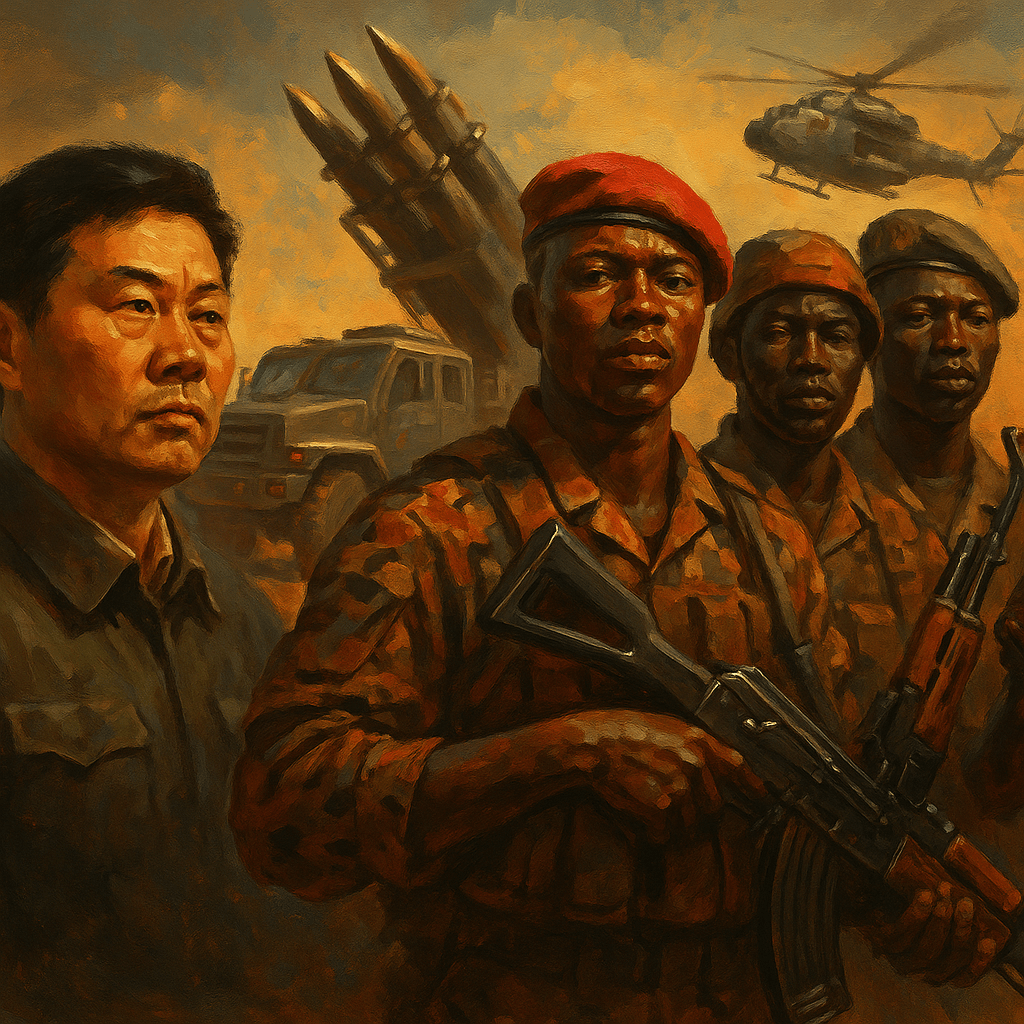
Burkina Faso, Mali, and Niger are breaking from the colonial script — and the multipolar future they’re building is what really keeps Washington awake at night
By Prince Kapone | Weaponized Information | August 9, 2025
I. Through the Barrel of a Narrative
“China Delivers Artillery and Armor to Burkina Faso” by Dylan Malyasov, published in Defence Blog on August 8, 2025, reads like a straight-line transfer of corporate press copy into the bloodstream of the imperial information economy. In three brisk strokes it sketches: a shipment of Chinese-made armored vehicles and artillery has arrived in Burkina Faso; the hardware is named, briefly described, and visually framed via social media snippets; and the acquisition is slotted neatly into a “trend” of African militaries turning to Chinese suppliers. The entire piece is short enough to scan, light enough to float, and heavy enough with subtext to sink any real understanding under the weight of its framing.
Malyasov’s byline is not a neutral credential. His career has been anchored in military-technical reportage that caters to defense industry stakeholders, recycling the idiom of procurement catalogues for an audience of uniformed brass, private contractors, and armchair strategists. This is a class position steeped in the reproduction of Western corporate-military power: a writer who works not as a critical investigator but as an echo chamber for the merchants of war. The outlet itself, Defence Blog, is a self-styled “independent” source whose political economy is welded to defense advertising, investor appetites, and the ideological currents of NATO-aligned strategic culture. It sits in the supply chain of consent manufacture, where clicks are monetized and narratives are standardized.
Names surface in passing — Norinco, TikTok user “issaka114” — along with the silent institutional machinery behind the lens and the ledger: state-owned arms giants, social media distribution channels, and the shadow network of security forums, arms expos, and intelligence-linked defense consultancies that metabolize such images into market signals and policy cues. These actors do not simply “appear” in the story; they are the conduits through which the story is constructed, circulated, and monetized.
The article’s propaganda architecture rests on several interlocking techniques. First, framing by technical fetishism: hardware is presented through specifications and battlefield roles, inviting the reader to marvel at form and function rather than ask why or for whom this machinery exists. Second, absence as inoculation: no political context, no historical texture, no mention of conditions that might explain the procurement — the omission itself serves to pre-empt dissenting interpretation. Third, emotional triggers through spectacle: the visual tableau of “rows of newly delivered equipment” in desert and forest camouflage activates a cinematic imagination of power projection, offering affect without analysis. Fourth, orientalist coding: “African militaries” are portrayed as a homogeneous bloc “diversifying suppliers,” erasing national specificities and casting the continent as a single passive marketplace for global powers. Fifth, legitimacy by trend association: the move is narrated as part of a “broader trend,” naturalizing the act as routine and strategically unremarkable. Sixth, soft-PSYOP laundering: the source material — a TikTok clip — is elevated to evidentiary status without scrutiny, leveraging the virality and informality of social media to launder a message that aligns with industry and geopolitical narratives.
What emerges is not reportage but choreography: a seamless blend of selective description, strategic omission, and subtle affect designed to steer the reader toward a comfortable acceptance of militarization as normal, unremarkable, and perhaps even inevitable.
Steel, Smoke, and the Silences Between
On August 8, 2025, video surfaced showing a large shipment of Chinese-made armored vehicles and artillery systems arriving in Burkina Faso. The cargo included VN22B fire support vehicles, PLL-05 120mm self-propelled gun-mortars, and SR5 multiple rocket launch systems, all painted in both desert and tropical forest camouflage. The video, posted by TikTok user @issaka114, was reportedly filmed at a port facility before the equipment was transported inland.
The VN22B, developed by China’s state-owned Norinco, is designed for rapid mobility and heavy firepower in high-intensity engagements. It is equipped with a turret-mounted cannon and integrated targeting systems suitable for both urban and open-terrain combat. The PLL-05 combines the indirect fire capability of a mortar with the direct-fire punch of a gun, enabling quick shifts between suppressing infantry, breaching fortifications, or engaging lightly armored vehicles. The SR5 GMLRS, also from Norinco, uses a modular launcher that can fire different calibers of guided and unguided rockets, allowing for precision strikes or saturation barrages at varying ranges.
These deliveries are part of a documented pattern in which African states increasingly procure Chinese military hardware. According to the Stockholm International Peace Research Institute (SIPRI), China’s share of Africa’s major arms imports rose from less than 10% in the early 2000s to over 25% in recent years, with Beijing offering competitive pricing, rapid delivery, and fewer political conditions compared to Western suppliers. Burkina Faso reestablished diplomatic relations with China in 2018 after breaking ties with Taiwan, opening the way for deeper defense cooperation.
What the Defence Blog report leaves unsaid is as revealing as what it includes. Burkina Faso has been in open rupture with France since January 2023, when the transitional government demanded the withdrawal of French troops. The country has also faced a decade of armed insurgency linked to groups affiliated with al-Qaeda and ISIS, a conflict that has displaced over 2 million people. In this security vacuum, Western military aid has often come with political strings, while Chinese equipment arrives without the same overt political preconditions.
Historically, the Sahel region’s militarization has been shaped by foreign interventions and training programs. The U.S. established a permanent presence through initiatives like the United States Africa Command (AFRICOM), while France maintained Operation Barkhane until its official end in 2022. These forces framed themselves as counterterrorism actors but operated within the larger architecture of securing resource corridors and political influence. Burkina Faso’s pivot toward Chinese arms signals not just diversification but a rebalancing in the global arms market within a contested geopolitical arena.
This broader context reveals contradictions the Defence Blog piece leaves untouched: the collapse of Western security strategies in the Sahel, the erosion of French neocolonial influence, and the rise of alternative security partnerships that bypass traditional NATO-aligned channels. The arrival of Norinco’s steel is not just a commercial transaction; it is a physical manifestation of shifting alignments in a multipolar arms economy.
From the Colonial Contradiction to Multipolar Recalibration
The heart of this story is not about a weapons shipment; it is about a tectonic shift in the balance of global power. Both China and Burkina Faso are nations struggling, in different historical contexts, to overcome the colonial contradiction — the irreconcilable conflict rooted in the theft of land, the plunder of resources, and the subjugation of peoples that underpins the capitalist-imperialist world system. For centuries, this contradiction has locked African nations into dependency, while the West’s military, financial, and ideological machinery ensured no path out. Now, cracks are appearing in that architecture, and in the Sahel those cracks are widening into fissures.
China’s rise — treated with naked hostility by the predatory West — is not simply an economic phenomenon; it is a geopolitical rupture in the unipolar order. This rise has opened a door for the government of President Ibrahim Traoré, and for Burkina Faso’s partners in the Alliance of Sahel States (Mali and Niger), to chart a different course. That course is best understood as multipolar recalibration: the deliberate reorientation of a nation’s economic, political, and security alignments away from the capitalist-imperialist core and toward the emerging multipolar bloc led by Russia and China. It is a process that begins with breaking the chokehold of Western dependency, but extends into building the material, military, and political capacities to defend sovereignty on new terms.
This recalibration is happening in a historical moment defined by imperialist decay — the systemic collapse of the U.S.-led order under the weight of its own overextension, declining productivity, and mounting global resistance. But decay does not mean retreat. The imperialist core has shifted from open invasions toward the more insidious tactics of hyper-imperialism: a decadent, desperate phase marked by spasmodic militarism, hybrid warfare, and the use of weaponized infrastructure and financial piracy to enforce compliance without direct occupation. Control is now projected through strategic chokepoints — whether in shipping lanes, payment systems, or digital networks — designed to strangle dissenting nations into submission.
In the Sahel, these imperial tactics have failed catastrophically. Decades of Western-backed counterinsurgency, military aid programs, and “capacity-building” projects left behind hollowed-out states, fractured armies, and destabilized societies. The result was not security but a widening zone of ungovernability — precisely the vacuum in which Burkina Faso, Mali, and Niger have now moved to expel French forces, reject Western diktats, and consolidate their own defensive alliance. In turning to China and Russia for arms, training, and logistical cooperation, they are not merely shopping for better deals on the global arms market; they are laying the groundwork for a security doctrine rooted in anti-imperialist sovereignty.
From the standpoint of the international proletariat and peasantry, this moment is rich in contradictions. On one side stands the decaying, desperate imperial order — still armed to the teeth and willing to enforce its will through any means short of outright nuclear war. On the other stands an emergent multipolar bloc, uneven and contradictory in its own right, but offering real cracks in the edifice of imperial control. The task for revolutionaries is to recognize in this realignment not a perfect solution, but an opening: a material shift in global conditions that can be leveraged in the struggle for liberation, socialism, and decolonization. Multipolar recalibration is not the end of the fight; it is the terrain upon which the next battles will be waged.
Joining the Multipolar Future: First Steps for Global North Revolutionaries
The contradictions now in motion in the Sahel are not abstract. They are being confronted head-on by real forces on the ground: the governments of Burkina Faso, Mali, and Niger under the Alliance of Sahel States; the grassroots militias defending villages from armed incursions; trade unions and youth movements agitating for national sovereignty; and regional platforms like the African Continental Free Trade Area being leveraged, however unevenly, toward more independent economic integration. In the wider Global South, we see this same pulse — from Venezuela’s Bolivarian process to Bolivia’s MAS, from Cuba’s socialist resilience to the coordinated resistance of BRICS+ states against dollar domination.
In the Global North, our position is weaker and less organized — but that does not absolve us of responsibility. On the contrary, it demands we start where we are, with modest but deliberate steps, to forge practical and durable links of solidarity with the forces already advancing the fight. The point is not charity, not empty “awareness,” but the slow, disciplined work of building a shared front against the same imperial system that exploits them abroad and exploits us at home.
Here are four concrete avenues of action we can take now:
- Targeted Campaigns Against Imperial Infrastructure: Identify and expose the corporations, banks, and logistics firms profiting from AFRICOM operations, French military contracts, or IMF debt regimes in the Sahel. Launch sustained pressure campaigns — divestment, boycott, and shareholder disruption — aimed at disrupting their political and financial comfort zones.
- Material Solidarity Initiatives: Partner with Sahel-based unions, farmers’ cooperatives, and community defense networks to channel funds, equipment, and technical support on their terms. This is not about exporting our agenda but reinforcing their capacity to defend sovereignty and meet immediate needs.
- Proletarian Cyber Coordination: Build secure digital infrastructure for cross-border collaboration — encrypted channels, mirrored archives, and counter-mapping projects that document imperial military assets and resource chokepoints. Make this intelligence accessible to allies in the Sahel and beyond.
- Political Education and Alignment: Organize regular teach-ins, study circles, and public forums in the Global North to root our movements in a concrete understanding of multipolar recalibration, the colonial contradiction, and the stakes of the Sahel struggle. Use these spaces to recruit, align, and prepare cadres for long-term solidarity work.
None of these steps, taken alone, will topple the imperial order. But each begins to braid our fates together with those already in motion against it. The multipolar future is not a spectator sport — it is being fought for now, in places like Ouagadougou, Bamako, and Niamey. If we in the Global North mean to stand on the right side of history, our task is clear: join that fight in whatever ways our conditions allow, and build the infrastructure of solidarity that will make us worthy partners in the battles to come.
 Weaponized Information
Leave a comment