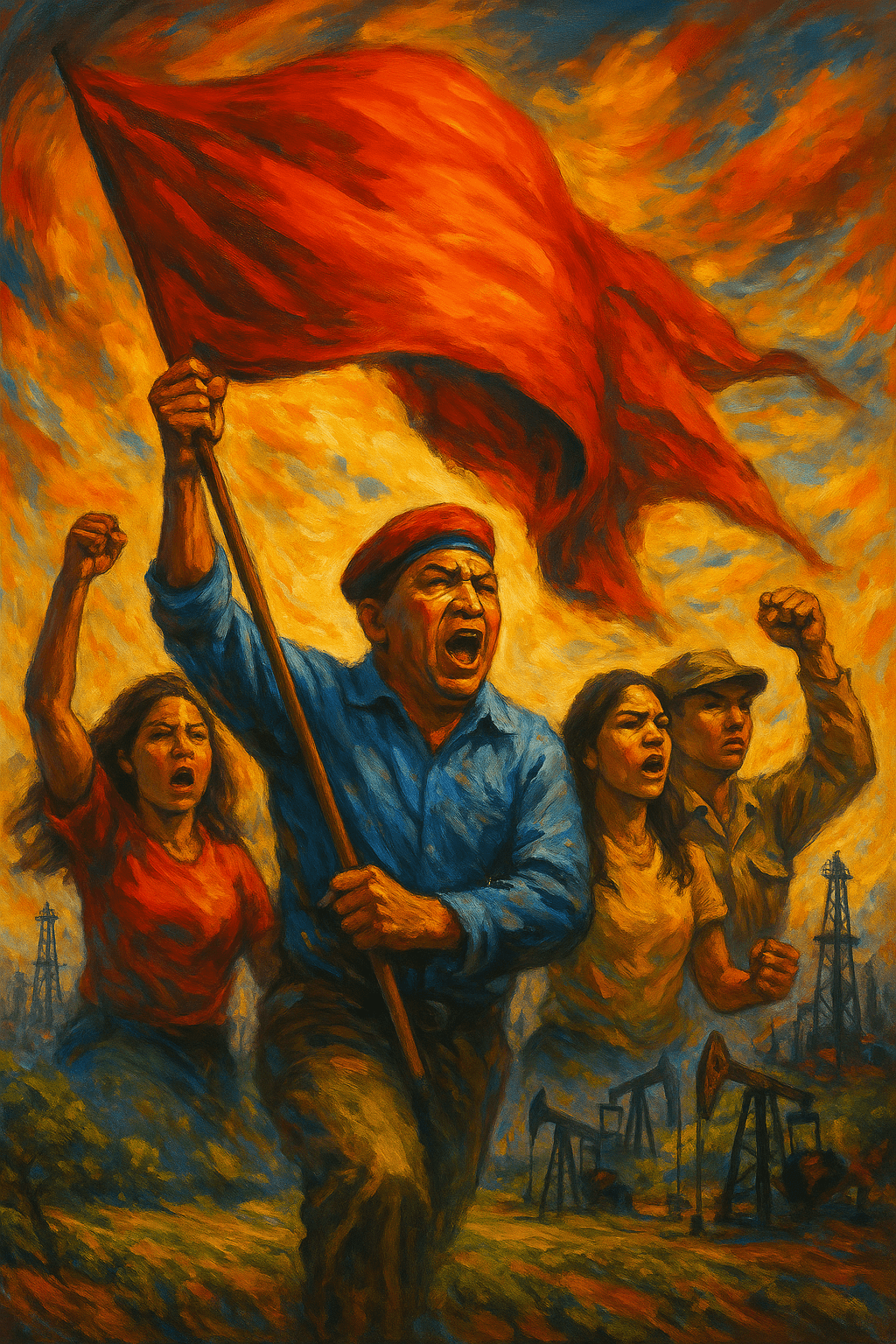
How Venezuela’s 7 Transformations Are Confronting Empire, Constructing Socialism, and Teaching the World to Fight
By Prince Kapone | Weaponized Information
July 31, 2025
Why Venezuela Matters in the Age of Empire and Collapse
At the dawn of the 21st century, when neoliberalism strutted across the globe declaring the end of history, one nation dared to say no. Venezuela—long plundered, long silenced, long ruled by comprador elites—rose up through the voice of Hugo Chávez and declared a Bolivarian Revolution. It was not just a change of government; it was a rupture with the empire’s script. It defied the neoliberal consensus, nationalized strategic sectors, poured oil wealth into housing and health, and dared to speak the word “socialism” without apology. And for that, Venezuela was marked for destruction.
For over two decades now, the U.S. empire—through sanctions, sabotage, coups, media warfare, diplomatic isolation, and economic strangulation—has waged hybrid war against Venezuela. The goal has never been “democracy,” “human rights,” or “reform.” It has always been recolonization. To make an example of a small nation that dared to assert its sovereignty. To show the world what happens when the poor take power.
And yet, the revolution endures. Bloodied, besieged, but unbroken. With every attack, it has learned, adapted, and evolved. Today, under the leadership of President Nicolás Maduro, Venezuela has launched a new phase of revolutionary planning known as the Siete Transformaciones—the Seven Transformations, or 7T. Far from a simple policy package, the 7T represents a comprehensive roadmap to defend, deepen, and consolidate socialism under siege. It is a war plan for survival. A counter-offensive against collapse. A revolutionary theory of development forged in the crucible of crisis.
Each transformation—productive sovereignty, territorial defense, revolutionary peace, socialist welfare, communal power, eco-socialism, and anti-imperialist internationalism—targets a core pillar of capitalist-imperialist domination. Together, they offer a living, breathing blueprint for how to resist empire, rewire the economy, and rebuild society from the ground up. Not in theory, but in practice. Not in abstraction, but in flesh and struggle.
This essay is not just an explanation of the 7T. It is a call to arms. Because if you live in the U.S.—in the belly of the beast—your neutrality is not innocent. It is complicity. Every time you buy gas, pay taxes, or consume media, you are participating—knowingly or not—in a war against people fighting to be free. But you don’t have to be. There is another way. A principled way. A revolutionary way.
To study Venezuela is to study a path out of despair. To defend Venezuela is to defend a front line of global resistance. And to join the struggle from within the empire is not charity—it is historical duty. The world is cracking open. The old order is dying. And a new one is fighting to be born. The only question left is: which side are you on?
The Rentier Wound and the War Against Bread
The revolution begins with bread—not as charity, but as a question of power. Who grows it, who distributes it, who eats, and who starves? In Venezuela, that question has always been haunted by a colonial curse: dependency. For over a century, the country was constructed—not developed—as a rentier state. A monocrop economy dripping in oil, pumping crude to the imperial core while importing almost everything else: food, medicine, machines, even thought. It was textbook dependency theory brought to life—value out, vulnerability in. The bourgeoisie fattened themselves on U.S. dollars; the poor were fed inflation, speculation, and hunger.
Hugo Chávez didn’t just see the problem—he named it. He understood that Venezuela’s economic structure wasn’t flawed; it was functioning exactly as imperialism designed. It was a colony in a petro-state costume. The wealth of the land served the few, while the many begged at the gates of the market. Chávez declared war not on poverty alone, but on the entire colonial logic that made poverty permanent. And in its place, he began to construct something radically different: a sovereign economy rooted in national production, food autonomy, and communal labor. Not “free markets with a conscience,” but socialism with mud on its boots.
This is the heart of the First Transformation in the 7T strategy: a productive revolution that dares to defy the rentier logic in the belly of blockade. After 2015, the U.S. and its European junior partners launched a hybrid war of economic strangulation—freezing assets, blocking trade, sabotaging the currency, and suffocating imports. The goal was simple: starve the people, then blame the revolution. It was siege warfare with spreadsheets instead of tanks. And yet, Venezuela did not fold.
Instead, it dug in. Communes began baking bread, running fish farms, planting cassava, roasting coffee, selling to their neighbors—not as charity, but as survival by self-governance. Cooperative production replaced speculation. Development banks were retooled to serve communal economies instead of crony capitalists. Agricultural collectives reclaimed land long hoarded by the latifundistas. Sanctions didn’t break the revolution—they accelerated its deepening. Under siege, the people began to produce—not despite scarcity, but because of it. This is not resilience—it’s counterattack.
And here in the United States, where supermarkets overflow but wages collapse, where food deserts stretch for miles and corporate farms drown us in poison, the lesson is urgent. Because rentier dependency is not unique to Venezuela—it is the architecture of global capitalism. The U.S. is a rentier empire, surviving off the labor and resources of others, exporting debt and war while importing the world’s suffering. We don’t produce—we extract. And now that system is eating its own children.
That’s why Venezuela matters. Not as a model to be copied, but as a battle to be joined. The fight for productive sovereignty is not a national quirk—it is the shared horizon of every people crushed beneath the weight of an economy designed to bleed them. The Bolivarian Revolution is not just feeding itself—it is showing the world that bread made in struggle tastes like freedom. And that’s a recipe worth learning.
Sovereignty Is Not a Flag—It’s a Fight
The empire taught us to think of sovereignty as a flag on a pole, a national anthem sung before football games, or a president shaking hands at the United Nations. But real sovereignty has nothing to do with symbols and everything to do with power—who owns the land beneath your feet, who controls the data flowing through your wires, who decides what gets built, what gets buried, and who eats. In Venezuela, the Second Transformation is not about patriotic theater; it is about reclaiming control over the material conditions of life. And that, comrades, is a war.
For centuries, Venezuela’s vast riches—oil, gold, gas, water, arable land—were plundered by foreign hands wrapped in white gloves. British banks, U.S. oil companies, Spanish shipping firms, IMF technocrats. The state became little more than a toll booth for transnational capital, while the people remained locked out of the wealth that bled from their soil. Even after formal independence, the colonial leash remained, disguised in treaties, investment contracts, and “development” loans. The Bolívar they celebrated in speeches was not the Bolívar of liberation, but the Bolívar of Wall Street portfolios.
The Bolivarian Revolution called bullshit. Chávez said plainly: you cannot be sovereign if you do not control your resources, your territory, your technology, and your narrative. So they began the long process of recovering what had been stolen. They expropriated oil operations and formed joint ventures with public control. They invested in scientific research, reopened shuttered factories, launched satellites, and defended the education system from neoliberal evisceration. And when ExxonMobil cried foul, Venezuela didn’t flinch. Because if sovereignty is negotiable, it’s already lost.
Now under Maduro, this battle has deepened. The hybrid war waged by the U.S. and its European junior partners isn’t just about regime change—it’s about recolonization. Every sanction, every asset freeze, every seizure of gold or blockade of medicine is aimed at breaking the Venezuelan state’s capacity to function autonomously. Even the recent aggression over the Essequibo region is part of this imperial strategy. Let’s be clear: the Essequibo is not just a border dispute—it’s a resource war wrapped in maps and legalese, backed by Exxon and enforced by the Pentagon. And Venezuela, against all odds, continues to assert its rightful claim to its territory—not because it wants more land, but because it refuses to surrender one more inch of its dignity.
But sovereignty doesn’t stop at territory. The revolution has also sought to reclaim memory. To tell its own story, in its own words, through its own channels. In a world where Google, Meta, and Hollywood rewrite history faster than you can click “skip ad,” controlling narrative is an act of survival. That’s why the Venezuelan people created their own news networks, documentary centers, and community radio stations. Because the truth, like the land, must be defended.
Meanwhile, here in the empire, we are told we are free. We wave flags, chant slogans, and pledge allegiance to corporations. But let’s be honest—what kind of sovereignty do U.S. workers and colonized peoples have? Our infrastructure is privatized. Our data is mined and sold. Our neighborhoods are bought and flipped by BlackRock. Our water is poisoned, our food is synthetic, our histories are erased, and our futures are mortgaged. The only thing we truly “own” is the debt we die in. If Venezuela fights to reclaim what is theirs, we must fight to claim what was never allowed to be ours.
That’s the lesson. Sovereignty is not granted—it is seized. Not by lawyers in suits, but by people in struggle. In Venezuela, it looks like Indigenous land demarcation, grassroots control of infrastructure, and a refusal to bow before the IMF. In the U.S., it might look like abolishing landlord control, fighting corporate surveillance, or building worker co-ops in the shadow of Amazon warehouses. Either way, it begins by rejecting the lie that freedom comes from a ballot or a brand. Real sovereignty begins the moment we say: this land, this story, this life—it’s ours. And we’ll fight like hell to keep it.
Peace Is the Right to Shoot Back
The empire loves to talk about peace. Peace as submission. Peace as surrender. Peace as silence in the face of domination. They want the colonized to lay down arms, close their mouths, forget their ancestors, and accept the bootprint on their neck as the natural order of things. But in Venezuela, the Bolivarian Revolution flipped the script. It declared that peace is not the absence of conflict—it is the presence of justice. And justice, in this world, must be defended.
This is the meaning of the Third Transformation. Revolutionary peace is not a hippie daydream—it’s a material force. It’s the organized capacity of the people to defend their sovereignty, their communes, their bread, their lives. After the U.S.-sponsored coup attempts of 2002, the oil sabotage of 2003, the paramilitary incursions, assassination plots, economic warfare, and fake humanitarian invasions dressed in Red Cross drag, the revolution knew better than to trust the empty promises of imperial diplomacy. They began to arm the people—not just with weapons, but with consciousness.
Today, Venezuela’s defense is not outsourced to some distant, professionalized army. It is grounded in the Bolivarian Militia: millions of workers, students, farmers, elders, and mothers trained to defend their neighborhoods, their communes, their schools. This is not just security—it is popular power in motion. The revolution built communal defense brigades that work in tandem with the military, not subordinate to it. It built logistics networks, food distribution routes, and civilian intelligence systems—all under siege, all under the constant threat of invasion. This is what peace looks like when the wolves are at the door.
Compare that to the U.S., where “peace” means drone strikes abroad and police occupations at home. Where every rebellion is labeled a riot, every resistance is branded a threat, and every poor community is kept “peaceful” by force. The National Guard floods Black neighborhoods faster than FEMA ever did. ICE agents snatch children in the name of “order.” School shootings go unanswered, but protests are tear-gassed within minutes. And through it all, the corporate media repeats the same script: America is a beacon of stability. Stability for who? For Raytheon shareholders?
We have to ask ourselves—what would it mean to build revolutionary peace here? In the barrios of Chicago, the trailer parks of Kentucky, the reservations of Arizona, the housing projects of the Bronx. What would it mean to defend ourselves—not with the isolated violence of desperation, but with the organized strength of a political project? The Black Panthers tried it. The Young Lords tried it. The American Indian Movement tried it. And the state hunted them down like dogs. But Venezuela proves it can be done—and that it can be sustained when the masses are not spectators but participants in their own defense.
The lesson is clear: peace is not granted by oppressors. It is built by the oppressed. It grows in the cracks of empire, under sanctions, under bombs, under censorship. Venezuela is showing us how to fight for it—militantly, collectively, and consciously. Not because they are violent, but because they refuse to be violated. So the next time someone tells you that peace means putting your hands up, remember this: in a world of colonial domination, peace is the right to shoot back—and the duty to organize so you don’t have to.
Welfare Is a Weapon When the Poor Hold the Trigger
The empire calls it charity. The liberals call it aid. The neoliberals call it waste. But in Venezuela, social welfare is not a handout—it is a front line. The Fourth Transformation of the Bolivarian Revolution is not about cushioning capitalism’s cruelty with just enough bread to dull the pain. It is about building an alternative logic: that the wealth of a nation should be measured not by its stock market, but by the health, housing, education, and dignity of its people. That feeding the hungry in a blockade is not just policy—it is defiance.
From the beginning, the revolution understood that you cannot build socialism on an empty stomach. So it launched the Misiones: sweeping programs to eradicate illiteracy, expand healthcare, build public housing, and redistribute food. Barrio Adentro put doctors in the poorest neighborhoods. Misión Vivienda erected millions of homes for working families. The CLAP food distribution system was built to bypass capitalist hoarding and deliver essential goods directly to the people—bread lines without the lines, medicine without the markup.
And then came the siege. After Chávez died, the U.S. ruling class smelled blood. Under Obama and then Trump, the sanctions tightened into a stranglehold. Billions in assets were frozen. Food imports were blocked. Spare parts were denied. International banking systems were weaponized to isolate the country. These were not just “sanctions”—they were acts of economic warfare, designed to generate suffering and then blame the very government under attack. It was textbook siege warfare, but with the IMF instead of catapults.
And still, the people did not starve in silence. They organized. The state, stretched thin, pivoted toward deeper communal integration. Communes took over food production and distribution. Doctors worked without pay. Neighborhoods formed collective kitchens. Students became medics. Farmers sold directly to co-ops. Solidarity replaced scarcity. The revolution, far from collapsing, adapted—and exposed the lie that only capitalism can feed people. In fact, it proved that capitalism can’t.
Now look around you. In the heart of the empire, people die waiting in hospital lobbies. Mothers skip meals so their kids can eat. Homeless encampments grow beside empty luxury condos. One bad illness and you’re bankrupt. One late paycheck and you’re on the street. This isn’t a developing nation under blockade—it’s the richest country in the history of the world. And still, basic survival is treated like a privilege instead of a right. If you want to see who the real “failed state” is, walk through Skid Row.
What Venezuela teaches us is that social welfare is not some Scandinavian luxury—it is class struggle in practice. It is the material embodiment of a government choosing the people over the market. It is a survival program in the face of imperial siege, and a model for what oppressed communities everywhere could begin to build. Abolitionist care, mutual aid networks, community clinics, tenant unions—these are not Band-Aids. They are embryos of a new society, one that dares to say: no one goes hungry, no one sleeps in the cold, no one dies because they are poor.
So let the capitalists sneer about “dependency” and “populism.” Let them pretend that cutting welfare makes people free. The truth is, socialism feeds people—and capitalism starves them. The Bolivarian Revolution is proving this every day, under siege and under pressure. And if they can do it while being choked by the empire, what excuse do we have? Welfare is a weapon. And it’s time we aimed it at the system that keeps us hungry.
Democracy Without Power Is Just Theater
Every four years, the empire tells us we are free. We are handed a ballot with two flavors of oligarchy, told to vote for the lesser evil, and then scolded for not clapping hard enough when nothing changes. This is what they call democracy. But in Venezuela, the Bolivarian Revolution offers something far more dangerous to the ruling class: real power in the hands of the people. The Fifth Transformation is not about reforming the bourgeois state—it is about constructing dual power, brick by brick, commune by commune, until the old order is not reformed, but replaced.
The revolution understands what Marx understood, what Lenin practiced, and what every colonized people who dared to dream of liberation has known: you cannot seize power for the people unless the people are already exercising power themselves. That is why Venezuela did not wait for constitutional amendments or NGO blessings. It built consejos comunales—communal councils rooted in neighborhoods, workplaces, and social missions. These councils didn’t just debate ideas; they managed budgets, oversaw infrastructure, distributed food, resolved conflicts, and developed local economies. They were the embryo of a new state, inside the shell of the old.
Then came the communes—larger formations integrating multiple councils, co-ops, and productive units. These are not symbolic. They are self-governed, planned, and run by the people who live and labor there. They operate on the principle of participatory democracy, not representative theater. Through assemblies, elected spokespeople, and communal parliaments, they decide what gets produced, how it’s distributed, and how disputes are handled. This is what power looks like when it grows from below.
And unlike the U.S. electoral system—which runs on billion-dollar campaigns, lobbyist bribes, and corporate media manipulation—Venezuela is experimenting with mechanisms of direct engagement: the 1×10 system, where each person organizes ten others into collective participation; the Congress of the Historical Bloc, which brings together revolutionary sectors to shape the national horizon; and ongoing referenda, digital feedback loops, and constitutional assemblies. Is it perfect? Of course not. But it is the people’s. And that makes all the difference.
Meanwhile, in the United States, we are ruled by a decaying aristocracy in Silicon Valley and Wall Street drag. Our so-called representatives are owned by banks, war profiteers, and real estate vampires. Our votes are counted, then discounted. Our communities have no budgetary power, no planning agency, no decision-making authority. The state is not ours—it is a police state, a corporate state, a settler state. And deep down, everyone knows it. That’s why voter turnout collapses, trust evaporates, and mass apathy becomes the norm. Democracy without power is just theater—and the curtain has already dropped.
Venezuela’s communal system is not a utopia. It is a battleground—messy, uneven, constantly under threat from within and without. But it is a revolutionary attempt to turn the slogan “power to the people” into an actual structure. And that’s what makes it dangerous. That’s why the empire fears it more than any election. Because if the people can govern themselves in Venezuela, under blockade and hybrid war, then what’s stopping us from doing the same in Detroit, in Oakland, in Appalachia, on Pine Ridge?
We must stop confusing procedure with power. Real democracy is not about casting a vote—it’s about casting off the system that makes you beg for crumbs. The Bolivarian communes are building that system now. And if we’re serious about liberation, we better start building ours. Because no empire in history has ever voted itself out of power. But people have organized themselves out of it—again and again. And they will again.
The Earth Will Not Be Saved by Capitalists
The planet is burning, drowning, choking, melting—and the billionaires are building bunkers. That’s their climate strategy. Not restoration, not justice, not survival for all—but gated ecocide for the rich, collapse for the rest. The same imperial powers that turned the world into a minefield of extraction and pollution now lecture us on “sustainability” while signing oil deals and funding war. But in Venezuela, the Sixth Transformation of the Bolivarian Revolution dares to ask a more dangerous question: what if ecological salvation won’t come from green capitalism, but from eco-socialism—rooted in sovereignty, stewardship, and revolutionary power?
Venezuela is not exempt from contradiction. It is a petrostate struggling to break its own oil dependency while funding its survival with the very resource it seeks to transcend. This is not hypocrisy—it is reality under siege. But within this contradiction, the revolution has carved out a radical horizon: the transition to an ecological civilization that centers Indigenous wisdom, agroecology, reforestation, and communal stewardship. Not as an NGO talking point, but as a living necessity in the face of climate war and economic strangulation.
Misión Árbol has planted millions of trees in the face of deforestation. Communal agricultural projects prioritize sustainable, low-carbon food production for local consumption rather than export profits. Agroecological schools teach campesinos to reject chemical farming and reconnect with ancestral land practices. Environmental brigades patrol natural parks, and Indigenous communities are gaining legal recognition of their territories, not just as symbols of inclusion, but as sovereign actors in planetary defense.
None of this is easy. The revolution is surrounded by extractivist powers, sanctioned by carbon-spewing empires, and besieged by economic warfare that makes ecological planning a daily struggle. But still, they move forward—because the choice is extinction or transformation. Because the Amazon is not just a biome, but a battlefield. Because defending the Orinoco is not a side issue—it is the class struggle in ecological form.
In the Global North, eco-anxiety has become a profitable brand. Tesla sells salvation. Greenwashing is policy. Carbon offsets are indulgences for corporate sinners. But let’s be clear: there is no capitalist transition to ecological sanity. There is no billionaire-backed roadmap to a livable planet. The same system that enslaved Africans, massacred Indigenous nations, and colonized continents now promises to “decarbonize” through electric cars and AI. It’s a scam—an expensive one. And the earth will not survive it.
What Venezuela reminds us is that ecology without class is just gardening. Environmentalism without anti-imperialism is just green imperialism. If we want to survive the century, we need to build systems that do not depend on war, debt, or extraction to function. We need a civilization where land is sacred, not collateral; where the forest is protected, not privatized; where human beings are stewards, not shareholders.
Standing Rock taught us that water is life. Appalachia reminds us that coal is death. Flint shows us what capitalism does to rivers. The Bolivarian Revolution is trying, in its own soil, to rewrite that story. Not with purity, but with struggle. Not with slogans, but with reforested hills, agroecological communes, and climate policy shaped by the poor. If we’re serious about climate justice, we cannot just demand solar panels—we must demand socialism. Because the earth will not be saved by capitalists. It will be saved by those they tried to bury.
Multipolarity Is the Weapon of the Weak
Washington calls it a threat. The media calls it chaos. The think tanks call it destabilization. But for the vast majority of humanity—for the global poor, the colonized nations, the sanctioned, the invaded, the looted—this thing they fear has another name: hope. The rise of a multipolar world is not a disruption to the so-called rules-based order; it is the refusal to keep dying under its boots. And at the front lines of this rebellion, bleeding and fighting with stubborn dignity, stands Venezuela.
The Seventh Transformation of the Bolivarian Revolution is not a diplomatic side quest. It is a central battlefield: the arena where sovereignty is defended, trade is liberated, and imperial isolation is shattered. After being cast out by the U.S. and Europe—banned from SWIFT, sanctioned into economic warfare, robbed of gold reserves, slandered by media cartels—Venezuela turned toward the world’s other half. Not to beg, but to build. Bilateral trade with China and Iran. Oil and medical cooperation with Cuba. Scientific and agricultural collaboration with Russia. South-South solidarity with ALBA, CELAC, and BRICS+. This is not charity—it is counter-hegemony.
And make no mistake: the empire knows it. That’s why the U.S. calls every sovereign government an “authoritarian regime.” That’s why coups are staged in Bolivia, blockades tightened on Nicaragua, wars prolonged in Syria, and cold war hysteria stoked against China. Because multipolarity isn’t just a geopolitical shift—it’s a class war in international form. It threatens the dollar. It threatens Wall Street. It threatens the ability of the empire to dictate who eats and who starves, who trades and who collapses, who gets IMF credit and who gets color revolutions.
Venezuela didn’t start this war. But it has become one of its most courageous soldiers. And not by accident. Chávez understood that internationalism was not some moral gesture—it was strategic survival. He forged PetroCaribe not to win awards, but to break U.S. oil monopolies. He backed ALBA not just for regional unity, but to create an economic bloc rooted in dignity, not debt. Maduro has continued this under siege, refusing to retreat into isolation or submission. Instead, he has made Venezuela a bridge—between continents, between liberation movements, between the possible and the necessary.
Meanwhile, here in the belly of the beast, we are taught to see multipolarity as a threat to “our interests.” But whose interests? The tech monopolies? The weapons contractors? The fossil fuel executives? Because it’s certainly not the interests of working-class families in Detroit, Jackson, or Oakland who suffer from austerity, surveillance, and militarized police—all funded by the same imperial machine that bombs Yemen and sanctions Caracas. The truth is, the U.S. working class has more in common with the people of Venezuela than with the parasites that rule them both.
Supporting multipolarity is not treason—it is internationalist self-defense. It is the recognition that no people can be free so long as one empire claims the right to rule all others. And Venezuela is proving that rebellion is still possible, that dignity can still speak with a foreign accent, that small nations can still say “no” to empire—and survive.
So let’s be clear: to stand with Venezuela is not to romanticize it. It is to recognize that it fights where many have folded, that it resists where many have sold out. It is to choose the camp of the oppressed, not the comfort of neutrality. Multipolarity is not a slogan—it is the demand that no nation, no matter how rich or violent, has the right to crush another. It is the weapon of the weak—and the weak are rising.
To Defend Venezuela Is to Defend Ourselves
If Venezuela falls, the lesson to the world will be clear: resist the empire, and you will be starved, smeared, sabotaged, and destroyed. That’s the warning shot they’ve tried to fire since Chávez first raised the banner of 21st-century socialism. But two decades later, that shot has misfired. Venezuela, bloodied but unbowed, still stands. And its survival is not just a miracle—it’s a roadmap. The Seven Transformations are not abstract reforms; they are a revolutionary logic of survival, forged in fire, sharpened in struggle, and aimed directly at the heart of imperial domination.
Every one of the 7T’s attacks a vital artery of colonial capitalism: rentier dependency, territorial subordination, military pacification, welfare austerity, liberal fake democracy, ecological collapse, and imperial hegemony. Taken together, they constitute not just a policy agenda—but a weapon. A living system of anti-capitalist resistance in the 21st century. One that must be studied by revolutionaries, defended by internationalists, and supported by all who claim to oppose empire in more than just words.
Because let’s be honest, comrades—what Venezuela is resisting today, we will all face tomorrow. The sanctions, the asset freezes, the disinformation campaigns, the privatizations, the repression, the isolation. They are testing the weapons of economic warfare on Caracas now, so they can use them on Chicago and Cape Town and Calcutta later. The colonial boomerang always comes home. The same financial systems that loot the Global South enforce austerity in the Global North. The same tech monopolies that blacklist Venezuelan media are silencing dissidents here. The same state that funds coups abroad funds cops at home. This isn’t charity—it’s shared destiny.
That’s why defending the Bolivarian Revolution is not just about solidarity—it is self-defense. If we want to live in a world not governed by billionaires, not choked by fossil fuels, not ruled by warlords in suits and diplomats in drag, then we have a duty to defend the frontline experiments in building that world. Venezuela is one of them. Not perfect. Not utopian. But real. Human. Revolutionary. And still alive.
So what do we do from the belly of the beast? We study Venezuela—its victories and contradictions. We expose the lies of our media and call out the cowardice of our institutions. We build solidarity campaigns, host teach-ins, send material aid, amplify Venezuelan voices, pressure our governments, disrupt the imperial consensus, and organize. Most importantly, we reject the silence. Because silence is betrayal—and neutrality, in the face of empire, is complicity.
The future is not written. But Venezuela is showing us how to hold the pen. The question is whether we will pick it up—or keep scribbling in the margins of a system that would rather see us starve than see us free.
 Weaponized Information
Leave a comment