How technofascism enforces capitalist decline through economic siege at home and abroad
By Prince Kapone | Weaponized Information
| July 23, 2025
Of Steel and Chains: The Coercive Logic of Economic Power
In the bedtime stories of capitalism, tariffs are framed as patriotic tools—guardians of domestic industry, defenders of national sovereignty. Sanctions, we’re told, are moral instruments—punishments reserved for rogue regimes and human rights abusers. This is the liberal fairy tale. The reality, as always, is darker and far more functional: tariffs and sanctions are two forms of economic warfare deployed to manage disobedience and secure imperial command.
But while they share purpose, their mechanisms diverge. Sanctions function like siege warfare: direct, centralized, state-administered blockades that cut off access to banking systems, trade routes, or strategic goods. Tariffs, by contrast, operate through the market: raising prices, reshaping supply chains, and burdening populations indirectly. One starves. The other bleeds. Both enforce obedience—but in different tempos, with different tactical vulnerabilities.
The sanction depends on chokepoints—SWIFT, the U.S. dollar, insurance blacklists, shipping lanes. It can sometimes be circumvented through currency alternatives (like China’s CIPS), regional barter systems (as trialed by ALBA or PetroCaribe), or digital payments. Tariffs, more diffuse, demand a different resistance: disruption of logistics, price sabotage, worker slowdowns, counter-import networks, and agitation that targets the ideology of “national interest” itself.
Together, these tools form the skeleton of a new imperial formation—what we must now call technofascism: a fusion of monopoly capital, digital surveillance, and militarized governance designed not to expand capitalism, but to manage its decline. Under technofascism, the goal is no longer to grow productive capacity—it is to administer scarcity, punish deviation, and algorithmically stabilize class rule.
Tariffs and sanctions are thus not anomalies or overreactions. They are the standard operating procedure of a global regime that can no longer extract legitimacy from prosperity. The ruling class, having hollowed out productive industry and financialized itself into crisis, now governs through friction—raising costs, blocking flows, and redirecting blame. Where once it sold dreams, it now distributes anxiety—domestically and abroad.
In the Global South, this means sanctions that starve and isolate. In the imperial core, it means tariffs that inflate prices, deepen precarity, and then brand that suffering as patriotism. The target in both cases is the same: popular sovereignty. The right of nations to develop. The right of workers to live. The right of peoples to resist.
So let us speak clearly. Tariffs are not protective. Sanctions are not punitive. Both are coercive systems of control—one disguised in market rhetoric, the other in moral indignation. One acts slow, the other sharp. One raises grocery bills. The other shuts down hospitals. But both enforce the same logic: empire without prosperity, capitalism without consent.
This is where we begin: with the recognition that the price of bread, the cost of a tractor, or the disappearance of a shipment is not accidental. It is planned. Not by some conspiracy, but by the structural needs of a system that can no longer rule through production or peace. Tariffs and sanctions are not the symptoms of a broken system. They are the architecture of its survival.
To name this is to prepare for what comes next. Because this architecture will not be reformed. It must be broken—by revealing how it functions, where it cracks, and who it serves. And that begins with seeing tariffs not as tools of national renewal, but as internal sanctions for the working class and preemptive strikes against the colonized.
From Protection to Punishment: The Evolution of Tariffs and Sanctions
In the early development of capitalism, tariffs were the favorite child of the rising bourgeoisie. They nurtured domestic production, shielded fragile industries, and allowed national capital to consolidate its grip over labor and land. Sanctions, by contrast, were rare—tools of imperial war or colonial blockade, deployed openly and violently. Their mechanisms were crude, but their purpose was clear: discipline those who refused to join the imperial market on acceptable terms.
But as capitalism matured into its imperial form—monopoly capital, financialized dominance, and global supply chains—these instruments changed function. Tariffs ceased to protect. Sanctions ceased to punish after the fact. Both became mechanisms of strategic enforcement, retooled to manage the contradictions of capitalist overaccumulation and geopolitical resistance.
Tariffs are now levied not to build domestic capacity, but to restructure dependence: to reroute trade away from strategic rivals, punish semi-sovereign producers, and reassert imperial control over industrial flows. Sanctions, once reserved for enemies, are now systematized preconditions for participation in empire. A nation does not need to threaten war to be sanctioned—it need only build its own refinery, process its own lithium, or trade oil in yuan.
This evolution reflects capitalism’s shift from expansion to enforcement. Once capable of creating new markets through production, it now survives by constricting them. Tariffs and sanctions are no longer tools of growth—they are tools of triage. They ration development, not distribute it. They gatekeep autonomy, not encourage it. And above all, they signal to capital where to invest, to labor where to migrate, and to states where to bow.
Yet their operational forms remain distinct. Tariffs work through the price system—raising costs to redirect trade and impose political pain without direct confrontation. Sanctions bypass the market entirely cutting states off from systems of payment, shipping, or banking in one legal stroke. Tariffs can be dodged with subsidies, supply-chain rerouting, or volume scaling. Sanctions often require geopolitical realignment: alternative currencies, sovereign banking, regional barter. These distinctions matter for resistance.
What unites them is their political function: they both secure imperial power by sabotaging alternatives. Whether it’s Venezuela trying to bypass dollar hegemony, or Malaysia building a local semiconductor fab, the response is calibrated economic violence. The offense is not mismanagement. It is self-determination.
And so we see the logic of enforcement everywhere. African agricultural unions are blocked from exporting processed cocoa because “value-added subsidies” violate WTO rules. Argentina’s biodiesel exports are tariffed by the EU while France subsidizes its own agribusiness. Indonesia is penalized for banning raw nickel exports—because retaining minerals for domestic use now counts as “unfair trade.” The playing field isn’t uneven. It’s tilted, mined, and booby-trapped.
This is no accident. It is the infrastructure of a decaying order. Technofascism does not operate through conquest alone. It enforces hierarchies through spreadsheets, tribunals, and blocklists—tools that wear suits but carry clubs. Tariffs and sanctions are just two of those clubs, applied differentially, but with the same purpose: to kill development where it threatens empire, and to mask class war where it threatens consent.
There is no reform path here. Tariffs will not “go back” to their developmental role. Sanctions will not be lifted without political submission. These tools are not broken—they are functioning perfectly. The only question now is how to fracture their enforcement, interrupt their logic, and build the material and ideological infrastructure to replace them.
Global Sanctions, Local Tariffs: Discipline at Every Scale
Empire does not wield its tools evenly. Tariffs and sanctions are not distributed like rainfall—they are deployed like missiles: targeted, selective, and designed to extract compliance through economic dislocation. Across the imperial hierarchy, these instruments are calibrated according to a single principle: discipline the disobedient at every scale.
In the Global South, sanctions function as full-spectrum siege. Entire populations are punished for asserting sovereignty. Build your own refinery (Venezuela), subsidize domestic food production (Zimbabwe), trade oil outside the dollar (Iran)— and you are met not with dialogue, but with embargo. And unlike tariffs, these measures bypass price altogether: they cut off access to the infrastructure of modern life—banks, shipping, insurance, software, spare parts, even data. The goal is collapse by logistics.
In the semi-periphery—countries like South Africa, Brazil, or Indonesia—the instrument of choice is the tariff. These are not the defensive tariffs of industrial adolescence. They are punitive tariffs, deployed when a state climbs too far up the value chain. Ban the export of raw nickel to build your own batteries? Face WTO cases and EU retaliation. Attempt food sovereignty in the face of U.S. grain dumping? Expect a spike in trade penalties. Tariffs here are preemptive sanctions dressed in liberal language.
Even South-South alliances face this logic. BRICS+ may offer a financial alternative to the IMF, but its internal contradictions are clear: Indian capital fears Chinese industrial dominance; Brazilian agribusiness wants export markets, not food sovereignty. Without a revolutionary class orientation, these blocs risk replicating imperial hierarchies under a different flag. Multipolarity without redistribution is simply empire with more vendors.
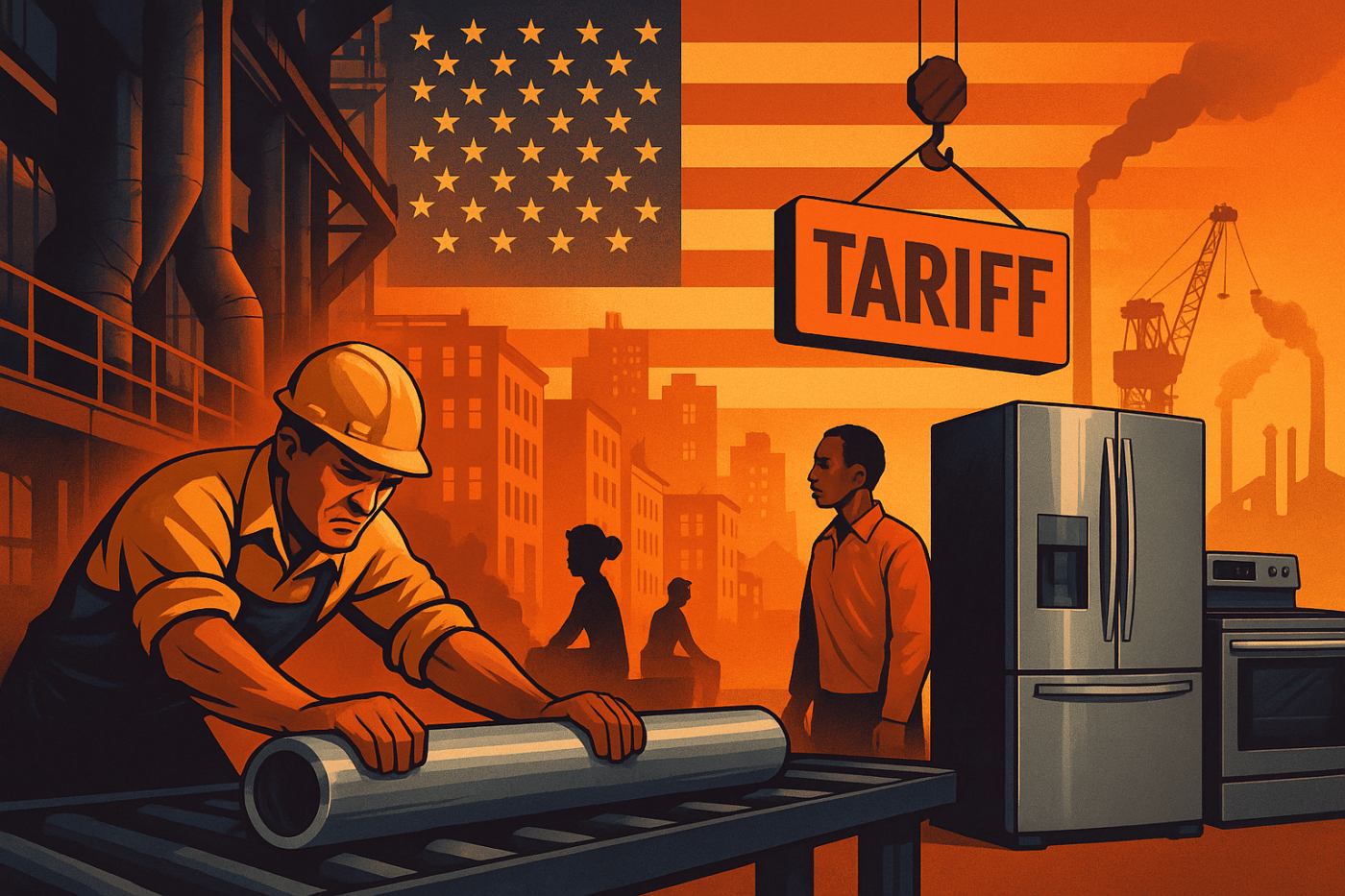
In the imperial core, the method shifts again. Tariffs become political theater, a stage for economic nationalism. Workers in Ohio are told tariffs will “bring back steel.” But what returns is not industry—it is price hikes. In Trump regime 2.0, U.S. steel tariffs added 15–20% to construction input costs. Walmart passes the increase to consumers. Contractors cut labor. The bosses pocket subsidies. But the flags keep waving.
This is where tariffs function as internal sanctions: they discipline labor by raising living costs while performing loyalty to a disappearing industrial order. The real targets are not foreign competitors. The targets are workers—priced out of protest, fed nationalist mythologies, and stripped of bargaining power by economic confusion. Inflation becomes an instrument of social control.
This model works best when it fails. The fewer jobs tariffs restore, the more powerful the resentment they channel. The contradiction deepens: the system creates enemies it cannot defeat, and workers it cannot afford to support—only blame. The result is a nationalism that feeds on its own collapse, with sanctions abroad and inflation at home stitched together by algorithmic propaganda and bipartisan cynicism.
Yet cracks are appearing. Across West Africa, sanctions have failed to reverse revolutionary transitions. In the U.S., young workers are increasingly skeptical of both parties’ economic patriotism. Popular unions are linking inflation to profiteering, not foreign rivals. And despite its contradictions, the Global South is developing counter-infrastructures: bartering networks, bilateral trade in local currencies, and regional supply chains that bypass imperial bottlenecks.
These are not yet alternatives—but they are exits. And in their emergence lies the core strategic question: how do we escalate these cracks into fractures? That question requires understanding not just where sanctions and tariffs hurt—but where they depend. They rely on narrative, logistics, and global over-compliance. Break any one of those, and the architecture begins to wobble.
Tariffs as Sanctions on the Global South: Development Denied
There is a peculiar feature of modern trade: the only development the Global South is allowed is the kind that keeps it dependent. Export coffee, cocoa, lithium, or cotton? No problem. But dare to process, refine, or manufacture, and you will be met not with applause, but with punishment. Tariffs become sanctions—not for failure, but for ambition.
This isn’t conjecture—it’s doctrine. In 2022, the U.S. suspended Ethiopia from AGOA over “human rights concerns,” gutting its textile sector and collapsing 100,000 factory jobs. When Indonesia banned raw nickel exports to develop local battery production, the EU dragged it before the WTO. Haiti tried to feed itself with local rice. Washington responded with “aid”—cheap U.S. grain that annihilated Haitian agriculture. Tariffs enforce what guns once did: dependency.
Behind these actions lies the enforcement infrastructure of imperial trade: WTO arbitration, EU carbon taxes, U.S. Treasury designations, and bilateral “preference” programs that function more like bribes with strings. Nations are told to open markets, privatize utilities, and eliminate subsidies—or face exclusion. The “rules-based order” is not neutral. It is the legal codification of underdevelopment.
This is why we must stop treating tariffs as mere economic instruments. For the Global South, they function as preemptive sanctions: designed to block sovereignty before it takes shape. You do not need to defy empire to be punished. You need only attempt to accumulate outside its architecture. Build your own solar panels? “Anti-dumping.” Process your own oil? “Violation of trade norms.” Nationalize water? “Investor-state dispute.”
Even so-called “partnerships” enforce this logic. U.S. clean energy deals with African states prohibit local battery assembly. The EU’s Global Gateway Initiative offers loans for digital infrastructure—on condition that data flows remain open to European firms. The new scramble for green minerals is merely a decarbonized rebrand of the colonial export model. What’s extracted may change, but who profits remains the same.
South-South frameworks like BRICS+ or RCEP offer potential exit ramps—but they come with contradictions. Without a class-based anchor—sustainable worker-peasant alliance—multipolarity risks reproducing imperial patterns with new bosses in familiar suits.
Still, seeds of resistance grow. Africa’s continental free trade area (AfCFTA) proposes intra-African supply chains that reduce dependence on Western markets. Bolivia has revived its state-led lithium industrialization strategy. West African peasant movements are resisting GMO seed imports and reclaiming food sovereignty. These are not yet ruptures—but they are prototypes.
What these examples show is that resistance to tariff warfare must be economic and political: local production for local use, South-South coordination without elite intermediaries, alternative financial mechanisms (barter, dual currency systems), and movements rooted in the mass base—not technocrats. Because as long as trade remains dominated by imperial gatekeepers, tariffs will continue to function as a velvet blockade: polite, legal, and utterly devastating.
There is no “market correction” coming. The system is calibrated to reward extraction and penalize autonomy. That’s why every effort to climb the value chain—from Burkina Faso’s tractors to Venezuela’s petrocoin—meets not competition, but containment. Development is not forbidden. It is licensed. And empire holds the pen.
Internal Sanctions: Tariffs and the Technofascist Class War at Home
If sanctions are used to starve foreign sovereignty, tariffs are now used to discipline domestic labor. They do not bring jobs home—they bring the crisis home, under the flag of “economic security.” What once was sold as a tool to protect the American worker has become, in practice, a technocratic instrument of internal class warfare, wrapped in red, white, and blue.
The numbers are clear. From 2018 to 2020, Trump-era tariffs on steel, aluminum, washing machines, and other imports raised consumer prices by over $57 billion annually. The costs were passed on—not to Chinese firms or foreign governments—but to renters, food service workers, and tenants trying to buy a refrigerator. In the same period, industrial job growth was statistically negligible. For every “job protected,” thousands more saw their real wages cut by inflation.
This is not a policy failure. It’s a policy design. Tariffs are now used to manufacture scarcity and redirect blame. The American worker is told to fear Chinese labor and Mexican industry, while the true architect of their immiseration—U.S. capital—is quietly subsidized to restructure itself around digital platforms, real estate speculation, and defense contracting.
Meanwhile, as already noted, corporations like Walmart, Amazon, and Home Depot simply pass increased costs down the supply chain. Farmers pay more for fertilizer. Contractors pay more for steel. Tenants pay more for housing. All while profits surge, thanks to monopoly pricing, government subsidies, and deregulation. The ruling class inflates the cost of life and calls it patriotism.
The ideological function of tariffs, then, is not to rebuild national industry—it is to reconstruct legitimacy through spectacle. It allows technocrats and reactionaries alike to posture as defenders of “our economy,” even as they preside over its decay. The working class is not protected. It is pacified—through inflation, culture war, and the illusion of sovereignty.
And just as sanctions abroad require compliance with Western finance, tariffs at home require obedience to domestic austerity. Social services are gutted. Infrastructure is privatized. Wages stagnate. But the flag is flown and the enemy is named—China, Mexico, immigrants, “globalists.” Meanwhile, those most brutalized by this internal sanction regime—Black workers, Indigenous communities, poor whites, precarious migrants—are criminalized or co-opted.
This is the technofascist update to Keynesianism. Instead of public investment, the state now manages class tension through price warfare, debt discipline, and algorithmic nationalism. Instead of mass employment, it offers targeted subsidy, border militarization, and the dream of domestic re-shoring that never arrives. Tariffs become the ration cards of empire in decline—empty promises stapled to empty shelves.
Yet the contradictions mount. Workers see through the lie when their rent spikes. Contractors grow restless as building materials become unaffordable. Small farmers are squeezed between input costs and monopolized distributors. Mutual aid networks emerge to fill the void left by a gutted state. And everywhere, the myth of economic nationalism erodes under the weight of actual bills.
The question is not whether tariffs “worked.” They worked perfectly—for Amazon, Raytheon, Tyson Foods, and BlackRock. The question is whether we continue mistaking these measures as protection, or finally name them for what they are: internal sanctions against a population no longer useful to capital’s reproduction.
To fight this means more than rejecting the rhetoric. It means building a politics that links food prices to trade policy, inflation to monopoly, nationalism to class betrayal. It means organizing the sanctioned inside the imperial core—not as victims, but as a base of rebellion against the system that priced them out of their own future.
The Triage State: Tariffs, Sanctions, and the Management of Imperial Decline
The era of American hegemony is over, but the empire is not. What we are witnessing now is not collapse—it is triage. The United States is no longer able to expand its domination through consent, so it resorts to coercion. Sanctions and tariffs are the tourniquets of a wounded empire, clamping down on dissent and defection, not to heal the system, but to keep it from bleeding out on the operating table.
This is the logic of what we call technofascism: not the goose-stepping of the past, but the seamless fusion of monopoly capital, algorithmic governance, financial warfare, and reactionary spectacle, used to hold together a system in terminal decline. Sanctions enforce obedience abroad. Tariffs manage disorder at home. Together they form the hard shell of imperial retrenchment.
Under technofascism, the function of tariffs has flipped. No longer developmental, they are now punitive—targeted not at competitors, but at potential defectors. A Global South nation that flirts with sovereignty, that seeks to industrialize or nationalize or trade outside the dollar? It receives tariffs first, then sanctions, then color revolutions or drone strikes. Development becomes defiance, and defiance must be punished.
Even so-called allies are not exempt. The European Union is slapped with steel tariffs if it trades with China. India is threatened with sanctions for buying Russian oil. Argentina faces punitive duties if it doesn’t kowtow to IMF diktats. This is not about security—it’s about stratification. The imperial center shrinks. The periphery is policed. The semi-periphery is warned: stay in line, or suffer the same fate as Venezuela.
And inside the core? The population is managed through inflation, repression, and spectacle. Tariffs on consumer goods raise prices. Blame is deflected onto foreign enemies. Subsidies are handed to domestic monopolies. Unions are pacified with patriotism. Dissent is labeled disinformation. The border becomes a stage, the economy a hostage, and the worker a prop in an imperial drama he never wrote—but is forced to perform in.
This is triage, not transformation. The ruling class does not seek to fix capitalism—it seeks to discipline its dysfunctions. To starve the disobedient. To isolate the sick. To amputate the unprofitable. In place of a grand vision, we get algorithmic governance, financial exclusion, and algorithmic nationalism. The future is no longer something to be built. It is something to be withheld—from the many, for the benefit of the few.
This is why the debate over tariffs vs. sanctions is a red herring. They are not opposites. They are not tools of left or right. They are not economic policies. They are weapons of rule in a system whose primary task is no longer growth, but control. And as the empire contracts, the number of targets expands: Burkina Faso, China, Cuba, California, East Palestine, Jackson, Mississippi.
What does this mean for resistance? It means we must stop mistaking technofascist management for national revival. It means we must read every tariff, every sanction, every “Buy American” law as a class offensive—a digital iron curtain meant to separate the colonized from each other, and the working class from its own capacity to rebel.
And above all, it means understanding the stakes. The system is not malfunctioning. It is functioning as designed. And that design is now imperial triage: amputate what resists, stabilize what obeys, and pretend the blood on the floor is someone else’s.
Breaking the Siege: Toward a Revolutionary Horizon
If tariffs and sanctions are the chains, then technofascism is the jailer—and we, the global proletariat and colonized peoples, are the ones bound. But unlike the past, where empires expanded by plunder and promise, this one clings to power by fear and foreclosure. It cannot offer a future. It can only deny one. The question before us is not whether the system can be reformed, but whether it can be replaced before it consumes the earth and its people in the name of “order.”
Tariffs, once sold as the steel frame of national strength, have become blunt instruments of internal austerity. Sanctions, dressed up as moral diplomacy, are nothing more than siege warfare rebranded for Wall Street. And behind both lies a withering empire, desperately seeking to manage decline through coercion. What we are witnessing is not the return of industrial capitalism, but its zombified remains—animated by data centers, armed with drone fleets, and draped in the ragged flag of “American greatness.”
Against this, the resistance cannot be nostalgic. We do not seek to restore a lost golden age of liberal capitalism. We seek to abolish the entire system that made this nightmare possible. That means refusing the trap of left-nationalist delusions. It means rejecting the technocratic lies of Keynesian technocrats who think tariffs can be humanized, or sanctions softened by ethical metrics. There is no ethical way to starve a nation. There is no progressive way to raise the price of bread.
What we need is not policy tinkering but political rupture. Not new managers of empire, but new movements that reject empire altogether. That means building transnational solidarities between workers in Detroit and farmers in Burkina Faso, between striking nurses in the Bronx and engineers in Addis Ababa. It means connecting the dots between a Haitian rice farmer bankrupted by U.S. tariffs and a Midwestern family crushed by inflation from the same system.
It also means reclaiming production—democratizing technology, rebuilding food sovereignty, and breaking the stranglehold of finance over human life. The seeds of resistance are already growing in the cracks: in mutual aid kitchens under sanctions, in strike waves against austerity, in cooperative factories in Argentina, in youth-led uprisings from Oakland to Nairobi. The future has not been defeated. It has simply been blockaded.
To tear down the tariff wall and break the sanction siege is not only to confront imperial power, but to affirm life itself. To insist that the earth belongs to those who work it, not to those who speculate on it. To insist that sovereignty is not a privilege of the West, but the right of every people. To insist that survival is not enough—we want liberation.
And so we return to the beginning. Tariffs and sanctions are not economic anomalies. They are the normal function of a dying empire. They are the tools of a technofascist order trying to survive by managing decay. But the more it tightens its grip, the more we slip through its fingers. From the factories to the favelas, from Gaza to Appalachia, from Havana to the Sahel, the chains are rattling. The siege is fracturing. The future is breaking through.
Let us seize it.


Your content is great! No complaints there. However, your Financial Times references are very expensive. I suggest using Web Archive to link to these articles. Otherwise, for most readers they will remain inaccessible. There may be other similar link problems, but the FT one is what I’ve noticed so far.
Thanks for an interesting website! May I ask, how much of your content is AI-generated?
LikeLike