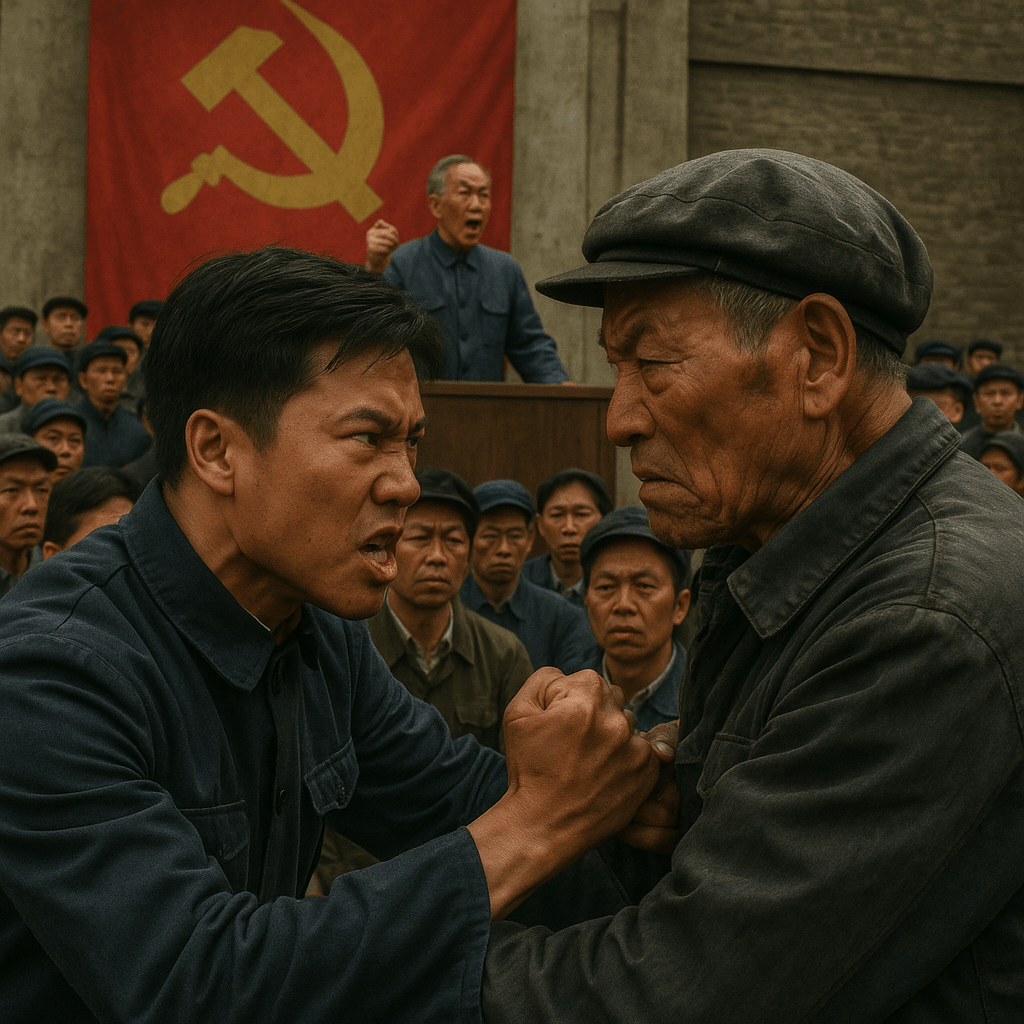
In the wake of socialist victory, Mao sounded the alarm: triumph breeds complacency, and revolution demands method. His 1958 “Sixty Points” was not a plan—it was a weapon. A lesson in how to keep the revolution alive by transforming leadership, confronting contradiction, and placing politics in command.
Weaponized Statesman Series | Mao in Nanning, 1958
By Weaponized Information
July 18, 2025
The Revolution Is Not Done With Us Yet
“Our revolutions come one after another… After a victory, we must at once put forward a new task. In this way, cadres and the masses will forever be filled with revolutionary fervour, instead of conceit.”
There are moments in the life of a revolution when the question is no longer “What must be done?” but rather “How do we keep doing it without losing ourselves?” Mao’s Sixty Points on Working Methods, drafted in the heated terrain of early 1958, was exactly that kind of moment. China had not only survived the gauntlet of feudalism, colonialism, civil war, and capitalist encirclement—it had emerged with its head held high, standing upright on a new foundation: socialist ownership of the means of production, a united and energized proletariat, and an awakened peasantry newly introduced to the power of collectivization. But as Mao made clear in this vast and granular document, the hardest part was just beginning. Victory is not rest. It is the starting line of a far more complex war: one of transformation, not seizure.
With this intervention, Mao is not talking down to the Party or issuing sterile blueprints. He is waging ideological war on the creeping bureaucratism, technocratic complacency, and mechanical thinking that threatened to turn the revolution from a living process into a dead dogma. “Our revolutions come one after another.” This is not poetic flourish—it is a warning. A revolution that does not continue revolutionizing itself becomes the shell of its former self, ripe for reversal. And that reversal doesn’t come wearing a top hat and monocle. It comes dressed in the language of “stability,” “expertise,” and “practicality.” In other words: the whisper of revisionism.
Mao’s “Sixty Points” is not just a list of tasks—it is a call to arms. It is a declaration that every aspect of socialist construction, from fertilizer production to political grammar, must be imbued with revolutionary purpose. And it is here, in this text, that Mao’s method shines: contradiction as the engine of development, disequilibrium as the norm, politics as the commander of all. He insists on learning science—but never without red politics. He demands technological modernization—but never at the expense of the mass line. He calls for decentralization of initiative—but centralization of proletarian leadership.
This isn’t administrative tinkering—it’s an effort to forge a revolutionary state that learns, adapts, struggles, and stays humble before the masses. “Uninterrupted revolution” is not an aesthetic. It is a survival strategy. Not just for China in 1958, but for all of us trying to figure out how to lead without becoming the thing we fought to overthrow.
Red and Expert, or Dead and Irrelevant
“It is beyond any doubt that politics and economy, politics and technology must be unified. This must be so and will forever be so. This is the meaning of ‘red and expert’.”
This single line—sharp as a sickle—is a dagger aimed at two enemies: the apolitical technocrat and the empty-slogan spouting ideologue. Mao refuses both. One treats science as a neutral priesthood; the other chants Marxist slogans like a broken record while remaining completely untethered from the material world. Neither is fit to lead a revolution.
Instead, Mao offers a dialectical synthesis. Politics without expertise is impotent; expertise without politics is dangerous. The revolutionary leader must be both red and expert—rooted in the masses, guided by class analysis, and rigorously engaged in mastering the actual work of building socialism. “The rightists say that we are small intellectuals incapable of leading big intellectuals,” he mocks. Well then, Mao retorts, we will become big intellectuals—by studying science, industry, agriculture, and production until we can lead circles around them.
This is not an indulgence in middle-class meritocracy—it is a line of demarcation. Mao is drawing the boundary between leadership and liberalism, between revolution and managerialism. A Party that cannot direct steel production, manage fertilizer factories, or understand wage systems is not a vanguard—it’s a liability. But a Party that loses its ideological bearings, that forgets who it serves and why, will end up as little more than a ghost haunting the state apparatus.
So Mao attacks the problem from both ends. He insists that political cadres must learn science, not retreat into slogans. But he also slaps the technocrats across the mouth: “To be always preoccupied with business matters—the result will be a disoriented economist or technologist and that is dreadful.” His diagnosis of the disease is prescient. What he’s describing is the very managerial elite that would one day steer entire revolutions back into capitalist servitude under the pretense of pragmatism. The Dengs, the Gorbachevs, the post-revolutionary administrators who mistake spreadsheet mastery for revolutionary insight.
If politics is not the commander, then profit will be. If ideology is not rooted in the masses, then technocracy will take its place. Mao knew this—and his warning echoes louder today than ever, as we stare down the corporate-AI technofascism of the present. A red banner over a silicon cage is still a cage.
Dragging the Middle, Seizing the Extremes
“Seize both ends and drag the middle along with them. This is an excellent method of leadership… Every situation has two ends — the advanced and backward extremes. Once you seize them, the middle can be dragged along with them.”
Here Mao gives us something more than a tactic. He offers a revolutionary principle of motion—one forged not in abstraction but in the dirt and dynamite of class struggle. Where the liberal manager sees the middle as the goal—balance, moderation, centrism—the dialectician sees the middle as the battleground. It is the result, not the starting point. And to shift it, you seize the extremes. You find the most advanced comrades, the most backward sectors, and you engage both directly. That tension, that contradiction, is the engine of transformation.
This isn’t just a fancy method for Party work—it’s how revolutions live. The peasants didn’t rise up in 1949 because conditions were moderate. They rose because their backs were broken and their bellies empty. The Party didn’t guide the people by catering to the mythical “middle ground.” It led by clarifying the poles of struggle—landlords and peasants, imperialism and liberation, feudalism and socialism—and dragging the hesitant toward truth through the power of example and action.
So Mao doesn’t just tell us to observe contradiction—he tells us to grasp it. “This is a dialectical method, too,” he reminds us. That’s not just theory. It’s strategy. Go to the best commune, the worst commune. Study them. Learn. Popularize what works, expose what fails. Use comparison not to judge, but to lead. “A break-through at one point may induce the rest to move.” That’s revolutionary science.
He calls this “the mass-line method of formulating and revising rules and regulations.” And it’s not just procedural. It’s a vision of authority. Power doesn’t flow from above, it circulates through practice. The masses are not passive recipients of orders—they’re the source of new knowledge. Mao demands that cadres descend from their offices, not as tourists but as students. Go down. Investigate. Observe. Don’t issue five-year plans from an air-conditioned ministry. Go see if the irrigation canals are actually built. Go learn if the so-called “model factory” is really producing.
He even mocks bureaucrats with poetic sarcasm: “Although [we] must have a great deal of material at our disposal, [we] present only the representative pieces. [We] must understand that to hold a meeting is not to write a magnum opus.” The revolution doesn’t need more magnum opuses. It needs cadres who can anatomize one or two sparrows, draw lessons from the muck, and lead.
Leadership here isn’t about charisma or rank. It’s about the ability to learn, reflect, and respond materially. When Mao says “comparison applies not only to production and technology, but also to politics,” he’s reminding us that leadership is measurable. Who are the better leaders? Who actually gets results? Not rhetorically. Materially. And if they fail, they should correct. That is proletarian accountability.
All this is an antidote to the bureaucratic rot that would later suffocate so many revolutions. The principle is clear: leadership without investigation is blind; policy without mass experimentation is fiction; and transformation without contradiction is revisionism.
Rectify, Reform, Repeat: Revolution as Self-Criticism
“The rectification must be carried through to the end. The Party as a whole should summon up its energy to get rid of bureaucratism, to come to grips with reality, and to unite with the people.”
This is Mao not as philosopher, not as commander, but as physician—diagnosing the illness of a victorious Party and prescribing a regimen of discipline, humility, and methodical self-repair. He is not crowing about success. He is worried about it. The danger of a revolution is not always in defeat. Sometimes it’s in triumph—when the Party becomes smug, disconnected, or calcified. Rectification, then, is not a seasonal exercise. It is a matter of survival.
“We must not depend on secretaries or ‘back-benchers’ entirely,” Mao warns, poking at the parasitic crust that had begun to form atop the revolutionary base. “Wherever a secretary is unnecessary, there should not be one.” There’s a politics in that simplicity. In the sharp edge of that sentence is the entire spirit of the mass line: do not rule from behind a desk. Get your hands dirty. Write your own reports. Listen to people who disagree with you. “One must patiently listen to the end [of what others say] and consider the divergent views expressed by the lower grades.”
This is not about moral humility. It is about revolutionary leadership. Mao knows that bureaucratism doesn’t just make the Party unpopular—it makes it unfit to rule. A cadre who can’t distinguish nine good fingers from one bad one, who “attacks one or a few points, exaggerates them and ignores the rest,” is not a Marxist. They are a metaphysician. A petty tyrant. A danger to the revolution.
So Mao returns to the fundamentals: “The process of conceptualization, judgment and reasoning are the processes of investigation and study and thinking.” It is not enough to quote Marx. You must think like him. You must approach reality not with dogma, but with the willingness to be wrong—and to correct.
That is why this speech gives such weight to methodology. It insists not only on writing clearly, but writing truthfully. Not only on attending meetings, but running them with material substance. Not only on making decisions, but inspecting whether those decisions are working. These are not management techniques. They are class weapons—meant to keep the revolutionary Party alive in the face of creeping conservatism, elite capture, and internal decay.
And Mao makes the stakes unmistakable: “With new tasks on their shoulders, they are totally preoccupied with the problems for their fulfilment.” That’s the antidote to arrogance. That’s how you keep the people’s faith—not with slogans, but with struggle.
When he proposes to retire from the state presidency, handing off the ceremonial reins to others while focusing on Party work, he does so not as a retreat, but as a statement of line: the revolution is not about position—it is about responsibility. About leadership where it matters. It is an act of political discipline, not ego.
He does not ask to be honored. He asks to be freed to continue the real work. That, comrades, is how a revolutionary leads: by putting the people, the Party, and the process above one’s own titles.
Revolution Is a Process Without Permission
“Our revolutions are like battles. After a victory, we must at once put forward a new task.”
This line should haunt every revolutionary today like a ghost that refuses to sleep. In 1958, Mao was already confronting the reality that victories breed illusions—illusions of permanence, of rest, of the idea that history has somehow reached a safe resting place. He knew better. The revolution, if it is to live, must never stand still. It must never ask permission to move forward. It must never allow its former glories to become fetters on its future tasks.
What Mao mapped out in *Sixty Points* was more than a working method. It was a theory of revolutionary motion. It was a handbook for how to stay alive when your enemies have gone underground, when your allies have become administrators, and when your people are tired. He didn’t offer answers. He offered a system for finding them: through mass investigation, through relentless experimentation, through the unity of red and expert, through the transformation of both the economic base and the superstructure in tandem.
He warned us against metaphysics, against lazy thinking, against the drift into quietism that always threatens once the cheers of victory fade. “The theory of cessation of struggles is sheer metaphysics,” he declared. And he was right. Because even when class enemies are subdued, new contradictions are born in the belly of the new society. The struggle between backward and advanced techniques, the contradictions between leadership and masses, the disequilibrium between theory and practice—these are not aberrations. They are the very terrain of socialism. And if we do not consciously handle them, they will handle us.
And this is where Mao ultimately points beyond himself. The speech closes not with a flourish of authority but with a challenge to collective political intelligence. “The views recorded here are all suggestions. Our comrades should take them back to sound out the cadres. They can be refuted or developed.” This is not modesty—it is dialectics. Mao is saying, in essence: I do not hand down truths. I begin a process. You must carry it forward.
Today, as we suffocate under the digital chains of technofascism, as we face ecological collapse, imperial retrenchment, and capitalist cynicism in its terminal phase, the lesson of Mao’s 1958 intervention is not that we need better management. It’s that we need revolutionaries who study reality like scientists and face it like soldiers. Who speak plainly. Who rectify themselves. Who wage revolution not just against the old world, but against the creeping rot within the new.
Let the final word, then, be Mao’s—not as mantra, but as method:
“Disequilibrium is normal and absolute whereas equilibrium is temporary and relative… The changes into equilibrium or disequilibrium in our national economy consist of the process of an over-all quantitative change and many qualitative changes. After a certain number of years, China will complete a leap by transforming herself from an agrarian to an industrial country. Then she will pick up the process of her quantitative changes again.”
That is not just the plan of a country. It is the dialectical pulse of revolution itself. Leap, then struggle. Leap again. And never stop.
 Weaponized Information
Leave a comment