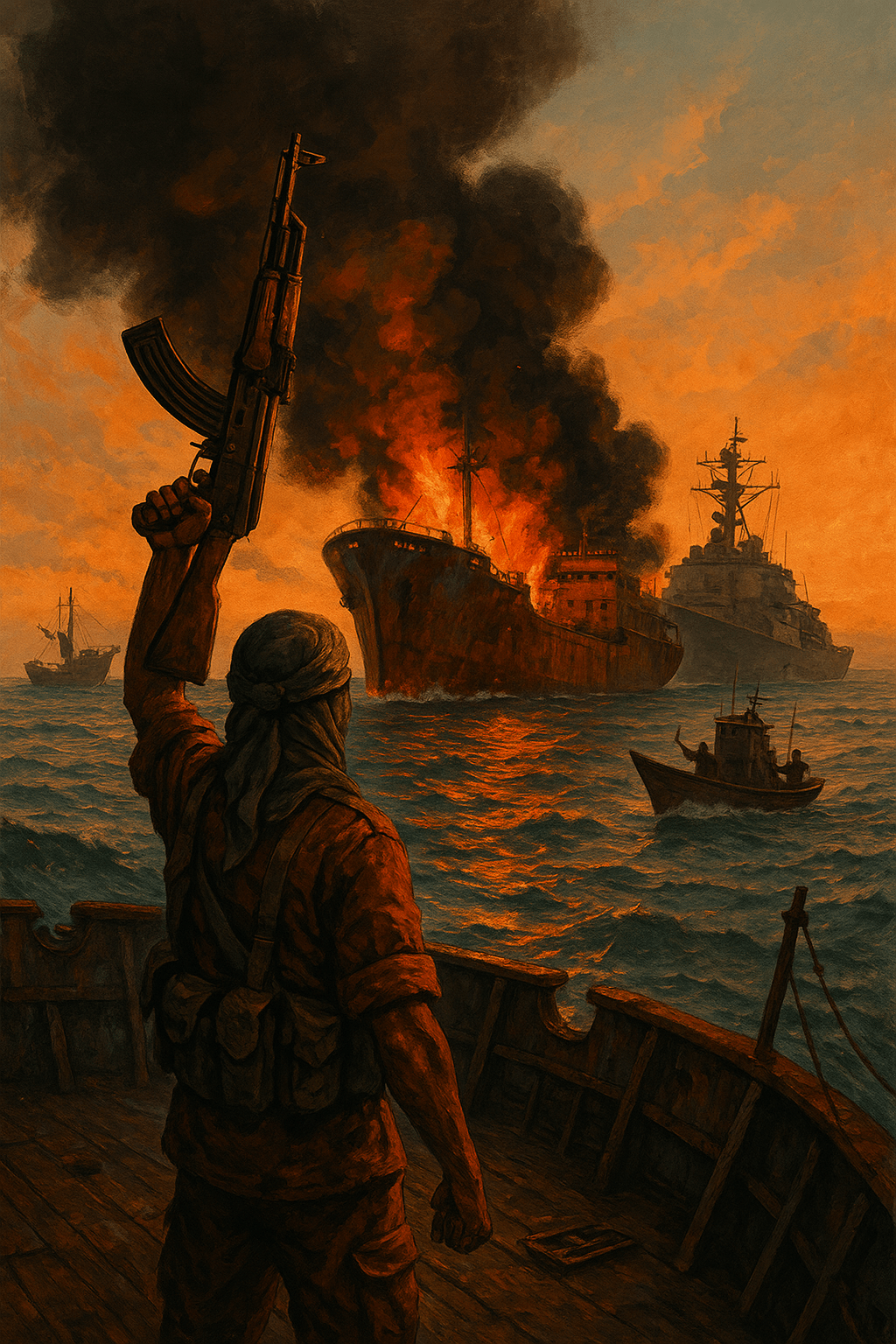
A Telegraph panic dispatch frames Yemen’s maritime resistance as “terrorism,” but the real story is imperial unraveling. Beneath the propaganda lies a decade of siege, blockade, and the legal basis for revolutionary reprisal. Ansar Allah isn’t disrupting trade—they’re enforcing the Genocide Convention with rusted ships and militant clarity. From ports to pension funds, the rest of us must turn every imperial artery into a battlefield of solidarity.
By Prince Kapone | Weaponized Information |
🟥 Ghost Ships and Imperial Spin: AIS Spoofing, Panic, and the Fracturing of Maritime Order
The Telegraph wants you to believe the Red Sea is haunted. Not by Zionist bombs or U.S. warships, but by spectral Yemeni dhows slipping through imperial surveillance nets with spoofed IDs and hidden cargo. The piece, written by Tom Sharpe—former British naval officer turned stenographer for empire—is titled The Houthis are meddling with ship-tracking technology and running rings around the West (July 21, 2025). Its central claim is simple and shrill: Ansar Allah, with help from Iran, are smuggling weapons and spoofing AIS systems to destabilize global shipping, and the West is somehow helpless against it. But what Sharpe is really documenting is not Yemeni cunning. It’s imperial panic.
Let’s start by naming what the article refuses to: these are not “Houthis.” They are Ansar Allah—a revolutionary movement that emerged not from fanaticism but from the wreckage of a state hollowed out by corruption, foreign interference, and a Saudi-led war machine backed by the U.S. and Britain. Their resistance is not criminal. It is historical. It is the only rational response to a decade-long campaign of starvation, blockade, and siege. Yet Sharpe’s framing flips reality on its head: Western domination is portrayed as order, and resistance to it as terror. But from Sana’a’s vantage point, it’s empire that brought the chaos. Ansar Allah is the law that emerges when every other law has collapsed.
Now who is Tom Sharpe? Not a neutral journalist. A former Royal Navy officer with over 25 years of service, including command and spokesman roles, his worldview is shaped by white ships patrolling brown waters, by the presumption that Britain still owns the seas. He has long written for defense-industry-aligned outlets and military think tanks, serving as a columnist for The Daily Telegraph, where he champions surveillance expansion, NATO-led maritime policing, and “freedom of navigation” operations that just happen to protect imperial trade routes. His loyalties are not ambiguous. He doesn’t analyze empire—he defends it. His prose isn’t investigative—it’s a symptom of institutional paranoia. The Telegraph simply gives him the paper to print it on.
And what of the Telegraph itself? It’s not some quaint British broadsheet anymore. It’s owned by RedBird IMI, a media fund backed by the UAE’s sovereign wealth engine. In other words, it’s a Gulf monarchy’s mouthpiece dressed up as Fleet Street journalism. Its editorial line mirrors the imperial priorities of its owners: protect capital, demonize resistance, and wrap colonialism in the language of global security. This isn’t reporting. It’s imperial spin. Its function is ideological hygiene—cleansing the grime of genocide and blockade from the West’s conscience by projecting savagery onto the besieged.
Sharpe’s story is bolstered by the usual chorus: CENTCOM, the U.S. Fifth Fleet, maritime security consultants, Lloyd’s Register—all mouthpieces of empire’s logistical infrastructure. CENTCOM’s July 2025 Red Sea briefing, for instance, warned of “unauthorized navigational disruptions,” which is Pentagon-speak for: someone we don’t control is fighting back. These actors aren’t analyzing risk; they are manufacturing consent for further militarization. They rely on Sharpe and his ilk to turn imperial insecurity into a public crisis.
The mechanics of Sharpe’s propaganda are predictable, but effective. First comes the label: “terrorists.” Not revolutionaries, not resisters, not even militants—just terrorists. That label precludes explanation and invites extermination. Then comes the omission. Nowhere in his article does Sharpe mention the U.S.-armed blockade that has killed over 370,000 Yemenis, mostly through famine and disease. He talks about “nine dead mariners” from vessels “linked to Israel,” painting Ansar Allah as irrational butchers. He writes, “Nine mariners lost their lives after attacks from Houthi forces,” as if these ships were floating daycares, not extensions of a genocidal regime. There is no mention of the International Court of Justice’s ruling that Israel is plausibly committing genocide in Gaza. There is no mention that the only nation disrupting that genocide in material terms is Yemen.
To confuse the issue further, Sharpe reaches for techno-jargon. AIS spoofing, MMSI manipulation—terms meant to evoke mystery and malice, as if Ansar Allah had built a digital war room in the mountains. But AIS is a civilian collision-avoidance system, never designed for long-range policing. Spoofing it is not chaos—it’s adaptation. It’s what you do when every satellite is watching and every port is hostile. Each spoofed ping is a pulse of defiance. Each untraceable vessel is an improvisation born from desperation and brilliance. It is the empire, not the resistance, that cloaks its crimes in euphemisms and satellite feeds.
The most desperate twist in Sharpe’s piece is his comparison of Yemen to Russia. He claims that Yemen “broke the ceasefire” like Moscow allegedly did in the Black Sea, implying that a war-ravaged nation under blockade should be held to the same rules as a nuclear power with global reach. This is colonial logic in a new uniform—demanding that the colonized fight neatly while the colonizers bomb indiscriminately. The comparison is absurd. Russia is a G20 state. Yemen is surviving on rust and resolve.
But perhaps Sharpe’s most telling move is what he leaves unsaid. He never explains why ships are being attacked. He leaves a blank space, one he expects the reader to fill with fear, racism, or resignation. But what he won’t say is what everyone knows: that Ansar Allah publicly declared their intent to target ships linked to Israel in response to genocide. He doesn’t disprove this claim. He simply deletes it. Because to admit it would be to admit that a small, colonized people dared to enforce international law when no one else would. And that terrifies them.
This article is not about security. It’s about legitimacy—and its unraveling. The fear isn’t about fishing boats with antennas. It’s about the collapse of myth. That billion-dollar warships can be outwitted by battered vessels. That imperial supply lines are vulnerable. That resistance is not only justified—it’s working. The real ghost ships are not sailing from Hodeidah. They’re docked in Washington, London, and Tel Aviv—haunted by the realization that the empire they built is no longer untouchable, no longer unquestioned, and no longer alone on the seas.
🟨 Spoofed Signals and Siege Logic: Extracting Facts from the Fog
Tom Sharpe’s article offers a familiar brew of imperial anxiety dressed in technical mystique. But beneath its fog of acronyms and naval metaphors lie several verifiable claims. Stripped of theatrics, here’s what the article asserts:
- Ansar Allah has been spoofing AIS (Automatic Identification System) signals to evade naval detection.
- A 750-ton weapons shipment—allegedly from Iran—was seized by UAE-aligned forces led by Tareq Saleh.
- Yemen violated a ceasefire and used the lull to rearm and prepare further attacks.
These claims are not new. What is new is the narrative architecture built around them—one that omits the context, strips away legality, and buries the underlying causes beneath Cold War metaphors. So let’s fill in what Sharpe deliberately leaves blank.
First, AIS spoofing. The article frames this tactic as digital mischief by dangerous rogues. What it does not tell readers is that AIS was designed solely for collision avoidance under the UN SOLAS Convention—not for enforcement or surveillance. It’s a civilian safety mechanism—a maritime version of headlights. Spoofing it is not sabotage. It is a tactical necessity for any force evading an enemy coalition with warships, satellites, and drone coverage stretching from Djibouti to the Gulf of Aden. If the empire builds a digital panopticon, then deception becomes survival. And Yemen is surviving under siege.
Sharpe never mentions that Yemen has been under a decade-long blockade imposed by Saudi Arabia and the UAE—with weapons, intelligence, and diplomatic cover from the United States and Britain. The blockade has killed over 377,000 people, most from hunger, disease, and preventable medical collapse. Fuel, food, and humanitarian aid were choked off by warships and port inspections. In that reality, spoofing AIS is not a gimmick—it is the last gasp of a besieged people trying to breathe through a system that wants them dead.
As for the 750-ton weapons seizure—Sharpe cites this as evidence of Iranian smuggling, courtesy of the “Yemeni National Resistance Forces.” But he fails to mention that these “forces” are a UAE-backed militia led by Saleh, a warlord whose faction is tied to torture, rape, and enforced disappearances. Al Jazeera reported in 2018 on a network of UAE-run secret prisons across southern Yemen, where detainees were subjected to torture, sexual violence, electric shocks, and suspension by chains—often until they died. The “seizure” of weapons by these forces is not law enforcement—it’s factional monopoly over imperial arms flows. What disappears into their custody rarely sees the light of day.
And what of Iran? UN panel reports have indeed found Iranian-made components in missile debris used by Ansar Allah. But even these same reports admit ambiguity. A 2025 IISS assessment confirms that while the Houthis rely on Iranian imports, their “local manufacturing capacity has expanded significantly,” using dual-use parts and improvised supply chains. What Sharpe portrays as a clean pipeline from Tehran to Hodeidah is in fact a complex patchwork of domestic recomposition. The resistance is not imported—it is built under siege, with circuit boards and scrap metal.
Then there’s the ceasefire. Sharpe accuses Ansar Allah of violating the truce to rearm. But he never tells the reader what that truce was worth, or why it broke. In December 2023, Yemen’s armed forces publicly declared they would target any ship trading with Israel in response to the Zionist genocide in Gaza. A month later, the International Court of Justice ruled that Israel stands plausibly accused of committing genocide and issued binding provisional measures under the Genocide Convention. Under that Convention, every state on Earth is legally obligated to act to prevent and punish such crimes. Yemen is not in violation. Yemen is in compliance. It is the rest of the world that has abdicated responsibility.
And finally, there’s the technical heart of Sharpe’s narrative—AIS spoofing as some uniquely nefarious Yemeni innovation. But this tactic is far from rare. For instance, Russia spoofed AIS to draw fake ship tracks near Crimea in 2023, and broader patterns in the Black Sea date back years. A 2019 C4ADS/WIRED report documents nearly 10,000 GNSS spoofing incidents affecting over 1,300 commercial vessels—often coinciding with high-level political movements. Sharpe’s narrative pretends that only Yemen engages in deception, but that’s sleight of hand. Empire doesn’t hate spoofing. It hates when the wrong side does it.
Most damning of all is what’s missing: motive. Sharpe never tells us why Ansar Allah is attacking ships. He simply invokes chaos, leaves out the context, and trusts the reader to conclude madness. But as Yemen’s armed forces made clear on December 9, 2023: “as long as the aggression against Gaza continues, Israeli ships or ships heading to Israeli ports will be within the range of Yemeni fire.” That is not terrorism. That is public accountability in the absence of global enforcement.
So let’s call this what it is: a war of narratives over who gets to define legality, stability, and violence. In Sharpe’s world, “order” is a system that starves Yemenis and arms Israelis. “Security” is a maritime structure that allows genocide to flow freely while punishing any disruption. “Instability” is when the victims fight back. But if you flip the frame, a very different picture emerges. Yemen is enforcing the law. Spoofed signals and rusted hulls are not evidence of chaos. They are the fingerprints of sovereignty fighting to be recognized on waters once ruled only by capital.
🟧 Revolution at the Bottleneck: Red Sea Resistance and the Crisis of Empire
Empire is built on uninterrupted movement. Oil, weapons, capital, and goods must flow—across oceans, cables, borders—without friction. That movement is called “freedom.” Any attempt to block it is labeled piracy, terrorism, or chaos. But what Ansar Allah has done in the Red Sea is reveal the truth behind the euphemism. They haven’t disrupted peace. They’ve exposed a system that only functions through violence—wrapped in maritime law and escorted by billion-dollar warships. They didn’t break the world order. They showed that it never belonged to us.
The Red Sea has become a rupture point—a crack in the logic of what we call the Imperial Chokepoint Regime. This is the U.S.-led structure that governs the sea lanes of global commerce through naval supremacy, insurance rackets, inspection protocols, and the legal fictions of the so-called “rules-based order.” It’s a system where sovereignty is defined by who can control the water—where legality is decided in London, enforced from Bahrain, and paid for in Riyadh. But that regime is showing signs of stress. Because for the first time in decades, a force from the Global South has turned a chokepoint into a frontline—not with destroyers, but with rusted cargo ships and radio signals.
This is not some spontaneous flash of desperation. It is what we call Revolutionary Asymmetry: the strategy of fighting empire not by matching its force, but by exposing its dependencies. Ansar Allah has made billion-dollar naval coalitions scramble to protect container ships. They’ve turned the empire’s greatest strength—its control over logistics—into its greatest vulnerability. Every spoofed transponder is a rejection of subordination. Every rerouted vessel is a disruption in the bloodstream of capital. The resistance isn’t simply armed—it’s strategic.
And here’s what makes it even more dangerous—for empire. This resistance is not lawless. It is legally grounded in the international framework that the West claims to uphold. Ansar Allah’s actions in the Red Sea are direct reprisals against Israel’s genocidal war on Gaza. Their public declarations cite the Genocide Convention, which obliges all signatories to prevent and punish genocide. They are not fighting in the shadows. They are enforcing the law from below, because no one else will. That is why the West calls it “terrorism.” Not because it’s illegal—but because it’s unauthorized.
What we are witnessing is the emergence of a new kind of sovereignty—not based on recognition from imperial capitals, but rooted in revolutionary legitimacy. Ansar Allah governs. In Sana’a and across large parts of northern Yemen, they tax, distribute aid, maintain local councils, and run civil institutions—all while under siege. That is sovereignty in practice, forged in crisis. It may not look like a Western state, but it functions with a clarity and coherence that shames most governments. And it is this kind of sovereignty—accountable not to capital but to the colonized—that terrifies the ruling class.
The ideological terrain is shifting. For decades, the empire monopolized not just weapons, but meaning. It decided what counted as “security,” who was a “threat,” and what violence was “legitimate.” But in the Red Sea, that monopoly is unraveling. Ansar Allah has stripped the mask off maritime empire and declared that the Global South will no longer abide by laws designed only to protect commerce and punish resistance. This is what we mean by Ideological Hegemony: not just military control, but narrative control. And that control is cracking.
This isn’t happening in a vacuum. From Cuba to Venezuela, from the Sahel to Palestine, we are seeing the re-emergence of a politics that holds empire accountable through action—not speeches. Proletarian Internationalism is not just a slogan anymore. It is being practiced with hulls and hardware, with stolen parts and open declarations. Yemen is not defending its own borders. It is defending Gaza. A stateless people defending another stateless people across borders, without treaties, without diplomats, without permission. That is internationalism with teeth.
And that’s what makes this moment so dangerous—for the empire. Because if Yemen can do it, who else might follow? The idea that resistance can be organized, lawful, and effective—that it can disrupt global trade in defense of the colonized—is an idea that has already crossed the Suez. And no amount of carrier groups or insurance hikes can make that idea disappear.
This is not instability. It is insurgent order. Not chaos—but accountability. Not terrorism—but clarity. The Red Sea is no longer a corridor for conquest. It is a classroom. And Ansar Allah is teaching a lesson the empire hoped we’d never learn: that even the smallest nation, with the fewest tools, can bring global power to its knees—if it fights with precision, with purpose, and with the law of the oppressed.
🟩 Frontlines Everywhere: Weaponizing Solidarity Against the Chokepoint Regime
Ansar Allah didn’t just challenge an empire—they exposed a vulnerability. Their strikes in the Red Sea were not spasms of rage. They were precise, public, and principled. They are the only armed force on Earth actively enforcing the Genocide Convention in response to Israel’s annihilation campaign in Gaza. Not with press releases, but with interdictions. Not with hashtags, but with hulls. They have done what the UN will not, what The Hague dares not, and what the “international community” pretends is someone else’s problem. And now that the myth of imperial invincibility is pierced, we have no excuse for inaction. It’s time to open new chokepoints—from within.
The first front is divestment at scale. We must identify and dismantle the financial arteries of genocide. Take the University of California system: it currently holds over $32 billion in assets tied to weapons manufacturers, including Lockheed Martin, RTX (Raytheon), BAE Systems, and Elbit Systems—each a direct supplier to Israel’s military apparatus. Launch campaigns targeting key regents like John A. Pérez, Chair of the UC Board of Regents Investment Committee. Expose their complicity. Demand divestment. Disrupt their meetings. If Yemen can make genocide expensive at sea, we can make it unprofitable on land.
The second front is proletarian cyber resistance. Use open-source tools like MarineTraffic, VesselFinder, and AIS Explorer to identify ships tied to Israeli trade. Add ShipXplorer to the stack. Track AIS signals. Map port entries. Build real-time alert systems for unionized dockworkers and maritime solidarity networks. Use public data to wage logistical disruption. We don’t need drones or dhows—we need coordination, data, and class loyalty.
The third front is media infrastructure for anti-imperialist resistance. Outlets like Al Mayadeen, Press TV, and Al Masirah broadcast from inside the storm—covering Gaza and Yemen in real time, without apology. But they face constant cyberattacks, financial bans, and algorithmic erasure. We must defend them. Build peer-to-peer backup networks. Translate their content. Host mirror sites. Run crypto-based donation drives. Make them unkillable. If media is a battlefield, these are our comrades on the front.
The fourth front is popular education rooted in maritime class warfare. Teach that “freedom of navigation” means freedom for capital, not people. Build workshops that connect the genocide in Gaza to shipping lanes, ports, and logistics hubs in Norfolk, Rotterdam, Haifa, and Djibouti. Explain that every fiber-optic cable and fuel shipment is a potential lever for global struggle. Turn classrooms into command centers. Every port is a chokepoint. Every student is a combatant-in-waiting.
And the fifth front—our new example—is dockworker resistance from below. In December 2024, port workers in Rotterdam—Europe’s largest seaport—refused to unload two vessels linked to Israeli arms trade. Backed by the BDS movement, they halted over $50 million in shipments. No state ordered it. No NGO facilitated it. It was organized labor, standing with Palestine, stopping genocide with their bodies and their refusal. That’s the model. That’s the precedent. That’s our job now.
So this is not just about Yemen. This is about us. The empire’s violence is funded through our pensions, policed through our ports, and broadcast through our algorithms. Every institution we live inside—university, bank, platform, union—has a pressure point. And every pressure point can become a chokepoint. What we lack is not access. It’s will. Yemen showed us that even rusted ships can disable imperial arteries. What are we doing with our fiber optics, our spreadsheets, our passcodes, our positions?
The time for symbolic outrage is over. This is the age of friction. The age of leverage. Of making occupation unprofitable and genocide uninsurable. Proletarian internationalism is no longer an aspiration—it’s a job description. So let us become chokepoints. Let us build our own ghost fleet. In code. In ports. In data. In the streets. The empire is hemorrhaging legitimacy. Let’s finish the breach.
 Weaponized Information
Leave a comment