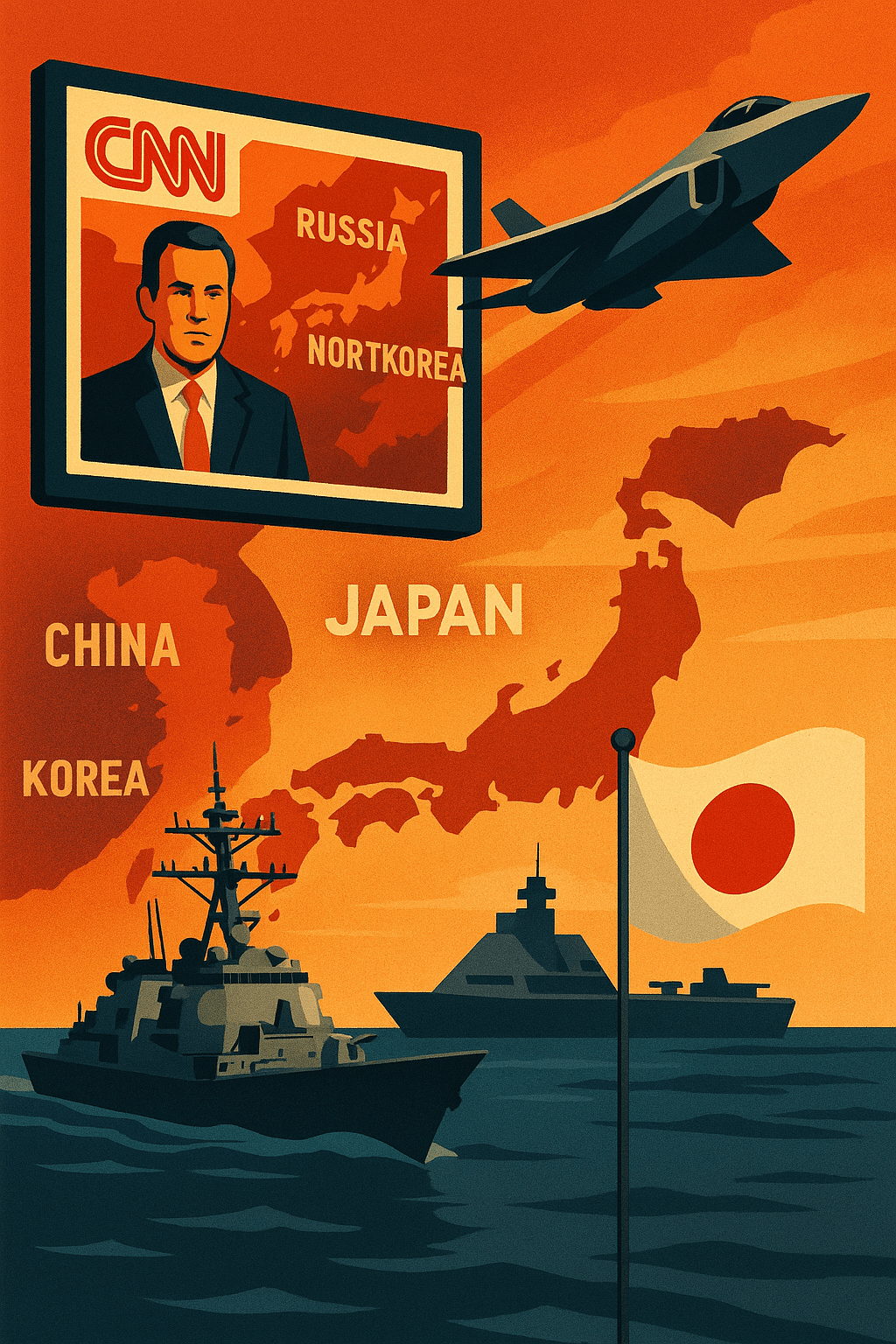
How corporate media scripts war as defense, omits empire from view, and repositions Japan as a frontline state in the U.S. Indo-Pacific war machine
By Prince Kapone | Weaponized Information
July 17, 2025
🟥 Weaponized Neutrality: How CNN Manufactures Consent for Pacific Militarization
On July 16, 2025, CNN published an article by Brad Lendon titled “China, North Korea and Russia represent biggest security challenge since World War II, Japan says.” The piece reads less like journalism and more like a press release for the Japanese Ministry of Defense. It uncritically transmits the language of Japan’s latest white paper while framing U.S.-Japan militarization as a sober response to looming threats. In just under a thousand words, it manages to construct a theater of global crisis while never once interrogating the scripts, directors, or funding sources behind the show.
Brad Lendon, CNN’s senior international military correspondent, has spent years producing uncritical coverage of U.S. military expansion in the Asia-Pacific region. In 2023, he wrote a glowing piece on Japan’s development of long-range missiles as a response to tensions with China, relying heavily on official government announcements, defense ministry press releases, and military-aligned publications while omitting any critical analysis of regional militarization or U.S. involvement. His reporting consistently aligns with Indo-Pacific Command’s messaging priorities, never citing anti-base movements, Global South analysts, or scholars of postcolonial military entanglement. His role is not to question empire’s narrative but to reinforce it—cleanly, efficiently, and with a journalist’s neutral mask.
CNN, Lendon’s platform, is not a neutral institution. Owned by Warner Bros. Discovery, its major shareholders include BlackRock and Vanguard—both of which hold stock in top weapons manufacturers. Thus CNN functions as a media amplifier for U.S. corporate-military interests. Its foreign affairs desk regularly sources from NATO-aligned think tanks like the Center for Strategic and International Studies (CSIS), where CNN contributors often serve as fellows. In 2024, CSIS received money from Lockheed Martin—a company whose weapons are sold to Japan as part of the very militarization this article normalizes. There is no disclosure of sourcing bias, no mention of the revolving door between U.S. intelligence and corporate media—just the illusion of objective reporting. CNN’s war drums come wrapped in the soft tones of professional decorum.
This article amplifies three central actors: Japanese Defense Minister Gen Nakatani, the Ministry of Defense white paper, and Admiral Samuel Paparo of the U.S. Indo-Pacific Command. Nakatani’s invocation of World War II frames the situation as an existential threat. The white paper declares the regional environment “the most severe” in 80 years, while Paparo chimes in to call China’s military growth “unprecedented.” None of these voices are interrogated; all are treated as authorities. The structural role they play in escalating tensions and justifying regional militarization is completely ignored.
The first propaganda mechanism deployed is crisis framing. Lendon anchors the piece in the claim that East Asia is now facing its gravest threat since the Second World War. This framing distorts both history and current power relations. It draws a straight line between fascist-era Japan and the People’s Republic of China—as if the roles had reversed—and presents military escalation as unfortunate necessity rather than calculated strategy.
Second is strategic omission. The article fails to mention the 119 U.S. military bases across Japan, including multiple sites in Okinawa that have long been contested by local communities. It does not mention the decades of U.S. pressure to reinterpret Article 9 of Japan’s constitution, or the reality that Japan’s defense posture is not sovereign but deeply subordinated to U.S. strategic command. These absences aren’t gaps in knowledge—they are features of an ideological filter designed to keep imperial scaffolding out of view.
Third is emotional manipulation. Lendon reproduces language about North Korean missiles “covering the entire Japanese archipelago” and Chinese “fait accompli” strategies, all without context. The goal is not to inform, but to inflame. By offering technical-sounding phrases and quantifiable threats without historical framing, the article primes the reader to feel encircled, under siege, and thus grateful for militarization. These psychological pressure points serve to align workers and civilians with ruling-class militarism.
Fourth, the article executes a sophisticated form of cognitive warfare. It uses technocratic language—“inter-state competition,” “shared strategic interests,” “forward presence”—to neutralize the political content of U.S. militarism. By presenting military escalation as bureaucratic management, it anesthetizes public consciousness. The empire is never visible—only the “concerns” of its allies. As WI’s July 14 essay demonstrates, this tactic is central to manufacturing legitimacy for U.S. sea power through euphemism and erasure.
Fifth is legitimacy inversion. China’s patrols are depicted as destabilizing, while U.S. and Japanese military buildup is rendered benign. Taiwan is described as a “democratically controlled island” under threat, yet the long-standing U.S. policy to use force against reunification goes unmentioned. The assumption is that power exercised by the U.S. and its allies is inherently lawful, while power exercised by others is inherently dangerous. This isn’t analysis—it’s imperial catechism.
Finally, the article leans into Cold War revivalism and Orientalist tropes. China, Russia, and North Korea are cast as a unified axis of authoritarianism. The piece echoes the civilizational anxiety analyzed in WI’s “China and the U.S.” article, where Western media revives 19th-century fears of “Asiatic despotism” cloaked in modern defense jargon. This is not about balance-of-power politics. It is about disciplining the Global South by other means.
What Lendon delivers is not reporting—it is a narrative weapon. Every sentence consolidates Japan’s re-militarization as sensible, even noble. Every omission shields U.S. imperial infrastructure from scrutiny. Every framing device pushes readers toward one conclusion: war is coming, and it is justified. But when empire tells you it’s preparing for defense, it’s usually preparing for conquest.
🟨 Beneath the Headlines: The Facts CNN Buried to Sell Japan’s Militarization
The Japanese defense white paper, as reported by CNN, portrays East Asia as a region slipping into chaos—citing growing threats from China, Russia, and North Korea. But what the article leaves out is more revealing than what it includes. Beneath its clean layout and official quotes lies a profoundly distorted account of regional power, history, and imperial infrastructure. What CNN calls “security challenges” are better understood as symptoms of a global order in crisis, one that Japan is not merely reacting to, but actively reproducing at Washington’s direction.
The presence of these bases is not incidental—it is central to the logic of forward deployment and deterrence that underpins U.S. imperial strategy in the Pacific. As the Department of the Navy’s Pacific Deterrence Initiative budget explains, U.S. forces west of the International Date Line are intended for “integrated deterrence and persistent campaigning,” enabling rapid response and power projection across the region. Similarly, definitions of forward-basing describe these overseas facilities as instruments of expeditionary warfare, deterrence, logistics, training, and intelligence-gathering. Japan is not a passive observer of regional militarization—it is a launchpad.
Also missing is any reference to the long history of Okinawan resistance. For decades, communities have protested against base expansion, noise pollution, environmental degradation, and sexual violence perpetrated by U.S. troops. In 2024, approximately 2,500 people, including Okinawa’s governor, rallied near MCAS Futenma against service-member crimes and aircraft noise. The ongoing struggle at Henoko, where activists continue to blockade construction of a new base built on coral reef and sacred land, is erased from the article—but this resistance dates back to at least July 2014 when locals in kayaks blockaded Camp Schwab in protest. A 2021 environmental report warned that Henoko landfill threatens coral reefs and endangered dugongs, with residents describing the bases as “like a cancer here” impacting land, life, and sacred waters. The WI exposé on U.S. militarism in the Philippines makes clear that this is not a Japanese anomaly, but part of a regional pattern of erasing Indigenous opposition to U.S. military expansion.
The article calls China the “greatest strategic challenge” but offers no evidence. It omits that China’s military budget, though growing, remains far below that of the United States—not just in raw numbers, but in global reach and doctrine. In 2024, the U.S. spent $997 billion on its military, compared to China’s $296 billion, accounting for 37% and 12% of global military spending respectively. Even when adjusted for purchasing power, China’s budget reaches only about 59% of U.S. levels, and its total military equipment amounts to less than half of what the U.S. possesses, according to a 2024 analysis by the Centre for Economic Policy Research (CEPR). As the Tricontinental Institute notes, “fear‑mongering about Chinese military spending is not substantiated by the facts” — their analysis stresses that much of China’s defense outlay is designed to resist encirclement, not to deploy force across oceans.
The article also ignores the history of the Senkaku/Diaoyu Islands, treating Japanese control as uncontested. In fact, Japan seized the islands in 1895 after its victory in the First Sino-Japanese War, formalized in the Treaty of Shimonoseki. These islands remain the subject of a long-standing territorial dispute. A 2023 regional law review by Beijing Foreign Studies University describes the dispute as rooted in “imperial-era seizures and Cold War arrangements,” arguing that framing China’s claims as “aggression” reflects a colonial narrative bias rather than legal consensus. Beijing Law Review (2023).
The article frames Russia’s presence in the Kuril Islands as an “occupation,” but skips crucial historical context. These islands were claimed by the Soviet Union at the end of WWII with U.S. awareness and tacit consent under agreements like the Yalta Conference and covert cooperation through Project Hula. Japan itself renounced claims to territories “acquired through aggression”—including the Kurils—in Article 2(c) of the 1951 San Francisco Peace Treaty. While the islands’ legal status remains contested, CNN’s depiction flattens a layered diplomatic and historical dispute into a one-dimensional narrative of victimhood.
The white paper and CNN both emphasize North Korea’s missile program as a pressing danger but make no mention of U.S. military activities that have directly shaped Pyongyang’s posture. In July 2025, the U.S. and Japan conducted nuclear-capable bomber drills over the Pacific, simulating strikes on North Korean targets. These drills were not defensive—they were escalatory rehearsals. The absence of this context transforms DPRK deterrence into irrational aggression. It de-historicizes Korean insecurity while legitimizing the very provocations that fuel it.
Japan’s militarization is not only political—it is economic. As explained in WI’s “Default of the West”, Japan faces a shrinking bond market and growing pressure to align more deeply with U.S. capital flows. Its defense budget—set to exceed $60 billion in 2025—is not simply a response to external threats. It is a structural adjustment to maintain relevance in a collapsing U.S.-led financial order. Militarization becomes a form of tribute: Tokyo secures access to U.S. markets in exchange for strategic compliance—a dynamic documented in the postwar San Francisco System. Under this framework, the U.S. guarantees Japan’s security in return for economic alignment and policy coordination, effectively tying open markets to geopolitical obedience.
This compliance extends beyond budgets. As detailed in WI’s “Steel and Saltwater”, Japan is being absorbed into a U.S. strategy of Forward Containment, which includes new missile hubs, logistics corridors, and drone launchpads stretching from Okinawa to the South China Sea.
CNN doesn’t just omit this context—it flips the script. By erasing the U.S.-led encirclement framework, it recasts China’s reactive posture as senseless aggression. But if Japan functions as a node in a pre‑emptive military lattice designed to contain China, then Beijing’s increased exercises aren’t aggression—they’re insulation. Scholars at Chatham House warn that China perceives itself as “encircled, contained, and suppressed”—a strategy driven by U.S. forward deployments in the region. Likewise, the long-standing island-chain strategy builds around bases in Japan and the Pacific to limit China’s naval and air power. Strip away this context and Beijing’s maneuvers are miscast as provocation—rather than calculated acts of defense.
Finally, there is the erasure of broader regional resistance. In the Philippines, the BAYAN alliance continues organizing mass protests against the return of U.S. troops under the EDCA agreement—seen when BAYAN-USA held rallies in Seattle and San Francisco on the EDCA anniversary, denouncing U.S. “circumvention” of the Philippine Constitution via BAYAN-USA. In South Korea, civic groups have waged sustained resistance against THAAD deployments—residents of Seongju even wrote letters in blood to oppose the radar site and mobilized mass protests at the installation site. And in China, public discourse on national defense is framed through collective memory of the Opium Wars, Japanese invasion, and Western colonialism—historical experiences shaping patriotism through education and media narratives documented in scholarly work on China’s “patriotic education” campaigns SSI on patriotic education. CNN’s narrative silences all of these perspectives, presenting militarization as inevitable truth rather than imposed imperial design.
To read CNN’s article in isolation is to enter a world where history began yesterday, power speaks only one language, and empire is a myth. But the reality beneath the headlines tells a different story—one of pressure, resistance, recolonization, and survival.
🟩 Theater of Protection: Japan’s Remilitarization and the Architecture of Narrative Occupation
The story CNN tells is simple: Japan is under siege. From the north, Russian bombers. From the west, Chinese patrols. From above, North Korean missiles. In this version of reality, militarization is not a choice—it is an obligation. But step outside this scripted theater, and a different picture emerges. One where the actors aren’t responding to threats, but following an imperial playbook. One where the stage itself—bases, treaties, logistics corridors—was shaped long ago not for peace, but for power. The U.S. Asia-Pivot strategy and its network of bilateral alliances secured forward positions to project force across maritime Asia. Through agreements like EDCA in the Philippines and permanent basing in Japan, Tokyo is not defending—it is being positioned.
This positioning is the calculated outcome of what Weaponized Information defines as Imperialist Recalibration. After failed wars, dollar instability, and growing resistance to U.S. interventions, empire adjusted. Gone are the full-scale occupations of the early 2000s. In their place: alliance-based militarization, layered proxy deployments, and narrative-driven legitimacy. Japan’s so-called “defense buildup” is not sovereign initiative—it is compliance with a U.S.-led order. The white paper CNN quotes so reverently is not a warning—it is a declaration of alignment. And this alignment isn’t costless. For Japan’s working class, it means austerity, stagnating wages, and public funds siphoned into contracts for U.S. defense firms.
This frontier is managed not just with weapons, but with perception. The media plays a central role in this architecture, executing what WI calls Narrative Occupation. This isn’t simple misinformation—it is the occupation of political consciousness. CNN transforms Japan’s military escalation into reluctant realism. It erases U.S. forward-basing, the memory of Japanese colonialism, and the economic subordination that locks Tokyo into Washington’s orbit. In doing so, it manufactures ambient consent—consent not as approval, but as inevitability. China becomes the threat by default. U.S. militarism becomes background noise. As WI’s “China and the U.S.” shows, this narrative inversion renders sea power expansion invisible, while casting defensive reactions as escalation. For workers, this means being programmed to applaud rising military budgets while livelihoods erode.
Such engineering is only possible by flipping the historical script. Here, the article performs its most dangerous ideological task: it rehabilitates Japan not only as a military partner, but as a moral one. By invoking World War II, CNN suggests Japan is once again standing up to tyranny. But this inversion is grotesque. It was Japan that waged genocidal war across Asia. It was Japan that colonized Korea, invaded China, and slaughtered millions from Nanjing to Manila. And it was the United States—not to dismantle, but to preserve—that integrated this empire into Cold War strategy. Today’s militarized Japan is not a repudiation of that past—it is a continuity. The veneer has changed. The function remains.
Beneath the narrative lies the infrastructure: a U.S.-led regional lattice of surveillance, missiles, logistics hubs, and command integration. This is not about “deterrence.” It is what WI identifies as Neocolonial Militarism—a configuration where nominally independent states operate under hegemonic command. Japan trains with U.S. doctrine, purchases U.S. systems, hosts U.S. assets, and repeats U.S. narratives. Its sovereignty is scripted. As WI’s “Steel and Saltwater” shows, the Pacific’s military infrastructure is not a collection of national strategies—it is a single architecture of imperial enforcement. This leaves Japan’s working class paying for a defense system that does not defend them, but binds them to empire.
This militarism is not only ideological—it is profitable. Japan’s arms buildup channels billions into Lockheed Martin, Raytheon, and Boeing—firms that fund the think tanks CNN sources and lobby the very governments writing the white papers. These corporations don’t just manufacture weapons; they manufacture threat narratives to justify them. The cycle is seamless. The incentive structure is closed. The cost is offloaded onto workers—in taxes, inflation, and diverted public funds. War is sold as security. Profit is laundered as patriotism.
From the standpoint of the global proletariat, this is not a story of defense, but one of imperial desperation. BRICS+ is expanding. Dollar hegemony is weakening. The unipolar moment is collapsing. U.S. wars have lost legitimacy. And so the empire recalibrates—not with bombs, but with bases; not with invasions, but with alignment; not with public consent, but with narrative occupation. Japan’s remilitarization is not the return of a Pacific power. It is the extension of a global crisis.
And those who pay the price are not the authors of policy, but its captives: Okinawan elders whose lands are seized. Japanese families whose social budgets shrink. Korean farmers displaced by missile shields. Filipino fishers surveilled by drones. Chinese workers demonized by media campaigns. These are not collateral—they are central. Their erasure is not accidental—it is engineered. And no amount of narrative camouflage can hide the rising truth: empire is failing, and its only defense is deception.
🟦 From Base to Bloc: Global North Strategies to Resist the Pacific War Machine
Empire doesn’t ask for consent—it assumes it. But across Asia, that assumption is unraveling. In Okinawa, elders and land defenders continue to blockade construction at Henoko, resisting the desecration of coral reefs and burial grounds by U.S. military engineers. In the Philippines, the BAYAN alliance is organizing mass protests against the Enhanced Defense Cooperation Agreement, which has turned northern Luzon into a staging ground for U.S. drones aimed at China. In South Korea, residents of Jeju Island and Pyeongtaek resist missile deployments and foreign troop presence. These are not scattered flashpoints. They are the living frontlines of a multipolar uprising—against recolonization, against militarized dependency, against the lie of defense.
This resistance is not symbolic. In April 2025, BAYAN protesters in Cagayan blocked access roads to U.S. EDCA sites, halting supply convoys and triggering a national debate on sovereignty. In Okinawa, a June 2025 legal challenge filed by local assemblies seeks to revoke construction permits at Henoko, citing violations of Indigenous land rights and environmental destruction. These actions don’t just expose the violence of occupation—they fracture the script. They interrupt empire’s performance of inevitability.
For those of us in the Global North, especially within the imperial core of the United States, the task is not to observe but to intervene. The first front is economic. We must target divestment campaigns against the corporations profiting from the Pacific war machine. Lockheed Martin, Raytheon, and Northrop Grumman are not abstract actors—they are embedded in our universities, pension funds, and local economies. The University of California system, for example, holds multi-million-dollar positions in these firms. Students, workers, and faculty must pressure institutions to sever these ties. War profiteering is not an investment—it is complicity.
Second, we must materially support anti-imperialist journalism and resistance networks across Asia. That means donating directly to grassroots movements like the Okinawa Environmental Justice Project or BAYAN Philippines. It means amplifying translated movement materials, hosting fundraisers, and developing logistical networks to send legal and media aid. Solidarity is not a slogan—it is infrastructure.
Third, we must build Proletarian Cyber Resistance projects that expose the hidden geography of empire. Using tools like OpenStreetMap, activists can collaborate with antiwar organizations to map U.S. military infrastructure across the First and Second Island Chains—detailing missile hubs, drone bases, logistics corridors, naval chokepoints, and command centers. These maps can include timelines of expansion, environmental impacts, Indigenous resistance, and treaty violations. They should be hosted on mirrored, decentralized servers, shared via encrypted channels, and circulated through digital teach-ins and print zines. This strategy draws from WI’s “Russia vs. the Shipping Cartel”, which demonstrated how strategic cartography can reveal imperial choke points across maritime Asia. If the empire surveils us, we return the gaze.
Finally, we must transform political education into a weapon. Launch study groups and teach-ins under a unifying banner: No New Pacific War. Study the history of Japanese imperialism. Study the re-militarization of postwar Japan. Study the U.S. security treaties that animate this violence. Use WI articles, BRICS+ communiqués, and testimonies from land defenders as source material. Bring in organizers from Asian diaspora communities, antiwar veterans, and Indigenous scholars. Teach the truth: that war is not inevitable, that empire is not permanent, and that resistance is already underway.
We are not powerless. We are entangled. The Pacific is not far. It is here—in our banks, our schools, our newsfeeds, our taxes. If we do nothing, we grease the wheels of recolonization. But if we act, we can jam the machine. From Oakland to Okinawa, from Seoul to San Francisco, from Cagayan to Chicago—the frontline is everywhere.
 Weaponized Information
Leave a comment