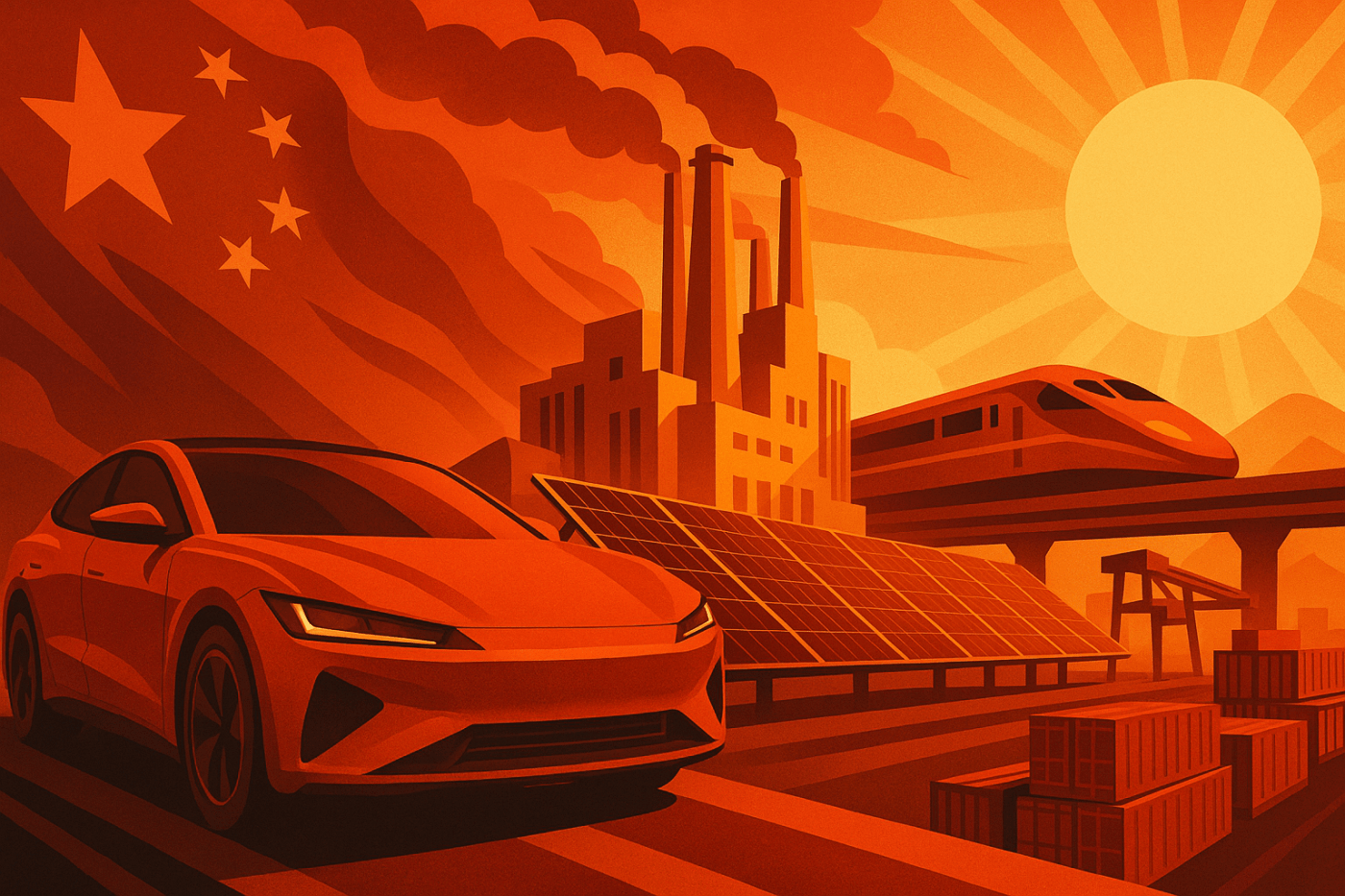
U.S. media frames falling Chinese prices as deflationary doom, but behind the headlines lies a deliberate strategy of scaled production, subsidized green tech, and trade rerouting—imperial protectionism can’t keep up.
By Prince Kapone | Weaponized Information | July 15, 2025
Economy Without Context: The New York Times Performs Statistical Orientalism
On July 14, 2025, The New York Times published a report titled “China’s Economy Grows Steadily Despite Trump’s Tariffs”, written by Keith Bradsher, the paper’s Beijing bureau chief. The article offers a cautiously admiring account of China’s second-quarter economic growth—1.1% over the previous quarter—driven by infrastructure investment, manufacturing output, and growing exports to Southeast Asia, Africa, and Europe. But even as it acknowledges China’s momentum, it quickly retreats into imperial suspicion, portraying Beijing’s development model as fragile, unsustainable, and possibly fabricated. It is a style of journalism that treats Chinese success not as reality, but as anomaly—a statistical illusion conjured by a state that Western liberalism insists must eventually fail.
Bradsher himself is no accidental correspondent. He’s a career technocrat with a journalist’s badge, having reported for the Times from Detroit, Shanghai, Hong Kong, and now Beijing. His beat has always followed capital: from the heart of America’s auto industry to the Asian cities where that industry offshored its production, then back again to monitor China’s rise with a skeptical eye. He writes with the fluency of the managerial class, translating imperial economic anxiety into the language of neutral expertise. But behind the charts and passive voice lies a loyalty not to the truth—but to capital’s worldview. In his hands, China never plans, it “distorts markets.” It never invests, it “inflates capacity.” It never strategizes, it “manipulates.”
His employer follows the same script. The New York Times is not an independent newspaper—it is the liberal wing of the U.S. ideological state apparatus. Its parent company is publicly traded and institutionally owned by firms like Vanguard and BlackRock, the very engines of Western financial imperialism. Its newsroom serves as the stenographer for empire: selling coups as democracy promotion, sanctions as human rights policy, and economic warfare as neutral policy debate. Whether defending Wall Street’s bailouts or laundering Washington’s war plans, the Times is a vital tool in the ruling class’s arsenal of soft power.
This article, like so many others, does not exist in isolation. It is circulated and amplified by Washington think tanks, finance-sector analysts, and trade hawks within the Trump administration. Outfits like the Hudson Institute and the CSIS seize on these narratives to call for more tariffs, more decoupling, more Cold War brinkmanship. Editorial boards and cable news anchors pick up the tone and deliver it to the masses, shaping the mental terrain on which imperialist economic policy is waged.
The propaganda function of this article is not found in outright lies, but in carefully curated truths. It opens with a “qualified success” frame—China’s growth is noted, but immediately couched in warnings of deflation, overcapacity, and dubious accounting. The reader is allowed to acknowledge the numbers but instructed not to trust them. Success becomes a paradox, and progress becomes pathology.
Then comes omission. The article devotes considerable space to China’s export pivot, but makes no mention of the impact Trump’s tariffs have had on American firms, workers, or consumers. U.S. economic blowback vanishes from view. We are led to believe that the trade war only hurts China, never the United States.
There is also emotional manipulation—not the fiery red-baiting of old, but the subtler despair of investor pity. The tone mourns falling prices, not for what they might offer ordinary consumers, but for the pressure they place on corporate margins. It is a bourgeois lament dressed up as economic analysis. Even the housing crisis is treated solely as a disruption to developers, not as a reflection of deeper contradictions in capitalist urbanization.
More insidiously, the article indulges in epistemological warfare. It plants doubt about the legitimacy of Chinese statistics—without presenting evidence—simply because they do not conform to Western norms. This is colonial logic at its finest: the idea that only Western institutions can measure, know, or verify economic truth.
Then comes the classic false equivalence.
When China subsidizes household appliance upgrades or electric vehicle purchases, it is accused of market distortion. When the U.S. government injects trillions into banks, fossil fuels, or “green capitalism,” it is seen as responsible stewardship. The same action is judged by two entirely different standards depending on who’s doing it—and who it benefits.
Finally, the piece closes with a subtle Orientalist flourish. China’s “frugality” is cited as a reason for lagging consumer demand, as if the economic challenges of a nation of 1.4 billion people can be traced to cultural thrift rather than structural austerity. This kind of essentialist framing depoliticizes poverty, moralizes deflation, and ignores the state’s decades-long prioritization of production over consumption—all while romanticizing Western consumerism as the universal ideal.
In the end, this isn’t an economic report—it’s a ritual. A reaffirmation of the liberal belief that China cannot possibly succeed on its own terms. Every positive metric must be neutralized, every contradiction flattened, every deviation explained away. The Times plays its part with expert choreography: managing perceptions, preserving imperial narratives, and gently whispering into the ears of its readers that, no matter how many trains China builds or factories it opens, the West still defines reality.
Growth Under Siege: Mapping the Terrain Behind the Metrics
Bradsher’s article, for all its omissions and framing tricks, does present a range of empirical data points that allow us to piece together a clearer picture of China’s current economic trajectory. The following claims are either stated directly or implied through official figures and analyst commentary presented in the original piece:
- China’s economy grew 1.1% from April to June 2025 over the previous quarter, projecting to an annual rate of about 4.1%.
- The export sector remains robust, particularly toward Southeast Asia, Europe, and Africa, with some re-exportation to the U.S. via third countries.
- Retail sales declined 0.16% in June 2025 compared to May, though still up 4.8% year-over-year.
- Real estate development fell 11.2% in the first half of 2025.
- Factory and infrastructure investment—especially high-speed rail—has increased significantly.
- Consumer subsidies for electric vehicles and energy-efficient appliances were rolled back in some cities due to budget shortfalls.
- China’s official year-over-year GDP growth stood at 5.2% in Q2 2025, aided by a low base effect from spring 2024.
- Interest rates on Chinese bonds are at an 11-year low to stimulate borrowing and investment.
- Rural pensions remain extremely low, averaging around $20 per month, with a government-promised 2% increase this year.
But what the article fails to provide is the broader economic and geopolitical context needed to interpret these numbers—both in terms of the historical forces shaping them and the strategic aims they reflect. This silence is not accidental. To begin correcting it, we must situate China’s present within the architecture of economic war being waged against it.
First, the article omits the devastating impact of U.S. tariffs on its own economy. The Trump regime’s April 2025 decision to spike tariffs to as high as 145% on a wide range of Chinese goods—before temporarily pausing in May—was part of a larger strategy of economic siege. While Bradsher mentions this in passing, he sidesteps the repercussions inside the United States: soaring input costs, disrupted supply chains, retaliatory countermeasures, and mounting pressure on U.S. agribusiness and tech firms. According to Brookings, U.S. importers bore the vast majority of cost increases during prior rounds of tariff escalation—over 90%—with disproportionately negative impacts on working‑class consumers and small businesses.
Second, the re-routing of Chinese exports through Southeast Asia is part of a deliberate trade strategy enabled by the Regional Comprehensive Economic Partnership (RCEP) and the expansion of infrastructure corridors across the Global South. Chinese firms increasingly use Vietnam, Thailand, and Malaysia as transshipment hubs to bypass direct tariff walls—highlighting the absurdity and futility of U.S. protectionist logic in a globally integrated production system.
Third, the so‑called “glut of capacity” in China’s manufacturing sector must be understood as the legacy of a state‑directed industrialization model that prioritized physical infrastructure and productive capacity over speculative consumption. The government has deliberately flooded key sectors with capital—EVs, photovoltaics, battery storage, high‑speed rail—not only to meet domestic energy and transit needs, but to position China as the global production center for green transition technologies.
Fourth, the consumer weakness Bradsher highlights is real, but not cultural. It is a consequence of structural limits in China’s social safety net and the lingering effects of a rural–urban dual economy. A recent Reuters investigation confirms that rural pensions covering hundreds of millions of elderly Chinese remain severely underfunded, often providing as little as ¥123 (~$17)/month. With low retirement security and volatile job markets, household savings rates remain high and retail spending cautious.
Fifth, the drop in real estate investment is not simply a market correction—it reflects a structural pivot. For nearly two decades, real estate speculation functioned as China’s de facto growth engine, absorbing surplus capital and urbanizing hundreds of millions. But the housing bubble has cracked. Beijing is now attempting to redirect investment flows toward productive, socially necessary sectors—part of the country’s 14th Five-Year Plan. As a recent Reuters report notes, this transition entails political risk and financial turbulence but signals a deeper systemic recalibration.
Finally, Bradsher’s concern over “deflation” misses the broader industrial logic. Falling prices in sectors like EVs, solar panels, and home appliances are not symptoms of collapse but indicators of intense price competition, scaled-up production, and public subsidization.
In sum, what the Times portrays as fragile, unstable, or artificial is in fact the material outcome of a contested, deliberate, and globally entangled development strategy. China’s economic structure is shifting—but not collapsing. Its contradictions are sharpening—but they are being managed through state instruments that Western liberal economists neither understand nor acknowledge. And while its consumer sector remains a weak link, its export-industrial machine is reconfiguring itself in defiance of siege warfare from the imperial core.
Industrial Sovereignty in a Time of Siege: Reframing China’s Economic Contradictions
What the Times article reduces to economic paradoxes are, in truth, the visible contours of an unfolding class war on a planetary scale. The contradictions in China’s economy—rising exports, falling consumption, massive industrial overcapacity, slumping real estate—are not signs of dysfunction, but expressions of a strategic attempt to resolve imperial crisis from the periphery. To understand what’s happening, we must cast off the liberal lens of “market equilibrium” and instead apply a dialectical analysis of imperialism, sovereignty, and production. This is not a story about GDP percentages. It is a story about a global system trying to discipline a state that refuses to die on schedule.
The first and most essential lens is that of Imperialist Recalibration—the shift in U.S. and Western policy toward aggressive economic coercion as a substitute for declining productive power. The Trump tariffs, far from being policy miscalculations or short-term leverage plays, are part of a long-term attempt to reassert imperial control through punitive instruments. Unable to out-compete China on infrastructure, energy transition technologies, or long-range planning, the U.S. falls back on siege: tariffs, sanctions, export bans, and dollar-based financial blackmail. This is not the “free market”—it is organized sabotage.
What China is doing in response is not merely defensive—it is an assertion of Developmental Sovereignty: the right and capacity of a state to direct economic activity toward collective goals, independent of external diktats. By subsidizing strategic sectors, building transport and energy infrastructure, and preserving a degree of macroeconomic autonomy through state-owned banks and capital controls, China is carving a path that neither conforms to neoliberal dogma nor replicates Soviet command economics. It is a hybrid model under construction—riddled with contradictions, yes, but aimed at circumventing dependency.
The West calls this “distortion.” But it is the West that has long distorted the world economy through what must be named: Neocolonial Extraction. For decades, the Global South has been reduced to resource zones and labor pools—feeding Northern consumption while being denied the means to develop. China, for all its flaws and internal contradictions, offers an alternative industrial pole. Its financing of ports, railways, and power plants across Asia, Africa, and Latin America is not altruism—but it is also not Wall Street colonialism. When Zambia renegotiates copper exports on new terms, or Pakistan uses Chinese-built energy corridors to reduce fuel imports, the imperialists panic—not because these are failures, but because they are beginnings.
A fourth concept is critical here: Epistemological Warfare. The casual dismissal of China’s statistics, the incessant skepticism toward its economic model, the portrayal of planning as manipulation—these are not neutral criticisms. They are acts of ideological policing. The West must frame China’s achievements as illegible, unreliable, or fraudulent, because to admit otherwise is to undermine its own mythology: that only liberal capitalism can produce prosperity. That only the market can allocate value. That planning is inherently authoritarian. The war on Chinese numbers is, in essence, a war on any alternative to financial hegemony.
The contradictions inside China—urban-rural inequality, suppressed wages, speculative excess, and lagging consumer confidence—are real. But they are the contradictions of a state navigating a hostile world system while attempting to maintain some control over capital. Unlike the U.S., where capital controls the state, China’s internal struggles reflect an unresolved tug-of-war between Party, capital, and labor. In this context, falling real estate prices are not a meltdown—they are a necessary correction. Declining retail sales are not cultural defects—they are outcomes of historical underinvestment in social security. And deflation is not collapse—it is a symptom of price war strategy deployed in service of industrial saturation.
Most importantly, China’s strategy must be seen from the standpoint of the Global South, not the metropole. To a steel worker in Bolivia, a dam worker in Pakistan, or a port mechanic in Kenya, China’s investment and trade may be lifelines—imperfect, but materially better than IMF austerity or U.S. drone diplomacy. To the rising industrial proletariat of the Global South, the Chinese model represents a contested but living example of what it means to wrest planning power from finance, to organize production for something other than shareholder dividends. It is not a blueprint—but it is a wedge.
In the long arc of capitalist crisis, China’s internal contradictions will sharpen, just as Western pressure intensifies. But unlike neoliberal states, Beijing retains levers of command. It can expand public investment, nationalize bankrupt developers, reconfigure labor flows, or redirect trade corridors. Whether it does so in service of workers or capital remains an open question. But the point is—it can. And in a world suffocating under the rule of banks and billionaires, that capacity alone makes China a threat to empire.
From Siege to Solidarity: Building a Revolutionary Response in the Global North
China’s economic endurance under siege is not just a regional story—it is a global signal. It reveals the fragility of U.S. empire, the limits of coercive economic warfare, and the possibility—however uneven—of an industrial order beyond Wall Street. For the working classes of the Global North, the lesson is not to romanticize the Chinese model, but to recognize the imperial reaction it has provoked. When a Global South nation refuses to collapse, it is branded a threat. When it succeeds on its own terms, it becomes a target. That pattern is the blueprint of empire. And if we are serious about dismantling it, we cannot remain spectators.
Our position must be clear: we stand in solidarity with the right of all nations—including China—to pursue economic development free from imperial interference. This does not require endorsing any government uncritically. It requires acknowledging that the real enemy of humanity is the system that seeks to destroy every experiment not born in the boardrooms of the West. From Cuba to Zimbabwe, from Iran to China, the script is always the same: isolate, sanction, smear, destabilize. What we are witnessing now is the latest act in that script. And it demands our refusal.
Across the Global South, resistance is already underway. A prime example is the industrial zone integration strategy linking China and Southeast Asia through the China–Laos railway, which has transformed inland Laos into a critical corridor for goods flowing across Eurasia. Cambodia’s logistics parks and Thailand’s EV supply chain hubs are not merely trade nodes—they are material expressions of multipolar autonomy. These aren’t just pipelines—they’re lifelines. They enable states to bypass U.S. maritime chokepoints, dollar-dominated trade, and IMF-imposed austerity. These projects reflect what the imperialists fear most: that the Global South might begin to trade, build, and govern without them.
For those of us in the belly of the beast, solidarity cannot be symbolic. It must be strategic. We offer four concrete forms of action that revolutionary forces in the imperial core can take to undermine the economic warfare machine and build new lines of internationalism:
- 1. Campaign Target – Expose and Disrupt Tariff Warfare: Launch a grassroots campaign against the Trump administration’s tariff regime. Frame it not as “protecting American jobs,” but as economic warfare against the Global South and a price-gouging mechanism for U.S. capital. Demand congressional hearings, build union alliances, and expose how tariffs fuel inflation for workers while enabling economic bullying abroad.
- 2. Mutual Aid Initiative – Fund Multipolar Media: Direct funds and technical support to independent media outlets in the Global South that expose economic warfare and highlight local resistance—from African Stream to Kawsachun News. These voices are routinely silenced by Western platforms. Platform them. Translate them. Build with them.
- 3. Proletarian Cyber Resistance – Build a Sanctions Tracker: Create a public, open-source digital archive of U.S. and EU sanctions, tariffs, and coercive economic measures worldwide. Include timelines, economic impact data, affected sectors, and corporate beneficiaries. Use it as an educational and organizing tool to reveal the hidden infrastructure of economic war.
- 4. Political Education Program – Debunk the China Threat Narrative: Host teach-ins, workshops, and study groups that trace the racialized and imperial foundations of anti-China propaganda. Link current U.S. rhetoric to the long history of Cold War psyops, yellow peril discourse, and manufacturing consent for war. Disarm empire’s ideological weapons by exposing their lineage.
These tasks are not about “defending China” in the abstract—they are about weakening empire in the concrete. Every narrative we dismantle, every policy we expose, every alliance we build chips away at the scaffolding of U.S. dominance. The war against China is not just a trade dispute. It is a campaign to preserve a dying world order. Our duty is not neutrality. Our duty is sabotage.
 Weaponized Information
Leave a comment