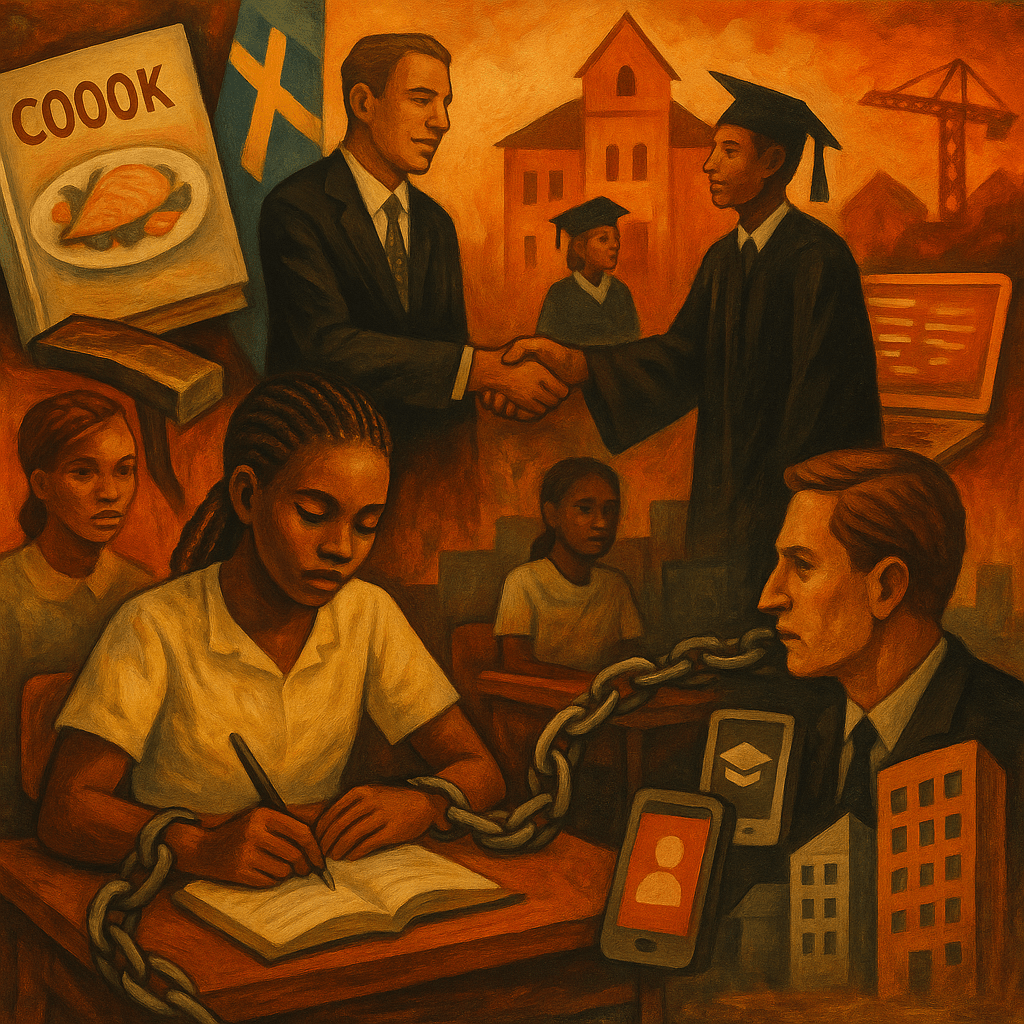
Behind the cookbooks, scholarships, and incubators lies a calibrated strategy of imperial control—dressed in the language of education but rooted in the logic of dependency and extraction.
By Prince Kapone | Weaponized Information | July 11, 2025
Cookbooks, Classrooms, and the Contours of a Quiet Coup
On July 11, 2025, The Nation ran a strikingly chipper article titled “Nigeria, Sweden launch bilateral cooperation in youth empowerment, education.” Written by Tony Akowe, it reads less like reportage and more like a diplomatic press kit. The piece casts the Nigeria–Sweden Parliamentary Friendship Group Summit as a feel-good jamboree of equal partners, featuring scholarships, digital learning platforms, and—because no soft coup is complete without dessert—a Nigeria–Sweden “Fusion Cookbook” that pretends jollof rice and Swedish meatballs can stitch together a just world.
On the surface, it all feels wholesome: handshakes between bureaucrats, students granted opportunities, and mutual cuisine exchanged as tokens of goodwill. But if you squint past the confetti, the machinery reveals itself. This isn’t development. It’s theater. And Akowe? He’s the court poet, serenading empire in prose.
The show begins with framing manipulation. Words like “inclusiveness,” “grassroots,” and “youth empowerment” are tossed around like seasoning—undefined but meant to taste good. The summit, held in the marble corridors of Abuja’s elite, is dressed up as a village fair. The tone flattens power asymmetries, laundering imperial relations in the warm rinse of partnership. This is classic false equivalence: the idea that Sweden and Nigeria walk into the room with the same weight, when in fact one arrives with the IMF in its back pocket, and the other with debts and donor forms.
Then comes the emotional bait: the “fusion cookbook” becomes the summit’s symbolic centerpiece. It’s a cute story—meatballs meet egusi stew. But this isn’t just about food. It’s about consent. Culinary diplomacy becomes a metaphor for obedience. Empire, now smiling through recipes, feeds its narrative through the stomach. The cookbook functions as an emotional decoy, diverting attention from geopolitical capture to tales of shared kitchen joy.
But Akowe’s sharpest tool is strategic omission. Whole worlds are scrubbed out—not through oversight, but design. There’s no mention of the structural conditions that birthed this summit, no exploration of who wins materially from these “partnerships.” What remains is a flattened timeline—depoliticized, dehistoricized, sanitized. And in that vacuum, another weapon is slipped in: cognitive softening. Buzzwords like “innovation,” “collaboration,” and “mutual benefit” are repeated until critique feels rude and skepticism feels out of place.
The article also traffics in civilizational tropes. There’s a quiet but steady drumbeat suggesting that Swedish knowledge is what Nigerian youth need to be “uplifted.” No open racism, just the whisper of paternalism. Sweden teaches, Nigeria learns. Sweden gifts, Nigeria receives. Sweden leads, Nigeria follows. This is the grammar of empire—cleaned up, sweetened, and served on diplomatic china.
As for Tony Akowe, this is par for the course. His byline at The Nation appears most often under soft-focus pieces about government programs, foreign dignitaries, and donor-funded initiatives. He doesn’t report. He recites. His journalism is stenography for the status quo.
The Nation itself isn’t just a newspaper—it’s a node in the ruling class feedback loop. With long-standing ties to Nigeria’s political elite, it has mastered the art of echo. When foreign investment, IMF packages, or Western “partnerships” are in play, the paper leans into consensus, not conflict. It doesn’t challenge empire. It translates it into local dialect.
The summit’s spectacle is amplified by a well-rehearsed supporting cast: NGOs, tech startups, embassies, university liaisons. Each plays its part as if floating above politics. But there’s nothing apolitical about them. They are part of the soft machinery of global influence. Akowe never interrogates their motives, funding pipelines, or long-term agendas. Their presence is simply assumed to be virtuous. That’s not reporting. That’s compliance.
What we’re witnessing isn’t a bilateral agreement. It’s narrative warfare. And like all effective psychological operations, it doesn’t rely on lies—it relies on what you’re encouraged to feel. The Nigeria–Sweden summit happened. But the version we were fed? That’s fiction. A polite hallucination where empire dons a chef’s hat, hands out scholarships, and smiles warmly from across the table—while tightening the grip behind your back.
What the Headlines Don’t Teach: Context, Contradictions, and the Capitalist Classroom
Beneath the diplomatic spectacle of the Nigeria–Sweden Parliamentary Friendship Group summit lies something more deliberate—a structure of imperial governance wrapped in the language of “empowerment” and “partnership.” To understand what really unfolded in Abuja on June 25, 2025, we have to strip away the brochure-speak of The Nation’s coverage and excavate the silences, omissions, and material realities that expose Sweden’s neocolonial playbook.
The article makes a few key claims:
- The summit advanced education ties between Nigeria and Sweden through scholarships and student exchanges.
- SchoolTry, a Swedish-Nigerian EdTech company, now operates in 500+ schools across five African countries.
- NECO enabled Nigerian students in Sweden to take national exams abroad.
- Minnesota State University launched a joint research initiative with Nigerian and Swedish partners.
These may sound like harmless milestones—steps forward, even. But each one, upon closer inspection, is a brick in the architecture of imperial integration. As Torkil Lauesen argues in Riding the Wave, Sweden doesn’t dominate through occupation—it embeds itself. Historically, it played subcontractor to the colonial empires: shipping iron for slave chains, funding railroads in the Congo, and plugging itself into global supply chains to rise with the tide of Western capital (pp. 13–17).
After WWII, Sweden hitched itself to U.S. imperialism not with tanks, but with terminals—signing on to transatlantic intelligence sharing, including XKeyscore, the NSA surveillance program revealed by Sveriges Television (pp. 88–91). Its March 7, 2024 entry into NATO only cemented this role. These days, it doesn’t need boots on the ground; it needs educational platforms, embassies, and NGO partnerships.
Through Sida, Sweden funnels roughly 0.79–0.9% of its GNI into official development assistance—well above the UN’s 0.7% target. But that generosity is deceptive. As Lauesen makes clear, much of this aid is a feedback loop: money goes out the door, then flows back to Swedish firms and consultants, turning “solidarity” into a business model (p. 170). These scholarships and EdTech programs don’t empower—they extract. A DonorTracker/OECD report confirms that African students who study abroad are far more likely to stay abroad. That’s not development. That’s brain drain.
Platforms like SchoolTry—often backed by Sida-incubated investments through Swedfund—are not simply “educational tools.” They’re market instruments, collecting behavioral and biometric data in the name of progress. According to Lighthouse Reports, such platforms often operate more like surveillance infrastructure than student resources. This isn’t digital inclusion—it’s data colonialism.
None of this emerged from a vacuum. The groundwork was laid in the 1980s and ’90s, when IMF and World Bank-imposed Structural Adjustment Programs (SAPs) gutted Nigeria’s education system. Budgets were slashed by 30%. Over 1,000 schools were shuttered. Fees were imposed on what used to be public rights. As documented by UNESCO in Education, Adjustment and Reconstruction, these reforms didn’t fix the system—they dismembered it. Today, over 20 million Nigerian children are out of school, as confirmed by UNESCO and reported by outlets like Premium Times. But instead of rebuilding public education, the summit doubles down on privatized digital “solutions” that outsource pedagogy and capture dependency.
Even Sweden’s celebrated “feminist foreign policy”—lauded at the summit—is more about posture than principle. A SWP-Berlin study admits it’s less liberation, more “norm entrepreneurship”—a soft power strategy aimed at shaping global South institutions without the mess of direct coercion. Meanwhile, Sweden bankrolls biometric migration regimes in West Africa, funding border surveillance and data-sharing programs, as Statewatch reveals. Educated Nigerian youth may be welcomed as students—but they’re tracked as migrants. The message is clear: your mind is wanted, but your body is policed.
These contradictions aren’t anomalies. They’re features. Sweden’s education diplomacy is not an act of friendship—it’s an insurance policy. As Nigeria deepens ties with BRICS+ and shifts toward multipolar alternatives, the West scrambles to secure footholds in the minds of future elites. Lauesen calls this the “new global division of labor”: raw materials flow one way, and so does talent. Sweden gets the patents, platforms, and prestige. Nigeria gets diplomas, surveillance tools, and a deeper seat at the kids’ table of empire (p. 147).
This isn’t a partnership. It’s a pipeline—with Nigerian youth as the input and Swedish capital as the refinery. The summit didn’t challenge inequality. It managed it—with a smile, a grant, and a downloadable app.
Scholarships and Shackles: How Imperialism Teaches the Colonized to Obey
It’s one of empire’s oldest tricks: turn the classroom into a containment cell and sell it as “progress.” What unfolded at the Nigeria–Sweden summit wasn’t diplomacy—it was textbook Imperialist Recalibration: the quiet readjustment of imperial tools, both coercive and ideological, to maintain dominance in a world that’s no longer bowing so easily. The era of coups and covert ops hasn’t ended—it’s just had a makeover. No more suitcases of cash and strongmen in sunglasses. Now the empire comes bearing scholarships, EdTech apps, and sanitized syllabi wrapped in buzzwords.
In this context, “youth empowerment” isn’t empowerment at all. It’s labor discipline with a smile. As Torkil Lauesen explains in his work on Unequal Exchange, core capitalist states extract not just raw materials, but minds. Education under imperial rule isn’t a liberatory tool—it’s a sorting mechanism. It lifts up those who play by the rules of capital and sidelines those who don’t. The aim isn’t enlightenment. It’s enlistment. The African student is not being trained to transform the system—they’re being shaped to serve it. Empire doesn’t fear ignorance. It fears the wrong kind of knowledge.
This is what Neocolonial Governance looks like today. Sweden no longer needs to rule Africa with boots or bases. It governs through grants, platforms, and glossy development partnerships. The summit’s obsession with “inclusive education” and “climate entrepreneurship” wasn’t a sign of progressive intent—it was imperial crisis management. And the crisis isn’t hunger. The crisis, from the vantage of Stockholm or Brussels, is that too many African youth might choose a union over a start-up, collective farming over impact investing, revolution over resume-building. These are energies that must be contained. Education, when wielded by imperial hands, doesn’t awaken. It sedates.
And then there’s Sweden’s green hypocrisy. In one room, it poses as the climate messiah. In another, it bankrolls border surveillance to stop Africans displaced by environmental catastrophe. This isn’t contradiction—it’s choreography. Under the banner of Green Capitalism, core nations reindustrialize using cobalt and lithium pulled from African soil, while offering back “resilience programs” and biometric checkpoints. The message is clear: help us save the planet, but don’t try to enter it.
The partnerships announced—from Nasarawa to Minnesota—aren’t neutral pipelines of knowledge. They’re conduits of control. As Lauesen reminds us, the ideological state apparatus has been outsourced. African universities don’t set the terms of these exchanges—they inherit them. Instead of fostering intellectual sovereignty, they normalize submission. Instead of training revolutionaries, they train risk managers. Inclusion here doesn’t mean freedom. It means being allowed into the machine—just in time to oil its gears.
It’s no coincidence that the summit wrapped with the unveiling of a “fusion cookbook.” Empire no longer wants to be feared—it wants to be liked. It wants to smile while it smothers. The cookbook is soft power in edible form: jollof rice meets Swedish meatballs, while EdTech platforms quietly absorb school systems. Teachers become customer service reps. Students become datasets. This isn’t diplomacy. It’s domestication.
This summit was not a leap forward. It was dependency, rebranded. An attempt to bury revolutionary potential under grants, emojis, and policy briefs. But the veil is thin. Millions of Nigerian youth live beyond the reach of these programs—unemployed, uncredentialed, and increasingly unafraid. The elite may try to digitize and distract them. But history has taught us: containment always breaks.
In this crumbling global order, education’s task is no longer to reform empire—it is to rupture it. In that task, proletarian internationalism is not nostalgia. It is necessity. And in the long war between schooling and liberation, the most radical pedagogy is still struggle. To break free, we must first learn to unlearn. Because empire doesn’t just occupy land—it occupies minds. And it is there that the revolt must also begin.
From Tech Incubators to Liberation Schools: What We Must Do Now
It’s not enough to expose the trap. We have to shatter it. The stage-managed farce of “youth empowerment,” orchestrated by Sweden and rubber-stamped by Nigeria’s comprador class, calls for more than critique—it demands disruption. For those of us in the belly of the beast, solidarity must be more than symbolic. It must be material, strategic, and rooted in our historical duty to sabotage the circuitry of empire from within. We don’t just speak truth to power—we jam its signals, reroute its pipelines, and build new circuits for people’s power.
First, we name our comrades on the front lines. We declare full solidarity with the National Association of Nigerian Students (NANS) and grassroots educators across West Africa who are building learning spaces unshackled from donor agendas. These aren’t workshops funded by NGOs—they are revolutionary classrooms where pedagogy becomes insurgency. Every time a student union fights tuition hikes, or a rural school rejects a European curriculum module, a crack forms in the edifice of neocolonial control.
Second, we amplify what real resistance looks like. In 2025, Burkina Faso drastically revised academic ties with French universities. No more imported expertise. No more dependency dressed as collaboration. Instead, they’re funding people-run research centers focused on food, land, and energy sovereignty. This is educational liberation—not a study abroad program in Stockholm, but a laboratory in Ouagadougou run by revolutionaries, not consultants.
For comrades organizing inside the imperial core, here’s how we join that front line—not in theory, but in action:
1. Campaign Target: End University Complicity in Soft Power Diplomacy
Demand full disclosure and divestment from imperial entanglements. Pressure universities like the Minnesota State University system to sever ties with NATO-aligned aid agencies and tech firms profiting from EdTech colonization. Soft power needs soft institutions. Break the link.
2. Mutual Aid Initiative: Fund Liberation Learning
Channel funds directly to the front. Use platforms like Mutual Aid Disaster Relief to support radical educators and student organizers in Nigeria. Prioritize rural classrooms, anti-capitalist curricula, and grassroots digital literacy projects. Feed the future, not the foundations.
3. Proletarian Cyber Resistance Tactic: Counter-Mapping Sweden’s Soft Power Footprint
Build an open-source archive of Sweden’s imperial interventions. Trace their aid money, surveillance deployments, tech contracts. Use maps, infographics, and web tools to expose the reach. Decentralize the data. Turn it into a weapon for movement schools and organizing collectives.
4. Political Education Focus: Teach Against the Technocrats
Don’t just read—organize study circles. Build revolutionary syllabi featuring Lauesen’s The Long Transition, Nkrumah’s Neo-Colonialism: The Last Stage of Imperialism, and movement-grounded texts. Teach Sweden’s “education diplomacy” for what it is: technocratic imperialism. Turn classrooms into consciousness factories.
We must stop mistaking “access” for liberation. The true curriculum isn’t downloaded—it’s built in struggle. The final exam isn’t a degree. It’s whether we act. Whether we fight. Whether we win.
 Weaponized Information
Leave a comment