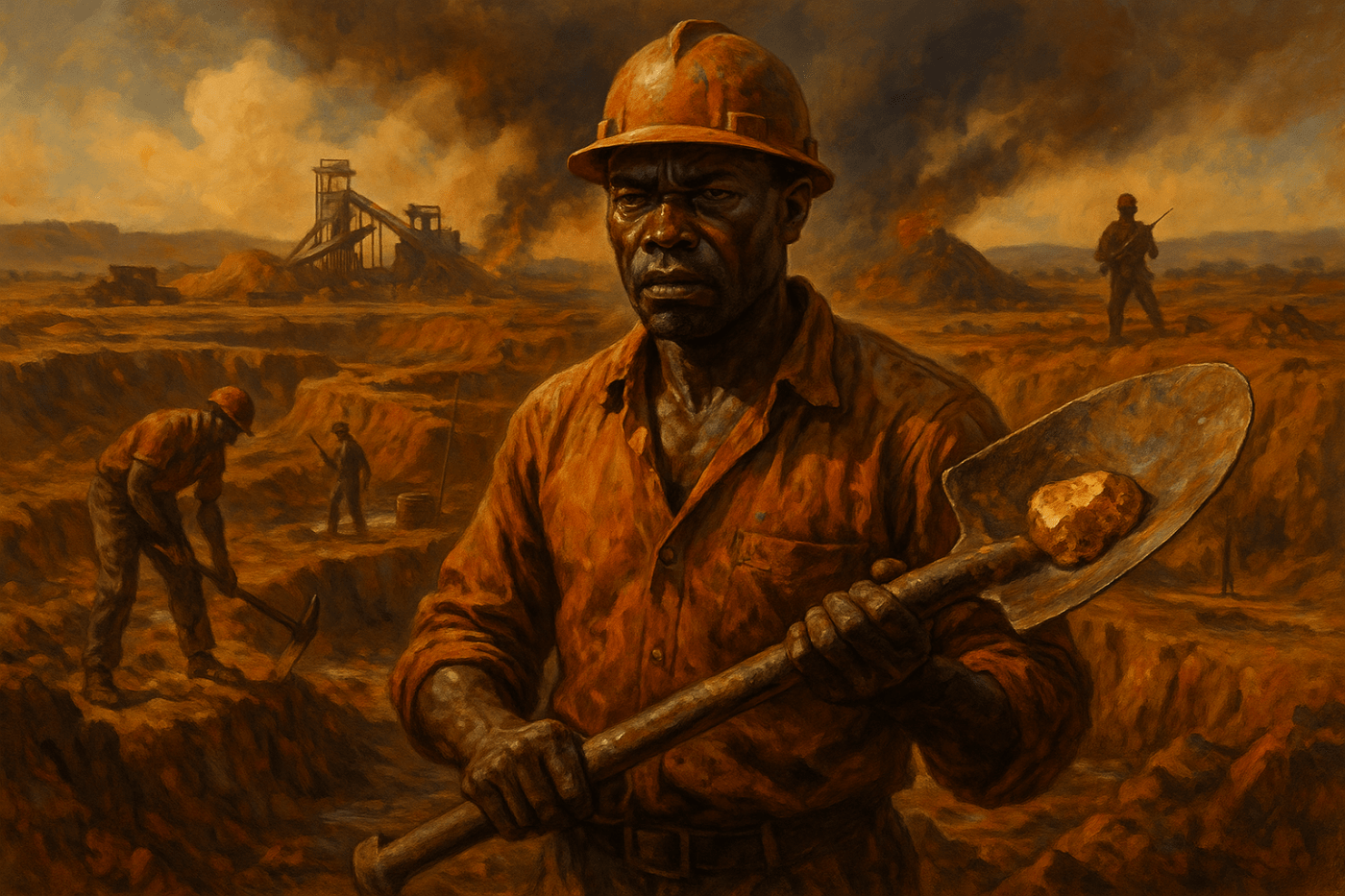
What Australian miners, Canadian financiers, and Western media call a “milestone” is in fact a warzone—where sovereignty is built with shovels, not slogans, and every ounce of gold extracted is a test of who holds power beneath the surface.
By Prince Kapone | Weaponized Information | July 3, 2025
The Gospel of Gold: How Empire Writes Its Victories
On June 20, 2025, Business Insider Africa published an article titled “Burkina Faso mine delivers first gold pour as Australian firm hits milestone”, authored by Solomon Ekanem. At first glance, it reads like a straightforward business update: a gold mine has delivered its first pour, investors are satisfied, and timelines are being met. But beneath the spreadsheet polish lies something more dangerous—a narrative of empire retold in the language of efficiency, growth, and partnership. This isn’t reporting. It’s public relations in prose form—an ideological transmission dressed as neutral information.
Ekanem’s voice is not that of a journalist but of a well-trained court scribe. He selects words with surgical precision—not to inform, but to soothe. The article is saturated with investor vocabulary: “milestone,” “operational readiness,” “ahead of schedule,” “under budget.” It’s less about gold than it is about grammar—the grammar of capital, where success is always measured in numbers, never in lives. Nowhere does the piece mention the human beings who live, labor, or die near this mine. Not a single villager, worker, or local authority is quoted. Their absence isn’t oversight—it’s method.
The outlet publishing this piece, Business Insider Africa, wears its African mask well, but its accent betrays it. It’s the regional costume of a Swiss media conglomerate—Ringier AG—operating in concert with German and U.S. partners. What looks like African media is in fact a delivery system for capital ideology, repackaged to appear local. The colonizer no longer needs a flag; it has a domain name. And with it, the empire broadcasts its worldview with a smile and a sidebar of export stats.
The narrative’s emotional scaffolding is as precise as its vocabulary. There’s gratitude—offered by the executive chairman of the mining firm. There’s optimism—about future output and fiscal performance. There’s celebration—of project completion, efficiency, and investor confidence. But this isn’t joy; it’s theatre. The reader is cast in the role of shareholder, invited to feel pride in “milestones” whose benefits accrue elsewhere. It’s the kind of joy only empire can manufacture: a happiness that depends on someone else not being seen.
The framing trick is subtle but deadly. Gold extraction is described as development. The mine is not a foreign occupation of national territory—it’s a “project.” The company isn’t a private profiteer—it’s a “partner.” Ownership is mentioned, but only in passing. State involvement is celebrated with statistical crumbs—percentages devoid of context. The underlying power relations are never named, because the performance depends on obscuring them. This is not ignorance. It is erasure with purpose.
Then comes the ideological scalpel—the phrase “geopolitically complex jurisdiction.” The term is bloodless, technical, and sterilized. But its function is old and familiar. It replaces the colonial language of “savage,” “unstable,” or “uncivilized” with a euphemism fit for quarterly reports. The translation is simple: these people can’t govern themselves. This land is risky. It needs oversight. It needs a steward. It needs us. What empire once declared with bayonets, it now whispers through boardrooms.
Nowhere in the article is there a pause to ask: Who benefits? Who decides? Who suffers? Those questions aren’t just unasked—they are unthinkable in this framework. The goal is not to understand the world but to manage its perception. The article doesn’t explain—it anesthetizes. It doesn’t interrogate—it affirms. In place of complexity, we are given confidence. In place of contradiction, a milestone.
What we’re left with is not journalism, but the ritual of imperial reassurance. It tells foreign investors that their money is safe. It tells financial analysts that timelines are intact. And it tells the rest of us nothing—because we are not the intended audience. This is not a press release gone rogue. It is propaganda by design. And it is effective because it doesn’t shout—it smiles. It says nothing controversial, because it has already chosen its side. And like all good propaganda, it doesn’t need to lie. It only needs to omit. And it does so with devastating precision.
What the Milestone Masks: The Empire Beneath the Ounces
Beneath the headline about gold bars and project milestones lies a trench filled with history, contracts, and contradictions. The Kiaka mine, presented by Business Insider Africa as a glittering triumph of development, is in fact a monument to continuity—the continuity of foreign ownership, capital flight, and colonial logic dressed in the business casual of global finance. What the article refuses to say aloud is precisely what defines the present moment in Burkina Faso: the mine is not a product of revolution, but a relic of empire.
The Kiaka project is owned 90% by an Australian firm, West African Resources, which acquired the concession in 2021 from B2Gold Corp and GAMS‑Mining F&I. This deal, struck under the prior Burkinabè government, was signed within an investment regime built to attract foreign capital, not to defend national sovereignty. The remaining 10% stake—now reportedly increased to 15% through recent reform—is held by the state. But what matters is not the number; it is the structure. Ownership without control is ceremony. And in this case, real control lies offshore.
The mine’s development was funded by Sprott Inc., a Canadian asset manager specializing in gold-backed finance, and Coris Bank, a regional lender based in West Africa. These institutions are not neutral lenders—they are active agents in the architecture of imperial extraction. Sprott’s model hinges on political risk arbitrage and legal immunities; Coris, for its part, operates as a conduit for transnational capital rather than a brake on its power. In the language of finance, they are “partners.” In the language of history, they are reinforcements.
In July 2024, Burkina Faso revised its mining code, increasing the state’s free equity in new mining projects from 10% to 15%, with an option to purchase an additional 15%. New laws also introduced shorter permit durations, partial domestic processing requirements, and the creation of two new state-controlled mining funds. These reforms mark an attempt by the Traoré government to insert sovereignty into a system designed to deny it. But without control over arbitration, capital flows, and export infrastructure, such reforms remain vulnerable—both legally and materially.
Most mining contracts in Burkina Faso are locked in by investor–state dispute settlement (ISDS) regimes embedded in bilateral investment treaties. One such case is Sarama Resources Ltd v. Burkina Faso, brought under the Canada–Burkina Faso BIT signed in 2015. These mechanisms allow corporations to sue states in foreign tribunals for billions, effectively punishing national governments for asserting even partial control over their own resources. As outlined in the UNCTAD dispute settlement database, Burkina Faso has faced multiple such cases—all rooted in contracts written before the current government took power.
These same contracts also mask the magnitude of wealth extraction. According to a 2023 UNCTAD report, Burkina Faso loses more than $2 billion annually to illicit financial flows—primarily through gold smuggling and transfer mispricing. Contrary to media portrayals, this theft is not driven by informal miners but by multinational corporations and their intermediaries, who under-invoice exports and shift profits through offshore jurisdictions. This is not a failure of enforcement. It is the success of a system engineered to conceal theft behind paperwork.
Environmental costs are no less severe. A 2024 study published in *Environmental Monitoring and Assessment* by Dabiré et al. found dangerously high levels of arsenic, mercury, and other heavy metals in soil samples from gold-producing areas in Burkina Faso. While focused on the Kalsaka region, the findings mirror known risks in Kiaka, where previous activity under B2Gold likely produced similar outcomes. Reporting from Intellinews describes ongoing land degradation, water contamination, and displacement near mining sites across the country. None of this appears in Ekanem’s article. No toxins, no floods, no poisoned rivers—just ounces and optimism.
But the Kiaka mine doesn’t exist in a vacuum. Its operations unfold in a region undergoing tectonic political change. Burkina Faso, along with Mali and Niger, has exited ECOWAS and joined the Alliance of Sahel States (AES). Together, these governments have expelled French military forces, initiated joint infrastructure plans, and proposed a regional gold-backed currency to challenge CFA franc dependency. These moves threaten not only Western military control but also the financial channels through which mineral wealth is extracted.
That’s why firms like West African Resources, and funders like Sprott, now play a more visible role. This isn’t a retreat of imperial power—it’s a rebranding. As French bases close and flags come down, the contracts remain. As previous analysis at Weaponized Information has shown, the strategy is not to abandon control, but to mask it. Australia replaces France. Canadian banks replace the CFA. But the logic remains: extract, export, and erase.
Yet the Burkinabè state is not idle. It has begun to fight back. A national gold refinery is under construction in Ouagadougou, designed to reduce dependence on foreign smelters. SOPAMIB, a new state-owned mining company, has begun acquiring key assets and pursuing legal claims to retake control of strategic mines like Tambao. Artisanal export permits have been suspended to reduce smuggling. These are not symbolic gestures—they are the early tremors of something deeper. But you wouldn’t know it from reading Business Insider Africa. You’d think the only story worth telling was about ounces. The real story—the one they buried—is about power.
Digging With Cuffed Hands: The Contradiction Is the Struggle
To call the Kiaka mine a “milestone” is to misread the moment. It is not a step forward in development—it is the clearest expression of the contradiction Burkina Faso is trapped within. This mine, this foreign-owned furnace pouring ounces of gold into imperial vaults, is not a symbol of progress. It is a battlefield. Not because it fails to align with revolutionary aspirations, but because it sits squarely at the crossroads of a postcolonial state’s desire for sovereignty and an imperial world system designed to deny it.
The truth is as blunt as the terrain: the Kiaka mine is not the product of the Traoré government—it is the residue of imperial architecture. The contract was inherited. The financiers were already embedded. The legal clauses were locked in. This was not a deal negotiated in sovereignty; it was signed under duress, in a world order where the illusion of independence masks the permanence of subordination. So the question isn’t “Why hasn’t Burkina Faso nationalized the mine?” The question is “How do you dismantle an empire with your hands still cuffed to its contracts?”
What we are witnessing is not surrender. It is a strategic navigation of imperialist recalibration. As French forces are expelled and the old colonial management systems erode, capital repositions itself—not to relinquish control, but to preserve it. Australian mining firms, Canadian financiers, and international arbitration courts don’t represent a new era. They represent a new mask. What we’re dealing with is Imperialist Recalibration: the systemic reorganization of foreign domination under the guise of partnership, productivity, and reform. The flag may change, but the chain remains.
Under this recalibrated regime, Burkina Faso is not passive. It is improvising sovereignty from within the storm. The construction of a national gold refinery in Ouagadougou is not a PR stunt—it is a strategic wedge driven into the system of offshore dependency. SOPAMIB is not simply a state enterprise—it is a political weapon in a terrain still occupied by foreign capital. The government cannot yet fully expropriate the mine, but it is building the scaffolding that will one day allow it to do so. This is not idealism. It is the anatomy of Dual Power: the simultaneous operation of old and new systems of authority, ownership, and legitimacy within the same physical and political space.
But even this limited sovereignty incurs punishment. Every step toward independence is met with legal reprisal or financial retaliation. To demand more equity, to reroute refining, to regulate export flows—these are treated not as sovereign acts but as violations of sacred contracts. That’s because the international financial regime is not neutral. It is a weapon. Under the banner of Debt Colonialism, institutions like ICSID, the IMF, and bilateral investment treaties function as imperial enforcement arms, punishing postcolonial states for any deviation from the path prescribed by empire.
In this context, even partial reforms are insurgent acts. The refinery trains Burkinabè metallurgists and technicians. It builds pricing autonomy. It lays the material foundation for regional value chains independent of European gatekeepers. SOPAMIB’s legal pursuit of the Tambao manganese mine—blocked for over a decade by French courts—is not a side project. It is a direct confrontation with the mechanisms that have locked African wealth into European hands for centuries. These are not liberal reforms. They are counter-institutions in a war economy. They are ruptures.
And what enables this war economy to persist is a deeper logic—one that runs through every pit, every contract, every poisoned aquifer. That logic is Necro-Extractivism. This is not resource extraction gone wrong. It is extraction functioning precisely as intended. Profit margins are built on ecological ruin, labor precarity, and legal impunity. The cheaper the life, the higher the return. The fewer the regulations, the quicker the ounces leave. Violence is not the cost of this system—it is its precondition. Death is not collateral—it is the collateral.
So we must stop measuring revolution by the speed of expropriation. There is no clean break. There is trench warfare. The contradiction is not evidence of failure—it is evidence of struggle. The state continues to license foreign operations, yes. But it also builds internal capacity, strengthens regulatory muscle, and fortifies control over downstream infrastructure. Sovereignty is not a moment. It is a process of erosion—slow, deliberate, and shaped by every fight over every shipment, every contract renegotiation, every law rewritten in defiance of colonial inheritance.
To see the mine as proof of defeat is to misunderstand the terrain. This is not a postcolonial state capitulating to empire. This is a postcolonial state organizing within empire’s fortress—digging not for profit, but for leverage. Every bar of gold that leaves the furnace also signals the scale of the challenge. And every policy built to intercept that flow—every refinery, every public company, every suspended export permit—is a blow struck in the slow demolition of imperial infrastructure.
The Kiaka mine is not the end of sovereignty. It is one of its first proving grounds. And if we read it honestly—not as a milestone of development, but as a contested trench in the long war for self-determination—then we understand something deeper: the revolution is not somewhere else. It is already underway, beneath our feet, beneath the headlines, and beneath the ounces counted in someone else’s ledger.
From Ledger to Liberation: Turning Imperial Supply Chains Into Sites of Struggle
The mine at Kiaka is not just a hole in the ground—it is a window into the circuitry of global domination. What flows out of it props up the illusion of Western prosperity. Every ounce of gold refined under foreign contracts reappears not in Burkina Faso’s schools or hospitals, but in the balance sheets of hedge funds, the holdings of pension plans, the endowments of elite universities, and the vaults of imperial central banks. If the Global South is being plundered in broad daylight, then the Global North is where the loot gets stored. And that means solidarity cannot be symbolic. It must be insurgent. If they dig the trench, we dismantle the logistics. That is our task.
Let’s start where we live. Public institutions across the Global North are quietly complicit in the architecture of recolonization. The California State Teachers’ Retirement System (CalSTRS) holds stakes in private equity funds managed by Sprott Inc.—the very financier underwriting the Kiaka operation. Harvard University, with its $53 billion endowment, allocates capital into opaque private equity portfolios, many of which mirror the structure of gold funds tied to West African mining ventures. These investments are not accidents. They are pipelines. Every dividend earned from these portfolios is drenched in the dust of displaced villagers and toxic runoff. The first step, then, is a campaign of exposure and rupture: demand audits, force divestment, and cut the link between our public wealth and their private violence.
Next, we fund what the empire fears: revolutionary infrastructure. Not every outlet labeled “independent” is on the side of the people. Some civic media in the region recycle NATO-aligned narratives under the cover of “transparency” and “civil society.” We don’t fund neutrality—we fund resistance. Support outlets like AES Web TV, the joint media platform of the Alliance of Sahel States. Support their servers, their editors, their communications networks. We cannot just cheer from the sidelines—we must materially equip those building a new information ecosystem, one rooted not in grants from Brussels, but in the dignity and sovereignty of the Sahelian people.
Third, we trace the theft. The imperial economy is built on opacity—on shell companies, contract redactions, offshore flows, and investor anonymization. We break that with counter-mapping. Build a publicly accessible digital map that traces the chain: Kiaka to Ouagadougou, to Perth, to Toronto, to Zurich. Layer it with contract ownership, arbitration histories, export destinations, and institutional investors. Make the supply chain legible to organizers, students, workers. Turn spreadsheets into pressure points. Because when we can see the system, we can strike at it. This isn’t academic—it’s a weapon.
Finally, we teach. We confront the lie of “geopolitical complexity” with political clarity. This isn’t about complexity—it’s about recolonization. It just wears a suit now instead of a uniform. Develop curricula that connect African extraction to Western wealth. Run union teach-ins that expose how Canadian pensioners profit from cyanide runoff in Burkina Faso. Turn the mine into a lesson, not in economics, but in empire. We don’t need to invent new slogans—we need to make visible what is already happening. That “stability” here is subsidized by “instability” there. That the comfort of our institutions is built on the backs of those buried beneath them.
And let’s not pretend this is theory without precedent. In 2024, Tanzania’s Bullion Program repatriated its national gold reserves and launched sovereign vaulting protocols to reduce dependency on the IMF’s liquidity leash. That was not a reform. It was an insurgency. It proved that financial sovereignty is not a utopia—it’s a strategy. And it’s being replicated. The AES bloc is attempting the same. Not just to kick out foreign troops, but to cut off the economic arteries that feed the imperial heart. That is the real war—and it is already underway.
So let us be clear: we do not stand apart from this process. We are inside it—because the gold doesn’t vanish into the sky. It lands in our banks, our schools, our cities. And that means we have a role—not as spectators, but as saboteurs. We cannot expropriate the mine from here. But we can expropriate the profits. We can sever the pipelines. We can burn the contracts—if not in court, then in the court of public pressure. And we can make every mine a classroom. A site not of despair, but of discipline. Because if the people of Burkina Faso are digging trenches of sovereignty, then we must turn every imperial institution into a pressure point. That is how solidarity lives: not in rhetoric, but in rupture.
 Weaponized Information
Leave a comment