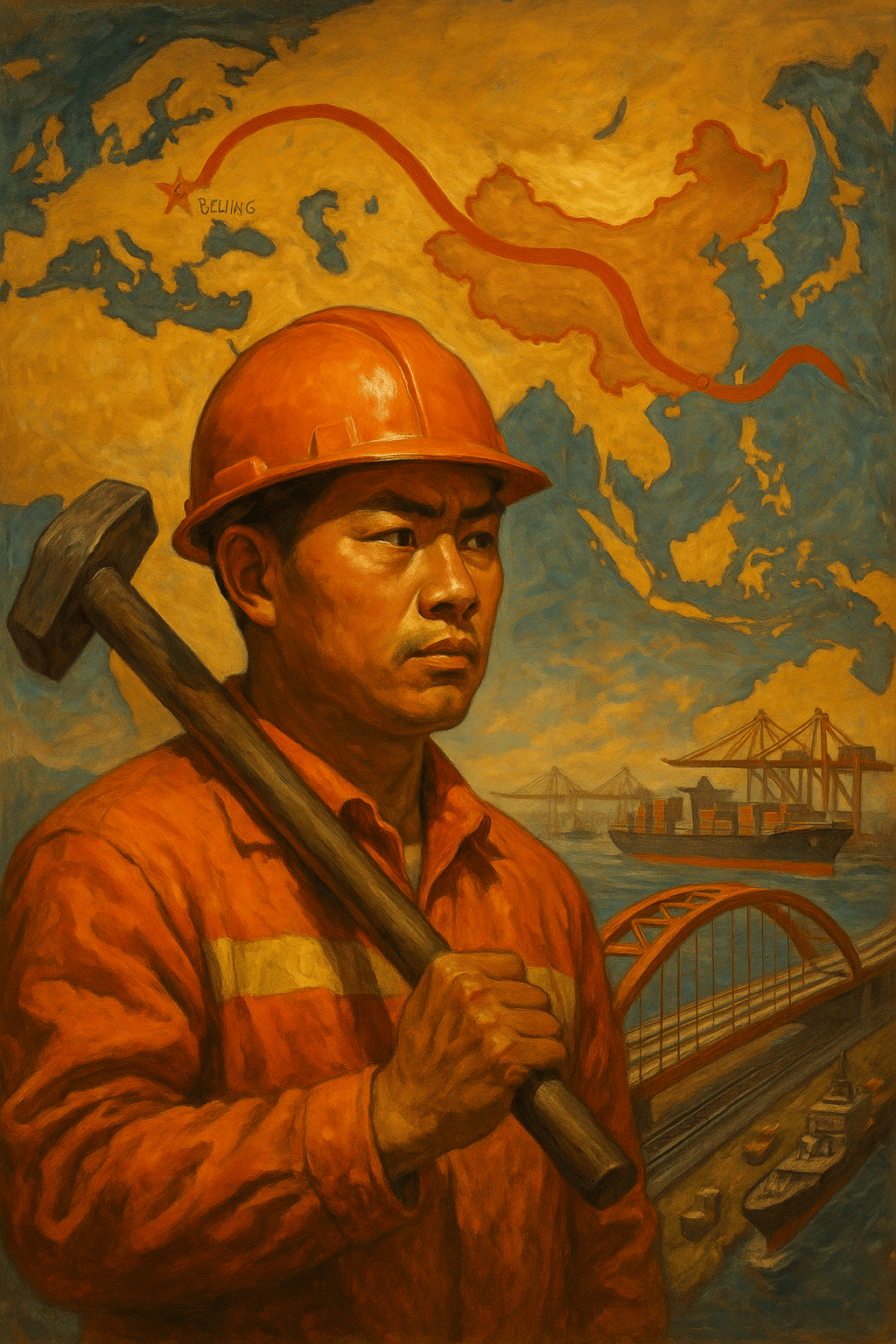
When the imperial press screams “debt trap,” that’s usually the sound of empire losing its grip.
By Prince Kapone | Weaponized Information | July 10, 2025
Soft Words for Hard Power: The Imperial Alibi of Triangular Cooperation
When China builds a railway in Ethiopia, connecting Addis Ababa to Djibouti’s ports in under ten hours, it’s branded a “debt trap.” When the IMF demands austerity, slashing Zambia’s health budget to pay Western bondholders, it’s called “reform.” This is the language of empire, a slick doublespeak that masks sabotage as salvation. On July 9, 2025, The Diplomat published “Beijing’s Triangular Play: Weaving Development, Diplomacy, and Multilateralism,” a masterclass in this deception. Authored by Gu Bin, a doctoral candidate at Singapore’s RSIS think tank, the piece cloaks imperial anxiety in academic calm, warning that China’s “triangular cooperation”—joint development projects with third countries or multilateral partners—signals a cunning power grab. Don’t be fooled. This isn’t analysis. It’s propaganda in a pinstripe suit.
Gu Bin’s credentials seem neutral, but his institutional roots betray the game. RSIS, the Rajaratnam School of International Studies, is no ivory tower—it’s a cog in the U.S.-aligned security machine, funded by Singapore’s Ministry of Defence and cozy with Lockheed Martin’s security forums and U.S. embassy policy networks. Gu’s article isn’t scholarship; it’s clerical service to empire, laundering the fears of a declining hegemon through footnotes and jargon. The Diplomat itself, Tokyo-based and wired to Western think tanks like CSIS and the Atlantic Council’s Global China Hub, plays stenographer to U.S. Indo-Pacific strategy. Its pages amplify containment without ever saying the word, a regional megaphone for the Pentagon’s talking points.
The article’s weapon of choice is Discursive Pacification—a tactic that smothers imperialist narratives in bureaucratic velvet. Gu never accuses China outright. Instead, he deploys loaded phrases like “calculated adaptation,” suggesting Beijing’s aid is a Trojan horse for geopolitical dominance. Take his claim that China’s training programs with Singapore for ASEAN nations are an “evolving strategy to entrench influence.” The phrase drips with suspicion, implying manipulation without evidence, framing China’s every move as a chess play rather than a response to Global South demands. It’s a rhetorical sleight-of-hand, turning infrastructure into intrigue while ignoring the roads, schools, and grids China delivers.
Worse, the piece infantilizes Global South nations. When Timor-Leste or Bangladesh join China and Singapore in trilateral initiatives, Gu calls it “hedging”—as if these states lack the agency to choose their partners. This is the old colonial playbook: deny the South strategic clarity, paint their decisions as reactive or coerced.
The article’s most insidious move is its backhanded praise. Gu lauds China for aligning with “global development norms,” as if legitimacy depends on mimicking Western models. It’s a trap: Beijing can build bridges, but only if it bows to the West’s rules. This is empire’s performative tolerance—China is welcome to participate, but never to lead.
Even the history of triangular cooperation is whitewashed. Gu traces it to the 1978 Buenos Aires Plan of Action (BAPA), but conveniently forgets how the West hijacked this Global South initiative. By the 1980s, the OECD-DAC cartel repurposed triangular aid to tether South–South partnerships to Northern oversight, ensuring no solidarity could bloom without Western strings. China’s use of the format today isn’t mimicry—it’s subversion, turning an imperial tool into a platform for mutual gain. This isn’t the story Gu tells. His version is a containment narrative, framing China as suspect, its partners as dupes, and the West as the eternal referee of “proper” development. It’s not commentary—it’s counterinsurgency.
The Facts Buried Beneath the Buzzwords
Strip away the buzzwords—“capacity building,” “recipient-driven cooperation,” “future-oriented partnerships”—and what’s left? A quiet, stubborn truth: the Global South is making moves, and China’s not just a guest at the table—it’s building it. Since 2018, Beijing has scaled up its development diplomacy through the China International Development Cooperation Agency (CIDCA), working with Singapore to train officials from ASEAN and Timor-Leste, hosting trilateral summits with Pakistan and Bangladesh, and pushing its Global Development Initiative through UNDP and regional platforms. This isn’t just talk. A 2022 SAIS-CARI study found that 65% of China’s development finance in Africa has gone to tangible, sovereign infrastructure—energy grids, highways, rail systems. Not PowerPoints. Not pilots that disappear when the money dries up. We’re talking roads that carry harvests, not hype. We’re talking cables, not consultants.
But the article in The Diplomat plays coy, carefully sidestepping the skeleton holding up the whole aid system. There’s no mention of the OECD’s Development Assistance Committee (DAC), the Western donor cartel formed in 1970 that decides what counts as “real” aid and who gets to give it. The U.S., EU, and Japan sit at the head of that table. They made the rules: privatize your water, deregulate your farms, slash your education budget—and then maybe, just maybe, you’ll qualify for a loan. China never signed up for that game. It walked around the table entirely. That refusal isn’t passive. It’s a rebellion, a brick thrown at the window of neoliberal development orthodoxy.
| Donor | Outcome |
|---|---|
| China | Addis-Djibouti Railway, 65% infrastructure investment (SAIS-CARI, 2022) |
| West | 78% USAID funds to contractors, not schools or clinics (SIGAR, 2023) |
And while we’re on the subject of silence, let’s talk about the trillions funneled into Western aid boondoggles. The 2023 SIGAR report makes it plain: more than 78% of USAID’s funds in Afghanistan between 2002 and 2021 didn’t rebuild schools or clinics. They went to war contractors and private security firms. In sub-Saharan Africa, Western “assistance” mostly evaporates into the pockets of foreign consultants who hold workshops no one remembers. Meanwhile, Afrobarometer surveys across Ghana, Nigeria, Kenya, and Uganda show something different: when Chinese aid arrives, things get built. Roads. Hospitals. Power plants. The kind of stuff people can actually touch. The kind of stuff the West hasn’t delivered since the Marshall Plan—and even then, only to white Europeans.
Take Zambia. In 2023, it was China—not the IMF, not the Paris Club—that stepped up to restructure $6.3 billion in external debt without demanding austerity. No mass layoffs. No gutted healthcare budgets. No “fiscal discipline” sermons. Just space for a country to breathe. Compare that to Bolivia, where water privatization triggered an uprising, or Haiti, where IMF reforms devastated local agriculture in favor of cheap U.S. imports. The West arrives with a calculator and handcuffs. China brings rebar and laborers. That’s not romanticism—it’s concrete.
Even the idea of “triangular cooperation” gets scrubbed clean. The article name-drops the 1978 Buenos Aires Plan of Action but forgets the part where it got steered off course. BAPA was born from the dream of South–South solidarity, a call for coordination outside the empire’s grip. But within a few short years, the OECD‑DAC began shaping the narrative, branding triangular cooperation as a space for “mutual learning” while quietly reasserting Western oversight. Aid norms were rewritten in the language of accountability, transparency, and efficiency—but always defined on neoliberal terms. What was once a project of liberation was nudged toward compliance. China’s reentry into this terrain isn’t mimicry—it’s insurgent revision. Where the West used triangular deals to insert banks and contractors, China uses them to build railroads and clinics. That’s not cooperation under empire. That’s defection from it.
Then there’s the elephant with the CIA badge: USAID. The agency isn’t just about food aid and textbooks. It’s always had a double life—as a front for U.S. intelligence. Since its founding in 1961, USAID has worked hand-in-glove with the deep state, from Latin America to Africa to Southeast Asia. It funds friendly NGOs and opposition parties, infiltrates movements, and helps grease the skids for regime change. None of this is acknowledged. Nor is the fact that the IMF and World Bank use debt like a cattle prod, forcing entire nations into submission—privatizing Tanzania’s water, deregulating Haiti’s markets, auctioning off the future to preserve the illusion of solvency. This isn’t a conspiracy theory. It’s just history the empire doesn’t like to see in print.
So why do countries turn to China? Because they’re not stupid. Because they remember what happened when they believed the West. Because they know what it means to be promised partnership and handed a chain. When the West shows up with a slide deck and China shows up with an excavator, it’s not a hard choice. The Kenyan Standard Gauge Railway transformed regional freight transport—cutting the Mombasa→Nairobi trip from about 10 hours to ~5 and slashing delivery times and costs according to Kenya Railways and multiple sources. No consultant ever did that. Sovereignty today doesn’t live in slogans—it lives in cement, copper wire, and bridges that don’t collapse. The Global South isn’t looking for charity. It’s building a future, brick by brick, outside the master’s house. And it’s not asking for permission.
Steel and the Interregnum
The global economy isn’t an open field—it’s a killbox. The empire’s Sanctions Architecture is a lattice of financial landmines: SWIFT cutoffs, dollar weaponization, IMF conditionalities, and undersea cable monopolies. It’s how Venezuela was barred from importing insulin. It’s how Zimbabwe was choked by offshore banks. These aren’t policies—they’re siege weapons dressed in suits. The terrain China moves through is this scorched earth, where any attempt to breathe outside Washington’s script gets met with legal warfare and economic strangulation. When China builds the Vientiane-Boten Railway in Laos or lays power grids across Ethiopia, it’s not because Beijing is a benevolent giant. It’s because the South needs exits. And China, for now, is laying down tracks where the West plants tripwires. This is not escape from empire’s battlefield, but a strategic rerouting—a counteroffensive carved in steel and concrete.
This isn’t some utopian alternative. It’s a form of Value Chain Subversion—a socialist state navigating a capitalist world with steel and leverage instead of bombs and signatures. China’s state-owned firms like CREC or PowerChina don’t operate like Exxon or Bechtel. They build ports and railways, but they answer to a state agenda, not shareholder greed. Kenya’s Chinese-financed Standard Gauge Railway bypassed IMF plans to privatize Mombasa port. That’s not development—it’s counteroffensive infrastructure. These are anti-imperial arteries carved out of imperial terrain. When CASIC installs fiber-optic networks in Uganda, it’s not about techno-utopia. It’s about replacing Facebook’s digital plantation with local capacity. State capital × anti-imperial sovereignty = infrastructure that de-fangs dependency.
Now compare that to the empire’s preferred export: Necro-Extractivism. In Zambia, Glencore poisons rivers while gutting jobs—Kansanshi mine profits in blood. In Haiti, IMF reforms dismantled local rice production and replaced it with starvation. These are not development failures—they’re blueprints. The imperial economy profits not in spite of death, but through it. Meanwhile, China builds vocational schools, railways, and energy plants. Are they flawless? Of course not. Environmental degradation, labor suppression, and elite deals persist. But these contradictions exist within a structure that builds bandwidth, not mass graves. One leaves cancer clusters. The other leaves cranes.
The global shift toward multipolarity isn’t salvation—it’s scaffolding. BRICS+ is not the new Comintern. But when the New Development Bank expands local currency lending, it builds a trellis for sovereignty to climb. The African Union’s payment systems don’t overthrow the dollar, but they armor cross-border trade from SWIFT’s guillotine. CELAC isn’t socialism reborn, but it’s a blow against hemispheric obedience. These are breathing spaces—not end goals. In a world where obedience is purchased with food insecurity, oxygen is a revolutionary asset. When Niger expels French troops to protect its uranium, or Cuba trades medicine with BRICS partners despite U.S. blockades, these are not just policies—they’re scaffolding for a world where sovereignty isn’t a slogan.
The West’s question—“Is China the new empire?”—misses the plot. It’s not about romanticizing Beijing. It’s about reading the map correctly. China doesn’t overthrow empire. It exploits the cracks in its walls, then installs scaffolding. Its cranes are not symbols of liberation. But they are the tendons of a dual and contending power in a dying unipolar order. Its financing doesn’t erase contradiction. It buys time. It builds leverage. It lays bricks before blueprints.
So when China steps into triangular cooperation, don’t mistake it for mimicry. It’s reversal. It’s reclamation. Triangular aid was hijacked by the OECD to launder imperial control through “South–South” language. China’s version pries it back—building training centers in Timor-Leste, not surveillance hubs; laying fiber optics, not conditionality. Where coups once traveled, freight now runs. Where USAID once funneled destabilization, cranes now raise vocational schools. That’s not revolution in form—but it is revolution in function. A future doesn’t arrive from declarations. It arrives in power cables, in reinforced bridges, in the widened roads where the masses will march—not with permission, but with purpose.
Mobilization: Breach the Corridors, Break the Siege
If we in the imperial core are serious about supporting a multipolar world, we need to stop talking like it’s a metaphor and start organizing like it’s a frontline. Triangular cooperation isn’t just a headline on a diplomatic memo—it’s a signal. A flare shot across the sky from the trenches of the Global South. It means the siege is shifting. And the question now is: will we help break it, or just watch from our windows while pretending neutrality is still an option?
Start with the money. You want to know who actually enforces the imperial chokehold? Look at your bank account. Citibank is the U.S. Treasury’s primary dollar-clearing agent for cross-border transactions. It’s not just holding your paycheck—it’s holding the lever that makes sanctions stick. Venezuela can’t buy dialysis machines? That’s Citibank. Syria can’t get wheat? That’s Citibank. If you still bank with them, you are holding shares in blockade enforcement. Move your money. Tell your comrades. Tell your union. Divest.
Next: name the names. The same World Bank officials who locked Sri Lanka into dollar dependency are now “senior fellows” at the Atlantic Council. The IMF’s Africa desk is stacked with former Citigroup economists and USAID contractors. It’s a revolving door of plunder dressed in policy jargon. That door won’t close unless we start jamming it. So jam it. Use your platforms. Use FOIA. Use investigative tools like the IMF-Watch Directory or Corporate Watch. Launch a campaign to expose every official who helped engineer economic sabotage in the name of “aid.” Force them into the light. Not to shame them—to neutralize them.
But don’t stop there. This is not just about naming villains. It’s about building alliances across borders. Support the African Rising in Kenya—where Chinese infrastructure gave workers jobs, but Western media gave them propaganda. Help cover legal fees. Spread their story. Make it clear: we hear you, we see you, and we’re not watching from a distance anymore. Every time a Western outlet smears Chinese development as “neocolonial,” we should be amplifying the workers who actually built those railways, staffed those factories, and want more—not less—South-South investment.
This is not about hero worship. It’s not about defending China from critique. It’s about defending reality from distortion. It’s about standing with the global working class, not the Wall Street–Langley think tanks that cloak their sabotage in humanitarian language. It’s about breaking the algorithm of silence that keeps workers in Detroit alienated from miners in Congo, or students in Berlin disconnected from port workers in Indonesia. The multipolar world is not some abstract thesis—it’s being built right now in fiber optic cables, in barter trade deals, in mutual aid clinics, in protests against the IMF. And if we want to live in that world, we better learn to fight for it.
The imperial machine runs on amnesia. It counts on you forgetting what was done in your name. So remember. Remember the coups. The famine sanctions. The stolen elections. The privatized water. The NGO lies. And remember this: the Global South is not waiting for us to join. They’re already moving. The question is whether we’ll catch up—or stay shackled to the fantasy of benevolent empire.
If you’re in the Global North, your role is not to lead. It’s to flank the enemy from within. Dismantle the propaganda labs. Block the banks. Hack the narrative. Fund the struggle. And most of all—listen to the South, not with pity, but with political discipline. Because solidarity is not charity. It’s sabotage.
 Weaponized Information
Leave a comment