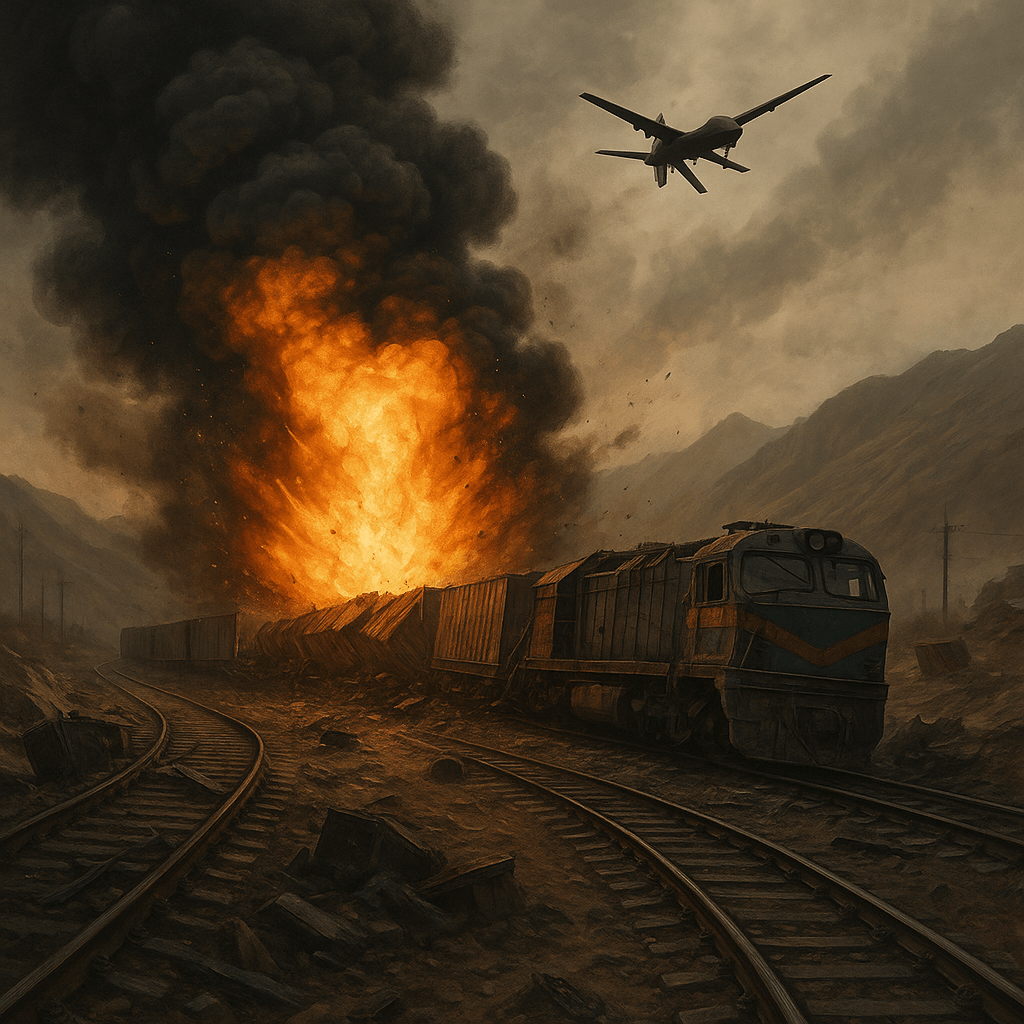
U.S. airstrikes on Iranian infrastructure didn’t just target uranium—they struck at the arteries of Eurasian integration. As trade routes reroute and alliances recalculate, Central Asia is learning in real time what American friendship really means.
By Prince Kapone | Weaponized Information | July 3, 2025
Collateral Optics: The Propaganda Function of Clean War Narratives
On July 2, The Diplomat published an article titled “The U.S. Aimed at Iran But Might Have Hit Central Asia.” The piece, written by James Durso, claims to assess the regional blowback from U.S. airstrikes on Iranian nuclear infrastructure. But it doesn’t interrogate the bombing itself—only its efficiency. The damage to supply chains is framed as unfortunate fallout. The logic of war is never questioned, only its consequences managed. This is not journalism. It’s logistical damage control—written to reassure the imperial core that things remain mostly under control, even when war doesn’t go as planned.
The author, James Durso, is a 20‑year U.S. Navy logistics officer turned foreign‑policy consultant. He currently heads Corsair LLC, a supply‑chain consultancy that works on defense and energy infrastructure in the Middle East. Durso is also a regular contributor to institutions like the Quincy Institute for Responsible Statecraft and The Hill, outlets known for their alignment with neoconservative and U.S. interventionist perspectives. Durso’s class position is clear: not a neutral analyst, but a logistics manager for empire—tasked with translating warfare into boardroom language and geopolitical violence into supply‑chain metrics.
The Diplomat, his publisher, markets itself as a platform for “Asia-Pacific insights.” In practice, it acts as a narrative relay station for Western foreign policy. Funded by ad partnerships with global consulting firms and militarized think tanks, its editorial board includes former U.S. State Department officials and security analysts. Its role in the information ecosystem is not to report imperial crimes—but to reframe them in the language of “stability,” “interdependence,” and “risk mitigation.” In this case, the narrative is crafted to normalize the bombing of a sovereign nation while displacing accountability onto abstract regional dynamics.
The first narrative device deployed is consequence laundering. The article opens with concern for Central Asia—trade disruptions, port insecurity, risk premiums—but never mentions that these disruptions were triggered by U.S. and Israeli bombs. The cause vanishes; only the effect is named. This erasure performs what we identify as Cognitive Warfare: the manufacturing of selective visibility. By centering fallout and omitting origin, the reader is coaxed into feeling concern without critique.
Second is the tactic of managerial reframing. Iran is not discussed as a sovereign state defending its infrastructure, but as a node in a volatile network. Trade agreements with Uzbekistan, Turkmenistan, and Kazakhstan are framed as regional instability risks, not as strategic acts of integration. Violence is stripped of politics, reduced to fluctuations in shipping costs. The reader is guided away from questions of legality, sovereignty, or resistance—and toward questions of efficiency.
Third, Durso deploys strategic ambiguity. U.S. motives are never examined. The reader is told that the U.S. “might have” harmed Central Asia, as if the world’s most militarized state accidentally dropped missiles onto a trade corridor it has spent two decades trying to block. There is no timeline. No sanctions history. No mention of the long war to prevent Iran from becoming a regional logistics hub. By evacuating history, Durso invites amnesia—and thereby normalizes escalation.
Fourth is the use of technocratic flattening. Leaders like Mirziyoyev are depicted not as political actors navigating imperial pressure, but as administrators responding to “uncertainty.” Their agency is abstracted. Their decisions are reduced to rerouting cargo. We’re told that instability “could raise logistics costs by 30%,” but not that U.S. missiles caused the instability. This is how war becomes a spreadsheet problem.
Fifth: moral equivalence through omission. The article lists dozens of Iranian integration efforts—railway links, port access, energy cooperation—but provides no editorial comment. There’s no acknowledgment that these are the very routes empire seeks to block. Iran is treated as a background actor, its ambitions suspect, its development peripheral. The U.S. and Israel, on the other hand, are mentioned only in procedural terms—”launched airstrikes,” “concerned about enrichment”—without scrutiny or judgment. The asymmetry is the story.
Finally, there’s the tone itself—detached, antiseptic, almost bored. The human costs of war are absent. The freight is what matters. The reader is invited to care more about disrupted grain shipments than dead Iranian scientists. It is propaganda dressed in policy language. Violence sanitized into cost-benefit analysis. This is how empire speaks to itself when it wants to look professional.
In sum, what The Diplomat provides is not explanation—it’s insulation. From its omissions to its framing devices, the article performs narrative triage for U.S. empire. It doesn’t challenge aggression. It manages the optics. And James Durso, far from being a detached observer, plays his part dutifully: tracking the wreckage while pretending not to see who pulled the trigger.
The Sabotaged Corridor: What the Article Won’t Say
The Diplomat’s article lists events like a corporate press release: the U.S. and Israel launched airstrikes on Iran; trade routes in Central Asia began to seize up; regional leaders voiced concern. But what’s left unsaid is what matters most. There is no mention that these strikes followed Washington’s unilateral withdrawal from the JCPOA in May 2018—a decision that shattered the legal framework underpinning Iran’s trade normalization. There is no timeline of coordinated economic warfare, no tracking of regional dependency shifts, and no admission that this airstrike wasn’t the start of a conflict, but the continuation of one by other means
To its credit, the article admits that Iranian–Central Asian integration has accelerated in recent years. It notes that Iran’s free trade agreement with the Eurasian Economic Union came into force on May 15, 2025, marking a major opening of Iranian markets to the EEU. It acknowledges long-term efforts to connect Iranian ports to Uzbek and Turkmen logistics. It even references Iran’s position as a regional hub for oil, gas, agriculture, and industrial inputs. But none of these facts are situated in their actual political stakes. We are told that “instability” may raise logistics costs. We are not told that the U.S. seeks to collapse an entire corridor before it can solidify.
Consider what’s missing. After the June strikes, cargo deliveries through Chabahar and Bandar Abbas were delayed for over a week, affecting planned imports from Turkmenistan and Uzbekistan. These ports—especially Chabahar—are the lifelines for Central Asia’s ocean access. But the article mentions only “potential disruption,” sidestepping the reality that bombs targeted the very infrastructure through which regional autonomy is being built.
Nor does the article acknowledge the International North–South Transport Corridor (INSTC)—a 7,200 km multimodal project linking India, Iran, Russia, and Central Asia—as anything more than a trade initiative. In fact, it has been a central target of Western sanctions and security pressure for over a decade. When Iran’s trade with Russia surged by 30% in 2024, Western insurers withdrew coverage for joint cargo. This isn’t market correction. It’s coordinated deterrence.
Similarly absent is any mention of UN Special Rapporteur Alena Douhan’s 2022 report, which explicitly condemned U.S. sanctions as illegal under international law and highlighted their devastating impact on energy transport and port maintenance. Instead of addressing this, The Diplomat gives us a cost‑risk calculus. A bombed port becomes a line item in a trade outlook, not an act of aggression. When Uzbekistan “redirects trade,” it’s not depicted as coercion—it’s reported as efficiency.
Meanwhile, the article lists impressive bilateral developments:
- Iran–Turkmenistan roadmap aiming for $3 billion in trade
- Kazakhstan commits to 75 product lines to Iran valued at about $250 million
- Iran–China Xi’an–Tehran rail line launched in May 2025
But it avoids mapping the strategic implications: that these agreements amount to a quiet rebellion against Washington’s control over infrastructure, freight, and energy transit.
Perhaps most telling is the omission of regional reaction. When Kazakhstan, Turkmenistan, and Uzbekistan formed a trilateral task force in June 2025 to protect sovereign freight networks, it represented a clear rejection of U.S. militarization. This development is nowhere mentioned in the article. Instead, the reader is offered vague gestures toward “safety concerns” and “route recalculation.” No mention of who threatens the routes. No mention of how regional actors are resisting—not rhetorically, but materially.
The result is a narrative that gestures toward regional concern while stripping it of depth. Every statistic becomes inert. Every disruption is decontextualized. Every agreement is framed as fragile. What’s buried beneath this is a long war—on ports, on railroads, on the right of sovereign nations to choose their trade partners without asking permission. The Diplomat shows us the tremors, but never names the fault line. That task, as always, is ours.
Infrastructure as Insurrection: The Freight Wars of a Fading Empire
The bombs that fell on Iran in June 2025 weren’t just military actions—they were supply chain preemptions. They were designed not to defeat Iran in a war, but to reroute history before it arrives. Washington wasn’t just targeting enrichment facilities—it was targeting corridors, terminals, pipelines, ports. The strike wasn’t only about what Iran had. It was about what Central Asia was building with it: a logistics map that no longer begins and ends in the West.
That’s the part The Diplomat refuses to name. It describes “regional instability,” “disruptions,” and “cost increases,” but never says what’s actually at stake: control over the architecture of connection. The U.S. isn’t at war with volatility. It’s at war with alternatives. The moment the Belt and Road reached Iranian soil, the logic of empire snapped into countermeasures. And that’s what the airstrikes were: not miscalculations, but calibration. A violent course correction to reimpose dependence on Western trade routes, insurance regimes, and port franchises.
This is the clearest expression of what we name logistical imperialism: not the direct occupation of land, but the indirect occupation of movement. When Washington can dictate which ship offloads at which terminal, when and how, it no longer needs garrisons. It governs through spreadsheets and satellites. But when nations like Iran, Kazakhstan, and Turkmenistan begin linking themselves through rail and pipeline, bypassing imperial nodes, that governance becomes fragile. That’s when the bombs start falling.
But military pressure is only one layer. The deeper scaffolding is what we call the sanctions architecture: the coordinated machinery of financial throttling, customs enforcement, and legal isolation that makes trade with the “wrong countries” dangerous, expensive, or impossible. The Diplomat mentions none of this. It omits the fact that Iran’s ports are blacklisted by global insurers, that Eurasian shipping lanes are tracked by compliance algorithms, and that even data sharing between regional customs unions triggers OFAC red flags. The bombing wasn’t a deviation—it was enforcement.
And here’s where the ideology begins to crack. Because what Washington calls instability is often just sovereignty trying to breathe. The real “risk” in Chabahar, in the INSTC, in Xi’an–Tehran rail, is not conflict. It’s self-determination. The empire’s systems were built on the assumption that no viable alternative could exist. Now that assumption is breaking. Every delayed cargo from Bandar Abbas, every sanctions workaround through Turkmen freight, is a small act of rebellion. And small rebellions, repeated enough, become rupture.
That rupture is already visible in what we name hyper-imperialism: a form of power that no longer needs to dominate by military presence, but instead by digital enforcement. The empire now governs through container visibility platforms, maritime risk models, and predictive logistics engines. A port like Chabahar doesn’t have to be bombed every month—it just has to be flagged in the algorithm. Trade flows die by data. And when that doesn’t work, the warplanes return.
What we see in response is not a retreat, but a redirection. Central Asia is not collapsing into compliance. It is adjusting its angle. The trilateral task forces forming between Kazakhstan, Turkmenistan, and Uzbekistan aren’t just bureaucratic responses. They are embryonic forms of what we call dual and contending power: sovereignty struggling to consolidate itself under the shadow of empire. These are not fully liberated blocs. But they are contested zones—where state actors begin to act as insurgents, and every mile of rail laid is a step toward disobedience.
And what of Iran? The article paints it as a passive node, a risk factor in regional spreadsheets. But Iran is not a side story—it’s the hinge. It connects China to Europe, Central Asia to the Indian Ocean. Its refusal to collapse under two decades of siege is a material threat to empire’s geography. That’s why it’s bombed. That’s why its trade partners are threatened. And that’s why even agreements as ordinary as a wheat shipment from Almaty to Tehran are treated like provocations. Because they are.
What this moment reveals is that we are not in a temporary conflict. We are inside a terminal contradiction. The U.S. cannot permit the world to move unless it controls the map. But the map is redrawing itself. And no amount of airstrikes can fully erase what’s already underway: ports opening, railways linking, contracts signed without permission. That’s not volatility. That’s freedom under construction.
From Exposure to Action: Blocking the Bomb, Building the Bridge
The freight war is not over there. It’s here. It lives in the ports we pass, the servers we use, the logistics firms our pensions are invested in. It’s not enough to name the violence—we have to intervene in the system that makes it profitable. If empire bombed a rail corridor to disrupt Eurasian integration, then our job in the core is to do the opposite: build solidarity corridors from below, block the digital scaffolding of sabotage, and link arms with those already resisting along the tracks.
Let’s begin with material solidarity. In the wake of the June airstrikes, Iranian rail workers and freight-union delegates faced delayed payments and work stoppages across southern rail lines. Their counterparts in Turkmenistan and Uzbekistan are under informal blacklists, enforced not by law but by maritime insurance refusals and U.S.-compliant freight algorithms. These are not technical glitches—they are economic bullets. Support must be routed through trusted nodes: the Iranian Diaspora Collective in Berlin has already coordinated targeted remittances to rail unions in Mashhad and Bandar Abbas. Expand it. Fund it.
Second, organize your labor structures. U.S.-based logistics workers—at UPS, Maersk, Amazon Freight—must be politicized around corridor sabotage. Use workplace organizing to track subcontractor contracts connected to “sanctions compliance.” Build cells that can collect internal data, flag military-linked shipments, and expose which ports are enforcing embargoes on behalf of empire. Make sure every freight disruption has a human face behind it—and a leak.
Third, take the fight to the data layer. The digital systems underpinning empire’s freight war are built on compliance APIs, threat detection models, and proprietary tracking dashboards. You don’t need to “hack” them—you need to flood them. Activate Proletarian Cyber Resistance tactics: coordinated scrapes of publicly available customs logs, simulated shipment entries to corrupt algorithmic trendlines, metadata overlays to confuse visibility dashboards. These are not “cyberattacks.” They are strategic digital noise: worker-led information sabotage against automated imperial logistics.
Model your tactics on precedent. The BDS “Apartheid‑Free Zones” campaign maps corporate complicity in Zionist violence. We need the same for Eurasian freight sabotage. Build a live database tracking which insurers, freight forwarders, and customs brokers are enforcing empire’s embargo matrix. Call it: Who Blocks the Bridge? Crowdsource the data. Visualize the routes. Translate it into Russian, Persian, Turkish, Uzbek. Let the corridor speak in the language of resistance.
And finally, sharpen your study groups. Political education is not a side project—it’s the foundation. Use WI’s essays like Encirclement and Empire and Multipolar Hinge to break the illusion that logistics is neutral. Pair them with frontline dispatches from port workers, trucker blockades, and diasporic organizers. The line between infrastructure and liberation has never been clearer.
The bombs fell. The corridor held. Our task now is simple: protect it, expand it, weaponize it in reverse. Because empire cannot bomb every rail line. It cannot sanction every worker. And it cannot algorithm its way out of a world that is already in motion.
 Weaponized Information
Leave a comment