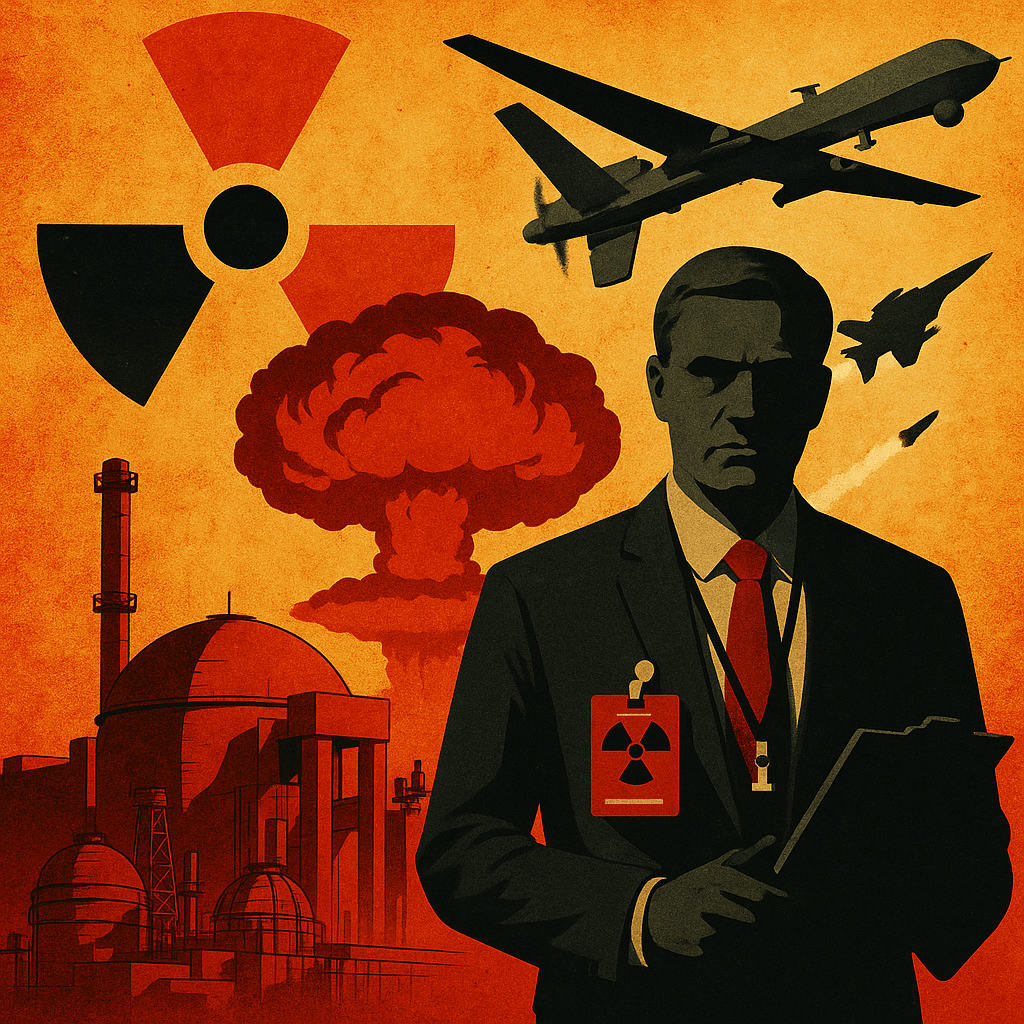
How a former MI6 officer embedded in the IAEA transformed audits into airstrikes, and inspections into war infrastructure.
By Prince Kapone | Weaponized Information | July 3, 2025
From Inspection Report to Assassination Protocol: The Bureaucrat Who Pulled the Trigger
June 13: Israeli warplanes strike Iranian nuclear research facilities, killing nine scientists and engineers.
June 22: the United States joins in, launching Operation Midnight Hammer, bombing Fordow, Natanz, and Isfahan.
June 30: Iran expels Nicholas Langman, Deputy Director of the IAEA, from its territory.
That’s the sequence. Not the one Reuters ran with—but the one that actually unfolded. And when the events are placed in order, the narrative falls apart like an expired sanction. Langman wasn’t kicked out because Tehran threw a tantrum. He was expelled because his clipboard became a missile. The man didn’t just document reactors. He mapped targets. His audit trail fed a kill chain. And when the drones hit, his name was on the invoice, not the obituary.
The Western media performed its usual mop‑up operation. “Iran expels top UN nuclear inspector,” announced Reuters, presenting Langman as a professional pencil‑pusher wronged by a rogue regime. Rafael Grossi, head of the IAEA, did his routine. Iran’s action, he claimed, was “damaging international trust.” Not a single outlet asked how expelling a British operative could possibly be more provocative than the bombings that preceded it. No one bothered to explain why “trust” only ever flows from South to North. And absolutely no one told you who Langman actually was.
Langman wasn’t just some man in Vienna with a badge and a blazer. From 2010 to 2018, he served in MI6, Britain’s foreign intelligence service, embedded in the Iran Strategy Group—a multi-agency unit that specialized in soft sabotage and covert escalation. He transitioned to the IAEA in 2020, right when the U.S. and Europe were intensifying pressure on Iran after Trump pulled out of the nuclear deal. As The Grayzone exposed, Langman’s job was not technical. It was tactical. He laundered intelligence through inspection protocols, embedded “anomaly” flags into bureaucratic memos, and mapped sensitive infrastructure under the cover of multilateral neutrality. He didn’t deter strikes—he enabled them.
This is how information war is waged now. First, you frame the target: Langman’s removal gets described as irrational and escalatory, even though it came more than a week after an Israeli airstrike that killed nuclear scientists using data tied to IAEA visits. Then, you omit the facts: no one mentions Langman’s MI6 background, no one traces the timeline between audit reports and drone payloads, no one admits that inspections have been turned into recon missions. Finally, you summon sentimentality: Grossi invokes “trust” like it’s a sacred principle rather than a leash used to strangle sovereign states. This isn’t diplomacy—it’s warfare in a blazer and lanyard.
The entire story rests on a sacred myth: that the IAEA is neutral. So let’s look at the numbers. Israel has never signed the Non-Proliferation Treaty. It holds over 400 undeclared nuclear warheads. No inspections. No oversight. No sanctions. Iran, on the other hand, is a signatory. It allows inspectors into its facilities, signs onto enrichment limits, and complies with protocols—and still gets bombed. This isn’t oversight. This is what we call colonial calibration: a system where the colonized are monitored, measured, and punished, while the colonizer does as he pleases, with no questions asked.
When the IAEA audits Iran, it isn’t merely monitoring uranium levels—it becomes a node in a broader intelligence network. Iranian state media reported that confidential letters sent to the IAEA—listing nuclear scientists—were passed to Israeli intelligence and led to targeted killings. While the IAEA’s technical mandate remains nuclear verification, the site-access metadata, convoy observations, and behavioral logs its teams collect can be repurposed as raw targeting intelligence. That latent function isn’t a glitch—it’s baked into the system.
Langman’s defenders will say he was just a professional following procedure. But so was the colonial surveyor who mapped Indigenous land before the army came. So was the anthropologist who cataloged tribal customs before the forced relocations. So was the IMF accountant who “audited” Ghana before selling off its commons. Langman isn’t an aberration—he’s the upgrade. The modern imperial operative wears a suit, files reports, and codes compliance language. Where gunboats once sailed, now Excel files glide. Where once the strike came before the inspection, it now arrives right after the Google Sheet is uploaded.
So let’s go back. June 13: Israeli warplanes hit Iranian scientists. June 22: U.S. warplanes follow. June 30: Iran ejects Langman. That’s when the Western press declares a crisis. But the crisis didn’t begin with Langman’s revoked visa. It began when nuclear inspections were converted into assassination checklists. When a monitoring agency became a logistics firm for missile strikes. Langman wasn’t punished for breaking the rules. He was removed for executing them exactly as intended. Rules written not to safeguard peace, but to manufacture deniability. In the IAEA’s hands, “verification” became the syntax of war. And Nicholas Langman? He was its designated triggerman.
When Bureaucracy Becomes Battlefield
The war on Iran didn’t begin with fighter jets. It began with a form field. Long before June’s air raids, the empire had already automated aggression—translating policy into platform, and diplomacy into data. No declarations. No invasions. Just compliance reports, audit flags, and spreadsheet-based siegecraft. The IAEA stood at the center, no longer neutral, but recalibrated—serving not as a brake on escalation, but as its staging interface.
This architecture has been years in the making. In 2010, the UN Security Council passed Resolution 1929. A month later, the U.S. codified CISADA, a sanctions regime that made access to the global financial system contingent on political obedience. By 2012, Iran was booted from SWIFT entirely. The logic wasn’t legal—it was infrastructural. FINNet compliance systems flagged accounts, froze transactions, and blacklisted entire sectors. Chainalysis, a crypto-surveillance firm tied to U.S. intelligence, joined the effort. The result was a weaponized bureaucracy: algorithmic strangulation disguised as nonproliferation.
The consequences were brutal. Between 2012 and 2019, Iran lost over $50 billion per year in oil revenue. Clinics ran out of cancer medication. Dialysis machines sat idle. Insulin was rationed like contraband. Children died waiting for medicine. And still, U.S. officials insisted the sanctions were “targeted.” But there were no bombs. Just screens, workflows, and denials.
The IAEA made that fiction sustainable. Its reports provided the moral syntax. With each flagged anomaly—“unusual readings,” “pending clarification”—the illusion of neutrality held, even as the noose tightened. Inspections weren’t about confirming violations. They were about codifying suspicion. And suspicion, rendered in bureaucratic language, became the engine of escalation.
Then came the payload. On June 13, Israeli jets bombed Iranian nuclear research facilities. The justification? A leaked internal IAEA report, citing inconsistent radiological data near Esfahan. Ten days later, the U.S. launched Operation Midnight Hammer, targeting the same zones—Fordow, Natanz, Isfahan. These were not misunderstandings. These were missile strikes synchronized with metadata.
And the metadata contradicted the mission. The IAEA’s own 2023 Safeguards Statement found no evidence of nuclear material being diverted for weapons use. A previous report in 2021 (GOV/2021/42) acknowledged that even with 60% uranium enrichment, it would take months of sustained, detectable effort to reach weapons-grade. None of that effort was observed. But accuracy was never the objective. Ambiguity was. Because ambiguity generates options. And options justify strikes.
This is how modern empire operates: through plausible suspicion, not proven guilt. Through procedural opacity, not transparency. And at its core sits a transnational enforcement machine that disciplines some states while exempting others entirely. Israel, whose nuclear program sits outside every treaty and beyond all inspection, audits no one and answers to nothing. Iran opens its doors and is bombed through them.
So when Iran expelled Langman on June 30, it wasn’t an overreaction. It was the act of unplugging an interface that fed their sovereignty into an imperial targeting matrix. Langman wasn’t removed for what he believed. He was removed for what he enabled. In a system where oversight becomes overkill, terminating the conduit is not provocation—it’s preservation.
The Audit Trail That Killed
Empire has traded in its bayonets for backends. It no longer needs declarations or deployments. It just needs data. Through this transformation, inspections have become executable code. Nicholas Langman didn’t malfunction. He functioned. He took a monitoring system and recompiled it into a targeting protocol. His reports weren’t about deterrence. They were about designating—creating the plausible suspicion that turns a regulation into a strike.
Central to that transformation was the IAEA’s “Incident Reporting System.” Originally a ledger of technical anomalies, it was retooled under Langman’s direction to generate cross-referenced inputs for intelligence actors. IRS-7F codes—marking “inconsistent facility behavior”—became tactical signals. As revealed by multiple investigative reports, data from these inspection visits—license plates, convoy patterns, staff movements—was mirrored in Mossad targeting files. Langman didn’t authorize the assassinations. But he fed the machine that made them operationally viable.
That same machine governs sanctions. While Langman flagged centrifuges, FINNet and its Chainalysis-trained systems flagged food imports and medicine shipments. One algorithm targeted hardware. The other, human survival. Different scripts—same logic. In both, the interface executes imperial policy in real time, without a single uniform on the ground. Death delivered through denial.
And there was never any pretext for panic. The IAEA’s 2023 Safeguards Statement confirmed that no nuclear material had been diverted. Earlier reports acknowledged that even with elevated enrichment levels, Iran lacked the capacity—or the activity—to weaponize. But the reports were never about proof. They were about programmable suspicion. Enough uncertainty to activate escalation. Not enough clarity to call it off.
This is epistemic violence: the systemic weaponization of “neutral” knowledge to frame colonized states as inherently duplicitous. Langman didn’t need to fabricate anything. He just needed to format it correctly. “Pending clarification.” “Awaiting verification.” “Insufficient explanation.” Each phrase became a digital landmine. The audit became the airstrike. The form became the fuse.
And that asymmetry wasn’t an oversight—it was the blueprint. Israel exists outside every treaty regime. Its nuclear stockpile is never logged, never flagged, never inspected. It is not held to account. It is exempt by design. Iran, meanwhile, is treated as guilty by default—no matter the data, no matter the compliance. In this configuration, oversight is not distributed. It is imposed. Inspection does not equal transparency. It equals subordination.
That’s why expelling Langman wasn’t a diplomatic outburst. It was a firewall. A hostile API had embedded itself inside the sovereign operations of a nation targeted for subversion. Tehran cut the feed. Not because it wanted opacity, but because it recognized that the system calling itself “oversight” was actually a remote-controlled kill switch.
Langman wasn’t a rogue bureaucrat. He was the interface. And once the bombs confirmed what the spreadsheets had mapped, the next step was obvious: disable the input. Disconnect the auditor. Dismantle the link between inspection and annihilation. Because in the hands of empire, even a lanyard becomes a trigger.
Sabotage the Interface, Reclaim the Future
Langman didn’t sabotage the system. He executed it. The spreadsheet synced, the drones deployed, and the audit trail became a flight path. What followed wasn’t tragedy—it was infrastructure performing as designed. So the task ahead isn’t just to expose that infrastructure. It’s to dismantle it. To shut down the circuits of plausible deniability that convert inspections into executions and bureaucrats into artillery spotters.
The first blow is forensic countermapping. If Langman’s IRS-7F flags preceded Mossad strikes, we answer with the Sanctions Trigger Index—a global, open-source archive tracing how IAEA anomaly language correlates with material escalation. From Esfahan to Damascus, Caracas to Pyongyang, the pattern is consistent: inspection terminology precedes imperial aggression. “Inconsistency” becomes causus belli. We flip the logic. We inspect the inspectors.
Second, we deploy proletarian cyber resistance. Not just watchdogging, but weaponizing. Coders and comrades must map the data flows Langman rode in on—scrape archived reports, reverse-engineer the IRS backend, flag Palantir modules and Dynacon contracts. If empire hides behind compliance platforms, we crash those platforms with sabotage, syntax, and counter-infrastructure. Every database has a weak point. Every API can be severed.
Third, we rupture the narrative supply chain. Today, the IAEA drafts a memo, the UN repeats it, Reuters prints it, and MSNBC narrates it. That circuit doesn’t report—it manufactures consent. We break the loop with militant metadata: crowd-sourced grids of flagged audits, banned medicines, sanctioned food shipments, assassinated scientists. Verified. Visualized. Weaponized. Not to sway power, but to expose it—brutally, publicly, and permanently.
Fourth, we build parallel institutions of verification. The IAEA can’t be reformed. It performs exactly as intended. So we don’t beg for balance. We construct it. Regional frameworks of arms inspection—run by sovereign states, not imperial satellites—must emerge from South-South alliances. Inspectors who answer to the people, not to Vienna. No more neutrality that functions as imperial camouflage. Verification must serve peace, not preemption.
Finally, we follow the money and name the war profiteers. According to BlackRock’s Q1 2025 Schedule 13G filing, over $2.1 billion is invested across Langman’s operational infrastructure: Palantir (AI targeting), Rafael Systems (drone manufacturers), and Dynacon (IAEA API contractor). These are not software vendors. They are logistical arms dealers cloaked in enterprise branding. Their dividends depend on death. Our resistance begins by making their contracts visible—and untenable.
Because the empire counted on silence. On inspection as obedience. On our willingness to be monitored, flagged, and bombed while its own arsenal sits unlogged and unspoken. But Langman’s system left a trail. From spreadsheet to warhead, the connection is no longer theoretical. It’s operational.
And that leaves us with a decision. To mourn the victims of metadata, or to dismantle the machine that made them targets. To expose the syntax of death—and replace it with systems of life. This was never about compliance. It was about control. It was never about verification. It was about violence. And in that calculus, resistance is not a choice. It’s survival.
 Weaponized Information
Leave a comment