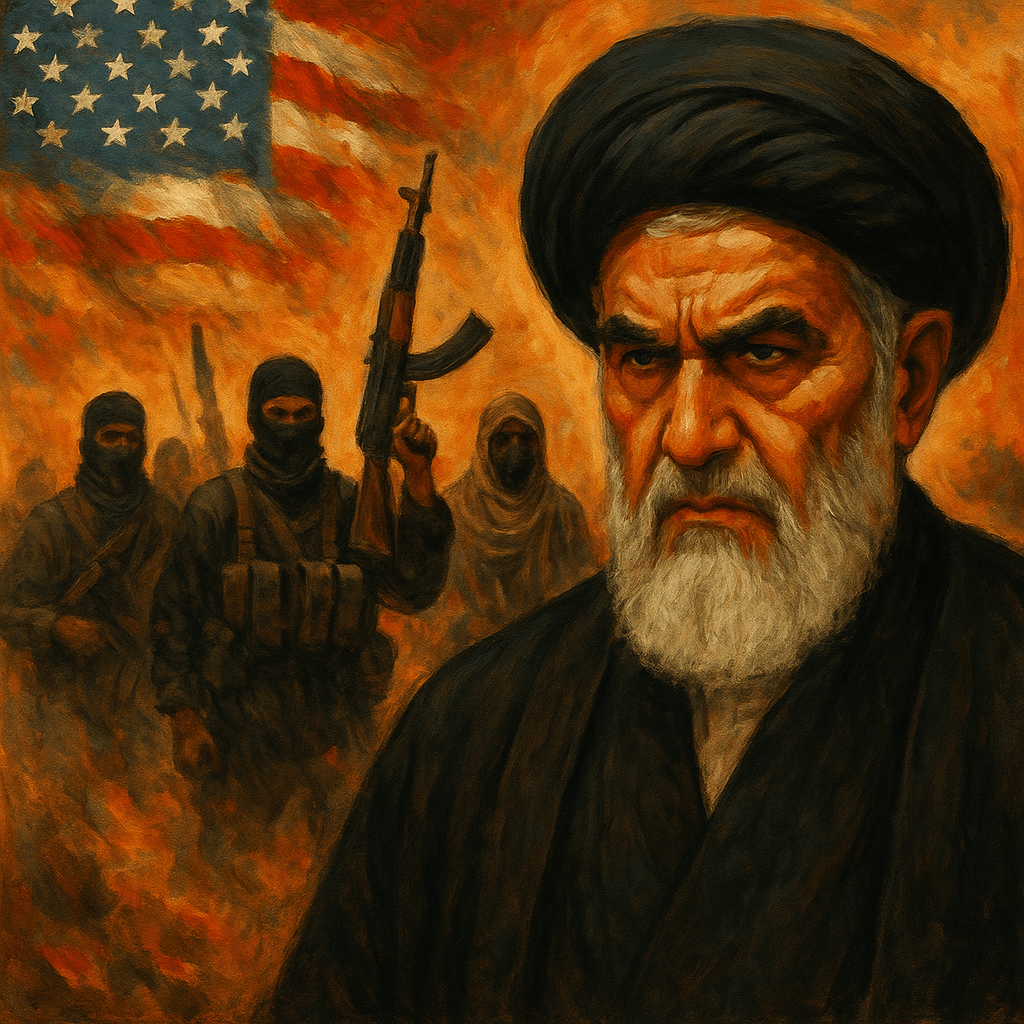
By collapsing Shia-led anti-imperialist movements into the same category as U.S.-backed jihadist terror networks, Western media wages narrative warfare to justify siege, sanctions, and war. But the real fear isn’t extremism—it’s sovereignty.
By: Prince Kapone | Weaponized Information | June 26, 2025
I. Excavation – Inverting Islam: The West’s Narrative Assault on Iran
The Foreign Policy article “Rebranding Terror” performs a sleight of hand so routine it almost goes unnoticed: it collapses the entire Islamic resistance axis into the category of “Islamism,” and then fuses “Islamism” with “terrorism.” Hezbollah, the Houthis, Hamas, Iraqi militias, and even Iran itself are rendered indistinguishable from ISIS and Al-Qaeda. This is not an analytical mistake—it’s narrative discipline. It erases the differences between revolutionary Shia resistance and nihilist Salafi jihadism to serve a singular ideological goal: preserving U.S. imperial legitimacy in the Middle East.
Foreign Policy is no neutral observer. It was co-founded by Samuel Huntington, the Cold War strategist best known for theorizing the “clash of civilizations”—a concept that cloaked Western supremacy in the language of cultural conflict. Today, Foreign Policy is owned by Graham Holdings, the same corporate entity that formerly owned The Washington Post. It is deeply embedded in the imperial media-intelligence circuit, echoing narratives developed by the Council on Foreign Relations, the Atlantic Council, and the Washington Institute for Near East Policy—all of which are funded by U.S. defense contractors, Gulf monarchies, and the U.S. State Department itself.
The Foreign Policy article’s central claim is simple: Iran, through its support of “Islamist” movements, is the source of extremism in the region. In this framing, the fall of Iran would end “Islamism” altogether. This is not journalism—it’s geostrategic storytelling. It reverses reality: Iran funds hospitals, satellites, and university systems, while Saudi Arabia carries out beheadings, crucifixions, and executes dozens each year. But only one of these states is branded an existential threat. This inversion is not accidental—it is essential to maintaining a colonial order built on military bases, petrodollars, and mass disinformation.
This propaganda operation does not stop with Foreign Policy. The UK’s Times warns of “terror groups like Hezbollah and the Houthis” using social media to spread bomb-making guides, without any evidence. The Sun UK claims that Iran is activating sleeper cells to bomb the West. Meanwhile, the U.S. designates Ansar Allah as terrorists while it provided arms, intelligence, and diplomatic cover to Saudi Arabia’s genocidal war on Yemen. Across these outlets, Shia movements are framed as medieval fanatics—while theocratic U.S. allies are portrayed as “modernizers.”
This framing is not just racist—it’s counterinsurgency. It delegitimizes popular resistance by casting it as irrational fanaticism. It suppresses the memory of Islamic civilizations that pioneered medicine, astronomy, and ethics during Europe’s Dark Ages. It hides the fact that modern Shia resistance—from the 1979 Iranian Revolution to Hezbollah’s anti-colonial struggle in Lebanon—has always been less about theology and more about sovereignty. That is the threat: not Islamism, but independence.
II. Extraction & Contextualization – Manufacturing Consent Through Conflation
The Foreign Policy article makes three central moves: it collapses disparate Islamic actors under the label of “Islamism”; it then equates “Islamism” with terrorism; and finally, it casts Iran as the central pillar holding this supposed architecture together. It names Iran’s support for Hezbollah in Lebanon, the Houthis in Yemen, and militias in Iraq and Syria as evidence of a regional terror network. Notably absent from this list are the U.S.-backed forces that helped birth ISIS, supported Al-Qaeda in Syria, and armed sectarian proxy armies across the region.
Let’s begin with what’s missing. Saudi Arabia’s documented export of Wahhabi extremism—a rigid, hyper-sectarian ideology—is ignored. As The New York Times reported in 2016, the Saudi state spent billions globally to propagate a form of Islam that helped lay the ideological groundwork for jihadist violence. The U.S. government, meanwhile, knowingly backed militant Sunni factions in Syria to destabilize the Assad government—creating the perfect breeding ground for ISIS. Seymour Hersh and other investigators have shown that CIA and Gulf state weapons shipments to Syrian rebels ended up arming jihadist networks. These realities are excluded from the Foreign Policy narrative.
The deliberate lumping of Shia resistance movements with Salafi jihadists is a geopolitical tactic. In reality, Hezbollah, the Houthis, and Iran-backed Popular Mobilization Forces (PMF) in Iraq are the enemies of Al-Qaeda and ISIS, not their allies. In 2013, for example, Hezbollah entered Syria specifically to prevent the collapse of the Assad government and the takeover of Damascus by Salafi jihadists. The Houthis have consistently clashed with Al-Qaeda in the Arabian Peninsula (AQAP). Yet the article groups these actors under the same umbrella to erase the ideological and strategic divide between anti-imperialist resistance and nihilist reaction.
Historically, the Shia Islamic tradition has often been a site of theological resistance to tyranny. The martyrdom of Imam Hussein in the 7th century has been invoked for centuries as a moral compass against unjust rulers. The Safavid Empire—the foundation of modern Shi’ism as a state formation—emerged in direct contradiction to the Sunni Ottoman Empire, which was itself aligned with Western trading powers. Today, Iran continues that legacy of political sovereignty and scientific independence, investing in advanced research, satellite technology, and public medicine—despite being blockaded by Western sanctions.
The Foreign Policy article says nothing about Iran’s elected institutions, constitutional framework, or public science infrastructure. Instead, it flattens Iran into a theocracy and its allies into death cults. This is not just historical erasure—it is narrative warfare. It turns every act of resistance into extremism, every anti-colonial government into a rogue regime, and every alternative to U.S.-Gulf hegemony into an existential threat.
III. Reframing – From “Islamist Threat” to Anti-Imperialist Sovereignty
The narrative presented by Foreign Policy and its imperial media siblings collapses under scrutiny. Iran is not the epicenter of global jihadism—it is one of its fiercest enemies. The movements it supports—Hezbollah, the Houthis, and the Popular Mobilization Forces—are not religious nihilists but organized expressions of anti-colonial sovereignty. They do not seek a global caliphate or a return to medieval rule. They seek freedom from U.S. bombs, IMF bondage, Israeli apartheid, and Gulf monarchy aggression.
What the West calls “Islamism” is often a political theology of resistance. Shia movements in particular—steeped in the martyrdom of Karbala—carry forward a historical memory of rebellion against empire. From the Safavid opposition to Ottoman and European incursions, to the 1979 Iranian Revolution that overthrew the U.S.-installed Shah, to Hezbollah’s defeat of Israeli forces in 2000 and 2006, this lineage is not one of terrorism, but of anti-imperial self-determination.
What truly terrifies the West is not religion—it is independence. Iran is a regional power outside the U.S. security architecture. It has developed a semi-autonomous industrial base, a robust university system, and a nuclear energy program. It provides a model—however flawed—of postcolonial governance that has not been fully recolonized by financial institutions, Silicon Valley, or NATO command. It is precisely this deviation from imperial circuitry that demands demonization.
Meanwhile, Saudi Arabia, the UAE, and Qatar—all U.S. allies—propagate actual theocratic authoritarianism. Riyadh’s system of mass executions, public floggings, and gender apartheid is not merely tolerated but armed and subsidized by the West. The United States sold over $5 billion in weapons to Saudi Arabia and the UAE in 2023, even as their warplanes bombed Yemeni children. But these regimes are never labeled “Islamist.” Their repression is framed as “moderation” and “modernization,” because it serves U.S. hegemony.
The contradiction is glaring: Shia-led movements that defend their people from imperialist siege are called terrorists; Sunni monarchies that spread sectarian violence and bankroll U.S. militarism are called allies. The real divide is not between “moderate” and “radical” Islam. It is between sovereignty and submission, resistance and compradorism, multipolarity and unipolar domination.
The Foreign Policy narrative is not designed to understand the Middle East. It is designed to misdirect class anger, justify war budgets, and pacify the Western public. It is a weapon of cognitive warfare, aimed at masking a collapsing imperial order by blaming its crises on the victims of its own violence.
IV. Mobilization – Countering Narrative Warfare and Building Anti-Imperialist Power
This is not just a case of journalistic bias. It is narrative warfare—an information architecture designed to anesthetize critical consciousness and reproduce imperial command. When Western media equates Iran’s regional alliances with terrorist nihilism, it serves a purpose: to sever solidarity, justify encirclement, and preempt any multipolar alternative to U.S. domination. But if the battle is ideological, then we must meet it with counter-hegemonic force.
First, we must expose the propaganda function of media institutions like Foreign Policy, The Times, and The Sun. These are not neutral outlets—they are information arms of empire. Their role is not to explain the world, but to render empire invisible and its victims monstrous. Their method is erasure through conflation, caricature, and cognitive overload. Their solution is always more surveillance, more sanctions, more war.
Second, we must reclaim historical memory. Shia Islamic movements have long carried revolutionary, anti-colonial, and egalitarian dimensions. From Imam Ali’s struggle for justice to Imam Hussein’s martyrdom at Karbala, from the Safavid defense of Persian sovereignty to the 1979 Iranian Revolution, these movements have fought not only against colonialism but against internal oligarchies and comprador elites. These histories belong to the global struggle for liberation—not to the caricatures of Western media.
Third, we must begin delinking from technofascist infrastructure. The same corporate-state matrix that floods our timelines with anti-Iranian propaganda also surveils our movements, censors dissent, and conditions the public to fear resistance. The same digital platforms that amplify imperial framing also algorithmically bury any message of multipolar solidarity. We must build our own communications systems, anti-imperialist media, and political education programs capable of cutting through the fog of war and the fog of news.
Finally, we must build institutions of dual and contending power in the heart of empire. The real enemies are not Sunni or Shia, Iranian or Arab. The real enemies are Raytheon, Lockheed, Palantir, BlackRock, and the imperial states they feed. Their power rests not just on bombs, but on belief—on the consent of the governed, the confusion of the misled, and the silence of the comfortable. We must organize where they cannot: in the cracks, the contradictions, and the communities that still remember how to fight.
Our task is not merely to defend Iran from slander. It is to join hands with all forces resisting empire—from Gaza to Yemen, Caracas to Caracas, Harlem to Tehran—and to dismantle the ideological scaffolding that props up imperial power. They fear Iran not because it is religious, but because it is ungovernable by Washington. They fear Islam not because it is irrational, but because it remembers justice. And they fear you—worker, thinker, fighter—not because you are weak, but because you are waking up.
 Weaponized Information
Leave a comment