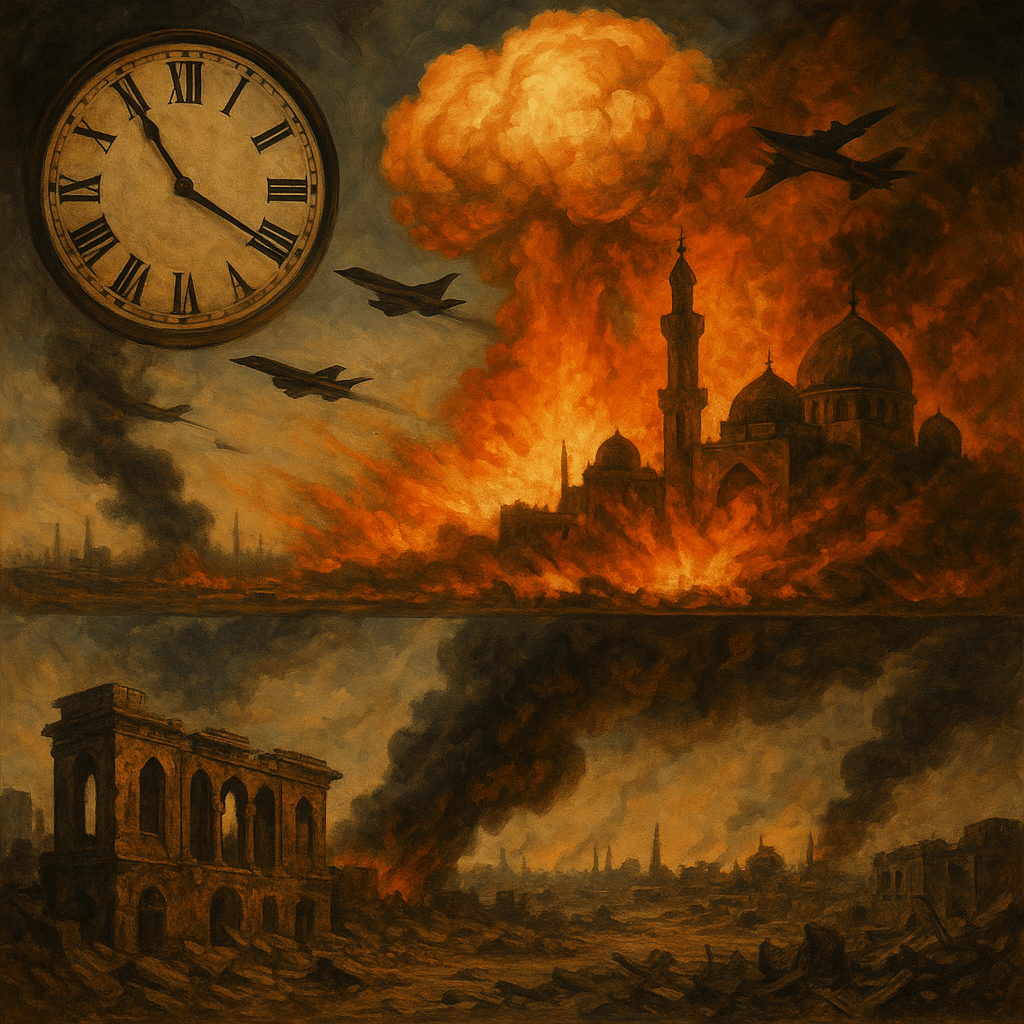
Trump’s “two-week window” isn’t about restraint—it’s about imperial maneuver. Behind the wire-service language lies cognitive warfare, nuclear apartheid, and the countdown to deeper war.
By Prince Kapone | Weaponized Information | June 19, 2025
“Two Weeks to Midnight”: Reading the AP’s War Wire
Yesterday the Associated Press splashed a headline across the global wire: President Trump will decide in a fortnight whether to hurl U.S. bombs at Iran. On the surface, it is boiler-plate conflict reporting—body counts, missile tallies, a presidential sound-bite. Underneath, it is a tidy script for empire, timed to the metronome of U.S.–Israeli escalation. Our task is to pry open the copy and see whose fingerprints stain the ink.
The bylines tell a familiar story of class allegiance. Sam Mednick, once embedded amid French paratroopers in West Africa, now files from Israeli-occupied Palestine; Jon Gambrell runs AP’s Gulf-Iran desk from a Dubai high-rise built on petro-dollars; their colleagues Natalie Melzer and Melanie Lidman round out a quartet whose careers orbit Western security priorities. They write for a 179-year-old cooperative—the AP—whose board is stacked with corporate media chiefs and whose half-billion-dollar revenue stream now includes licensing deals with AI giants like OpenAI. In other words: a not-for-profit veneer masking a political-economy welded to U.S. power. 0
The narrative is then piped through a chorus of imperial functionaries—White House press secretary Karoline Leavitt, Israeli defense chief Israel Katz, Prime Minister Benjamin Netanyahu, and EU diplomat Josep Borrell—each performing their role in the machinery that manufactures consent for endless war.
Now, let’s slice through the prose and watch the propaganda gears turn:
1. Casualty Symmetry: The piece twins hundreds of Iranian dead with two-dozen Israeli fatalities to fabricate moral parity and bury the colonial imbalance at the heart of this conflict.
2. Cinematic Suffering: Iranian bodies are reduced to statistics; Israeli patients are rolled past the camera in high-definition pathos—anguish staged for primetime empathy.
3. Unverified Villainy: Israel’s claim that Tehran fired cluster munitions is printed without independent evidence, a ready-made war crime for tomorrow’s talk-shows.
4. Nuclear One-Way Mirror: Iran’s 60 % enrichment is cast as apocalypse-adjacent, while Israel’s undeclared nuclear arsenal passes in a single, shrugging clause.
5. The “Reasonable” Emperor: Trump’s two-week delay is framed as statesmanlike caution. We recognize it as imperialist recalibration: time to plot a joint sneak attack, let Tel Aviv soften the target, or coerce Tehran into surrendering sovereignty.
6. Historical Amnesia: Absent are the suffocating U.S. sanctions, the Gaza genocide, the decades-long settler siege—all the material scaffolding that makes Iranian deterrence a rational act. Erase the past, and Washington’s bombs look like conflict resolution rather than colonial enforcement.
Strip away the wire-service polish and what remains is an instruction manual for cognitive warfare: naturalize Zionist aggression, demonize Iranian resistance, elevate Trump to referee of a match he helped rig. The clock they ask us to watch is not a countdown to peace but the tick-tock of hyper-imperial decline.
From Casualty Lists to Colonial Roots: Seeing the Full Terrain
The AP story lays out some brutal facts: Israeli strikes leveled Iran’s enrichment and military sites at Natanz, Arak, and Fordow, killing at least 639 people—including 263 civilians—while wounding over 1,300. Iran responded with around 450 missiles and 1,000 drones, injuring hundreds and causing approximately 24 Israeli deaths (including scores at Soroka Medical Center), according to reporting from both the Associated Press and Al Jazeera. These facts—the stains of war—are undeniable. But they are signposts on a blood-soaked map, not the territory itself.
What they scrubbed out: The story makes no mention of U.S. sanctions since 2018 that halved Iran’s oil exports and slashed GDP from roughly $445 billion in 2017 to around $205 billion by 2020. The Jerusalem Institute for Strategy and Security and World Bank both confirmed this collapse. It also ignores inflation north of 40–50%, youth unemployment exceeding 50%, skyrocketing food costs, and widespread hunger—material conditions that hardened Iran’s resilience. These were not side notes—they were the furnaces stoking Iran’s resistance.
A timeline of escalation: This confrontation ignited on June 13, 2025, when Israeli jets struck Iran’s nuclear infrastructure and assassinated key military figures—a strike that followed years of hybrid sabotage including Stuxnet, drone assassinations, and proxy attacks, as detailed by Reuters. That same day, Iran launched missiles and drones toward Jerusalem, Tel Aviv, and Beersheba—precisely as Trump announced a two-week ultimatum, reported in the Associated Press.
Geopolitical flashpoints: Iran now enriches uranium to 60%—a threshold dangerously close to weapons-grade—and retains enough stockpiles for multiple bombs, though no weaponization is confirmed. According to analysis by Reuters, the International Atomic Energy Agency has raised “serious concern” over Iran’s enrichment at this level. The 2015 JCPOA provided relief in exchange for limits; Trump’s 2018 withdrawal collapsed that framework and triggered the current nuclear sprint. As the Associated Press reports, European diplomats are currently meeting in Geneva as Iran resists further infringements on its sovereignty. Iran’s foreign policy is rooted in solidarity with regional liberation movements and a commitment to a multipolar world—resisting both U.S. hegemony and Zionist expansion.
In historical perspective: Israel’s bombardment cannot be detached from 75 years of settler colonial violence, U.S. arms subsidies, occupation, and the global injustice of nuclear apartheid. Nor can Iran’s missiles be dismissed as mere escalation—they are deterrence born of existential siege. This clash unfolds amid the dying gasp of unipolar imperialism—reactive, hybrid, and coercive.
The AP’s snapshot captures destruction, but elides its origins. It shows blood—but not the trenches dug by sanctions, colonial mawkishness, nuclear apartheid, or resource siege. To truly understand resistance, we must trace suffering to its source. Only then do the real actors—the oppresed, the resistors—come into view.
Staging the Pause, Reloading the Gun: Trump’s Delay as a Weapon of War
The AP frames Donald Trump’s two-week window as sober restraint—a pause to reflect, assess, and choose between war and peace. But that’s fiction. The pause is not a break in the violence. It is an extension of it. It’s not a countdown—it’s choreography.
Trump is not delaying war. He is staging it. The two-week gap serves three core purposes: coordination, coercion, and cover.
First, coordination. Israel’s initial bombardments were massive but incomplete. Their targets—Fordow, Arak, Natanz—include deep-underground bunkers that Israel cannot reliably destroy alone. The delay allows the U.S. military to position assets, authorize logistics, and finalize joint targeting plans under the cover of “deliberation.” B-2 bombers, carrier groups, refueling tankers—these don’t move overnight. The two weeks are not peace—they’re prep time.
Second, coercion. The delay exerts pressure—not just on Iran, but on Europe, Russia, China, and the wider Global South. It floods the diplomatic theater with manufactured urgency: “Act now or war begins.” This is classic imperial hostage-taking. By dangling the prospect of escalation, the U.S. seeks to force Iran to capitulate, force the EU to broker a surrender, and force the world to normalize a hyper-imperialist war.
Third, cover. The pause grants imperial narrative space. It gives Trump airtime to posture as reluctant—”we’re weighing our options.” It gives the media time to humanize Israeli victims and obscure Palestinian and Iranian dead. And it gives liberals time to beg for de-escalation, rather than organizing resistance. The delay doesn’t break the imperial timeline—it buys it narrative legitimacy.
This tactic is not new. Lyndon Johnson delayed bombing halts in Vietnam to manipulate peace talks. Bush played for time with UN inspections before carpet bombing Baghdad. Israel paused for “humanitarian corridors” in 2006 Lebanon—right before flattening southern villages. The imperial playbook is always the same: talk peace while reloading the gun.
Time under empire is not neutral. It is weaponized. It is used to shape perception, fracture resistance, and prepare the next blow. Trump’s pause isn’t a chance to avoid war—it’s the prelude to its escalation.
And the AP plays its part. It does not ask: who gave Trump the right to decide anything about Iran’s future? It does not ask: what right does a settler state with nuclear weapons have to dictate terms to a sovereign nation? It simply repeats the countdown. It surrenders time, space, and narrative to the very empire it’s supposed to scrutinize.
But we refuse to surrender the clock. We don’t wait for missiles to fall to call it war. We don’t wait for presidents to declare intentions before organizing resistance. Trump’s delay is not our window—it is our warning. And our duty is not to watch the clock. It is to break it.
No More Waiting: From Tehran to Gaza, the Time to Stand is Now
The AP’s narrative wants us to sit tight—watch the war unfold like a movie, wait for Trump’s final act. But the peoples of the Global South are not extras in an imperial production. From the missile-scarred neighborhoods of Isfahan to the pulverized corridors of Soroka hospital to the still-burning ruins of Gaza, working people are not waiting. They are resisting, rebuilding, and refusing to submit to a world where U.S. presidents flip coins over which country gets bombed next.
Our position is not neutral. We declare ideological and political unity with the Iranian people defending their sovereignty, the Palestinian people resisting occupation and genocide, and all oppressed nations standing in defiance of U.S.–Zionist war. We stand with those who reject the nuclear monopoly enforced by the West, who refuse to bend beneath the weight of sanctions architecture and settler-colonial siege.
This is not simply a military conflict—it is the frontline of a global class war. The West’s war machine is fueled not only by bunker busters and drones, but by narratives. When AP frames Trump’s two-week pause as wisdom, when it omits the history of sanctions, sabotage, and settler violence, it performs the ideological labor of empire. That’s why we must excavate, reframe, and mobilize—not just in thought, but in action.
Here’s what that looks like: Launch public campaigns to demand an end to U.S. military aid to Israel and the dismantling of unilateral sanctions against Iran. Organize teach-ins and political education projects that expose the realities of the war and the structure of nuclear apartheid. Build direct ties with Iranian and Palestinian solidarity networks operating underground, online, and on the ground. Amplify voices from the resistance—statements, dispatches, communiqués—and create channels to break the information blockade.
We must also fight on the terrain of finance and logistics. Pressure banks, universities, and city councils to divest from weapons manufacturers, surveillance firms, and Israeli apartheid. Support grassroots mutual aid projects serving refugee communities displaced by war and sanctions. And inside the imperial core, organize defection—not just moral, but material. Break with settler ideology. Expose Zionism. Sabotage militarism in every form it takes, from weapons shipments to war propaganda.
The two-week clock isn’t just Trump’s—it’s ours too. But we don’t use it to choose between bombs or silence. We use it to build the kind of revolutionary infrastructure that makes the empire’s clocks irrelevant. Time doesn’t belong to them. It belongs to the people who dare to remake the world.
 Weaponized Information
Leave a comment