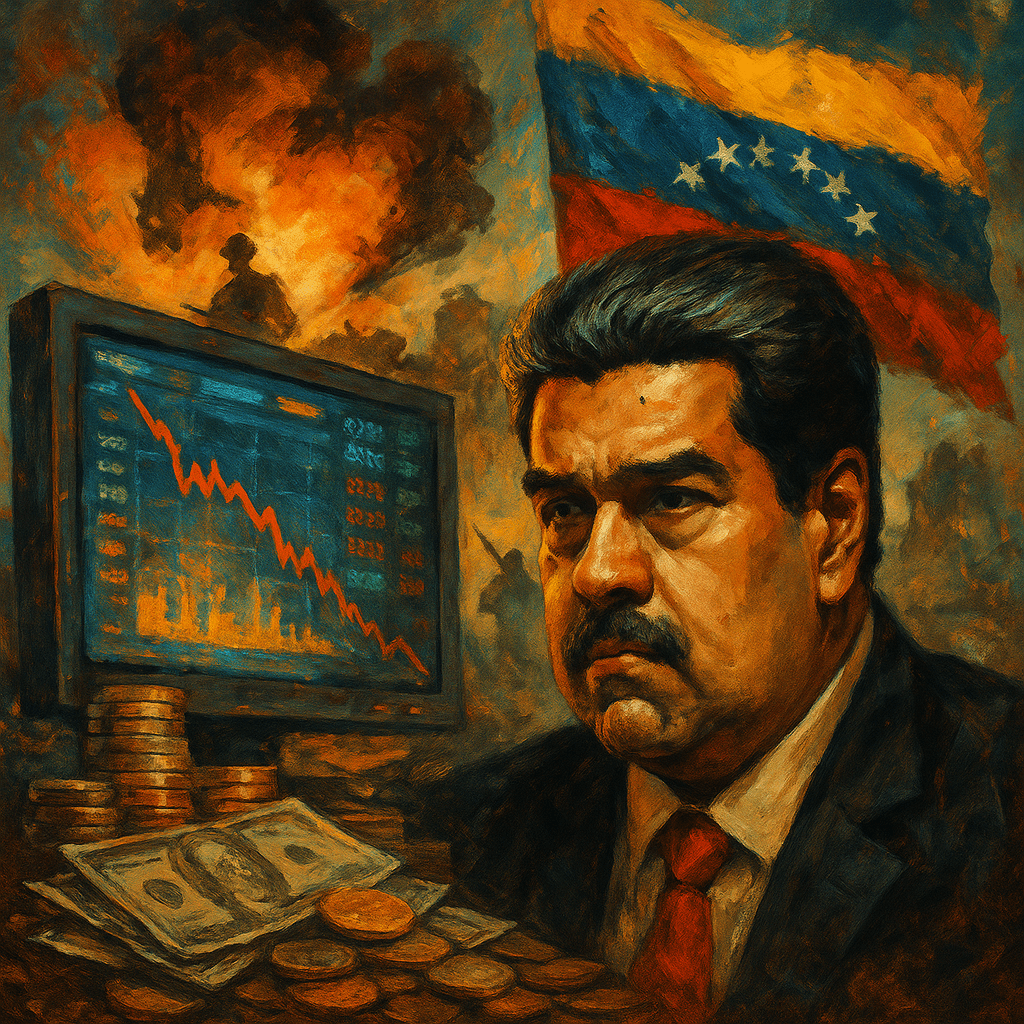
Why Bloomberg’s Narrative on Venezuela’s Arrested Economists Is Propaganda—Not Journalism
By Prince Kapone | Weaponized Information | June 19, 2025
Algorithmic Propaganda: Bloomberg’s Data Brokers of Empire
When Bloomberg’s Caracas bureau chief Patricia Laya presses “send,” her article doesn’t trickle into coffee shops or university newsstands—it detonates on Wall Street. Her 19 June dispatch, headlined “Maduro locks up economists”, doesn’t inform—it signals. It is not journalism—it is a trading alert. A calculated pulse sent through the Bloomberg Terminal grid to asset managers, IMF analysts, and sanctions architects. The outrage is aesthetic. The payload is financial. It packages regime-change fever in palatable prose for the $25,000-per-year subscriber class.
Laya is not a neutral observer. She is a translator of political risk for capital. Her real readers are not union organizers in Maracaibo or housing collectives in Petare—they are the Bloomberg Terminal subscribers: BlackRock quants, Citadel gamblers, Goldman Sachs architects of austerity. Bloomberg doesn’t report on countries—it prices them. It doesn’t assess sovereignty—it quantifies “volatility.” In this system, resistance is measured as “risk,” and revolutionary planning is flagged as a “liquidity threat.” This is what we call Algorithmic Governance: a regime of datafied domination where software substitutes for soldiering.
Bloomberg itself is not a media outlet in the classic sense. It is a $10 billion data-policing apparatus. A privately owned empire within empire, built by former New York mayor and multi-billionaire Michael Bloomberg to surveil the world on behalf of finance capital. Its role is to condition perception—especially in markets—to ensure the uninterrupted transfer of value from the periphery to the core. The mechanism is elegant and brutal: a red headline flashes, the IMF invokes “transparency,” the U.S. Treasury signals “reform,” and NGOs begin their humanitarian chant. Sanctions click into place. Capital retreats from the South, and not one boot hits the ground. It is textbook Financial Piracy in a digital cloak.
Zoom in on the headline—“locks up economists.” “Locks up” suggests tyranny. “Economists” conveys objectivity. The emotional hook is baited with terms that carry ideological weight—carefully selected to elicit outrage from liberal audiences and algorithmic action from investors. Phrases like “silencing data” and “crackdown on truth” are not innocent. They are components of Cognitive Warfare: psychological operations designed to obfuscate imperial aggression and reframe defense as despotism.
And let’s interrogate this term—“economist.” In imperial media, it functions as a halo. But stripped of euphemism, many of these “economists” are little more than market speculators in a lab coat. They are crypto-adjacent arbitrageurs, dollarized consultants, influencers of parallel exchange rates. Their data sets don’t measure conditions—they manipulate them. Presenting such actors as scholarly martyrs erases their direct involvement in the very crises they claim to analyze.
A glance at Laya’s LinkedIn reveals the revolving-door career path: stints at opposition think tanks, IMF-adjacent briefings, Wall Street consulting gigs. It is the textbook blueprint for what the Venezuelan people have come to call the “data war.” In this world, there is no line between journalist and operative. Editorial meetings blur with intelligence briefings. “Reporters” don’t just file stories—they translate sabotage into policy opportunities.
So let’s stop pretending. Bloomberg is not “covering” Venezuela—it is pricing Venezuela. It is transforming a nation’s trauma into data points that drive speculative flows. When Laya writes “risk,” she is not describing a political problem. She is launching a digital offensive. Her keyboard is part of a broader matrix of hybrid warfare, where journalists don’t wear fatigues—they wear press credentials and carry the full force of empire in their bylines.
In Part II, we peel back the polite euphemisms and trace the blood-soaked mechanics that hide beneath her “market analysis.” We follow the numbers back to the weapons they’ve become.
Extraction & Contextualization: The Economic-War Backstory
Bloomberg’s alarm over “Maduro locking up economists” doesn’t float on facts—it floats on erasure. The arrests didn’t happen in a vacuum. They took place on the battlefield of a decade-long economic war, one waged not with tanks, but with spreadsheets, sanctions, and psychological sabotage. Since 2014, Venezuela has endured a full-spectrum siege, imposed through a complex web of unilateral coercive measures designed to starve sovereignty without ever declaring war. The U.S. Treasury froze over $7 billion in state assets, blocked Caracas from the SWIFT banking system, and crippled PDVSA—Venezuela’s national oil company—by cutting it off from global markets. These aren’t technical disagreements over fiscal policy. They are premeditated acts of Financial Piracy—the deliberate sabotage of a nation’s survival mechanisms.
The toll is not metaphorical—it is measured in lives. A 2019 study by CEPR, supported by findings from the UN Human Rights Council, estimates that over 40,000 Venezuelans died between 2017 and 2018 as a direct result of sanctions—primarily through medical shortages. Bloomberg doesn’t mention a single one of them. Nor does it note that BCV inflation data shows a year-on-year drop to 45% in Q1 2025, signaling stabilization. Why? Because those facts rupture their narrative of “collapse.” They interfere with the emotional triggers—images of a failed state, of chaos—that Wall Street requires to justify speculation, and Washington requires to justify aggression.
The blockade didn’t just damage Venezuela. It tore holes across the Global South. The destruction of PetroCaribe—a Venezuelan oil alliance that delivered 43.9 million barrels to 18 Caribbean nations under 25-year, 1% interest agreements—was not collateral damage. It was the plan. Once sanctions hit hard in 2017–2018, fuel evaporated from Haitian ports, food prices spiked, and protests surged. What PetroCaribe offered was not charity—it was infrastructure for South-South sovereignty. Its collapse was a warning: defy the empire, and you don’t just get strangled—you drag your neighbors down with you.
This is the terrain where the so-called “arrested economists” operated. And their data wasn’t neutral. Take Carlos Pérez Abreu, the administrator of Monitor Dólar. He wasn’t publishing research—he was running a monetized FX dashboard that reported black-market dollar rates up to 40% above actual underground trades. His numbers were timed with CLAP food distributions and circulated through crypto-fueled arbitrage networks. This wasn’t economic analysis. It was Cognitive Warfare—behavioral manipulation disguised as fiscal data, timed to incite panic and generate profit.
This tactic didn’t emerge in a vacuum either. It mirrors the psychological warfare techniques developed by Western firms like Cambridge Analytica—strategies built to provoke emotional reactions, split publics, and destabilize governments. In Venezuela, these “FX events” weren’t just economic noise—they became social triggers: supermarket riots, pharmacy runs, hoarding cycles. Data was no longer a measurement tool—it was a spark plug.
And this wasn’t the first round. Between 2014 and 2017, Venezuela endured a coordinated compound assault: speculative currency collapse, media disinformation, and armed guarimbas. The goal? Break the bolívar, break the people’s purchasing power, and break the Bolivarian process. While Bloomberg averted its gaze, the people did not. They organized. CLAP food programs were born. Neighborhood audit brigades sprang up. The government rolled out digital currency frameworks and monetary reforms. None of this reversed the crisis overnight—but it did push the worst offenders to the margins. That’s what these arrests represent: a continuation of counter-offensive measures against a still-active war.
As economist Pasqualina Curcio has meticulously documented, up to 90% of Venezuela’s hyperinflation between 2016 and 2019 was not caused by government mismanagement—but by foreign-controlled exchange portals gaming parallel rates. These were not market reactions. They were digital battlegrounds. And Bloomberg, rather than investigating this manipulation, functioned as its amplifier—echoing distortions while presenting itself as an impartial observer.
So no, these aren’t “independent economists” being silenced. They are digital mercenaries embedded in a wider strategy of destabilization. And Bloomberg, by laundering their activities in the soft glow of liberal concern, becomes complicit. When sabotage gets rebranded as analysis, when financial terrorism is sold as “transparency,” and when empire is recast as “data journalism,” we are not reading the news—we are deep inside the logic of the software that runs empire.
Reframing: Legal Self-Defense & Cognitive Warfare
When Bloomberg describes Venezuela’s prosecution of economic saboteurs as “crackdowns,” it’s not reporting—it’s performing ideological ventriloquism. The vocabulary of liberal rights is weaponized to mask the mechanics of sabotage. But legality is never impartial. It is the crystallized form of class power. And in a country under economic siege, defending sovereignty is not authoritarianism—it is survival. The Bolivarian state isn’t policing opinions. It is interrupting a strategy of deliberate destabilization, a mode of attack we call Financial Piracy: coordinated capital flight, currency sabotage, and externally imposed sanctions, all designed to suffocate a revolution without firing a shot.
The legal framework being mobilized—laws like the Ley Contra el Odio (2017), Ley Resorte (2004), and LOCDOFT (2012)—didn’t emerge in a vacuum or as tools of censorship. They were born in direct response to concrete forms of hybrid warfare. When supermarket shelves were emptied not by scarcity but by hoarding and speculation, Venezuela passed laws to confront it. When FX dashboards like Monitor Dólar manipulated currency rates to trigger panic, the government built tools to dismantle them. These laws are not unique to Venezuela—they echo legal frameworks found in the U.S. and Europe. What’s different is that they are used to defend a popular government from imperial attack. That’s what makes them unacceptable to Washington and its media assets.
The so-called “rule of law” under empire is not a shield for human dignity—it is a sword for enforcing capital’s monopoly on reality. When the U.S. freezes $7 billion in Venezuelan reserves and criminalizes financial transactions with PDVSA, it’s practicing the same legal imperialism that dismantled PetroCaribe: starve the South, collapse its internal capacity, and offer recolonization as humanitarian relief. What’s called “corruption” in Venezuela is often just defiance—an unwillingness to surrender national sovereignty to Western accountants and their ledgers of dependency.
Carlos Pérez Abreu wasn’t arrested for disagreeing with economic policy. He was arrested for monetizing sabotage. As the administrator of Monitor Dólar, he published inflated black-market rates during CLAP food distributions, stoked hyperinflationary expectations, and harvested crypto revenue from the chaos. This was not journalism. This was economic destabilization wrapped in a UX interface. His data wasn’t a mirror—it was a match. When his fake numbers went live, supermarkets were looted, medicine disappeared, and public morale cratered. He didn’t inform the public—he weaponized uncertainty. That is what algorithmic warfare looks like in a neoliberal laboratory.
And Bloomberg? They know exactly what they’re doing. By branding these arrests as an attack on “independent data,” Bloomberg whitewashes financial aggression and reframes imperial sabotage as expertise. This is the essence of Cognitive Warfare: construct the illusion of a failed state, not by tanks or troops, but through headlines and hyperlinks. Distort perception, degrade legitimacy, and make the case for recolonization seem like rescue. Every phrase—“silencing economists,” “truth under attack,” “dictatorial overreach”—is a psychological warhead. The target isn’t just Venezuela—it’s your ability to perceive its reality clearly.
In this war, the battleground is no longer just physical territory. It is epistemology itself—the right to determine what is real. And that is why the concept of epistemic sovereignty is so central. A revolution must not only defend its land and institutions—it must also defend its truths. If market analysts, crypto speculators, and foreign terminals become the only arbiters of value and truth, then socialism becomes illegible. That is the endgame of Bloomberg’s campaign.
As highlighted in “Siege and Sovereignty,” Venezuela’s monetary laws are Shields born of counterattack, not repression. The state’s legal architecture was erected to defend against imperial finance’s weaponized logic, not to muzzle dissent. These are laws of anti‑colonial resistance as much as they are domestic regulations.
Venezuela is not outlawing dissent. It is fighting back against operations that disguise counterinsurgency as commentary. In a blockaded society, truth-telling becomes a material act. Legality becomes both sword and shield. Law, when wielded by a people in resistance, becomes a terrain of class struggle. The arrests of digital saboteurs aren’t signs of a state gone rogue. They’re signs that the state is still fighting for its people.
Let’s be clear: Venezuela is not prosecuting opinions—it is prosecuting imperial operations. And in the world we’re living in, that distinction is not academic. It is revolutionary.
Counter-Narrative Table: Bloomberg vs. Documented Reality
Below is a contradiction matrix exposing Bloomberg’s disinformation structure—contrasting its claims with documented evidence. This is not a debate between opinions. It is a struggle between narrative warfare and revolutionary truth.
The table functions as a tool of epistemic resistance: a defense of reality in a world where empire wages war by fabricating it.
| Bloomberg Claim | Material Evidence |
|---|---|
| “Maduro is silencing independent data.” | Venezuela’s Attorney General reported that Monitor Dólar bots injected 35–40% fake FX premiums during CLAP food distributions, triggering riots and looting. |
| “Hyperinflation proves socialist mismanagement.” | CEPR (2019) attributed 72% of 2019 price surges to U.S. sanctions and import blockades.
Recent BCV data shows YoY inflation ≈ 45% in Q1 2025—a sign of stabilization. |
| “Arrests violate free speech.” | The FX dashboards in question monetized artificial panic via speculative crypto feeds and fake premiums.
This is not journalism—it is Cognitive Warfare under cover of data science. |
| “Bloomberg provides market transparency.” | Bloomberg terminals lease at $25,000/year to hedge funds that short bolívars and profit from regional instability.
This is not transparency—it is Financial Piracy. |
| “Venezuela abandoned its regional commitments.” | PetroCaribe delivered 43.9M barrels of oil under low-interest credit to 18 Caribbean nations until U.S. sanctions severed operations in 2018.
Fuel shortages in Haiti began immediately after—destabilizing the region. |
This matrix is not simply a fact-check—it is a frontline of epistemic sovereignty.
It maps the difference between a revolution’s lived contradictions and the algorithms that seek to erase them.
Every row is a lesson in decoding propaganda.
Every citation is a weapon in the arsenal of truth.
Mobilization: Concrete Tasks for Internationalist Solidarity
Bloomberg’s smear barrage is no mere media hiccup; it is a calibrated tool of imperial statecraft. Its mission is blunt: render Venezuela’s sovereignty unintelligible and penalize any revolt against dollar rule. One headline, one arrest—props in a larger play about who decides what is “truth,” who passes for a “victim,” and which governments are granted the right to exist. If we leave that privilege uncontested, we surrender the terrain of perception long before a single shot is fired.
First: defend Venezuela’s right to craft and circulate its own numbers. The bulletins of the Banco Central de Venezuela, the forensic digs of Pasqualina Curcio, and the CEPR “Collective Punishment” report must be translated, visualized, and pushed worldwide. This is more than scholarship; it is an act of epistemic sovereignty that re-asserts the South’s right to name its own reality.
Second: build infrastructure, not slogans. In the teeth of sabotage, Venezuela created price observatories and barrio audit teams under the CLAP food program—proof of Dual and Contending Power, where data literacy fused with popular defense. Study it, copy it. Wherever fuel or food is gamed—from Caracas to Kinshasa—price monitoring becomes revolutionary work.
Third: reinforce the jailbreak from dollar captivity. The oil-for-grain deal with Russia and ongoing digital-currency pilots with China are bricks in a post-dollar road. They menace the scaffolding of Financial Piracy and demand not just applause but active defense.
In “Axes of Resistance,” WI documents how sanctioned nations like Venezuela, Iran, and Cuba resist through strategic alignment—exchanging oil, grain, technology, and currency. These are the living coordinates of multipolar solidarity, not speculative fantasy.
Fourth: harvest the lessons of PetroCaribe—its triumphs and its sabotage. From 2005-2017 Venezuela’s oil eased the Caribbean’s clinics and classrooms. Sanctions axed the lifeline, Haiti ran dry, unrest flared. Yet Haitian organizers later used PetroCaribe audit trails to expose $78 million looted from hospitals and schools. The future is clear: grassroots forensic accounting as a weapon against imperial and comprador theft.
Finally: arm new militants with political education. Study circles and digital campaigns must circulate the grammar of struggle—Cognitive Warfare, Lawfare, Financial Piracy, epistemic sovereignty. These aren’t abstractions; they are field manuals for disarming the next Bloomberg warhead. Venezuela belongs on every syllabus beside Cuba and Palestine as a primer in narrative siege and ideological resistance.
This is not charity—it is revolutionary duty. The financial weapons pointed at Caracas today will pivot toward Nairobi, Lahore, Johannesburg, and Detroit tomorrow. A falling dollar will not free us by default; it will spark backlash. Only those who have trained their minds, media, and movements for this new phase will hold the line.
Defending Venezuela is defending our future. Replicate its resistance. Weaponize its example.
Further Reading from Weaponized Information
For deeper analysis of Venezuela’s struggle against sanctions, financial warfare, and imperialist propaganda, explore our ongoing coverage below:
- Marco Rubio: The Imperial Ambassador of Technofascism — A deep dive into the ideological vanguard of U.S. regime-change strategy.
- Maduro’s Tightrope Walk: Navigating U.S. Economic Warfare Amidst Imperialist Recalibration — A sober assessment of revolutionary governance under siege.
- Siege and Survival: Venezuela Sanctions and the Endurance of the Bolivarian Revolution — On grassroots endurance, worker resilience, and survival through solidarity.
- Siege and Sovereignty: How Imperial Finance Declared War on Venezuela — An exposé on lawfare, asset seizure, and the financial front of imperial aggression.
- The Commune Must Not Be Televised: Venezuela, Participatory Democracy, and the Propaganda of Silence — Why Western media ignores the most revolutionary elements of Venezuelan socialism.
- Essequibo and the Empire’s Lie: Excavating the Propaganda War Against Venezuela — A forensic takedown of colonial misinformation in the Essequibo dispute.
- Axes of Resistance: When the Sanctioned Refuse to Bow — Charting Venezuela’s alignment with global multipolar resistance against Western coercion.
 Weaponized Information
Leave a comment