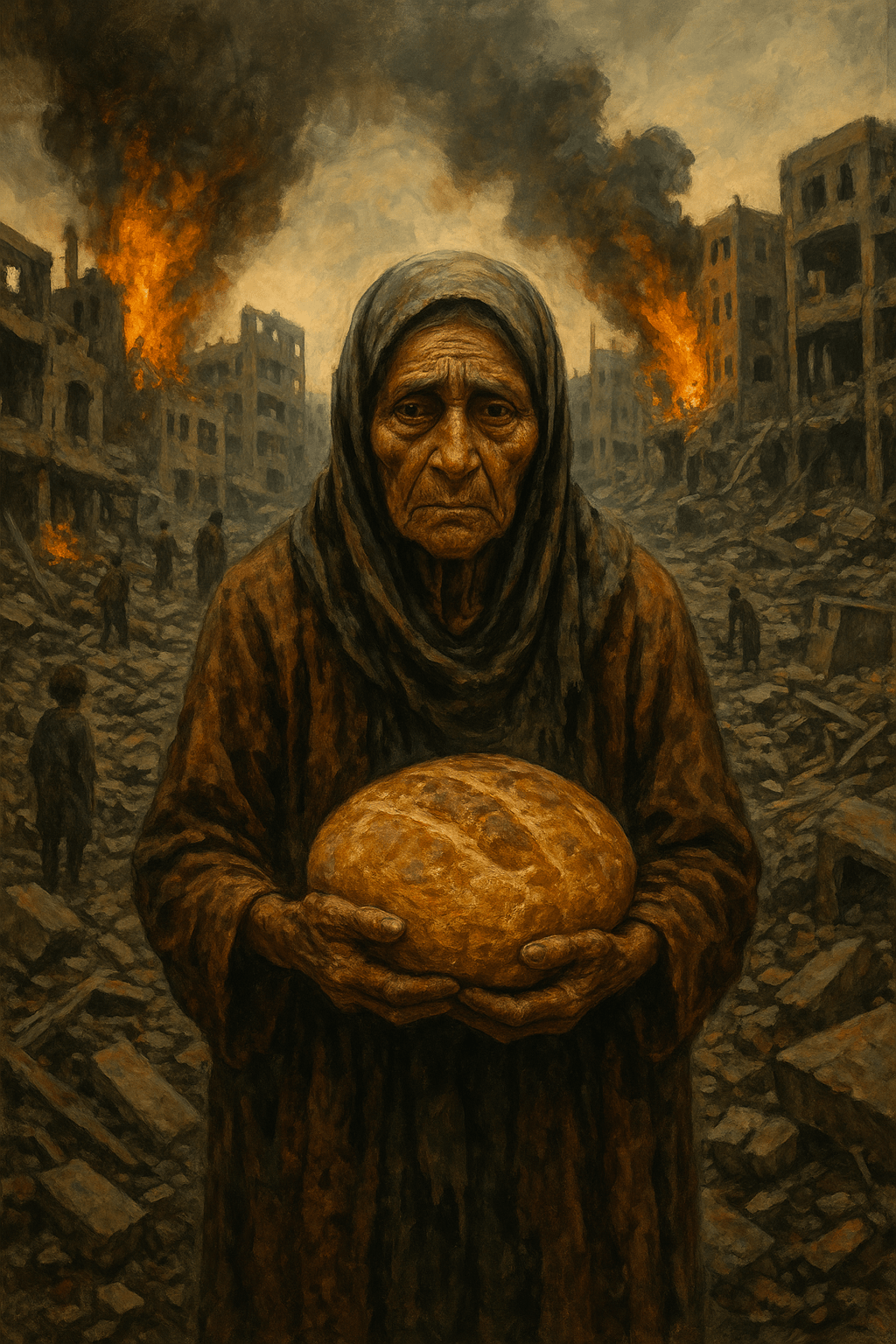
Gaza isn’t collapsing—it’s resisting. As Israel bombs bakeries and blocks aid, the empire calls it policy. We call it counterinsurgency. This is not famine. This is a war against life itself.
By Prince Kapone | Weaponized Information | June 12, 2025
Starvation as Statecraft: Dissecting the Bread War on Gaza
This isn’t a humanitarian failure. It’s a calculated campaign of settler-colonial liquidation. Gaza isn’t starving by accident—it’s being starved on purpose, and polite liberal outrage won’t stop it.
I. “Social Collapse” or Settler Strategy?
Middle East Eye’s recent article on Gaza’s hunger war reads like a diagnosis from a concerned doctor who dares not name the disease. “Israel has targeted bakeries,” it tells us. “Food warehouses destroyed.” “Infrastructure crumbling.” These are facts. Grim and graphic. But we must ask: what kind of war report calls a sniper a symptom? What kind of journalism stops short of identifying the imperial hand pulling the trigger?
The author—a London-based journalist whose byline appears across various centrist and “Middle East–focused” platforms—operates inside the tightly controlled airlock of Western discourse. While the piece acknowledges that starvation is being engineered, it skirts the foundational indictment: that this is not just a humanitarian emergency. It is settler-colonial policy. It is not just siege—it is strategic liquidation. The crime is not merely social collapse, but imperial design.
The outlet itself, Middle East Eye, reflects this contradiction. Nominally critical of Israeli policy and Gulf monarchies, MEE walks the fine line between dissent and discipline. It is a Qatar-linked publication based in London, operating in a space where criticisms of Israel are allowed—so long as they remain procedural, never structural. One may say Gaza is starving. One may even imply it is being starved. But to name the hunger as Zionist counterinsurgency, to situate it within the violent logic of global settler empire? That crosses the line from journalism to insurrection.
And what of the amplifiers? The NGOs that wring their hands, issue reports, and raise donations while ignoring the fact that over 70% of Gaza’s bakeries have been bombed by the Israeli military? The UN agencies that speak of “food insecurity” as though it were an El Niño pattern instead of a military doctrine? These institutions form a chorus that mourns the violence—but only after stripping it of context, dismembering it from history, and denying it political meaning. They call it a tragedy. We call it state-engineered famine.
Even the language of the article betrays the limits of its frame. Terms like “social collapse,” “civilian hardship,” and “infrastructure breakdown” are deployed as if we were witnessing a natural disaster. There is no reference to settler-colonialism, apartheid, or U.S.-supplied weapons. There is no accounting for the decades-long siege, the decades-long resistance. Gaza is rendered a humanitarian tableau—not a battlefield in a centuries-old anti-colonial war.
This is where even fraternal propaganda falls short. By refusing to indict the imperial architecture that enables Zionist starvation, the article displaces the structural for the spectacular. It gives us aerial shots of ruined bakeries, but not the financial systems that fund the jets. It describes breadlines but never the geopolitical supply chains of siege. It dares to say “famine,” but not “colonialism.” And that, comrade, is the silence of complicity.
II. Siege by Design: The Architecture of Starvation
The numbers are grim. But what they reveal isn’t a humanitarian crisis. It’s a colonial siege with imperial sponsorship—deliberate, systematic, and genocidal. Since October 2023, Israel has imposed a “total blockade” on Gaza, severing the flow of food, fuel, medicine, and water to over 2.3 million people. And in the months since, the campaign has moved from siege to starvation. Israel’s military has not merely bombed Hamas tunnels—it has leveled bakeries, grain silos, livestock farms, food warehouses, irrigation systems, and fishing boats. This is not collateral damage. This is caloric counterinsurgency.
According to the World Food Programme, catastrophic hunger now stalks northern Gaza, with nearly every household skipping meals and many children dying of malnutrition. Oxfam reports that people in northern Gaza survive on just 245 calories a day—barely enough for one meal. In the north, survivors eat grass, cactus, and animal feed. Gaza’s farmers can’t grow, can’t harvest, can’t transport. And with most of the agricultural sector obliterated by Israeli strikes, the destruction of food production isn’t an accident—it’s policy.
The Palestinian economy has collapsed—Gaza’s GDP has fallen by more than 80%, with “decades of stolen futures” buried beneath rubble and siege. This is how empire works. Not just through warplanes and phosphorus bombs, but by dismantling the possibility of collective life. Gaza isn’t just being punished. It’s being unmade.
And yet, the crime still dares to wear the mask of legality. In May 2024, the International Criminal Court filed arrest warrant applications against Israeli Prime Minister Netanyahu and Defense Minister Gallant, citing the use of starvation as a weapon of war. Human Rights Watch confirmed the same: starvation as a war crime. Israeli Finance Minister Bezalel Smotrich declared publicly that starving Gaza was “justified and moral.” The veil is off. This is not siege—it is extermination by attrition.
Meanwhile, aid deliveries remain strangled, with the UN and NGOs reporting systematic blockades, denials, and even attacks on aid convoys. Western commentators still ask if “proportionality” is being maintained—as if famine were a math problem. As if the annihilation of a people can be weighed in calories.
What is unfolding in Gaza is not merely a humanitarian emergency. It is imperialist counterinsurgency in its most brutal form: the use of hunger as a weapon of pacification, the criminalization of food sovereignty, the militarized destruction of life’s barest necessities. The colonial contradiction is not just visible—it is edible. The settler feeds, the colonized starves. That is the material structure of this war.
III. Not Famine—Resistance: Reclaiming Gaza from the Humanitarian Cage
Gaza is not a pitiful scene of collapse—it is a frontline of resistance. It is not a humanitarian crisis in the abstract, but a counterinsurgency war zone where the people refuse to submit. Western media can’t stop invoking “social collapse,” but what they refuse to name is sumud—the Palestinian ethic of steadfastness. This isn’t about bread alone. It’s about the refusal to be starved into surrender. It’s about defiance in the face of empire. The people of Gaza have not collapsed—they have held the line against one of the most militarized settler regimes on Earth, backed to the teeth by the U.S. and its imperial accomplices.
In this war, hunger is not a side effect—it’s a weapon. But so is resistance. And the Palestinian people have wielded that weapon with dignity. From armed brigades to community kitchens, from tunnel supply networks to school lessons held in rubble, every act of life is a form of insubordination. This is not a people crushed. This is a people fighting for their very existence.
Let us be clear: under international law, Palestinians have the right to resist occupation by any means necessary. The Geneva Conventions, UN resolutions, and even Western liberal frameworks concede that an occupied people may resist. Yet every time a Palestinian picks up a stone—or a rifle—Western discourse cries “terrorism.” Why? Because a resisting colonized people threatens the imperial world order. Because the image of a people refusing to die disrupts the fantasy of a benevolent West. Because Gaza, in its ruin, exposes the rot at the heart of the so-called “rules-based international order.”
The Popular Front for the Liberation of Palestine, the Democratic Front, the armed wings of resistance—all of these formations are not fanatics. They are the product of a people denied land, water, rights, breath. They are the inheritors of a revolutionary tradition that runs from Algeria to Vietnam to Haiti. As revolutionary voices from across the Global South and diaspora have affirmed, to stand with Palestine is not an emotional gesture—it is a strategic imperative in the global fight against imperialism.
And what of the West’s obsession with “civility”? As tanks roll in and bakeries burn, we are told to remain “objective.” But neutrality in the face of starvation is complicity. Objectivity in the face of ethnic cleansing is cowardice. We are not neutral. We do not mourn Gaza as a tragedy—we recognize it as a front of the global class war.
Across the world, new battalions of solidarity are rising—not with hashtags and safe petitions, but with direct confrontation: dockworkers refusing to load Israeli weapons, hackers exposing war profiteers, students occupying buildings, farmers planting food for blockade survivors. This is what dual and contending power looks like: when the empire tries to starve out a people, the people answer by feeding each other, defending each other, and building new infrastructures of life in the shell of the collapsing old.
IV. We Don’t Feed Genocide—We Fight It
Let’s be clear, comrades: Gaza doesn’t need our pity. It needs our power. It needs our refusal to be complicit in the machine that starves it. And across the globe, that power is starting to show its teeth. This moment calls not just for slogans, but for strategy—concrete, material solidarity that breaks the siege, not just the silence.
Start with the ports. In Fos-sur-Mer, France, dockworkers with the CGT refused to load machine gun parts onto ships bound for Israel, declaring, “We will not be complicit in genocide.” In Genoa and Salerno, port workers followed suit. In Oakland, California, thousands blocked the Cape Orlando—a U.S. military cargo ship preparing to deliver weapons to Israel—while the ILWU held the line. This is not just protest. This is direct action against the supply chains of genocide. This is proletarian internationalism—applied like a wrench to the gears of empire.
Inside Palestine, resistance takes another form: food sovereignty. In Gaza, even under siege, the land fights back. The “Seeds of Resilience” program supported by AFSC distributes fresh produce to hundreds of families and bolsters local farmers. These aren’t just aid efforts—they’re acts of insurgent autonomy. During the First Intifada, Palestinians grew rooftop gardens, raised chickens in alleyways, and built informal barter networks to survive the blockade. That legacy continues today through community cooperatives and peasant associations—a resistance economy rooted in land, not loans.
This is what dual and contending power looks like: the refusal to rely on the same imperial systems that kill you. Gaza is not simply resisting bombs. It is resisting dependency. Every seed planted is a bullet dodged. Every cooperative formed is a checkpoint dismantled.
Globally, the movement must escalate. The call has already gone out from Palestinian civil society for international humanitarian convoys to break the famine blockade. This is not symbolic. It is strategic—an opportunity to link direct action, diplomacy, and anti-imperialist coordination. If the U.S. can drop bombs, we can drop bread—under our own flags, our own mandates, our own revolutionary legitimacy.
We can do more than rally. We can blockade ports, disable surveillance infrastructure, hack defense contractors, organize mutual aid supply chains, and build counter-networks for distribution, education, and defense. We can name and shame the corporations arming genocide—and disrupt their operations. We can turn our homes, campuses, and workplaces into anti-war nodes, not just solidarity slogans.
The enemy has made hunger their weapon. Let us make solidarity our shield. If they deny food, we grow it. If they burn homes, we shelter each other. If they erase life, we fight to preserve it—not just in Palestine, but in every frontline of empire.
We are not saviors. We are comrades. The Palestinian struggle is our struggle. Not because we are charitable, but because we are revolutionary. And that means not just mourning Gaza’s martyrs—but making sure they did not die alone. The question is not if we support Gaza. The question is: will we help it win?
 Weaponized Information
Leave a comment