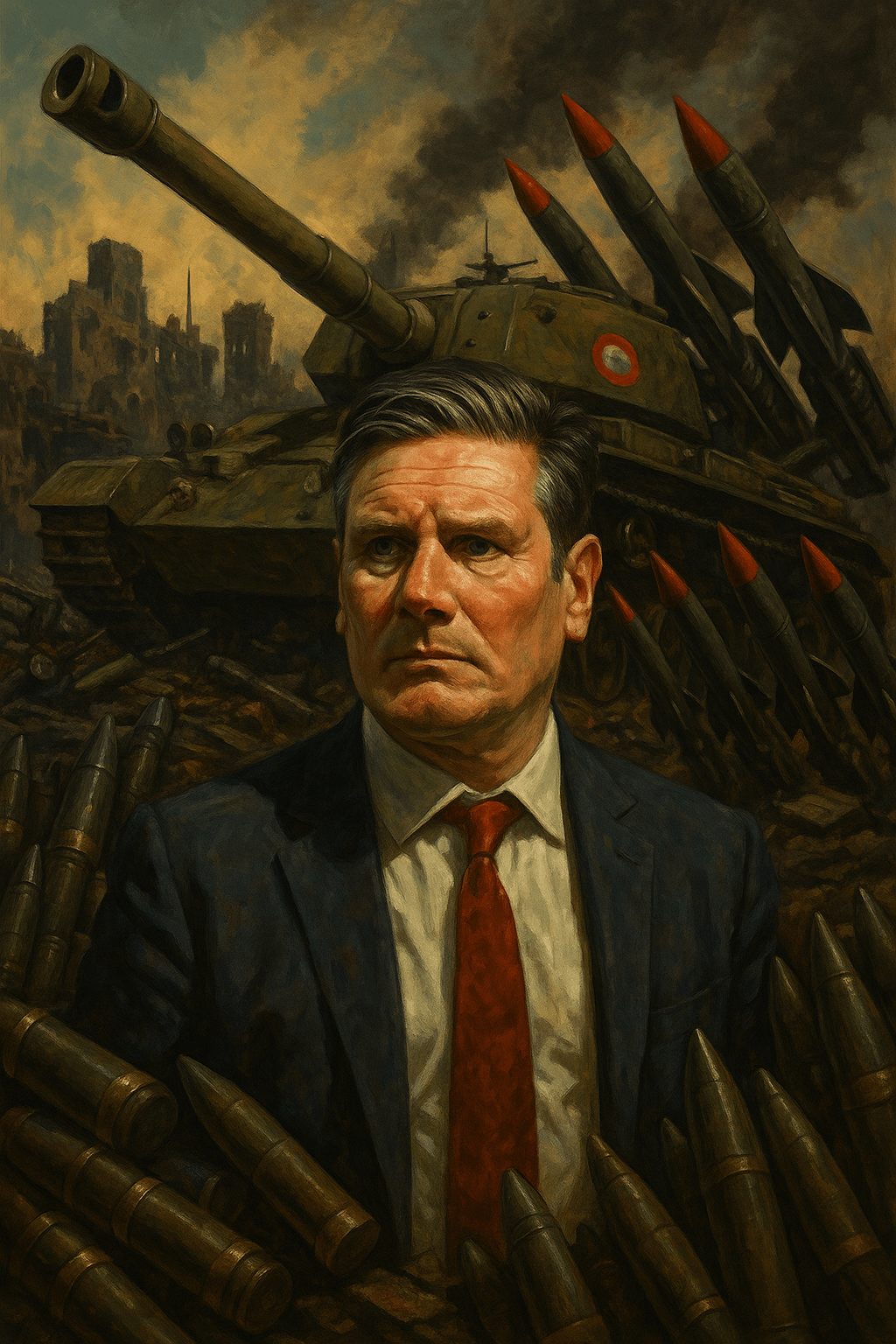
The Labour Party isn’t defending Britain—it’s fortifying empire for one last war-fueled ride into irrelevance.
By Prince Kapone | Weaponized Information
June 6, 2025
Keir Starmer Didn’t Betray Labour—He Finished the Job
On June 6, 2025, Venezuelan outlet teleSUR published a critical article by Silvana Solano titled “Britain’s Billions for Bombs: A Critical Look at Starmer’s War Agenda.” The piece reports on UK Prime Minister Keir Starmer’s unveiling of the country’s largest military spending package since the Cold War. Under the banner of “strategic modernization,” Starmer’s Labour government pledges £15 billion for nuclear submarines, the construction of new munitions factories, and massive investment in digital warfare. The report highlights how this aggressive militarization comes amid austerity, crumbling public services, and deepening class contradictions. Solano critiques the UK’s alignment with NATO escalation, its proxy warfare in Ukraine, and the broader implications of Britain’s deepening imperial commitments.
Silvana Solano’s article tells the truth you won’t hear on the BBC or Sky News: that Britain’s so-called “Labour” government just handed the military-industrial complex the biggest blank check since Thatcher, while telling working people there’s no money for hospitals, housing, or heat. And for that alone, her piece deserves to be read and circulated. teleSUR has long stood as one of the few media platforms that doesn’t kneel to NATO or Wall Street—and this piece is another solid contribution to the fight against imperialist amnesia.
But let’s not just nod our heads and move on. Let’s dig deeper. Starmer didn’t wake up one day and decide to militarize the UK economy for fun. He’s not malfunctioning—he’s functioning perfectly. This is what the Labour Party was redesigned to do: manage empire in crisis. To turn bomb factories into job programs. To swap class struggle for national security. And to do it all with the fake polish of “competent governance.”
The people behind this aren’t hiding. George Robertson, a NATO man through and through, is running Labour’s so-called defense review. John Healey, parroting talking points from BAE Systems, is selling this as a “jobs plan.” And Starmer? He’s the top lawyer for empire. A man who made his name prosecuting the poor, waving through MI5 surveillance powers, and now wrapping austerity and war in the red tie of respectable politics.
But Starmer isn’t just arming for war—he’s selling off the country to fund it. As we documented in our WPE on BlackRock’s economic conquest, the UK has already been handed over to finance capital. The same Labour government that’s pledging billions for bombs is also courting Wall Street to buy up Britain’s pensions, hospitals, and real estate. This isn’t just militarism—it’s technofascist recolonization through asset liquidation.
What Solano makes clear—and what we aim to sharpen—is that this isn’t about defending Britain from some phantom enemy. It’s about Britain defending its status in a collapsing imperial order. Starmer’s military surge is just the UK doing its part in the hyper-imperialist cost-sharing program known as NATO. You want to sit at the big boys’ table? Pay your dues. Build your bombs. Train their proxy armies. That’s the deal.
This is the same Britain that can’t afford to fix school roofs or feed hungry kids—but suddenly has £15 billion to pump into submarines and drone swarms. They say it’s “modernization.” What it really is, is war Keynesianism for the elite and mass abandonment for everyone else. And don’t be fooled by the talk of “jobs.” These aren’t jobs for dignity—they’re jobs for death. Wage labor weaponized into foreign policy.
And why now? Because the UK knows its empire is over and its economy is crumbling. The City of London runs on stolen money, its energy pipelines are insecure, and its only remaining export is violence. That’s why they’re building missile factories. That’s why they’re pledging 3% of GDP for “defense.” They’re not defending the people—they’re defending capital. Defending relevance. Defending a system that’s bleeding out.
So yes, Starmer is dangerous. But he’s not a surprise. He’s just the latest in a long line of professional caretakers for British empire—more polished than Sunak, less crude than Johnson, but no less loyal to the forces of decay. He’s not breaking from Labour’s history. He’s fulfilling it.
Bombs, Budgets, and the Crisis of Empire
Starmer’s war agenda isn’t a policy shift—it’s a symptom. A symptom of a decaying empire scrambling to hold onto relevance through force, fabrication, and financial firepower. The facts in Solano’s article are stark: £15 billion pledged for nuclear submarines. Plans to build six new munitions factories and acquire 7,000 long-range weapons. Military GDP set to rise from 2.3% to 2.5% by 2027, with a clear path to 3% soon after. Tens of thousands of Ukrainian troops trained under “Operation Interflex.” Digital warfare commands being built. The British military no longer aims to be bigger—just “more lethal.”
What’s being presented as a “strategic modernization” is in fact part of NATO’s hyper-imperialist military tax—what Weaponized Information has called the “5% for Death” doctrine. This isn’t about national defense. It’s about feeding the military-industrial complex while Western economies spiral into stagnation. NATO, unable to maintain hegemony through production or diplomacy, now demands tribute through war budgets. And Starmer, the obedient administrator, is paying up.
But the deeper context is this: imperialism is in freefall. The UK, once the world’s colonial command center, now finds itself economically dependent, geopolitically sidelined, and structurally irrelevant. The so-called “energy exit” from Russia was a mirage—British and EU dependency on cheap Eurasian energy has only deepened since 2022, as shown in WI’s investigation into the myth of European energy independence. The economic decline is real—and the only thing rising faster than inflation is the defense budget.
Meanwhile, the same UK that claims to stand for peace and human rights has been pillaging Ukraine under the cover of “solidarity.” British arms companies are neck-deep in the Ukrainian war economy, turning the country into a militarized IMF colony. Operation Interflex has trained over 30,000 Ukrainian soldiers—not for peace, but to prolong a proxy war that profits NATO and weakens Russia. At home, that war economy is now being nationalized: the munitions factories are just the domestic arm of a colonial strategy exported abroad.
Britain’s financial core—the City of London—remains a major beneficiary of this chaos. While bombs fall and people starve, British banks continue to launder wealth stolen through sanctions and asset seizures. In Euroclear’s $300 billion heist of Russian reserves, we saw how so-called “law” becomes looting when empire needs cash. The UK’s renewed war footing must be understood as an extension of that same logic: military budgets as instruments of financial piracy.
This isn’t accidental: Britain’s economy has already been restructured for extraction. Starmer’s war budget is not the first act—it’s the closing chapter of a process where financial occupation replaced democratic governance. The “capitulation point,” as Larry Fink calls it, wasn’t metaphor—it was milestone. Britain is not being saved by investment—it’s being bought by it.
And yet, outside the collapsing transatlantic sphere, the world is changing. Russia and China have forged a new pole of strategic resistance, while countries like Venezuela, Iran, and Ethiopia are building new economic corridors, military partnerships, and currency systems. The UK isn’t responding to a threat—it’s reacting to a world that no longer needs its approval. Its war budget is not about security—it’s about clinging to relevance in a world moving on.
This is the real “strategic context”: a multipolar world struggling to be born, while an imperialist one thrashes violently in decline. Starmer’s Labour Party isn’t leading—it’s tailing behind the war chariots of Washington, Brussels, and Wall Street, waving a flag that used to mean something, and now only signals retreat.
This Isn’t Defense—It’s the Panic of a Dying Empire
Let’s put it plainly: what Starmer is selling as “security” is just the panic of a ruling class with no future. You don’t spend billions on bombs when your people can’t eat or see a doctor unless you’re not planning to take care of them at all. This isn’t a defense strategy—it’s a funeral procession for the British welfare state, draped in the Union Jack and flanked by drone squadrons.
This is the logic of hyper-imperialism in motion: when your economy can’t produce, your currency can’t dominate, and your people don’t believe in your system anymore, you turn to militarism. You lash out. You militarize the economy, discipline the workers, and search the globe for new enemies to justify your collapse. That’s what NATO has become—not a defensive alliance, but an economic life support machine for the decaying core of global capital. And Starmer’s Labour isn’t resisting it—it’s managing the British wing of it.
They say the war budget will “create jobs.” But jobs for what? Building the machines that will starve Yemen? Bomb Gaza? Train soldiers in Ukraine to die in a U.S. proxy war? This isn’t a jobs program—it’s a death program with payroll benefits. They are asking working-class people to build the very weapons that will come back to haunt them, whether in empire’s foreign wars or in the surveillance systems that watch them at home.
This is what we call militarized imperialism: the fusion of military buildup and economic policy into one unified strategy of survival for the capitalist elite. Public investment doesn’t go to schools, clinics, or green energy—it goes to missiles, tanks, and facial recognition software. Labour’s “Plan for Change” is not a social program. It’s a colonial rebrand of war economy politics, designed to stabilize the system long enough to ride out the storm—at our expense.
This is the convergence of war and capital. Austerity and rearmament. The war economy is not a reaction to crisis—it is the strategy. Starmer’s Labour has become the perfect steward of this model: sell off what’s left of the public sphere to BlackRock, and use the war budget to keep the machine running just long enough to finish the fire sale.
But here’s the part they’re terrified of: the world is moving on. While Britain digs deeper into the NATO war hole, countries like Russia, China, Venezuela, Ethiopia, and Iran are realigning their economies, their currencies, and their militaries to break free from U.S. and EU domination. These aren’t rogue states. They’re laboratories of anti-imperialist possibility.
That’s why Labour calls them “threats.” Not because they’re dangerous to the people of Britain—but because they’re dangerous to the system that keeps Britain on top and the rest of the world underneath. The so-called “autocracies” aren’t launching invasions or demanding NATO tithes. They’re showing the world that another path exists—a path where sovereignty doesn’t mean servitude, and development doesn’t require debt or destruction.
Starmer’s war budget isn’t a mistake—it’s the clearest admission we’ll ever get that the ruling class has no plan for the future except to entrench, repress, and fight the world into submission. But it won’t work. Because no matter how many drones they buy or submarines they launch, the reality is simple: empires die, and the world remembers who bled for peace and who profited from war.
We remember. And we fight not just to expose the lies, but to build the power to end them.
The War Budget Has No Mandate—But We Do
The people of Britain didn’t ask for more bombs. They asked for housing, for heat, for nurses, for a life that doesn’t feel like a slow collapse. The ruling class answered with submarines. That contradiction is the opening. It’s where we strike.
We stand in full ideological unity with the forces resisting this war machine—be they dock workers in Genoa refusing to load weapons to Israel, activists in Manchester sabotaging arms shipments, or the Bolivarian revolutionaries in Venezuela who dared to call Starmer what he is: a “reckless, insane, and diabolical” manager of empire. From Caracas to Moscow, the message is clear—humanity needs peace, and peace will not come from NATO’s bayonets.
But peace doesn’t mean passivity. It means action. We don’t just condemn this budget—we organize against it. And we don’t just protest—we build. We construct dual and contending power: people’s media, people’s education, people’s defense, people’s economy. Starmer’s Labour wants to monopolize the future of British politics inside a war economy. We build outside of it.
And we’re not alone. Across the Global South, nations are aligning outside the dollar, breaking the sanctions chokehold, and forging anti-imperialist sovereignty on their own terms. That’s where we take our cues—from movements that have been burned by empire and still stand, fists up, flags high.
So what now? We offer five immediate lines of material struggle:
- Disrupt the arms pipeline: expose, blockade, and sabotage the supply chains feeding Britain’s war industries—from drone factories to BAE Systems boardrooms.
- Amplify multipolar voices: share and study statements from Maduro, Putin, Nasrallah, and others targeted by the war machine—not to worship leaders, but to learn from resistance.
- Build revolutionary labor alliances: support workers organizing in strategic sectors like logistics, transportation, and energy—especially those refusing to be complicit in militarism.
- Launch counter-narrative campaigns: flood digital and physical spaces with anti-imperialist analysis that reframes NATO not as a “security alliance,” but as the world’s most dangerous cartel.
- Organize dual power projects: from mutual aid and community defense to revolutionary study circles and independent media—everything we build outside their system is a strike against it.
This isn’t about left-wing posturing or moral critique. It’s about preparing for rupture. We don’t have time for symbolic politics. The world is splitting open, and the question is simple: which side are you on?
The war budget has no mandate. The people never voted for it. But we don’t need permission to resist—we only need the courage to act, the clarity to organize, and the internationalist discipline to know that every dollar spent on bombs is a theft from the people, and every step we take toward liberation is a blow against empire.
And we don’t wait. We strike now.
Further Reading from Weaponized Information
- “Britain at the Brink: BlackRock, Financial Conquest, and the New Colonialism”
- Drowned in Debt, Sold for Scraps: How Ukraine’s Mineral Deal Seals Its Neocolonial Fate
- Looters in Pinstripes: Euroclear, the EU, and the Neo-Colonial Heist of Russia’s Wealth
- The Energy Exit That Wasn’t: Europe, Russia, and the Propaganda of Imperial Dependency
- The Unbreakable Front: China, Russia, and the Shattering of U.S. Supremacy
- Axes of Resistance: When the Sanctioned Refuse to Bow
- Victory Day in Moscow: Russia, Africa, and the Rebirth of Anti-Imperialist Sovereignty
- 5% for Death: NATO’s Military Tax and the Hyper-Imperialist War Budget
- Merchants of Death, Ministers of Peace: Brussels’ Lobby-Driven War Economy and the EU’s New Imperialism
- Forging Sovereignty in a Hyper-Imperialist World: Russia and Ethiopia’s Strategic Realignment Beyond the Dollar Matrix
- The Colonial Logic of European Repression: A Primer on Settler Reflexes in Modern Warfare
- Digital Bayonets: NATO’s Cognitive Warfare Doctrine and the Weaponization of Perception
- When Militarism Becomes the Economy: War Keynesianism and the Imperial Crisis Cycle
 Weaponized Information
Leave a comment