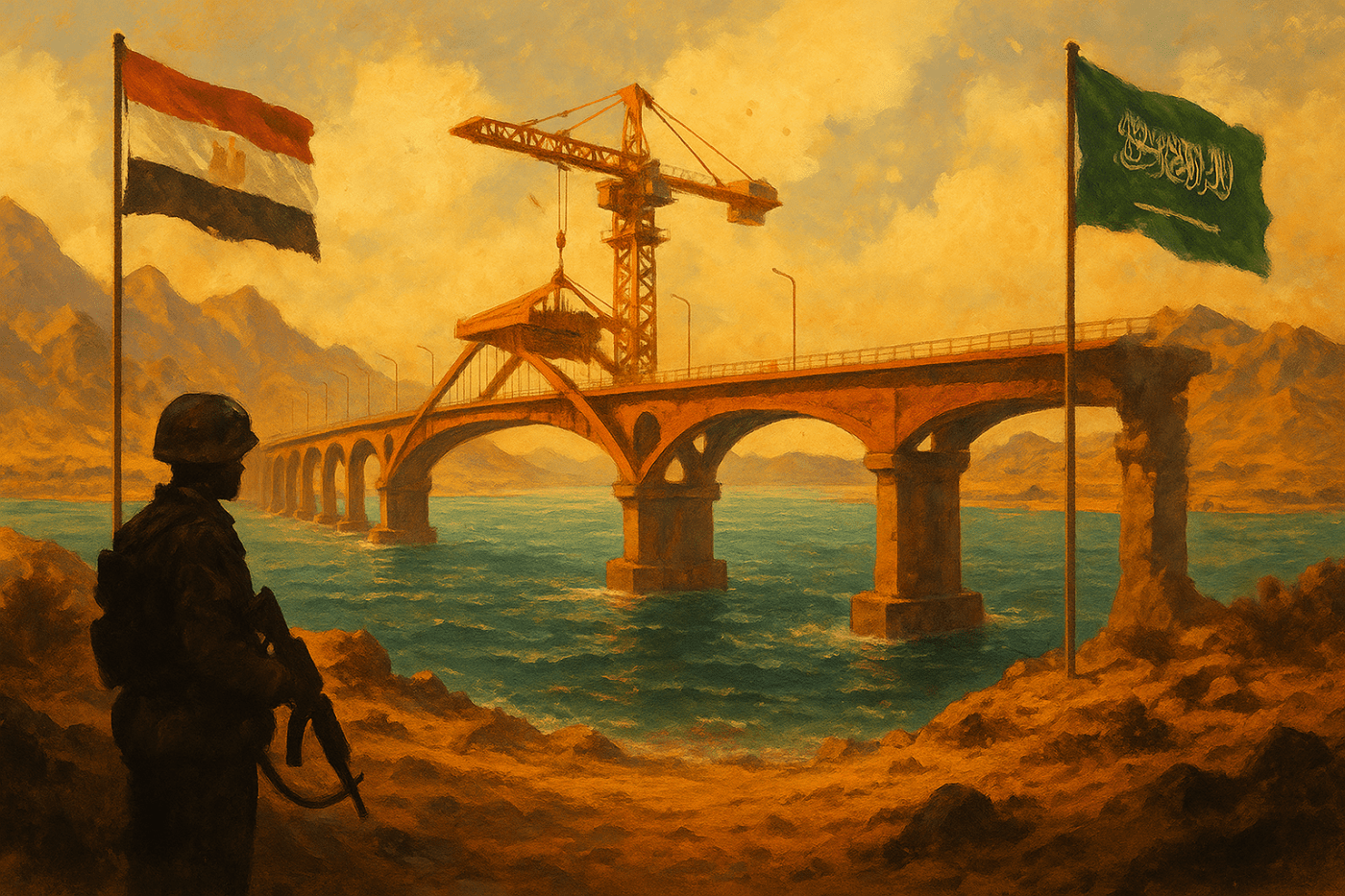
Saudi and Egyptian elites want you to believe a bridge across the Red Sea is about trade and tourism. But this isn’t just steel and concrete—it’s a contested front in the war over infrastructure, sovereignty, and empire’s unraveling grip.
By Prince Kapone | Weaponized Information
June 6, 2025
Architecture Without Politics—The Technocratic Mirage of Dezeen
Amy Peacock, the journalist behind this article, writes like most of the architectural press: detached, descriptive, and dutiful. Trained in the stylistic conventions of design journalism, she presents monumental state projects as though they were gallery installations—evacuated of history, power, and class struggle. Peacock is not an imperialist hitwoman like those at The Economist or AP; she’s something more banal: a stenographer of concrete, a scribe of skyline fantasies sold as progress. Her role is not to deceive maliciously, but to aestheticize power, to strip concrete of its content, and to mask contradiction behind renderings of symmetry and scale.
Dezeen Magazine, for its part, functions as a velvet glove on the iron fist of empire. It curates visions of the future sculpted by wealth, laundering Gulf mega-projects, Israeli settler architecture, and Silicon Valley surveillance hubs through a palette of clean lines and climate platitudes. It does not interrogate the class function of architecture or its position in the global system—it packages it for export, for admiration, for replication. As an outlet, Dezeen operates as a boutique arm of the broader imperialist media apparatus, soothing the conscience of empire’s technocrats with the promise that oppression can be beautiful—if it’s designed well.
The visionaries promoted here tell us everything we need to know. *Mohammed bin Salman*, aspiring autocrat and CEO-in-chief of Saudi Arabia, appears once again as the royal face of Gulf capital’s ambitions. *Nadhmi Al-Nasr*, Neom’s CEO, hovers in the background—engineer of a surveillance sprawl dressed up as ecological futurism. *Kamel al-Wazir*, Egypt’s transport minister and military man in a business suit, delivers the bureaucratic blessing. Reuters feeds the narrative. Google Maps supplies the image. The pipeline is polished, frictionless, and familiar.
But look closer at how the narrative is framed. There’s no mention of displacement. No exploration of sovereignty. No question of who the bridge will serve—or who it might displace. The project is framed as a benign connector of continents, a “qualitative transformation” of trade between Africa and Asia, as if tectonic plates had simply shaken hands. Terms like “development” and “tourism” are treated as inherently positive, with no interrogation of their underlying class relations or geopolitical implications. There is no empire here, no resistance, no contradiction—just infrastructure in a vacuum.
This is not propaganda in the blunt sense of the word. It’s not a lie told loudly. It’s a lie told quietly through omission, euphemism, and abstraction. It is, in short, what we call cognitive warfare—a war on thought itself, waged not by censoring facts, but by stripping them of meaning.
And so our task begins—not by accusing, but by excavating. Not by dismissing the facts, but by rescuing them from the rubble of their own presentation. In the next section, we’ll extract the material details of this project and re-situate them where they belong: inside a world system in crisis, in a region navigating imperial recalibration, and in a political terrain where every bridge is also a battleground.
Between Land Grabs and Liberation Corridors
The article tells us a bridge is coming—$4 billion worth of steel and concrete stretching across the Red Sea, linking Saudi Arabia to Egypt through Tiran Island. They say it’ll bring Africa and Asia closer, boost trade, speed up tourism, and tie the two continents together. Sounds like progress, right? That’s what they always say.
But behind the glowing language of “connectivity” and “qualitative transformation,” there’s something missing—something they don’t say because saying it would expose too much. They don’t mention whose land it crosses, who’s being moved out to make way, who’s financing it and why, and most of all, who stands to gain when the first cargo train rumbles over the water.
The bridge isn’t just a fancy piece of infrastructure. It’s part of a larger machine—a logistical corridor built to serve Neom, Saudi Arabia’s high-tech fever dream where AI meets apartheid. Neom is not a city for the people. It’s a surveillance project carved into stolen land, where the Indigenous Howeitat tribe has been arrested, displaced, and in some cases killed for refusing to disappear quietly. This bridge plugs Neom straight into the African continent—not to bring solidarity, but to haul cargo, capital, and whatever else the princes and bankers decide should flow.
But there’s more. This isn’t just about two countries flexing their development muscles. This is part of a larger shift—a reshuffling of the global deck. Across the Global South, countries are building alternatives to the dollar-drenched highways of Western finance. China’s Belt and Road, Iran’s Chabahar port, even Ethiopia’s state-run rail systems—they all point to something new: multipolarity. Not a utopia, but a battlefield where different paths are being fought for.
In that light, the Red Sea bridge is no small thing. It’s not built by the IMF, not tied to a World Bank loan, and not signed off by Washington. That alone makes it dangerous—to empire. As we showed in Wells of Defiance and The Long Road to Multipolarity, cracks are forming in the old order, and infrastructure is where some of the biggest fissures show up.
But let’s not get carried away. Just because the money didn’t come from New York doesn’t mean it came from the people. This is Gulf capital, channeled through sovereign wealth funds and autocratic regimes. As we laid out in Slick Sheikhs, Wall Street isn’t out of the picture—it’s just taking a backseat, letting others drive while still collecting rent. U.S. imperial strategy isn’t dead—it’s just gotten smarter. It knows how to profit from the projects it no longer controls, as we explained in Trump’s Gulf Tribute.
Egypt, too, is walking both sides of the line. On one hand, it’s building ties with China, resisting some Western dictates. On the other, it’s still run by a military-backed regime drowning in IMF debt and repression. Its shiny new capital city might be bigger than Cairo—but it’s built with the same old logic: secure the elite, pacify the poor, and pave over the contradictions.
So here we are. A bridge is being built. But a bridge to what? If it opens up new trade routes for the region, weakens Western chokeholds, and gives breathing room to South-South cooperation, that’s a good thing. We support that. But if it brings more land theft, surveillance, and exploitation under new management, then we call it what it is: neocolonialism with fiber-optic cables.
Infrastructure is never neutral. Who builds it, who owns it, who it serves—that’s the real blueprint. And whether this bridge becomes a path toward sovereignty or a corridor for capital will depend on who takes control of what flows across it—and who dares to reroute the current.
A Bridge to Somewhere—But for Whom?
Let’s be clear: bridges can carry more than cargo. They can carry politics. They can carry power. They can carry the possibility of something new—or the weight of something very old. That’s what makes this Red Sea project more than just steel beams and budget spreadsheets. It’s a question posed in concrete: who controls the flow?
What we’re looking at is not just a physical crossing between Egypt and Saudi Arabia. It’s a contested node in the global realignment unfolding before our eyes. The bridge is part of a broader shift away from U.S.-dictated infrastructure models—the IMF highways, the USAID fiber optics, the debt traps paved with “development.” The fact that this project isn’t funded by Washington or brokered by the World Bank matters. That’s a crack in the hyper-imperialist system. And in that crack, there’s space to maneuver—space for the Global South to build alternatives, however partial or contradictory they may be.
That’s the promise of multipolarity: not a finished project, but a battlefield. It opens up terrain where new alignments are possible, where the Global South might construct corridors of cooperation without asking permission from Brussels or Langley. And yes, that includes bridges like this—if, and only if, they are wrested from elite control and turned toward popular use.
But that’s not what’s happening here—not yet. What we have instead is a bridge built for capital, by capital. A corridor serving surveillance states and sovereign wealth funds, not the people living on either side of the sea. It links an Egyptian military dictatorship to a Saudi techno-monarchy, both of which repress dissent at home and cooperate with empire abroad when the price is right. And while it might weaken some U.S. influence in the region, it also extends the reach of Gulf compradorism and algorithmic governance—stretching Neom’s surveillance architecture across borders.
This is the contradiction we face. The bridge threatens U.S. dominance, yes. But it also threatens the poor who live on the land it cuts through. It displaces Indigenous communities while inviting Wall Street to reroute its profits through new ports. It dodges Washington’s leash, but not the logic of imperialist extraction. Unless seized by revolutionary forces—politically, economically, and ideologically—it becomes just another arm of the logistics empire.
And yet, we don’t dismiss it. We don’t fall into purist traps. We see the contradiction, name it, and ask what’s possible within it. Can bridges like this become lifelines for South-South solidarity? Can they be transformed into arteries of anti-imperialist resistance? Not under current management—but contradictions create cracks, and cracks are where revolutions grow.
If the bridge becomes a tool in the hands of the working class—if it facilitates people-to-people exchange, breaks chokeholds on regional trade, or connects liberated zones across borders—then it can be more than a monument to Gulf ambition. It can be repurposed as revolutionary infrastructure.
But that won’t happen on its own. It requires struggle. It requires consciousness. It requires movements that can take hold of what’s being built and redirect it. Until then, this bridge will remain suspended—between the promise of sovereignty and the peril of recolonization, between the possibility of rupture and the gravity of capital pulling everything back into its orbit.
It’s not enough to ask where the bridge goes. We have to ask: who’s allowed to cross—and who’s made to move out of the way?
Concrete for the People, Not the Princes
We don’t oppose bridges. We oppose the class that builds them for itself and blocks the rest of us from crossing. We don’t oppose infrastructure. We oppose infrastructure that displaces, surveils, and enriches the ruling class while dispossessing everyone else. What we’re calling for is simple: infrastructure in the service of the people, not capital. That’s the dividing line. That’s the red line.
We stand with the Howeitat tribe, whose resistance to Neom is not just a fight over land—it’s a fight against surveillance capitalism, forced removal, and Gulf technocrats trying to code a new kind of colonialism into desert soil. Their struggle reminds us that even in the age of AI and sovereign wealth funds, the battle for land and dignity remains grounded in the old colonial contradiction: those who have power, and those who have none.
We also draw strength from the examples that point in a different direction. Venezuela’s communal road building programs, Cuba’s people-centered infrastructure development, and China’s South-South rail diplomacy across East Africa have all shown—imperfectly but materially—that it is possible to build without colonizing, to develop without displacing. These are not perfect models, but they are cracks in the wall of capitalist infrastructure. They are signs that another kind of logistics is possible—one that serves food sovereignty, not fast fashion; one that connects people, not just markets.
Our call is not abstract. It is material, tactical, and rooted in struggle. Revolutionaries and anti-imperialists across the region and beyond must begin organizing:
- Map the logistics networks feeding Neom and its partner projects. These are the veins of a new colonial order—choke them with blockades, boycotts, and digital disruption.
- Support Howeitat resistance with international solidarity campaigns, legal defense, digital amplification, and economic pressure.
- Build narrative counterpower—challenge the glossy renderings and tech-utopian myths that legitimize these projects in the global press.
- Demand democratic control over infrastructure—from Cairo to Riyadh to anywhere else mega-projects are imposed without consent or accountability.
- Forge South-South revolutionary links—tie together land defenders, tech workers, union organizers, and displaced communities across borders. Make the bridge a site of convergence, not division.
This is the moment to act—not later, when the concrete has dried and the cameras have left. Not after the displacement. Not after the surveillance grid is already humming. Now. Because once they build the roads, the trains come next. And after the trains come the troops. That’s the history of empire in steel and stone.
So let us build our own bridges—not with Gulf capital and colonial blueprints, but with revolutionary solidarity, with peoples’ infrastructure, and with the conviction that we don’t have to live in a world where every road leads to capital and every crossing comes at someone else’s cost.
They build for profit. We build for liberation.
 Weaponized Information
Leave a comment