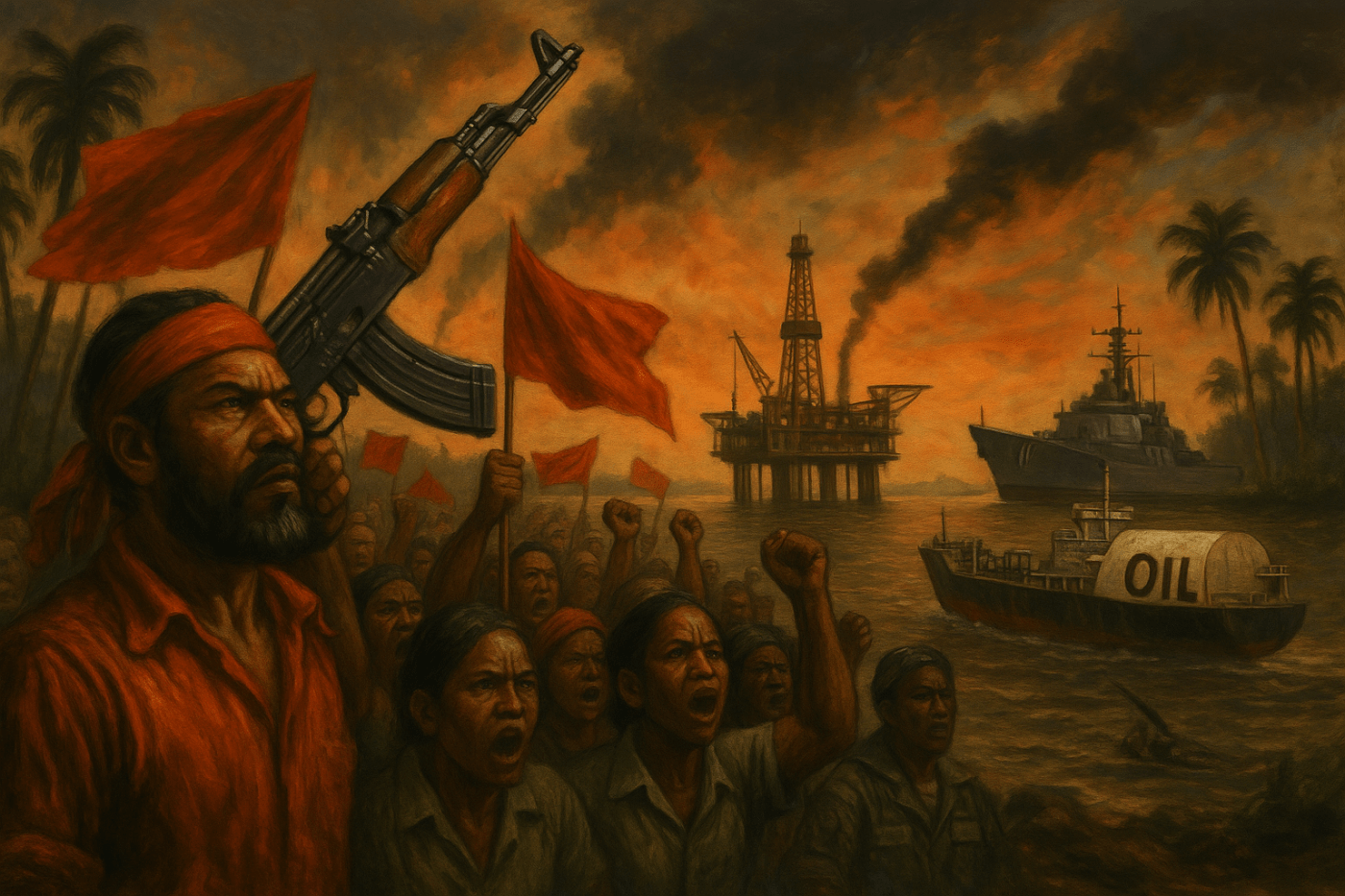
How corporate profit, colonial borders, and U.S. militarism converge to redraw the map of South America
By Prince Kapone | Weaponized Information | June 4, 2025
I. The Profits Were the Point: Framing Plunder as Progress
The article we are excavating—“Exxon-led consortium’s 2024 profit in Guyana rose 64% to $10.4 billion”, published by Reuters and authored by Kemol King—reads less like journalism and more like a sanitized quarterly report from ExxonMobil’s PR department. King, a Guyanese journalist routinely embedded in state-linked and corporate-aligned outlets, operates as a narrative technician for transnational capital. His career has mirrored the transformation of Guyanese media into a pipeline for corporate messaging—especially in the energy sector. Meanwhile, Reuters, owned by the UK-based Thomson Corporation, is a cornerstone of the imperialist media apparatus: its editorial line calibrated to serve the interests of Western financial institutions, oil conglomerates, and U.S.-aligned geopolitical interests. It does not report reality—it manufactures the ideological scaffolding required to make extraction look like development and militarization look like diplomacy.
Behind the article’s statistical cheerleading are names with real power and real roles: ExxonMobil, Hess Corporation, CNOOC, U.S. Southern Command, Lloyd Austin, Ali Irfaan, and the International Court of Justice. Each of them helps enforce, regulate, or benefit from this colonial-style carve-up of Guyana’s waters and Venezuela’s territory.
The core narrative technique of the article is strategic minimalism. King presents Exxon’s $10.4 billion in profit as a matter of economic fact—stripped of political content, historical context, or ethical weight. There is no mention that this sum is nearly quadruple Guyana’s annual national budget. No recognition that the profits come from a seabed under legal dispute. No acknowledgment that the oil fields lie within or adjacent to the Essequibo region, a territory long contested between Venezuela and Guyana. Instead, the article uses euphemisms like “growth,” “output,” and “royalties” to repackage plunder as progress. This isn’t journalism. It’s accounting for empire.
What the article aggressively omits is as telling as what it includes. There is no reference to the U.S. military presence in the region. No mention of Exxon’s disproportionate control over Guyana’s resource governance. No context about the 2016 oil contract signed under opaque, exploitative conditions. No inclusion of Venezuela’s legally grounded claim to Essequibo, affirmed in a national referendum by over 10 million voters. The result is a perfectly engineered ideological product: a story of success that hides the structure of looting.
The language itself is weaponized. The article avoids the term “neocolonialism” the way oil executives avoid taxes. It uses terms like “consortium” to make collusion sound collaborative, and “foreign direct investment” to launder what is essentially corporate occupation. The oil companies aren’t extractors—they are “partners.” Guyana isn’t being looted—it’s “benefiting from growth.” This is the grammar of recolonization. Contracts become shields. Profits become proof of legitimacy. And the plunder of a people is rewritten as a spreadsheet milestone.
In short, Reuters isn’t just reporting on Exxon’s profits—it’s rationalizing them. It presents neocolonial theft as natural, imperial presence as stabilizing, and corporate control over sovereign territory as a matter of best business practices. It doesn’t just obscure power—it enforces it. And in doing so, it performs its true function: to mask the forward march of hyper-imperialism beneath the sterile language of economic reporting.
II. Neocolonial Contracts, Disputed Borders, and the Machinery of Imperial Looting
Strip away the Reuters spin and a brutal picture emerges. ExxonMobil and its partners—Hess Corporation and China’s CNOOC—extracted $10.4 billion in profit from Guyana’s offshore oil reserves in a single year. This profit surge, a 64% increase from the year before, was generated almost entirely from the Stabroek Block, a massive offshore concession covering 6.6 million acres—much of it lying within or near the disputed Essequibo region. Guyana’s annual national budget, by comparison, hovers around $3 billion. The numbers aren’t just imbalanced—they’re imperial. They reveal a structure where one consortium of fossil capital accumulates more in 12 months than an entire nation is allowed to spend on its people.
These aren’t isolated facts. They’re nodes in a larger architecture of imperial control. As exposed in Oil, Empire, and the Battle for Essequibo, the 2016 production-sharing agreement between Exxon and the Guyanese state was drafted under conditions of extreme imbalance—signed by a comprador regime desperate for foreign investment and legally framed to guarantee lopsided returns for the oil giants. The so-called royalties are barely 2% of gross production. The Guyanese people are left with environmental risks, depleted sovereignty, and symbolic “shares” in a corporate venture that writes the terms, moves the oil, and controls the revenue.
But this is more than a contract issue. It’s a question of territory and sovereignty. The Exxon-dominated Stabroek Block is located adjacent to the Essequibo region—a territory long claimed by Venezuela and subjected to imperial cartographic violence since the fraudulent 1899 British arbitration. Venezuela’s claim, backed by historical treaties and affirmed in the 2023 national referendum by over 10 million voters, is not “aggression”—it’s decolonial continuity. The fact that Exxon continues to operate with full impunity in disputed waters is not a business decision. It is a geopolitical act—a forward advance of Western economic-military infrastructure under the cover of legal technicalities.
And behind this legal scaffolding lies force. As False Flags and Floating Platforms revealed, U.S. Southern Command has been actively militarizing the Guyana-Venezuela frontier: deploying surveillance assets, conducting joint operations, and positioning itself as “protector” of Exxon’s infrastructure. The goal is not just to deter Venezuela. It is to preempt any regional assertion of resource sovereignty that might challenge the flow of oil and profits to the North Atlantic ruling class. This is not about peacekeeping. It’s about pipeline protection.
And it is here that the media, law, and military converge. The ICJ’s fast-tracked legal proceedings over Essequibo, lauded by Reuters and U.S. officials, are not judicial—they’re strategic. As analyzed in The Ballot Box as Battlefield, the ICJ’s legitimacy has been weaponized to invalidate popular sovereignty in Venezuela while conferring legal cover to Exxon and its clients. Lawfare is the new gunboat diplomacy. It turns colonial maps into binding rulings, and popular referenda into “unrecognized acts.” What cannot be crushed with bombs is bracketed with procedure.
Finally, we must name the logistical systems underwriting all of this. The extraction is operated by Exxon, secured by U.S. naval dominance, adjudicated by imperial courts, and financed through Western capital markets. This is not mere profit. It is a textbook case of neocolonial extraction, organized through a coordinated system of legal capture, media suppression, and militarized deterrence. It is not a partnership. It is recolonization—written in contracts, enforced by command, and sanitized by headlines.
III. Oil Is a Weapon—So Is Narrative
What Reuters calls “profit” is in reality organized looting—an extraction of labor, land, and life that turns entire nations into logistical corridors for imperial wealth. When ExxonMobil walks off with $10.4 billion from Guyana in a single year, it is not the result of “investment.” It is the outcome of structural power: contracts signed under duress, enforced by warships, and shielded by corporate media. This is not capitalism working—it’s colonialism revived, digitized, and made polite with spreadsheets and legalese.
The framing of Guyana as a sovereign beneficiary of this windfall is a strategic hallucination. Guyana’s role is not that of a partner but of a proxy. The state functions as a regional outpost for the imperial core—a comprador interface between U.S. fossil capital and South America’s vast untapped energy reserves. Meanwhile, Venezuela—whose democratic referendum affirmed its historical claim to Essequibo—is painted as the aggressor. This inversion is not accidental. It is the ideological reflex of empire: to define self-defense as aggression and pillage as progress.
Yet history is not silent. The same imperial courts that today rush to validate Exxon’s offshore rights are direct heirs of the same colonial legal systems that once carved up Africa and Asia. The International Court of Justice, far from being an impartial arbiter, is structurally embedded in a system that privileges the territorial status quo of Western conquest. As Venezuela challenges this, not with bombs but with ballots, the imperial press grows louder. They must drown out the reality that the Global South is rising not just in rhetoric but in reclamation.
And the material basis of this reclamation is clear: Venezuela’s Bolivarian Revolution seeks to place its resources—oil, gas, minerals—under the democratic control of its people. Guyana, under imperial tutelage, offers its seabed to the highest foreign bidder. One pathway points to sovereignty, the other to servitude. What Exxon’s profit surge reveals is not just economic disparity but divergent models of governance: one organized around social wealth, the other around colonial rent.
The Essequibo struggle is not just a border dispute. It is a microcosm of the wider war between multipolar sovereignty and unipolar domination. Venezuela’s referendum, demonized in the West, was in fact an act of mass political education and popular empowerment. In contrast, Exxon’s contracts are inked in secrecy, insulated from public scrutiny, and enforced with foreign muscle. The revolutionary task is to reject this false neutrality—to name the line of antagonism clearly: between the forces of recolonization and the movements for liberation.
From the waters of Essequibo to the halls of the ICJ, the empire’s weapons have changed. But the goal remains the same: extract, suppress, divide. Our response must also evolve. We must transform our understanding of “news” into a weapon of clarity, and our analysis into fuel for solidarity. This is not about oil alone. It is about power—who has it, how it’s maintained, and how it must be taken back.
IV. From Recolonization to Revolution: Mobilizing for the Sovereignty of Essequibo
This is not just an oil story. It is a colonial war being fought with contracts, warships, and propaganda. As ExxonMobil extracts $10.4 billion in Guyana, the people of Venezuela and the working classes of the entire region face recolonization not at gunpoint, but by ledger sheet. The imperial core—via Exxon, Chevron, the U.S. Southern Command, and media firms like Reuters—has declared that the future of South America will not be determined by its peoples, but by its plunderers.
We declare full ideological unity with the Bolivarian Revolution, the Venezuelan masses who voted overwhelmingly to affirm Essequibo as part of their sovereign territory, and the revolutionary project of breaking free from the imperialist world system. Venezuela is not the aggressor—it is the front line in the battle to reclaim national dignity, territorial sovereignty, and control over strategic resources. Guyana’s people too are victims of this same imperial trap, locked out of wealth generated from their own seabed while the comprador state apparatus manages exploitation on behalf of foreign capital.
Resistance already exists: from the Bolivarian militias to the mass education campaigns that preceded Venezuela’s referendum; from movements within CARICOM questioning the role of U.S. militarization in the region to solidarity initiatives in Latin America and beyond. But what’s needed now is material internationalism. We must amplify campaigns that expose Exxon’s criminal contracts, support legal and political initiatives from Venezuela defending Essequibo, and stand against any military or diplomatic escalation driven by Washington.
Revolutionaries in the core can take the following actions:
- Expose ExxonMobil’s role in neocolonial plunder through media campaigns, educational forums, and direct action.
- Disrupt the political legitimacy of imperial arbitration mechanisms like the ICJ that exist to preserve colonial borders and corporate hegemony.
- Forge organizational alliances between climate justice forces and anti-imperialist movements to frame oil extraction as both an ecological and colonial crisis.
- Pressure elected officials and institutions complicit in backing Guyana’s claims and Exxon’s profits through lobbying, protest, and digital counterinsurgency.
This is not simply about defending Venezuela. It is about defending the principle that no nation has the right to rob another of its land, its labor, or its life. It is about striking down the lie that the “free market” decides who lives and who starves. It is about linking Essequibo to Congo, to Palestine, to Standing Rock, to every place where capital drills, devours, and destroys in the name of empire.
Let it be known: the empire may have maps, money, and media—but we have memory, solidarity, and the world to win.
 Weaponized Information
Leave a comment