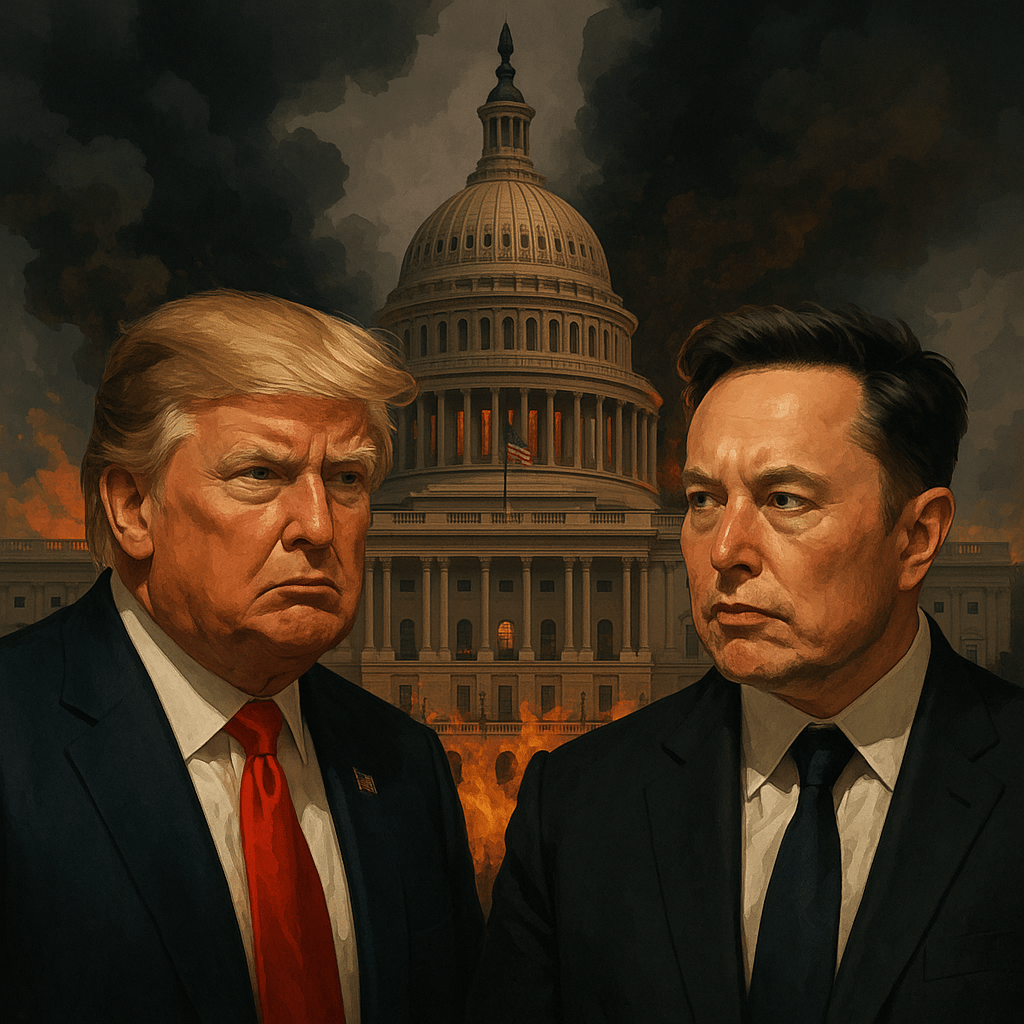
Austerity for the people, subsidies for capital—two wings of empire spar over who gets to pilot the crash landing
By Prince Kapone | Weaponized Information | June 3, 2025
The Manufactured Rift: A Class Dispute Masquerading as Public Debate
The article in question—published June 3, 2025, in The Washington Post and authored by Jacob Bogage and Theodoric Meyer—is not the work of independent journalism but a case study in elite stenography. Bogage and Meyer are longtime products of elite educational pipelines—Missouri, Columbia, McGill—whose careers have been spent transcribing ruling-class narratives under the guise of objective reporting. Their professional trajectory through establishment outlets like Politico and the Bezos-owned Post reflects not journalistic courage but ideological obedience. They do not speak truth to power—they serve it, framing the interests of billionaires and technocrats as legitimate policy debates while excluding the voices of the working class, the colonized, and the poor.
As for the outlet itself, The Washington Post functions today as the polished liberal wing of capitalist propaganda. Under the ownership of Amazon billionaire Jeff Bezos, the paper operates as a mouthpiece for market fundamentalism and digital imperialism. Despite its slogan—“Democracy Dies in Darkness”—its editorial direction increasingly reflects the political economy of elite consolidation: deference to private capital, erasure of class struggle, and uncritical amplification of state-corporate unity. Far from challenging empire, it manages its optics. It doesn’t expose injustice—it rebrands it.
Into this theater of illusion step figures like Elon Musk, Donald Trump, Ted Cruz, Kevin Hassett, Mike Johnson, John Thune, and Ron Johnson—each playing their part in the managerial drama of capitalist rule. Their titles differ—president, senator, technocrat, billionaire—but their function is shared: manage, manipulate, and maintain the declining U.S. empire through digital expansion, state repression, and social abandonment.
The article’s central narrative—Musk publicly denouncing Trump’s sweeping tax and immigration bill as a “disgusting abomination”—is framed as a dramatic rupture between two powerful men. In reality, it is a carefully staged spectacle, a scripted disagreement within the same imperial family. Musk is no outsider; he is the very architect of the surveillance and austerity regime now being formalized into law. His previous role as head of Trump’s DOGE (Department of Government Efficiency) was not an act of resistance, but a test run for automated austerity: cutting services, gutting the public, and turning governance into a corporate spreadsheet. The article whitewashes this history, portraying Musk as a newly awakened critic rather than a co-conspirator.
The Post amplifies Musk’s critique—“crushingly unsustainable debt,” “outrageous, pork-filled” bill—not as propaganda, but as policy commentary. It conceals the material basis for his outrage: the bill phases out EV tax credits and clean energy subsidies that pad Tesla’s bottom line. It’s not the poor being punished that bothers Musk—it’s that his slice of the imperial pie is shrinking. The article refuses to name this contradiction. Instead, it offers a sanitized play-by-play of elite disagreement while the actual victims—SNAP recipients, Medicaid users, undocumented workers—are rendered as budget line items.
There is no examination of the bill’s true function: a war budget wrapped in a tax cut, gutting social programs while militarizing borders and expanding state repression. Instead, the authors quote Kevin Hassett forecasting “robust economic growth,” as if capital accumulation at gunpoint were a moral good. They quote Ted Cruz and Ron Johnson calling for deeper cuts, as if starvation were a fiscal virtue. The poor are not interviewed. The colonized are not consulted. Working-class people are not even props in this performance—they are statistical abstractions, sacrificed in silence.
The Washington Post’s role is not to inform the public—it is to produce consent. This article does not reveal contradiction; it manages it. By staging this billionaire drama in moral terms, it repositions the political crisis as a personality clash. Trump is crude. Musk is principled. A false binary is constructed to give readers a sense of choice, even as both figures push the same imperial agenda: corporate tax relief, digital surveillance, debt discipline, and repression of the domestic and global poor.
In this carefully constructed illusion, democracy is not dying in darkness—it is being strangled in plain sight, on glossy newsprint, with the full complicity of corporate journalism. The only thing more dangerous than Trump’s bill is the machinery that makes it appear legitimate. And the Post, for all its prestige, is not reporting on that machine—it is operating it.
The Real Bill: Austerity, Empire, and the Internal Recolonization of the Poor
Strip away the billionaire bickering, and what remains is a legislative weapon of class war. Trump’s “One Big Beautiful Bill” is not just a tax and immigration package—it is a blueprint for recolonizing the domestic core of U.S. empire. It extends corporate tax cuts, slashes social programs, militarizes the border, and guts clean energy subsidies. But more than that, it encodes into law the new ruling-class consensus: crisis capitalism must be rescued through a fusion of austerity, automation, and intensified state repression. This is technofascism in legislative form.
As analyzed in Recolonizing the Core, the U.S. ruling class—faced with global multipolarity, domestic unrest, and ecological collapse—has turned inward. The Global South can no longer be superexploited without resistance. So the imperial state has redirected its violence at home. Social reproduction is being defunded. Medicaid is under attack. SNAP costs are being dumped on overstretched local governments, forcing them to raise taxes or kick families off entirely. This is not “balancing the budget”—it’s starving the surplus population. Austerity is not a fiscal tool; it is a class weapon.
The contradictions are stark. The bill transfers $150 billion to immigration enforcement—further arming ICE and Border Patrol—while simultaneously slashing support for the poor. It tightens eligibility for Medicaid, even as the cost of living and medical bankruptcy explode. It eliminates EV subsidies and renewable tax credits—not out of ideological purity, but because fossil fuel, arms, and private prison capital must be resuscitated. This is a political economy of organized abandonment and militarized containment. And as detailed in Technofascism and the Unified Ruling Class, it represents not a deviation but a consolidation: the Cowboy and Digerati factions of the white ruling class converging around a shared doctrine of extraction, discipline, and empire.
Musk’s departure from government, chronicled in Empire Reloaded, is framed as a principled stand, but it is better understood as a tactical withdrawal. His influence lives on through the DOGE apparatus he pioneered—an AI-driven austerity regime designed to eliminate “inefficiencies” (i.e., human needs). The very cuts now being proposed by the Senate—eliminating battery production credits, ending food support, sunsetting clean energy investment—are not a betrayal of Musk’s program. They are its logical extension. His real grievance is not with empire’s cruelty—it’s with the loss of his preferred position within it.
In When Billionaires Quarrel, we outlined how these elite squabbles mask deeper continuity: both Trump and Musk are loyal to the same objective—capitalist restoration through digital control, mass immiseration, and militarized governance. One prefers brute force nationalism; the other favors algorithmic optimization. But the result is the same: the state is restructured to serve capital, and the population is managed through hunger, surveillance, and coercive force.
The nonpartisan Congressional Budget Office tells us the bill will add $2.4 trillion to the debt over 10 years. But this figure obscures more than it reveals. The question is not how much debt—but who bears it. Tax cuts for capital are framed as growth. Health care for the poor is framed as waste. Musk complains about “unsustainable deficits,” but this austerity logic is precisely what DOGE was designed to automate: eliminate the poor to balance the books. In this war, the surplus population is not just unemployed—they are unwanted.
This bill is not the product of democratic debate. It is the logical outcome of a decaying empire that no longer needs its people except as consumers, inmates, or soldiers. It disciplines labor, consolidates capital, and criminalizes survival. This is not about Trump’s personality or Musk’s ego—it is about the structural logic of technofascism. And unless we name that logic, expose its roots, and organize against it, we will continue mistaking its symptoms for solutions.
One Class, Two Faces: The False Binary of Elite “Dissent”
The so-called clash between Musk and Trump is not a political rupture—it’s a corporate boardroom dispute playing out on a national stage. At its core, this is not about ideology. It’s about logistics: which faction of the ruling class will dictate the terms of imperial recalibration. Trump represents the settler-capitalist brute force strategy—wielding state violence, border militarization, and direct repression. Musk represents the technocratic precision strike—deploying data extraction, algorithmic governance, and privatized austerity. But neither opposes empire. Neither serves the poor. Neither represents the working class. They are rival engineers of the same death machine.
As exposed in The Architect of Technofascism, Musk’s ventures—from Starlink to DOGE to Neuralink—are not technological innovations for public good; they are tools of imperial management. His AI austerity platform was designed to automate the destruction of social infrastructure under the banner of “efficiency.” His surveillance satellites now map and monitor colonized territories in the Middle East and Sahel. His platforms are the software layer of recolonization. And his outrage at Trump’s bill? It emerges only when the spoils of empire are redistributed away from his sector.
In Technofascism and the Unified Ruling Class, we clarified that there is no longer a “divided” elite. The apparent friction between Silicon Valley, Wall Street, and MAGA reactionaries has collapsed into synthesis. The technocrats have been absorbed into the settler capitalist project, and the state has been retooled as a vehicle for digital enforcement of class rule. The police wear body cams powered by Palantir. Border patrol uses AI-generated heat maps. Food assistance is rationed by algorithm. And federal legislation like Trump’s “beautiful bill” is simply the legal codification of these colonial technologies.
Musk’s temporary exit from Trump’s inner circle, analyzed in Empire Reloaded, was never about resistance. It was a strategic repositioning. He leaves the room, but his logic remains. DOGE lives on as a policy template. SpaceX continues its military contracts. Tesla still profits from minerals extracted through neocolonial partnerships in Africa. Starlink maps the skies over Riyadh and Sana’a. When billionaires quarrel, the empire upgrades. It does not pause.
So what is the function of this public dispute? It is to contain political imagination. To render crisis as manageable. To transform a coordinated capitalist assault into a televised disagreement between two “options.” The message is: you must choose your executioner—Trump with his tanks, or Musk with his drones. This is not political debate. It is spectacle. It is war masquerading as governance. And The Washington Post is not a passive observer—it is the script supervisor.
Beneath the surface-level differences in style, tone, and policy emphasis lies total consensus: the poor must be disciplined, the border must be fortified, the digital infrastructure must be expanded to monitor dissent, and the empire must survive, no matter the cost. This is the real unity of the ruling class. And it cannot be reformed. It must be overthrown.
Reject the Spectacle, Confront the System
The time for illusions is over. There is no savior among billionaires. There is no side worth choosing in a knife fight between executioners. The Trump-Musk drama is not a democratic rupture—it is an elite distraction, designed to keep the people watching while the noose tightens. What they’re fighting over is not whether to dominate, but how. Their disagreement is not over justice—it’s over jurisdiction. And while they argue over the spoils of empire, the working class bleeds.
This bill is not a deviation from empire’s logic—it is its distillation. It turns hunger into fiscal policy. It turns debt into discipline. It turns the police into a budget line, and the poor into excess inventory. It weaponizes the very crises it claims to address. And it reminds us, as we’ve long said: technofascism is not coming. It is here. It is law. And unless we are organized, it will become permanent.
The only way forward is through revolutionary clarity. We must reject the spectacle of elite conflict. We must stop chasing better billionaires. There is no progressive inside the palace. There is no freedom in the fortress. Trump wants to jail the poor. Musk wants to automate their liquidation. Their feud is not our fight—but our future depends on defeating both.
We must build a new force—rooted not in elections, but in resistance. Grounded not in fantasies of reform, but in the realities of class war. We must unite the poor, the working class, and the colonized—those who bear the costs of every budget cut, every subsidy repeal, every “efficiency reform.” Because no matter which billionaire is in power, we are the ones made to pay.
What this moment demands is not passive analysis—it demands organized struggle. Mass political education. Coordinated economic resistance. Revolutionary dual power. And above all, a refusal to mistake their spectacle for our salvation. We do not negotiate with technofascism. We destroy it. We do not choose between tyrants. We choose the people. We choose liberation. And we fight for it.
 Weaponized Information
Leave a comment