Tracing the roots of white panic from colonial supremacy to imperial decline—and why defection from whiteness is the only way forward
By Prince Kapone | Weaponized Information | June 1, 2025
The Panic Is the Confession: Why So Many White People Feel Like the World Is Ending
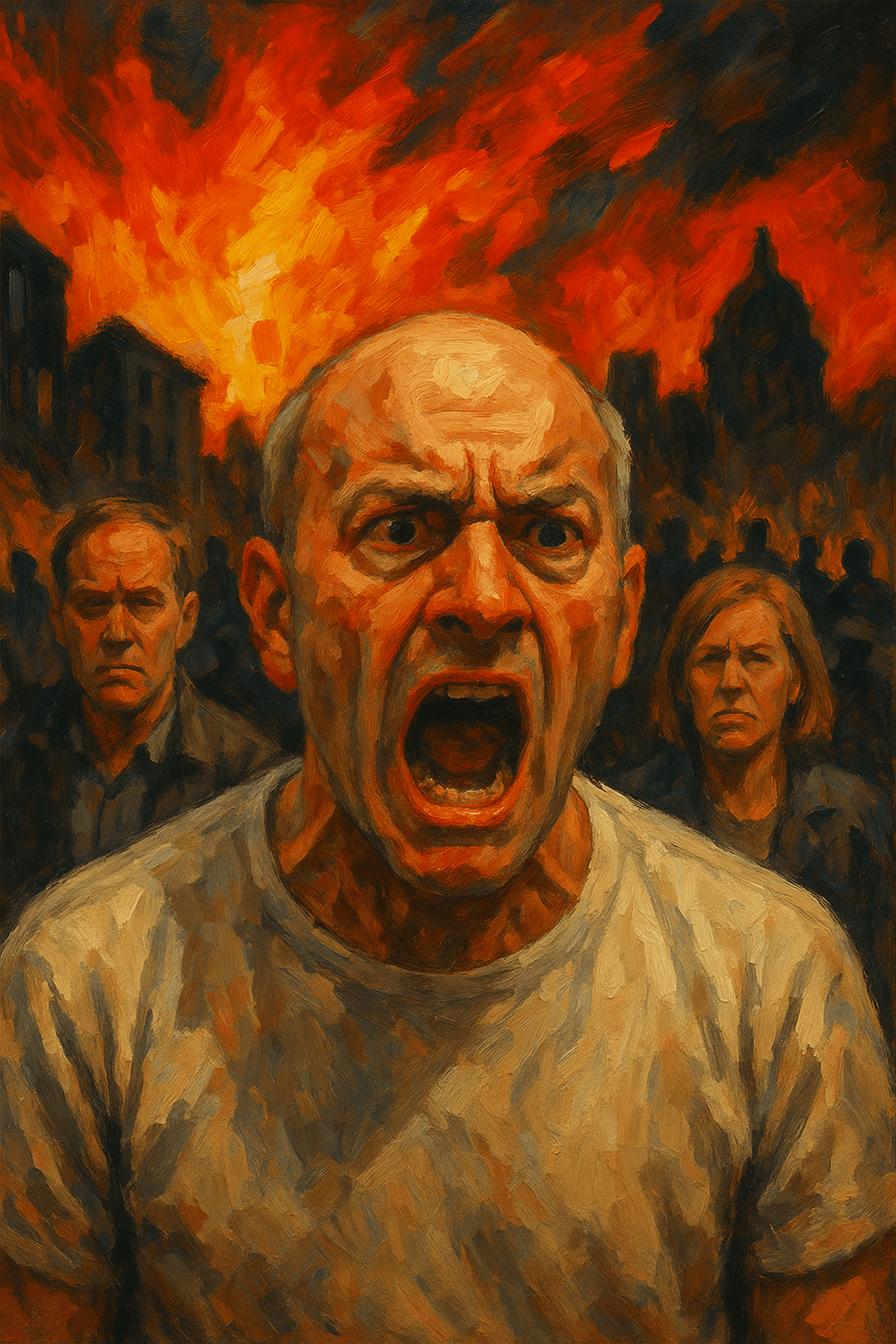
You can feel it in the air. Watch enough TV, listen to enough conversations, and you’ll hear it creeping in: “We’re being replaced.” “They hate us.” “Our way of life is under attack.” From MAGA rallies in the U.S. to street protests in France and conspiracy rants in Germany, a wave of white panic is crashing across the Western world. But panic about what, exactly?
If we’re being honest with ourselves—not performative, not defensive, just honest—the fear isn’t really about physical survival. No armies are marching into white suburbs. No policy is banning whiteness. What people like us are afraid of is losing our place. The position we’ve held, mostly without question, for generations—at the top.
That fear is real. But it’s not new. It’s what happens when a global system that’s long been tilted in your favor starts to wobble. When the safety you were taught to expect—economic, political, cultural—isn’t guaranteed anymore. And what’s left is an unspoken dread: that the world we inherited is collapsing and no one is coming to save us.
But maybe the more uncomfortable truth is this: no one was ever supposed to. Because the world we inherited—the one where whiteness means power, protection, and prestige—wasn’t built fairly. It was built through empire. It was built on top of someone else’s land, labor, and life. And deep down, many of us know it.
That’s why I say: the panic is the confession. It’s not just fear of change. It’s the subconscious admission that the foundation was never solid to begin with. That the stories we were told—that we earned everything, that we deserved everything, that the world needs us to lead it—were just that: stories. And now, as they fall apart, we feel exposed.
But if we can sit with that discomfort—if we can stop running from it—we might be able to ask better questions. Like: where did this fear come from? Who taught us to feel it? And what are we afraid of losing that we never had a right to hold in the first place?
To answer that, we have to go back. Before the panic. Before the fear. Back to where whiteness itself was forged—and what it was forged for.
Whiteness Wasn’t Born—It Was Built: The Ruling-Class Invention That Made Empire Feel Like Identity
If we’re going to understand where this panic comes from, we have to understand what it’s trying to protect. And that means facing a hard truth: whiteness—the kind we inherited in the U.S., in Europe, in Australia—was never just about skin. It was about power. It was a political invention designed to organize the spoils of empire.
Before conquest, before slavery, before colonialism, there were no “white people.” There were Italians, Irish, Germans, Slavs—many of them poor, landless, colonized themselves. But as Europe expanded outward, building a world system based on extraction, land theft, and human bondage, a new identity was stitched together to justify it all: white.
Whiteness was the velvet rope. The shortcut to citizenship, property, safety. It told poor Europeans: you may not be rich, but you’re not African. You’re not Indigenous. You’re not one of them. In return, all you had to do was look away while the machine kept grinding—the plantations, the reservations, the colonies.
And it worked. Not by lifting us up, but by giving us someone to stand on. It gave our grandparents jobs on stolen land, wages on stolen labor, and homes in redlined suburbs. It trained us to see our comfort as normal, and everyone else’s struggle as their own fault. It taught us that this system, rigged as it is, was ours to protect.
But what whiteness offered wasn’t freedom—it was a contract. A deal with the devil in the language of democracy. And now that deal is breaking down. The empire is in crisis. The scraps are shrinking. And the mask of innocence is slipping.
That’s why this moment feels so fragile. Because whiteness wasn’t built to withstand equality. It only knows how to rule. And as the world demands something different—as people push for land back, for reparations, for a planet not run by European capital—many of us feel like we’re being erased. But we’re not. We’re being asked to let go of an identity that was never ours to keep.
From Rulers to Victims: How the Empire Rebranded Decline as Persecution
Once we understand that whiteness was built to manage empire—to secure loyalty to the ruling order by offering petty dividends of superiority—it makes sense that its shape would shift when that order starts to break down. And that’s exactly what we’re living through now.
The colonial world we inherited is unraveling. The old confidence is gone. The wars aren’t being won. The jobs aren’t coming back. The dollar is wobbling. The world is reorganizing itself without the West at the center. And for millions of white people raised to believe they were the center, that collapse doesn’t feel like historical rebalancing—it feels like annihilation.
And so the identity once built around command gets flipped. It becomes victimhood. It becomes grievance. It becomes “we’re under attack.” You hear it in the street, on the news, in the family group chats: “We’re losing our country.” “They’re erasing our culture.” “We can’t say anything anymore.” The people who ran the world for 500 years are now convinced they’re being hunted.
This isn’t a psychological mystery. It’s an ideological restructuring. As whiteness loses its material advantage, it’s being repackaged as a site of pain. As something persecuted. Something noble in decline. Something worth defending. And this is how the ruling class keeps it alive—not through supremacy, but through siege.
Because if they can convince us that we’re victims, then we’ll keep defending a system that’s already stopped serving us. We’ll see every gain by someone else as a loss for us. Every act of resistance as a threat. Every crack in the empire as a personal attack.
This is how fascism finds its footing—not in strength, but in wounded pride. Not in confidence, but in a nostalgia that says, “We were great once. We were safe once. And someone took it from us.” It’s not true, of course. But it doesn’t have to be. All it has to do is work.
And it is working. At least for now. But it doesn’t have to. Because victimhood isn’t the only story we can tell ourselves. There’s another story, too. One that starts with a question most white people have never asked seriously: what if we were never meant to rule the world? What if we were meant to share it?
The question now isn’t whether whiteness can be saved. It’s whether we can break from it before it drags us deeper into fascism, deeper into climate collapse, deeper into war. Before it turns our fear into fuel for another generation of empire.
Because what we’re being sold now isn’t a future. It’s a bunker. And if we want to get free, we have to stop defending the identity that was designed to keep us loyal to the people who built it.
The “Great Replacement”… of What?: Decolonization Isn’t Genocide—It’s the End of a Monopoly
Once whiteness becomes a story of victimhood, it’s only a short leap to conspiracy. And nothing captures that leap like the “Great Replacement.” The idea that white people are being deliberately replaced—by immigrants, by Muslims, by Black and Brown people, by some vast, faceless force working to erase Western civilization.
It sounds ridiculous on its face. But millions believe it. Why? Because it gives shape to the fear. It offers a villain. It says: “You’re not losing your job because of capital flight—you’re losing it because of migrants.” “Your community isn’t in crisis because of austerity—it’s because the foreigners brought crime.” It’s not just a lie. It’s ideological misdirection.
The “Great Replacement” isn’t about demographics. It’s about the collapse of guaranteed dominance. It’s not that white people are disappearing—it’s that whiteness as a passport to power is eroding. And for those of us raised to believe that power was natural, deserved, or divine, the loss of it feels like an existential threat.
But let’s be clear: no one is replacing us. What’s being replaced is the colonial arrangement—the assumption that the West owns the future, that Europe defines humanity, that whiteness equals civilization. And if that feels like persecution, it’s only because we were never taught to imagine justice without us on top.
The ruling class loves this panic. It keeps us distracted while they hoard the last reserves of a dying system. While climate collapses, wars escalate, and capital consolidates, we’re told to blame people fleeing the very violence this system created. It’s a magic trick. A shell game. And it works—until we stop falling for it.
Because what’s really happening isn’t replacement. It’s return. People are returning to land, to memory, to self-determination. Nations long plundered are asserting dignity. Borders drawn by imperial hands are being challenged. The story is shifting—from one of conquest to one of correction. And that doesn’t erase us. It just asks us to live without domination.
If we can see through the lie—if we can name the fear for what it is—we can begin to unlearn what whiteness trained us to believe. We can stop clinging to myths of civilizational crisis and start confronting the real crisis: a world trying to move beyond empire, while we’re still being taught to mourn its collapse.
The Fear of Payback: White Projection and the Ghosts of Empire
If the “Great Replacement” gives white panic a political shape, projection gives it emotional fuel. Underneath the demographic myths and culture war slogans is something older and harder to name: we’re afraid because we know what was done.
We may not say it outright. We may not have learned the full history in school. But somewhere inside us, we know. We know the land wasn’t empty. We know slavery didn’t build itself. We know the riches of Europe weren’t dug from European soil. And because we know, we assume the rest of the world knows too.
And that’s when the fear turns into something else: What if they do to us what we did to them? What if the people we conquered rise up? What if they want revenge? What if justice means punishment? That’s the settler subconscious at work. That’s the colonial guilt in motion.
As Baldwin said, we’re not afraid of being hated—we’re afraid of being known. We project violence onto the colonized because violence is the foundation of the world we inherited. We assume the oppressed are planning what we’ve already done. It’s not clairvoyance. It’s memory.
But here’s the irony: the vast majority of people rising up around the world aren’t asking for revenge. They’re asking for freedom. For dignity. For land and life and reparations, yes—but not to become new colonizers. Only to live without empire’s boot on their neck.
It’s not that they hate us. It’s that they no longer fear us. And to a system that taught us power is the same as safety, that loss of fear feels like a threat. But it’s not. It’s a window. A way out. A chance to face history not as an accusation, but as an invitation to finally stop lying.
We don’t have to live in projection. We can live in truth. But first, we have to stop assuming that the people rising up want to take our place—when all they want is a world where no one is born into domination.
Fear as a Weapon: How the Ruling Class Uses White Panic to Defend Empire
Fear doesn’t just live in our minds—it’s fed to us daily, refined into policy, monetized by media, and weaponized by power. The ruling class knows what it built, and it knows how to defend it. White fear is not a glitch—it’s a feature. It keeps the gears of empire grinding even as the system that produced it begins to unravel.
Look around. The backlash is global. Border militarization. Surveillance states. Police budgets ballooning while public services collapse. Far-right parties riding waves of demographic panic into parliament. Social media algorithms amplifying white grievance around the clock. It’s not organic. It’s coordinated.
In the U.S., fear of “replacement” becomes migrant family separation and armed border militias. In France, it becomes bans on hijabs and state-sanctioned Islamophobia. In Britain, it’s “small boat” hysteria while the monarchy launders colonial wealth. In Australia, it’s offshore detention camps and stolen land repackaged as national heritage. The script is the same: tell white people they’re under siege, and they’ll defend the state—even as it turns on them too.
Because make no mistake: the state isn’t here to protect white people. It’s here to protect capital. Whiteness was never about care—it was about control. A contract offered to poor Europeans and settlers to secure the empire’s interior, in exchange for silence. Now that the crisis is global, that contract is being shredded.
Surveillance that was tested on Palestinians is now deployed in London. Military drones used in Afghanistan monitor U.S. cities. Prisons that disappeared Black revolutionaries now cage white opioid addicts. The tools of empire always come home.
But rather than face that, we’re told to double down. To fear the ones beneath us instead of the ones above us. It’s a setup. A pressure valve. A way to turn our confusion into loyalty. Our guilt into allegiance. Our discontent into consent.
And it works—unless we name it. Unless we see that our fear is being farmed. That the same system using us as a buffer is preparing to throw us away. Unless we stop asking how to get back to the top, and start asking how to bring the whole pyramid down.
Defecting from the Death Cult: What It Means to Abandon Whiteness Without Losing Yourself
So where does this leave us? If whiteness was never really about culture, never really about ancestry, never really about safety—only about empire, extraction, and control—what do we do now, as white people trying to live in a world that’s moving on?
We defect.
Not from ourselves. Not from our families or histories or languages. But from the lie that those things mean we were born to rule. From the idea that justice is dangerous. That equality is threat. That the only way to be safe is to be on top.
We defect from whiteness as power. From whiteness as loyalty to empire. We burn the contract that was written for us in the blood of colonized people, and we write something else with the ones who survived it.
That doesn’t mean self-hatred. It doesn’t mean moral performance. It means joining the fight to tear down the system that turned us into buffers for empire in the first place. It means standing where we were never supposed to: with the people our governments bomb, exploit, and criminalize. It means breaking ranks with the ruling class and refusing to be cannon fodder for their next war.
And it means humility. Understanding that we’re not the center. That we don’t have to lead, fix, or narrate everything. That the world doesn’t need whiteness to save it—it needs whiteness to get out of the way.
Defection isn’t symbolic. It’s political. It’s material. It’s siding with labor against capital, with the colonized against the empire, with the living against the machine. It means organizing, resisting, refusing to serve—whether in the army, the police, the courts, or the boardrooms.
The empire is collapsing. The question is whether we collapse with it, clinging to an identity that was never really ours—or whether we step into history, not as victims, but as people finally ready to live without a master.
No Conspiracy, No Genocide—Just History: The Empire Is Dying. Choose Your Side.
The fear was never about being killed. It was about being dethroned. The crisis isn’t that white people are under attack—it’s that the system that made whiteness into a global position of power is collapsing. And we were trained to mistake that collapse for our own.
But let’s be clear: the world isn’t conspiring against us. The world is healing from us. And if that healing feels like violence, it’s only because we were taught to confuse justice with persecution, and equality with erasure. That’s not truth. That’s empire talking through us.
What’s unraveling now is not our humanity—it’s the illusion that we were the only ones who had any. The world is not ending. The world is returning to itself. And we can return with it—but only if we stop defending a position we were never meant to hold.
We are not neutral observers. We live in the belly of the beast. The police protect our peace. The bombs drop in our name. The wealth in our banks is soaked in centuries of blood. Every attempt to claim innocence—without action—is just another form of allegiance.
So the choice is not between left and right. It’s not between progressive and conservative. It’s between siding with empire, or breaking with it. Between clinging to whiteness, or joining the world struggling to breathe without it.
That doesn’t mean waiting. That doesn’t mean watching. That means organizing. Learning. Unlearning. Putting skin in the game. Taking risks. Following leadership from those who’ve been resisting long before we showed up. And understanding that solidarity means more than words—it means disloyalty to the system that raised us.
There is no great replacement. There is no genocide. There is no conspiracy. There is only consequence. And there is only this moment.
The empire is dying. And the question is not whether we’ll survive it. The question is: what will we become once it’s gone?
 Weaponized Information
Leave a comment