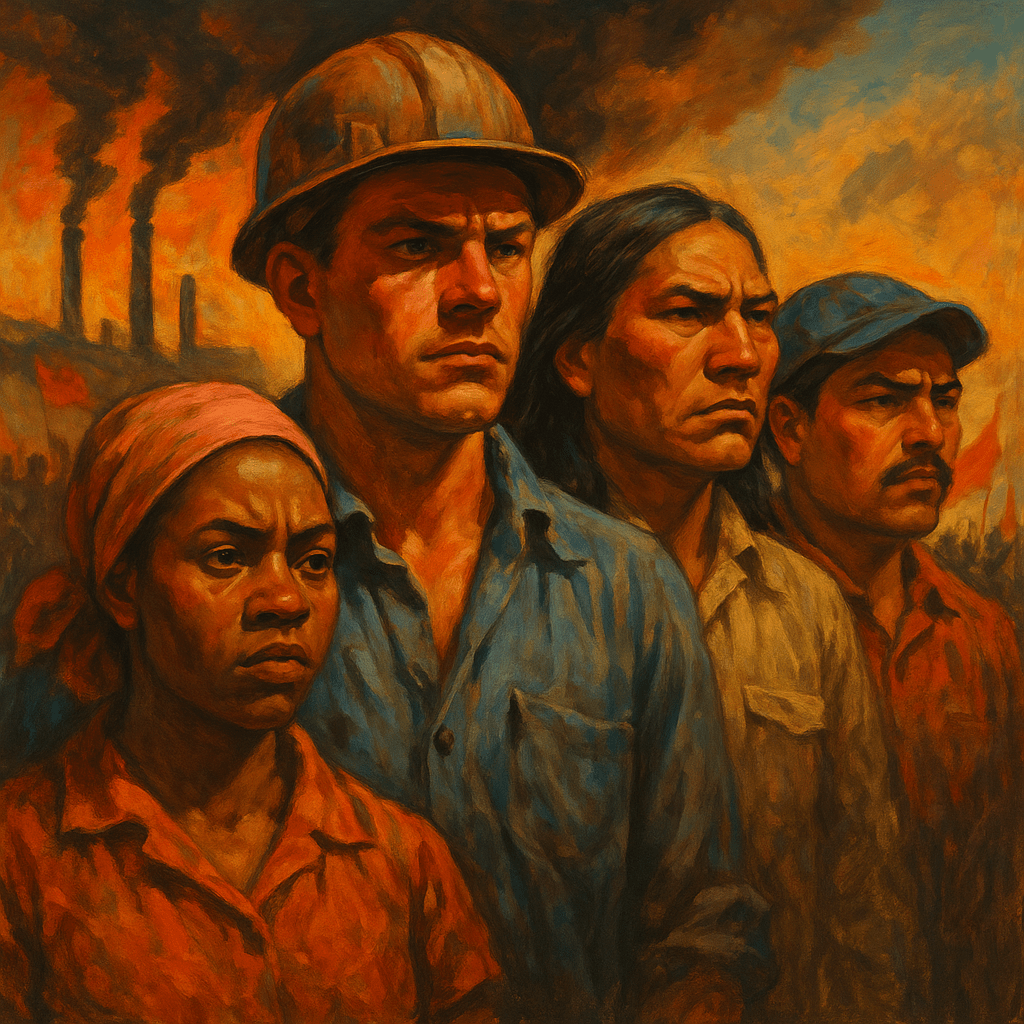
You can’t build a workers’ republic on a settler colony.
By Prince Kapone | Weaponized Information | June 1, 2025
Revolution Without Reckoning?
You hear it all the time—usually from someone quoting Marx on wages or waving a red flag at a march: “We need to focus on the working class.” But ask them what they think about Land Back or Reparations, and suddenly the room gets quiet. Or worse—hostile. “That’s identity politics.” “That’s divisive.” “We’ll deal with that after the revolution.”
But here’s the hard truth, comrades: there is no revolution without reckoning. You can’t build socialism on land you refuse to return. You can’t redistribute the wealth of a country without accounting for how that wealth was produced—through genocide, slavery, and colonial conquest. And if your program doesn’t include Land Back and Reparations at its foundation, then you’re not building socialism. You’re just negotiating a better contract inside a settler empire.
This essay is not about moralism. It’s about materialism. It’s about class struggle in its most concrete form. Because Land Back and Reparations aren’t charity. They’re not symbolic. They’re not liberal distractions from “real” economic issues. They are revolutionary demands that cut to the bone of U.S. capitalism and settler-colonial rule. They are the necessary preconditions for any serious effort to dismantle empire and build a society run by and for the oppressed.
So the question is not whether we support these demands. The question is whether we’re willing to admit that socialism in the United States is impossible without them. That there can be no workers’ republic without the restoration of land to Indigenous nations. No collective future without reparations for the African nation. No solidarity without accountability. No revolution without decolonization.
This piece is written for socialists, communists, anarchists, unionists—anyone serious about building a world beyond capitalism. It’s also written as a challenge: if you claim to stand for the working class, then prove it. Not just by fighting for wages and jobs, but by standing shoulder to shoulder with those whose land, labor, and lives were stolen to build this economy in the first place.
We’re not here to reform the settler state. We’re here to dismantle it—root and stem. And that means Land Back. That means Reparations. That means revolution.
Land Is the Basis of All Wealth: Marxism and the Colonial Question
Karl Marx didn’t mince words about how capitalism was born. It didn’t sprout out of peaceful trade or industrious innovation—it was, in his own words, “dripping from head to toe, from every pore, with blood and dirt.” The capitalist system, as Marx laid bare, required a process of violent “primitive accumulation”: the dispossession of the peasantry, the theft of common lands, and the brutal transformation of people into commodities.
In Europe, that meant the enclosures. In the Americas, it meant extermination. Colonization wasn’t capitalism’s prehistory—it was its launching pad. The United States wasn’t born from industry—it was born from invasion. Its wealth, its borders, and its power all began with a war for land. Land that was stolen from Indigenous nations. Land that was cultivated by enslaved African labor. Land that remains the foundation of imperial power today.
In Marxist terms, land is not just a commodity—it is the original means of production. Without land, there is no labor, no resources, no agriculture, no development. And in a settler-colonial state like the U.S., land isn’t neutral—it’s occupied territory. That means the working class here is not simply divided by income or job sector, but by their material relationship to conquest.
Indigenous people were not “displaced.” They were dispossessed—through military conquest, broken treaties, and forced removals that allowed settlers to turn stolen land into private property. That land was then turned into capital—speculated, commodified, and handed down through generations of settler wealth. It’s not just a legacy. It’s an active economic base.
At the same time, enslaved Africans were dragged across oceans not just to work the land—but to be the capital. Their unpaid labor produced the cotton that financed U.S. industrialization, the sugar that fueled empire, and the bodies that built infrastructure without rights, wages, or personhood. That labor was never paid back. Its value never returned. It was stolen, and it remains in the hands of the settler state and its descendants.
So when we talk about Land Back and Reparations, we’re not talking about fringe demands. We’re talking about correcting the foundational thefts that created the modern U.S. economy. We’re talking about returning the means of production to those it was stolen from. That’s not “identity politics”—that’s Marxism applied to the real world.
You can’t collectivize a plantation without first dismantling the slave system. You can’t nationalize land that was never rightfully yours. You can’t build socialism on stolen earth unless you give that land back—and give power back to those who were violently removed from it.
The left can chant about class struggle all day. But if that struggle doesn’t begin with the question of land, then it’s not revolutionary—it’s settler reformism in disguise.
Land Back Is a Class Demand—Not a Liberal Slogan
Say “Land Back” in a room full of socialists and watch the reactions. Some nod. Some look confused. Others scoff—“That’s not class struggle. That’s liberal identity politics.” But let’s get one thing straight: Land Back is not about inclusion, guilt, or symbolism. It’s about the land—the literal, material foundation of class power in a settler-colonial system. And returning it is not charity. It is class war.
Indigenous people are not a “marginalized group.” They are colonized nations. They had—and still have—territory, governance structures, economies, and systems of knowledge that were violently suppressed to make way for U.S. settler capitalism. What was taken from them was not just dignity—it was sovereignty. And what continues to be denied is not just representation—it’s land, water, and political power.
Here’s the part most socialists won’t say out loud: long before Marx put pen to paper, many Indigenous nations across Turtle Island were already living closer to communism than anything the U.S. labor movement has ever built—let alone imagined building. Land was held in common. Production was for collective use. Surplus was shared or returned to the earth. Women had political power. Social relations were non-exploitative. There were no landlords, no bosses, no police.
That’s not utopian romanticism. That’s historical materialism. And the settlers knew it.
As Russell Means once wrote, the original European colonizers and so-called Founding Fathers recognized the threat of Indigenous social structures. Because Indigenous societies were living proof that another world was not only possible—it already existed. A world without private property. A world without classes. A world without prisons or wage slavery. That example had to be extinguished. Not just militarily, but ideologically.
The genocidal war on Indigenous nations wasn’t just about seizing land—it was about erasing a real-life alternative to capitalism. What the bourgeois revolutionaries feared wasn’t just Indigenous resistance. It was Indigenous communism. That’s why the extermination campaigns, the forced assimilation, the reservation system, and the boarding schools were all necessary—to wipe out a social order based on communal life and reciprocity.
So when we say Land Back, we’re not appealing to liberal guilt. We’re demanding the return of the material basis of an Indigenous socialism that the settler state tried to destroy. Not out of nostalgia—but because that struggle is still alive. Because Indigenous resistance never stopped. And because the principles that governed Indigenous societies—collectivity, sustainability, accountability—are not relics of the past. They’re blueprints for the future.
Under capitalism, land is a commodity. Under colonialism, it’s a weapon. And under socialism, it must be decommodified and returned—not to the state, but to the people it was stolen from. That’s what Land Back means. Not federal recognition. Not advisory committees. Not land acknowledgments at conferences. Actual, material transfer of territory and resources to Indigenous nations. With no strings attached.
From a class standpoint, Land Back is a demand to abolish the settler landlord class. It strikes at the heart of capitalist property relations and the false legitimacy of U.S. borders. It calls into question who owns the land, who controls it, and who gets to live on it. It is a demand to end the white monopoly on land and the settler state’s territorial integrity.
Socialists who claim to oppose private property but balk at Land Back are exposing themselves. Because if you believe the land should belong to those who work and care for it, then there’s no group more qualified than the people who held it sustainably for thousands of years—before settlers turned it into parcels, pipelines, prisons, and parking lots.
Land Back isn’t a diversion from class struggle. It is its sharpest edge in a settler-colonial society. It forces the question: whose land? For what purpose? In whose hands? And for the socialist movement, it forces a choice—either stand with Indigenous nations in the fight to restore their stolen land, or stand with the system that took it in the first place.
You can’t collectivize what you refuse to return.
You can’t decolonize while defending settler claims.
And you sure as hell can’t build socialism on stolen land.
Reparations Are Not Handouts—They Are the Return of Stolen Labor and Value
Reparations are not about guilt. They are not charity. And they are not up for debate. Reparations are a revolutionary demand—a demand for the return of value that was violently stolen from African people over centuries of slavery, colonialism, segregation, and ongoing imperialist underdevelopment. This isn’t about feelings. This is about the mathematics of genocide and accumulation.
At its core, reparations is a class demand. It emerges directly from the Marxist recognition that labor is the source of all value. Every dollar of profit under capitalism is stolen from the laborer, and no labor has been more violently exploited, more systematically unpaid, and more foundational to Western capital accumulation than African labor. Reparations doesn’t deviate from class struggle—it clarifies it. It brings the question of surplus value back to its historical root: slavery, empire, and the extraction of Black life for white capital.
Let’s start with slavery. From 1619 to 1865, enslaved Africans were forced to labor without pay in the U.S. for 246 years. According to the U.S. National Archives and research by the Institute of the Black World, the average market value of an enslaved African’s labor in the mid-19th century was approximately $13,000 per year in today’s dollars. That means:
- 12.5 million Africans were trafficked across the Atlantic (with at least 10.7 million surviving the Middle Passage).
- Approximately 4 million enslaved Africans were in the U.S. by 1860.
- At minimum, that’s $52 billion in annual unpaid labor in 1860 alone.
- Across 246 years, compounded with interest, the U.S. economy owes at least $14.2 trillion in back wages—not including stolen lives, destroyed families, or profits generated through derivatives like cotton, sugar, and tobacco industries.
But this is only the tip of the imperial iceberg. Reparations must also account for:
- Profits from African bodies as capital: Enslaved people weren’t just laborers—they were property. Enslavers mortgaged them, insured them, used them as collateral. JPMorgan Chase, New York Life, and other financial giants directly profited from these practices.
- Imperial trade and finance built on slave exports: British and U.S. banks, shipping companies, and insurance houses amassed fortunes from slave-based commerce. Barclays, Lloyds, and Bank of America are among the institutions with direct ties to slavery.
- Capital accumulation in Europe and the U.S.: Eric Williams and Walter Rodney showed how the profits from the slave trade financed the industrial revolution in England and laid the foundations for capitalism in the U.S. These profits created entire classes of rentiers, speculators, and early capitalists.
- Land stolen through racial terror: After emancipation, Black communities were promised land and restitution—but instead faced Jim Crow, lynching, redlining, and state-sanctioned plunder. From the Tulsa Massacre (1921) to ongoing gentrification, Black property has been looted repeatedly. Estimated losses from racialized land dispossession alone exceed $300 billion.
- Denied access to wealth-building programs: Black veterans were denied GI Bill benefits. Black communities were excluded from Social Security, FHA mortgages, and New Deal public investment. These systemic exclusions were worth trillions over generations of compounding economic theft.
When you put all these together, the U.S. and Western Europe owe the African nation a debt of at least $20–30 trillion in reparations. That’s a conservative estimate. Some scholars have calculated upwards of $100 trillion if we include opportunity costs, land theft, compounded interest, and global underdevelopment caused by centuries of slavery and colonialism.
And still, this only captures the economic value. What about the psychic trauma? The cultural destruction? The rupture of identity, language, and kinship? What about the cost of centuries of police terror, incarceration, forced sterilization, and stolen Black futures? Reparations are not just about money—they are about the structural dismantling of systems built on theft. That includes returning land, abolishing racist institutions, funding Black-controlled schools, clinics, and cooperatives, and creating a new economy in service of African self-determination.
Reparations are not a liberal policy demand. They are a revolutionary process—a forced reversal of capital accumulation, a direct confrontation with settler wealth, and a redistribution of the very foundation of U.S. and European economic power. They are a demand for power, not pity.
So if you call yourself a Marxist, and you ignore Reparations, then you’ve skipped over surplus value entirely. Because Black labor didn’t just build the South. It built the North. It built Wall Street. It built Western empire.
And now it’s time to pay what’s owed.
The Colonial State Can’t Be Reformed—It Must Be Dismantled
The liberal fantasy—and let’s be honest, much of the white left shares it—is that the United States can be transformed into a just, equitable, socialist society through policy reforms, labor organizing, or electoral strategy. But this fantasy rests on a lie: that the U.S. is a nation-state like any other, rather than what it truly is—a settler-colonial empire built on stolen land, enforced through terror, and sustained by global extraction. You don’t reform an empire. You dismantle it.
The U.S. state is not a neutral structure waiting for progressive takeover. It is a colonial machine—its Constitution forged in slavery, its territory expanded through genocide, its economy rooted in racial capitalism, and its military designed to defend private property on a planetary scale. Its borders are imperial enclosures. Its courts are instruments of land theft. Its police are armed managers of the internal colony. Its function is not to represent the people—it’s to suppress them.
And yet, white Marxists have historically insisted on locating the working class only at the site of factory production—ignoring everything that comes before. Chairman Omali Yeshitela has long exposed this ideological shortcoming. He reminds us that exploitation doesn’t begin on the assembly line—it begins in the mines, the fields, the slave ships, and the reservations. Before there’s a wage relation, there is a global system of theft, coercion, and colonial extraction. The factory worker in Detroit exists because the minerals were pulled from Congolese soil by African children. The wage is made possible by a chain of unpaid, unrecognized, and unrelenting imperial violence.
Marx was right: all value comes from labor. But Chairman Omali sharpens that point—by reminding us that the most exploited labor is not just underpaid, but unpaid; not protected, but criminalized; not located in Western union shops, but in fields, prisons, maquilas, and extraction zones from Africa to Appalachia. This is the labor that built the world, and it remains the base of imperialism’s pyramid.
That’s why Land Back and Reparations aren’t compatible with U.S. state power. Because for the settler state to survive, those demands must be denied. To return the land is to acknowledge that it was never the state’s to begin with. To pay reparations is to admit that the entire system was built on a centuries-long crime. And to admit that is to begin to unravel the whole structure of capitalist legitimacy.
In this sense, the demands themselves are insurgent. They strike not at the symptoms of oppression, but at the core—the legal, territorial, and economic scaffolding of settler domination. This is not reform. This is rupture.
Revolutionary history backs this up. In Cuba, land reform and anti-colonial struggle were inseparable. In Zimbabwe, the return of land to Black farmers was the line in the sand that provoked Western outrage. In Vietnam, Algeria, Mozambique, and Burkina Faso, the socialist project began not with abstract programs, but with decolonization as class struggle.
And yet in the U.S., many leftists still imagine that we can skip that phase. That we can collectivize stolen land without returning it. That we can redistribute surplus without redressing theft. That we can build socialism without confronting the foundational contradiction: this is not just a capitalist state—it is a colonial one.
The U.S. isn’t a failing democracy. It’s a successful empire. And its institutions were never meant to deliver liberation—they were built to entrench settler supremacy. You don’t turn them toward justice. You abolish them, root and stem.
So the question isn’t whether the state can be reformed. The question is: will we build the power to destroy it? Not in some abstract insurrectionist fantasy—but through grounded struggle, led by the colonized, fueled by the working class, and guided by a vision of collective liberation that begins with truth: this land is not ours to govern. It must be returned. This wealth is not ours to manage. It must be redistributed. This state is not ours to seize. It must be dismantled.
Objections from the White Left—and Why They’re Wrong
Spend enough time in white leftist spaces, and you’ll hear the usual objections to Land Back and Reparations. They arrive dressed in Marxist jargon, but underneath is the same old settler anxiety: fear of losing position, fear of realignment, fear of revolution that isn’t centered on them. Let’s take these objections one by one—and dismantle them for what they are.
Objection 1: “It’s divisive.”
What’s divisive is building a socialist movement on the denial of genocide. What’s divisive is pretending that unity can be built by ignoring the very foundation of this country: the violent theft of land and labor. Revolution doesn’t begin by erasing contradiction. It begins by confronting it. Unity is not possible without justice—and justice is not possible without returning what was stolen.
Objection 2: “It’s not class-based.”
This is a favorite of the class-reductionist tendency, who somehow manage to quote Marx endlessly without understanding the basic premise: all value comes from labor, and all capitalist wealth is stolen labor crystallized in property and profit. Reparations is a class demand rooted in the superexploitation of African labor. Land Back is a class demand rooted in the forced dispossession of Indigenous nations. These are not side issues—they are the frontlines of class war in a settler-colonial state.
Objection 3: “It will alienate the working class.”
Whose working class? The one that benefits from stolen land and cheap global labor? The one that historically aligned itself with white supremacy to secure its place within empire? If your revolution requires appeasing the reactionary instincts of settlers, it’s not a revolution—it’s a PR campaign. The working class is not a holy object. It’s a contradictory, stratified, and historically divided formation. And it will not be transformed through flattery. It will be transformed through struggle and political education.
Objection 4: “It’s identity politics.”
Identity politics is when multinational corporations sell rainbow-colored bombs and call it progress. Land Back and Reparations are not about identity. They’re about material power. They are about dismantling the economic, political, and territorial foundation of settler colonialism. To equate revolutionary demands for self-determination with neoliberal symbolism is either disingenuous—or deeply ignorant.
Objection 5: “What about white workers?”
This is the panic reflex of a class that has gotten used to being at the center. Here’s the answer: white workers can join the revolution—but only by breaking from settlerism. That means supporting Land Back, supporting Reparations, and submitting to the leadership of the colonized proletariat. That’s not exclusion—that’s dialectics. Revolution is not a feel-good therapy session for the settler conscience. It’s a transfer of power.
Every one of these objections reveals the same thing: a fear of losing control. But socialism isn’t about preserving control. It’s about building a world without domination. And that begins by breaking with the structures—economic, ideological, territorial—that gave settlers their power in the first place.
So the next time someone tells you that Land Back and Reparations aren’t “class struggle,” ask them what class owns the land. Ask them who built the wealth. Ask them what side of the barricade they’re on—because the colonized aren’t waiting for permission. The struggle is already underway.
Revolutionary Strategy: What Land Back and Reparations Would Actually Do
Land Back and Reparations aren’t just demands—they are strategies. Revolutionary strategies. They are not moral gestures. They are structural interventions aimed at dismantling the settler-colonial foundations of U.S. capitalism and transferring power to the colonized. If taken seriously and fought for with discipline, these demands would do more to rupture imperialism than any number of slogans about class struggle abstracted from land and labor.
The African People’s Socialist Party (APSP) has made this clear for decades. Under the leadership of Chairman Omali Yeshitela, the APSP has consistently advanced Reparations as a concrete, class-based demand—not charity, but the organized return of stolen African value. Their strategy is not to beg the ruling class for inclusion, but to build a dual power apparatus rooted in African working-class self-determination. That includes Black-led economic development, political organization, and international solidarity with Africa and the diaspora.
The Uhuru Solidarity Movement—formed by white revolutionaries under the leadership of the APSP—is one of the only examples in the U.S. of a white organization that has made material reparations to the African community a core principle of its work. Not as philanthropy. Not as guilt. But as revolutionary self-correction: returning stolen resources to African hands, under African leadership, to build African power. That’s what reparations looks like in practice. That’s what revolutionary solidarity looks like in action.
On the side of Indigenous resistance, the call for Land Back has been most powerfully advanced by formations like the NDN Collective, the Red Nation, and a wide range of traditional and revolutionary Indigenous leadership across Turtle Island. From the resistance at Standing Rock, to the defense of sacred sites like Oak Flat and Wet’suwet’en territory, to urban land reclamation and the call for the abolition of Mount Rushmore—Land Back is not a hashtag. It’s an active, organized movement to dismantle settler control and restore Indigenous governance over stolen lands.
These struggles are not just defensive. They are constructing alternatives. Land Back means Indigenous food sovereignty, rematriation of ancestral territories, communal land stewardship, and the rebuilding of governance systems rooted in relational, non-capitalist values. It means disarming the colonial state’s control over land, water, and life—and replacing it with Indigenous autonomy, dignity, and survival.
Together, Land Back and Reparations would:
- Break the monopoly of white settler ownership over land and capital.
- Redistribute resources toward colonized communities who have been structurally excluded from accumulation and control.
- Shatter the ideological foundations of U.S. legitimacy as a “democracy.”
- Undermine the labor aristocracy and white middle-class base of U.S. imperialism.
- Build dual power institutions outside of state control—Black and Indigenous-led cooperatives, schools, health systems, and militias for defense and survival.
- Re-center the leadership of the colonized working class in the revolutionary process.
In short, these demands are not distractions from revolution. They are the revolution, when properly understood and practiced. They connect theory to strategy. They translate Marxism into anti-colonial practice. And they offer the possibility of actual rupture—not just in language, but in the structures that uphold capitalism itself.
If the white left spent half as much time studying the programs of the APSP or the Red Nation as they do debating historical socialism in Europe, they’d realize that the most advanced revolutionary thought in the U.S. today is coming from the colonized. It’s organized. It’s disciplined. And it’s already building the future in the ruins of empire.
The task of principled revolutionaries—especially those of us born into the settler population—is to get with the program. Not to tweak it. Not to co-opt it. But to support it materially, politically, and strategically.
Conclusion: No Socialism Without Decolonization
Let’s not be abstract. Let’s not be polite. Let’s be revolutionary: there is no socialism without decolonization. No workers’ republic built on genocide. No people’s democracy rooted in stolen land. No class liberation without the return of what was taken by force, by fraud, by blood.
Land Back and Reparations are not side issues. They are not “after the revolution.” They are the revolution—because they strike at the heart of what empire is: the accumulation of capital through conquest. To ignore them is to side with the conquerors. To downplay them is to uphold the parasitic foundation of settler wealth. And to delay them is to tell the colonized: wait your turn while we finish looting your future.
If you’re serious about Marxism, then follow it to its logical conclusion. Marx said all value comes from labor. Then follow the trail of value—from the sugar fields of Haiti to the cotton plantations of Mississippi, from the forced removals of the Trail of Tears to the mass incarceration of Black and Brown life. If labor is the source of value, and land the source of life, then socialism must begin by returning both.
This is not about guilt. This is not about charity. This is about power—who holds it, who built it, and who must reclaim it. Black, Indigenous, and colonized peoples are not asking for recognition. They are demanding redress, autonomy, and control over their own resources, territories, and futures.
So if your vision of socialism does not include Land Back, it is a lie.
If it does not include Reparations, it is theft in disguise.
If it centers settler comfort over colonized liberation, it is reformism in red drag.
The future will not be built by appealing to empire’s better angels. It will be built in struggle—led by the colonized, supported by defectors from the settler order, and rooted in revolutionary clarity. That clarity begins here:
- Land Back is not optional.
- Reparations are not negotiable.
- Decolonization is not symbolic—it is structural, material, and non-reversible.
We are not interested in a red-painted empire. We want its collapse. And in its place, the emergence of new forms of life—rooted in justice, in sovereignty, and in a socialism that begins where it must: with the return of what was stolen, and the reckoning that makes revolution real.
No socialism on stolen land.
No revolution without reparation.
No future without decolonization.
 Weaponized Information
Leave a comment