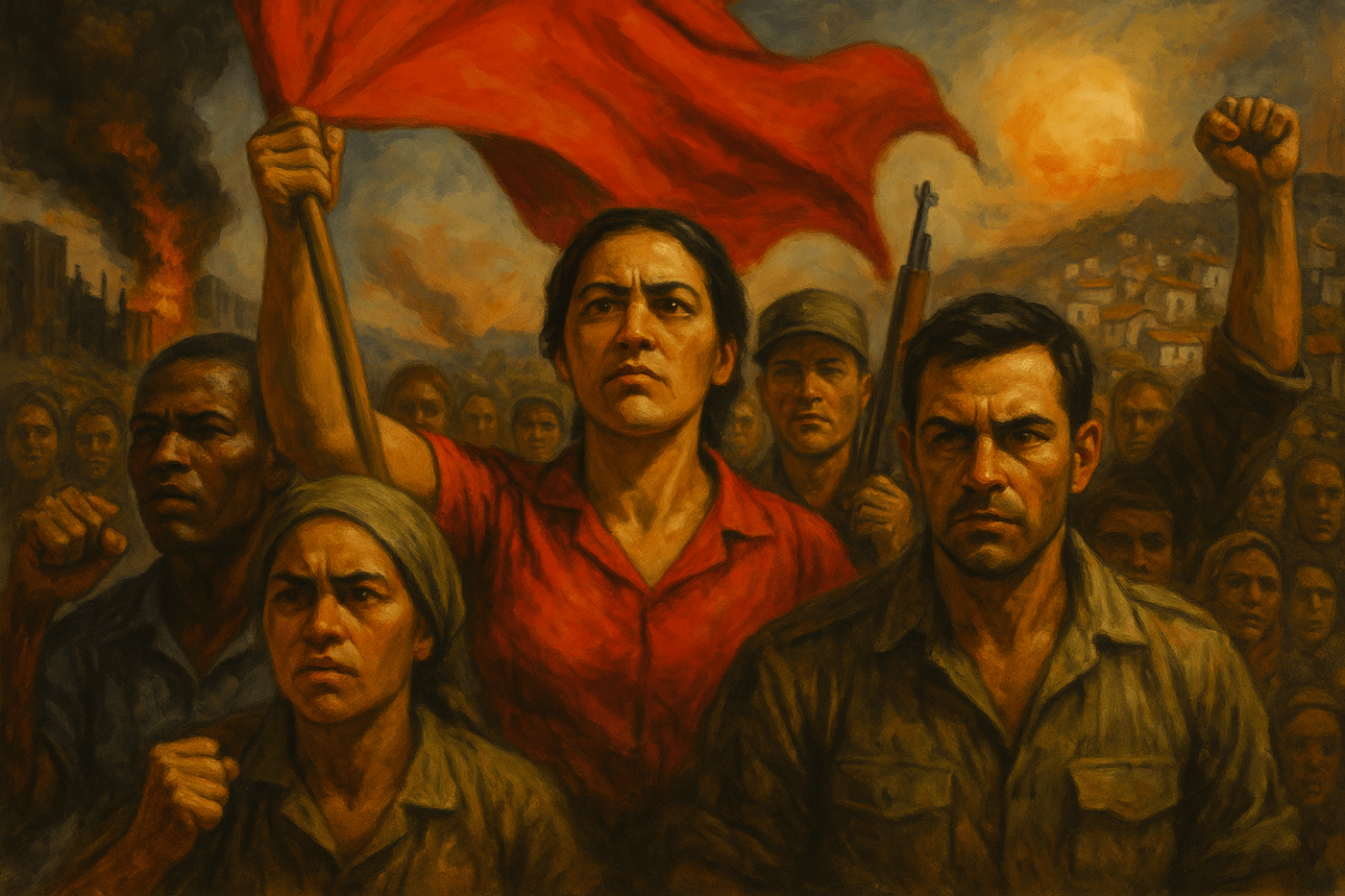
The empire calls it a sham, but the real fraud is the narrative. Venezuela’s elections weren’t staged by autocrats—they were fought for by a people under siege, refusing to surrender their sovereignty to imperial power.
By Prince Kapone | Weaponized Information
May 27, 2025
Part I – Theater of Deceit: Dissecting the Empire’s Electoral Smear Campaign
Julie Turkewitz did not arrive at her New York Times post by defying power—she arrived by serving it. As the Andes Bureau Chief stationed in Bogotá, she operates from a CIA-adjacent outpost that has long served as an operational rear base for U.S. destabilization campaigns across the Andean region. Her journalistic portfolio reads like a field manual in narrative warfare: demonizing socialist experiments, amplifying opposition figures who speak fluent neoliberalism, and filtering every popular victory in the Global South through a lens of suspicion and scorn. The New York Times—her imperial publisher—is not merely a news outlet. It is the ideological war room of the hyper-imperialist triad, owned and steered by a billionaire trust whose primary function is to repackage colonial violence as common sense and to present economic strangulation as humanitarian concern.
Benigno Alarcón lends his academic veneer to imperial talking points from the safety of the Andrés Bello Catholic University, while María Corina Machado and Henrique Capriles recycle Washington’s line like faithful proxies, lobbying for sanctions abroad while posturing as democrats at home.
The article’s propaganda functions are not subtle—they’re structural. Framing President Maduro as an “autocrat” and the election as a “performance” is not an opinion—it’s the premise. It’s baked into the narrative before a single fact is presented. The very first paragraph declares the vote illegitimate, not because of evidence, but because the electoral council is “stacked” and results are “presented without evidence”—as though the burden of proof lies not with the accuser, but the accused. The imperialist media apparatus has perfected this technique: invert the presumption of legitimacy so thoroughly that anything short of regime collapse becomes proof of tyranny. The absence of foreign monitors is painted as malpractice, yet no mention is made of the brutal U.S. sanctions regime that criminalizes international cooperation and weaponizes diplomacy itself.
The so-called “low turnout” becomes a story of apathy under dictatorship, never a symptom of exhaustion under blockade. The opposition’s boycott is dressed up as moral protest, when in fact it was a strategic retreat after years of failed lawfare, street violence, and ballot-box defeats. The New York Times dares not mention that Venezuela has conducted 32 elections since 1998—more than any NATO member state. Nor does it explain why, despite constant hybrid war, the PSUV remains the only mass political formation with organizational capacity in poor and working-class communities. Why? Because that would expose the truth: the U.S. hasn’t failed to topple Maduro because he’s a tyrant—but because the revolution still lives in the barrio.
No Western reader is told that communal councils, not oligarchs, plan public projects. That popular power, not private finance, is the engine of legitimacy. That what’s unfolding in Venezuela is not autocracy—it’s dual and contending power under siege. And that, comrades, is the real threat. Not a “stolen vote”—but a sovereign one.
Part II – Facts Under Fire: Extracting Truth from an Article Meant to Obscure It
Beneath the fog of propaganda, even enemy media occasionally stumbles into facts. The New York Times piece admits—though barely—that Venezuela’s ruling coalition won 22 of 23 governorships and a supermajority in the National Assembly. It notes the opposition’s fragmentation: María Corina Machado called for a boycott, while Henrique Capriles ran and won a seat. It records that the Essequibo region, long contested with Guyana, saw symbolic elections held. It mentions that polling places were open, ballots were cast, and results announced. But these facts are scattered like debris—unmoored from context, stripped of significance, and presented as anomalies rather than outcomes of material struggle.
Let’s put those fragments back into history. Venezuela’s voter turnout, pegged at just over 40% by the National Electoral Council, is nearly identical to the 2020 legislative elections—also boycotted by opposition sectors. That figure is higher than turnout in many U.S. midterms, yet nowhere does the Times frame American elections as suspect or illegitimate. The article omits the most decisive context of all: that Venezuela is surviving under an economic siege waged by the United States and its junior partners in the hyper-imperialist triad. Since 2015, over 930 unilateral coercive measures—sanctions—have been levied against Venezuela’s public institutions, economy, and people. This is sanctions architecture at work: deliberate, targeted immiseration aimed at regime collapse.
These sanctions have frozen billions in Venezuelan state assets, crippled the oil sector, and triggered currency collapse. They’ve starved hospitals of medicine, emptied grocery stores, and gutted infrastructure. According to CEPR, at least 40,000 civilians died as a direct result between 2017 and 2018 alone. The Times says nothing. It also fails to mention the communal councils and participatory democracy structures that organized millions to vote amid crisis. No mention of the Plan of Seven Transformations. No discussion of the election’s peaceful nature, which even opposition candidates like Capriles acknowledged.
Meanwhile, imperialist “democracy monitors” like the Carter Center—when their statements are cited—are used selectively and dishonestly. The NYT references them to cast doubt on the 2024 presidential election, but fails to mention that many international observers, including those from the African Union and the Caribbean Community, praised Venezuela’s electoral process. There’s no mention that the Maduro government invited observers from the EU, the UN, and the U.S.—many of whom declined or sabotaged the process. This is lawfare by omission. A war of facts, where silence is the sharpest weapon.
Ultimately, what’s left out of the article tells us more than what’s left in. The opposition’s failure is not just tactical—it’s existential. It has no mass base, no economic program, no plan beyond begging for U.S. intervention. The Times conceals this, not out of ignorance, but out of allegiance. Because to admit the truth—that a besieged revolution still commands the loyalty of millions—would be to concede the limits of Western power.
Part III – A People’s Reframe: From Ballot Fatigue to Revolutionary Endurance
Let us be clear: Venezuela’s elections were not an authoritarian pantomime—they were an act of revolutionary endurance. To vote in the middle of a blockade is not routine—it is resistance. To organize campaigns, staff polling stations, and secure ballots while facing sabotage, sanctions, and psyops is not performance—it is people’s power under siege. The story isn’t that the streets were quiet—it’s that the vote happened at all. And the deeper truth is this: what the empire cannot defeat through bullets, it tries to bury in narrative. But the commune is still alive, and the barrio is still voting.
The PSUV’s landslide was not just a victory of incumbency—it was a victory of rootedness. Unlike the fragmented elite opposition, the Chavista movement has infrastructure, neighborhood assemblies, political education, cultural work, and disciplined organization. It’s a coalition of teachers, campesinos, oil workers, youth brigades, and collectives. These are the same people that held the line during the 2002 coup, weathered the violence of guarimbas, survived hyperinflation and sanctions, and are now building food sovereignty and healthcare networks in defiance of financial strangulation. This is not authoritarianism—it is anti-imperialist sovereignty from below.
Voter apathy, where it exists, is not a rejection of the Bolivarian process—it is a consequence of imperial exhaustion. After years of sabotage, failed coups, confiscated assets, and psychological warfare, even the most loyal revolutionary grows weary. That is a human response, not a political verdict. The Western press weaponizes this fatigue, pretending it is ideological collapse, when it is in fact the price paid by a nation forced to govern itself while under siege. It is the psychological front of financialized counterinsurgency, and the struggle is ongoing.
But even now, amid hardship, Venezuela is charting a different future. The Comando Unitario Ven25 is consolidating the popular revolutionary bloc. The Plan of Seven Transformations is laying the foundation for decentralized, grassroots-driven development. Venezuela is not returning to capitalism—it is attempting to outlive it. While the U.S. consolidates technofascist stabilization at home—merging AI surveillance with police power to preempt dissent—Venezuela is building dual and contending power through communal councils, people’s budgets, and revolutionary pedagogy.
In the end, the question is not whether Venezuela’s democracy looks like Western parliamentarianism. It is whether people under siege can still shape their collective future. The answer is yes. And that is what terrifies the empire—not Maduro, not abstentions, not ballot counts—but the fact that the poor still believe in power. Their own.
Part IV – From Clarity to Action: Standing with the Commune, Fighting the Siege
This is the moment where lines must be drawn—not just in rhetoric, but in action. Weaponized Information declares full ideological and political unity with the revolutionary working class and the anti-imperialist forces defending the Bolivarian process. Venezuela is not perfect—but it is fighting. And in a world smothered by technofascism, managed consent, and imperialist decay, that fight is sacred. Our task is not to posture from afar—it is to close ranks with those resisting on the frontlines of history.
We remember the Embassy Protectors in Washington, who held the line in 2019 as coup plotters attempted to seize Venezuela’s sovereign space. We honor the material solidarity of Cuba, Iran, and the ALBA nations, who refused to echo U.S. lies and instead recognized Venezuela’s elections as legitimate expressions of popular will. We celebrate the millions of poor and working-class Venezuelans who, despite hardship, starvation-by-sanction, and Western mockery, continue to build a new society in the shell of the old.
But solidarity must move beyond admiration. It must become tactics. Here’s what we can do, today:
- Launch public pressure campaigns demanding the immediate lifting of U.S. sanctions and the unfreezing of Venezuelan state assets. Sanctions are not policy—they are siege warfare.
- Organize teach-ins and forums on Venezuela’s communal democracy, drawing lessons from the Plan of Seven Transformations and the structures of dual and contending power.
- Disrupt the imperialist media apparatus: submit op-eds, flood comment sections, and challenge disinformation in real time—every lie left unanswered is an imperial bullet left unblocked.
- Support grassroots institutions: donate directly to Venezuelan communal initiatives, buy from solidarity co-ops, and strengthen networks of revolutionary exchange between the U.S. and Latin America.
- Build our own commune: organize locally to establish food sovereignty hubs, tenant assemblies, people’s clinics, worker cooperatives—spaces of power that do not ask permission from the state.
This is not charity. This is not liberal activism. This is revolutionary alignment. Venezuela is not just defending its borders—it is defending the very idea that poor and colonized people have the right to govern themselves. The vote on May 25 was not the end of a process—it was a battle within a longer war. And we, inside the heart of empire, have a front in that war too.
So to the media lackeys who confuse siege with sovereignty, to the think tanks who draft war through white papers, and to the technocrats who count hunger as leverage: your days of domination are numbered. The revolution you feared did not die—it adapted. It endured. And it remembers.
¡Chávez vive, la lucha sigue!
 Weaponized Information
Leave a comment