By Prince Kapone | Weaponized Information
May 27, 2025
Part I – Unmasking the Messenger, Deconstructing the Narrative
Eileen Ng has carved out a career writing from the corridors of colonial continuity—first in Malaysia, then in Singapore, now under the polished byline of a transnational news syndicate: the Associated Press. She is not a lone propagandist, but a product of a journalistic pipeline designed to manufacture credibility while outsourcing ideology. Her résumé reads like a blueprint for compliant regional reportage—trained in ASEAN pressrooms, credentialed by liberal market publishers, and now supplying the West with digestible soundbites from the Global South. No wonder her article parrots U.S. talking points like a local spokesperson for the empire in exile.
Her employer, ABC News, is a core node in the imperialist media apparatus—a U.S. legacy outlet owned by Disney, the same conglomerate that markets genocidal fairy tales to children while laundering Pentagon narratives to adults. ABC functions as a cultural flank of U.S. foreign policy, blending entertainment and imperial spin into a single, seamless weapon of cognitive warfare. Its Asia-Pacific coverage is not journalism. It is counterinsurgency with a teleprompter.
Names like Collins Chong Yew Keat (an academic op-ed mill for Western-aligned Malaysian think tanks), Prime Minister Anwar Ibrahim (a familiar neoliberal face in the halls of IMF-approved governance), and even Donald Trump himself appear not as neutral players, but as instruments of imperial triangulation—each playing their part in the regional chess game of hyper-imperialism. They occupy positions within the Atlanticist grid, offering critiques or deals that circle the same black hole of empire.
Let’s turn to the article’s structure. Beneath the neutral tone and multilateral platitudes lies a barely concealed ideological campaign. Ng frames the summit as a diplomatic balancing act between China and the U.S.—but notice how “neutrality” is constructed. ASEAN’s tilt toward China is described as dangerous appeasement; U.S. tariff threats are presented as legitimate grievances. The Gulf nations’ interest in China is read as strategic pragmatism; China’s participation is framed as soft coercion. This isn’t balance—it’s bias.
The article studiously omits context: the history of U.S. military domination in the region, the economic violence of the Bretton Woods system, the structural adjustment chains imposed by the IMF, and the countless coups, occupations, and bombings that defined Pax Americana. In place of history, we get horse-race geopolitics, with ASEAN cast as a hesitant bride caught between two suitors. In reality, this summit signals something far more profound: the erosion of unipolarity and the quiet emergence of anti-imperialist sovereignty.
What Ng calls “grappling with volatility,” we call revolutionary rupture. What she reduces to a summit of trade logistics, we understand as a moment of multipolar architectural construction—a deliberate effort by the Global South to escape the orbit of dollar discipline and digital colonialism. Her attempt to reframe regional self-determination as passivity or risk is textbook cognitive warfare, weaponized through the syntax of neutrality.
So no, this article isn’t just a news piece—it’s an ideological intervention. Its function is to normalize empire’s loss of grip as a moment of regional confusion, to cast anti-imperialist alignment as geopolitical drift, and to prepare readers—especially in the West—for more aggressive countermeasures cloaked in “national security” rhetoric. But the real story here isn’t that ASEAN is wavering. It’s that the Global South is learning to walk without shackles.
Part II – Reading Between the Lines: What the Empire Doesn’t Want You to See
Strip away the editorial sleight-of-hand and what’s left are a handful of concrete facts—facts that, when contextualized properly, point to a quiet but irreversible shift in global power. ASEAN is hosting a tripartite summit with China and the Gulf Cooperation Council (GCC). This is not business as usual—it’s a decisive regional move toward economic integration outside the yoke of U.S. supervision. These three blocs—ASEAN, the GCC, and China—are laying the foundation for a multipolar economic corridor that spans the Pacific, Indian Ocean, and the Red Sea. And they are doing so amid intensifying U.S. tariff threats and imperial panic.
In the raw facts, there is already a rupture: China’s Premier Li Qiang is invited to the table. Trump is not. The GCC, long a loyal node in the U.S. empire’s oil architecture, is now co-signing economic convergence with China—and by extension, the BRICS+ economic framework. ASEAN, once bullied into submission by IMF conditionalities and Pentagon-backed coups, is now speaking a new diplomatic language: “resilience,” “interdependence,” and “sustainable prosperity”. These aren’t buzzwords. They’re ideological markers signaling a departure from the extractive logic of Bretton Woods.
The article reports that GCC-ASEAN trade hit $130.7 billion in 2023. But what it fails to explore is the composition of that trade. What kind of financial instruments are being used? Where is the dollar? Whose banking architecture underwrites it? We already know that several Gulf states—UAE, Saudi Arabia, Qatar—are flirting with yuan-based oil settlements. China is making inroads with digital payment systems across Southeast Asia. Currency swap agreements are quietly being normalized. What’s unfolding is a partial de-linking from the dollar matrix—not a revolution overnight, but a steadily accelerating exodus.
Ng also relays Trump’s threat of 32% to 49% tariffs on ASEAN members—barely pausing to mention that these unilateral trade assaults come after decades of the U.S. preaching “free markets” as gospel. Six ASEAN countries are listed as tariff targets, yet no mention is made of the obvious: this is economic warfare masquerading as trade policy. The aim is not fairness. It’s punishment—for daring to pursue independent relations with China. This is textbook imperialist recalibration: when hegemony falters, the velvet glove comes off and the iron fist of coercion takes its place.
Also buried in the piece is another telling fact: ASEAN is reportedly seeking a summit with Trump on these tariffs. This can be read two ways. Superficially, it appears submissive. But in truth, it reveals something deeper—Trump is no longer the default power center. He is now a meeting request. The room ASEAN wants to enter is one of negotiation, not supplication. Gone are the days of Washington dictating terms. The new era is one of contested terms—and the U.S. is now being asked to sit down at tables it used to command.
The article quotes Malaysian PM Anwar Ibrahim emphasizing “neutrality.” But neutrality, in this context, is less about fence-sitting and more about tactical non-alignment. It is not indecision—it is a conscious effort to remain uncolonized by either pole. And yet, even this so-called neutrality is leaning heavily eastward. Why? Because China is offering investment, infrastructure, and development without drone bases and structural adjustment. The U.S., by contrast, offers tariffs, coups, and digital occupation.
So yes, on the surface, this is a summit. But beneath that surface is a growing consensus among Global South actors: it is no longer profitable—or tolerable—to keep orbiting a collapsing empire. ASEAN is not turning its back on the West out of ideology alone. It is doing so out of material necessity. The economic center of gravity has moved. The infrastructure deals, the energy corridors, the currency swaps—they’re all pointing in one direction. And it’s not Washington.
Part III – Rewriting the Map: Between Multipolar Dreams and Empire’s Digital Chains
What we’re seeing in Kuala Lumpur is not just ASEAN diplomacy—it’s the slow construction of a new geopolitical architecture where the Global South charts a course beyond Bretton Woods, beyond Pentagon logistics, and beyond Washington’s permission. But to understand what’s actually happening, we must place this moment in dialectical tension with Trump’s recolonization tour through the Gulf just two weeks ago.
In Saudi Arabia, Qatar, and the UAE, Trump wasn’t retreating—he was repositioning. He brought satellites, humanoid robots, and AI contracts, not to spread innovation, but to export technofascist infrastructure to U.S.-allied monarchies. The trillion-dollar investments and arms deals were part of an imperialist recalibration strategy: privatize the empire, digitize repression, and subcontract control to loyal oligarchies. Starlink, Boeing, Palantir, BlackRock—they weren’t just corporations; they were the logistical nodes of empire’s new skin.
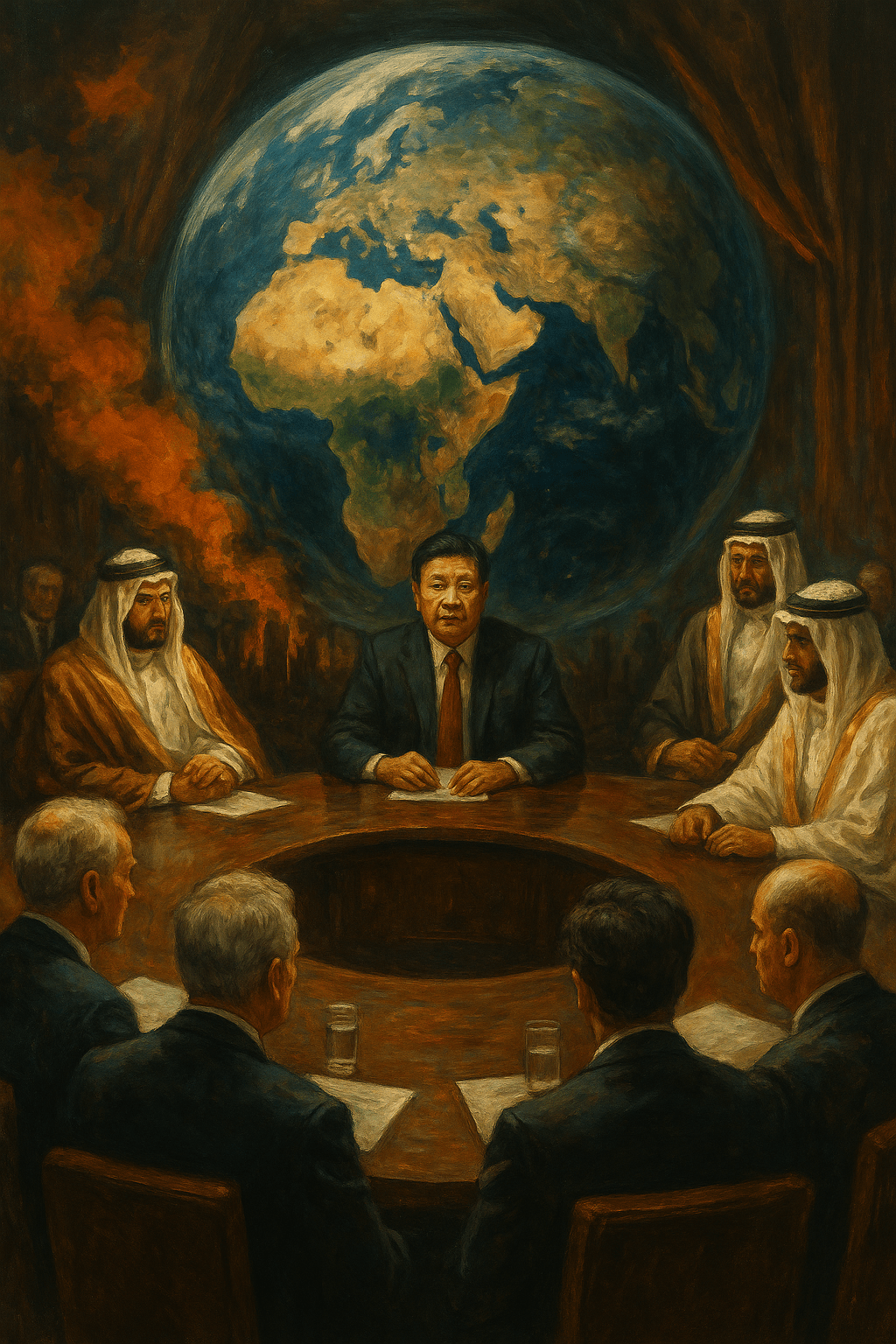
Meanwhile, in Kuala Lumpur, ASEAN and the GCC sit across the table from China—not Musk, not Trump, but Li Qiang. There are no satellites, no robot demos, no arms bazaars. Instead, the meeting is focused on trade, infrastructure, multipolar finance, and regional integration. This contrast is not incidental—it’s dialectical. It reveals two contending futures for the Global South: one shaped by technofascist empire and algorithmic control, and another shaped by sovereign negotiation within the multipolar realignment.
We must not be naive. Some of the same Gulf monarchs who just signed imperial contracts with Washington are now sitting in ASEAN’s summit halls. The contradiction is not resolved—it is being contested. The UAE, Saudi Arabia, Qatar—these are not anti-imperialist states. They are sub-imperial powers straddling two worlds: one foot in BRICS+, one hand still gripping the Pentagon’s purse. They are hedging. Testing. Playing both sides.
But the summit’s center of gravity is drifting eastward. Washington wasn’t invited. Trump’s threats of tariffs hang in the air like a colonial hangover. And while Gulf monarchs may still trade weapons for protection, they increasingly see China as a partner for development—not a warden of empire. What’s being negotiated in Kuala Lumpur is not yet liberation—but it is the erosion of U.S. geopolitical monopoly.
This is where our revolutionary lens must stay sharp. If Trump’s Starlink-paved desert tour was the architecture of hyper-imperialist enforcement, then this ASEAN-GCC-China summit is the slow laying of bricks for an alternative foundation. The question remains: who will control it? Will it serve the ruling elites of the South, or the oppressed classes building power from below? Multipolarity opens the terrain—but only revolutionary struggle can determine its direction.
And that’s why the summit matters. Not for its speeches, but for the rupture it represents: a world where the U.S. can no longer crash a meeting and dictate the terms. Where satellites and sanctions are not the only currencies of influence. Where Washington’s relevance is no longer assumed, but bargained—and sometimes denied outright.
Part IV – From Observation to Action: Organizing Against Empire in a Multipolar Moment
We do not watch these summits as spectators. We analyze them to act. The ASEAN-Gulf-China meeting in Kuala Lumpur reveals a world in flux, a fragile corridor of possibility opening as the old order crumbles. But possibility is not destiny. Without mass struggle, multipolarity will be no more liberatory than unipolar empire. The same Gulf monarchs cozying up to China were shaking hands with Trump just days before, buying weapons and surveillance satellites to deepen repression. The task of revolutionaries, then, is to seize the contradictions and push them toward rupture.
We stand in ideological unity with anti-imperialist forces throughout Southeast Asia, the Gulf, and the broader Global South who understand that sovereignty without justice is a hollow prize. We reject the cynical diplomacy of billionaires and bureaucrats, and affirm the strategic potential of de-dollarization, regional solidarity, and anti-imperialist sovereignty when driven by the working class and the oppressed.
Let us build the material and ideological infrastructure to make these breakthroughs permanent and transformative. Revolutionary rupture demands preparation, organization, and vision. Toward that end, we propose the following tactical imperatives:
- Expose and disrupt the technofascist expansion into Asia and the Gulf. Track satellite contracts, AI deployments, and predictive policing programs being exported by U.S. corporations. Organize cyber resistance to these surveillance systems and amplify dissident technologists who refuse complicity.
- Support dual and contending power formations across ASEAN and the Gulf. This includes independent trade unions, student organizations, media cooperatives, and tenant councils that defy state repression and U.S. alignment. We must fund, connect, and defend these formations.
- Reframe multipolarity as a contested terrain, not a savior. Conduct political education campaigns that unpack the difference between anti-imperialist sovereignty and elite-driven regionalism. Use the BRICS+ discourse to radicalize mass consciousness, not lull it into passivity.
- Forge concrete North-South and South-South solidarity projects. Link U.S.-based labor struggles and anti-policing campaigns with Southeast Asian resistance to technofascism. Coordinate information sharing, sabotage, and mutual aid across borders. Build a proletarian internationalism fit for the digital age.
- Combat cognitive warfare with guerrilla intellectual firepower. This means producing radical media, circulating counter-narratives, and exposing propaganda operations disguised as news. Use the WPE methodology to disarm imperial ideology at every turn.
The empire is not immortal. It is already cracking. But it will not collapse under its own weight. It will mutate, digitize, and subcontract its violence until it is disarmed by revolution. The summit in Kuala Lumpur shows a window of weakening imperial control. Let us not merely applaud it. Let us organize through it.
To the technocrats building empire 2.0 with cables and contracts, we say: we are building something deeper. Not an agreement, but a movement. Not a summit, but a struggle. Not a world managed by elites, but a world made free by the hands of the oppressed.
Another order is possible. But only if we fight for it.
 Weaponized Information
Leave a comment