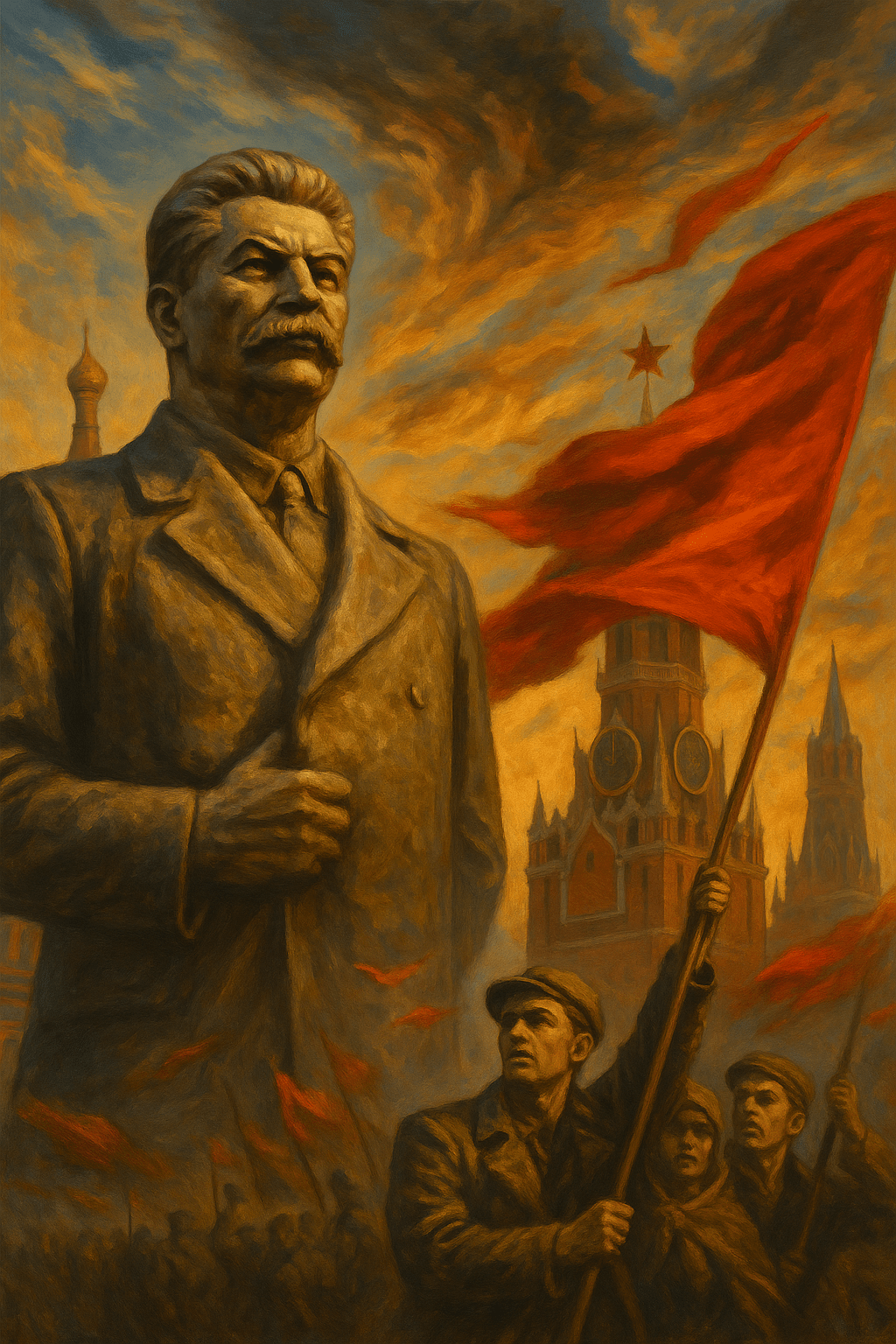
When empire trembles, it smears. Stalin’s monument in Moscow is not a return to tyranny—it’s a rupture in imperialist amnesia.
By Prince Kapone | Weaponized Information
May 27, 2025
Digging Through the Dirt: Who’s Telling This Story and Why?
“I know that after my death a pile of rubbish will be heaped on my grave, but the wind of History will sooner or later sweep it away without mercy.” Stalin said that, not in paranoia, but in clarity. He knew what empire would do to his name. What he didn’t know is just how long the wind would take—or how vicious the rubbish would be. That wind is starting to blow again. And it’s precisely why a recent CNN article covering the return of a Stalin monument to Moscow’s Taganskaya metro station has triggered a fresh round of Western hysteria.
The monument, originally installed in 1950 and removed during the de-Stalinization era, was reintroduced as part of the 90th anniversary of the Moscow Metro and the 80th anniversary of the Soviet Union’s victory over Nazi Germany. But you’d never know that from the article. It’s not a report—it’s a hit job. The statue becomes an excuse for liberal pearl-clutching, Cold War propaganda, and uncritical repetition of decades-old tropes about repression, dictatorship, and tyranny.
The article is published by CNN and syndicated via Reuters—both longtime pillars of the imperialist media apparatus. CNN, owned by Warner Bros. Discovery, exists to manufacture consensus for U.S. foreign policy, recycle Pentagon narratives, and project ideological hegemony under the guise of objective journalism. Its editorial line on Russia, China, Palestine, and Cuba has never been neutral. Its class orientation is clear: serve capital, launder empire, discredit revolution.
The piece is unsigned—typical for propaganda posing as reportage. The cowardice of anonymity allows ideological warfare to wear the mask of consensus. Meanwhile, figures like Alexander Zinoviev are positioned as “experts,” offering vague Cold War comparisons about conservatism and isolation. Yabloko, a liberal opposition party tied to Western NGOs and Atlanticist interests, is given space to demand memorials not to revolution, but to repression.
The article’s framing is textbook cognitive warfare. Stalin is labeled a “dictator,” stripped of context, disconnected from war, reconstruction, or victory. Readers are given emotive shorthand—gulags, purges, terror—while being denied basic facts: industrialization, antifascism, anti-colonial solidarity. Quotes from Putin and Medvedev are included not to clarify the state’s position, but to emphasize ideological ambiguity, discrediting both the monument and those who remember.
This is not about Stalin. This is about power. The ruling class knows the crisis of hyper-imperialism is deepening. The youth are asking different questions. Multipolarity is rising. The liberal center is collapsing. And in that moment, the memory of Stalin—messy, flawed, disciplined, victorious—becomes dangerous again. Not because of nostalgia, but because of what it might inspire.
Restoring the Record: Facts, Omissions, and the Geopolitics of Memory
Let’s begin with what the article doesn’t lie about. Yes, the Stalin monument was unveiled in Moscow’s Taganskaya metro station. Yes, it’s a recreation of a monument originally installed in 1950 and removed in 1966. Yes, it coincides with the 90th anniversary of the Moscow Metro and the 80th anniversary of the Soviet victory in the Great Patriotic War. These are empirical facts—and that’s where the facts stop.
What’s omitted is even more telling. There’s no mention that the Soviet people, under Stalin’s leadership, endured a war that killed 27 million and left their cities in ruins. No mention of how Stalin’s industrialization campaigns, conducted under siege, turned a semi-feudal backwater into a state capable of defeating the Nazi war machine. No reference to the fact that Stalin’s post-war diplomacy helped birth socialist states across Eastern Europe, Asia, and Africa. No acknowledgment that for much of the colonized world, Stalin’s name still represents defiance against empire.
Instead, the narrative is constructed on selective horror, decontextualized numbers, and Cold War boilerplate. The 700,000 figure from the Great Terror is trotted out—no mention of how it’s been challenged, inflated, or taken out of time and context. The gulag is invoked without noting that the United States still cages more people than any country on Earth, disproportionately Black, Brown, Indigenous, and working class.
The monument’s timing is cast as suspicious, as if the memory of Soviet sacrifice must forever be subordinated to liberal anxiety. That it reappears in the context of a Russia under sanctions and siege is presented as cynical nationalism—not as historical memory surfacing in a moment of renewed imperial aggression.
This isn’t just a local story—it’s global. The West is undergoing a crisis of legitimacy. Multipolarity is rising. BRICS+ is expanding. The Global South is breaking free from debt traps, IMF bondage, and dollar dependency. The very system Stalin fought to contain—Western imperialism—is cracking. And in that context, Stalin becomes a site of struggle. His memory is contested not because he is misunderstood—but because he is remembered too clearly.
What the Empire Forbids Us to Remember
To those who live by empire, Stalin is not a statesman—he’s a shadow, a specter, a statue they can’t seem to melt down. His name is never just history; it’s always insurgent memory. That’s why they fear the monument. Not because it romanticizes repression, but because it resurrects the possibility that the working class could govern again. And not just govern—but discipline, defend, and build.
Stalin is not hated because of what he destroyed. He’s hated because of what he built—and because what he built stood against what the empire needs: obedient nations, weak labor, privatized land, and amnesiac history. He didn’t just lead a country—he led a people out of feudal ruin, past fascist encirclement, and into modernity on socialist terms. A century later, that remains the cardinal sin.
That’s why any honest discussion of Stalin must begin with a simple truth: his legacy is not reducible to numbers, not containable by monuments, and not extinguished by de-Stalinization. His was a legacy of construction—of roads, railways, foundries, barracks, literacy campaigns, and front lines. And it remains contested not because it failed, but because it dared to win.
Red Star Over Nations: Stalin and the Anti-Imperialist Federation
Stalin’s first great ideological breakthrough wasn’t industrial—it was national. Long before he was Generalissimo, Stalin was the Bolsheviks’ foremost theorist on the national question. His 1913 essay Marxism and the National Question laid the foundation for a revolutionary approach to national self-determination—one that would eventually reshape the tsarist empire into a voluntary federation of equal republics.
Where Western liberalism universalized its own imperial identity, Stalin’s framework acknowledged the right of oppressed nations to sovereignty. Where colonialism imposed one flag and language, Stalin proposed a union grounded in cultural autonomy, linguistic diversity, and economic integration. This wasn’t bourgeois multiculturalism—it was a revolutionary synthesis of anti-imperialist sovereignty and proletarian unity.
Under his leadership, the USSR implemented programs of national education, language revival, and indigenous development—particularly in Central Asia and the Caucasus. Colonized nations were no longer junior partners but co-founders of a new state form. This model remains unmatched to this day.
In the context of settler-colonial empires like the United States, Stalin’s policies offer critical lessons: national liberation cannot be deferred to “democratic inclusion” within colonial frameworks. Real sovereignty requires rupture, redistribution, and reconstruction—from below, and along lines of historical justice.
Steel and Strategy: Stalin the Commander
The caricature of Stalin as a desk-bound bureaucrat dissolves quickly when confronted with his role in the crucible of the Russian Civil War. It was here, between 1918 and 1921, that Stalin proved not only his loyalty to the revolution, but his grasp of its military, logistical, and political demands. Assigned to some of the most critical fronts—Tsaritsyn, Petrograd, and the Polish front—Stalin worked not just as a political commissar, but as a strategic organizer. His reputation was forged under fire.
In Tsaritsyn (later renamed Stalingrad), Stalin oversaw the defense of a critical junction on the Volga River. He organized food supply lines, enforced party discipline, and dealt ruthlessly with counterrevolutionary elements. The chaos of the civil war required not sentimentality, but decisiveness. Stalin’s experience here left an indelible imprint on his political consciousness: revolutions do not survive on slogans. They survive on steel, planning, and the will to wield power.
This period also taught Stalin the limits of spontaneity and the dangers of factionalism. It’s no accident that his later insistence on unity, command hierarchy, and vigilance emerged from these years. The survival of the Red Army depended on organizational coherence—and the political clarity to recognize that White counterrevolutionaries, foreign interventionists, and internal opportunists were not “differences of opinion,” but enemies of the working class.
To the liberal historian, these are the origins of Stalin’s so-called totalitarianism. But to any serious revolutionary, they are the lessons of power seized, held, and defended. In the furnace of civil war, Stalin wasn’t theorizing revolution—he was making sure it didn’t die. And that made him dangerous—not to the people, but to the class that would’ve buried them.
Building the Fortress: Socialism in One Country
After the defeat of the German and Hungarian revolutions, and with Western powers moving swiftly to encircle the fledgling USSR, the global revolutionary wave began to recede. Stalin, unlike the dogmatists of his time, did not wait for Paris or Berlin to catch up. He pivoted. In the absence of world revolution, the Soviet Union would have to do what no state had ever done before: build socialism in one country—under siege.
This wasn’t retreat—it was strategy. With capitalist restoration always threatening from within and imperialist assault looming from without, Stalin knew that revolution could not survive on moral clarity alone. It needed steel, grain, electricity, tanks. Hence the Five-Year Plans. Hence collectivization. Hence the war on illiteracy. These weren’t abstract developmentalist dreams—they were the groundwork for independence, sovereignty, and survival.
Industrialization under Stalin was staggering in scale. In just over a decade, the USSR vaulted from a semi-feudal agrarian society to the second-largest industrial power on Earth. Entire cities were built from scratch. Electricity flowed through formerly peasant villages. Women were brought into the workforce en masse. The Soviet Union didn’t just modernize—it did so without colonies, without slave plantations, and without Wall Street capital.
Was it harsh? Of course. The global class war is not waged gently. The capitalist world made its “leaps” through genocide, slavery, and conquest. Stalin tried to do it with planning, education, and centralization. If his revolution made enemies, it was because it threatened an entire world system built on plunder.
What Stalin proved—despite all contradictions—was that socialism could be constructed not in theory, but in the concrete. That a sovereign working-class state could feed itself, defend itself, and organize itself against empire. And that’s what made socialism in one country a revolutionary act—not of retreat, but of defiance.
Preparing for the Storm: Purges, Pacts, and the Price of Time
The liberal imagination loves to invoke the Molotov-Ribbentrop Pact as proof of Stalin’s moral bankruptcy. What they never mention is Munich. In 1938, the so-called democracies of Britain and France handed Czechoslovakia to Hitler on a silver platter, hoping to divert the Nazi war machine eastward. Stalin read the map clearly: war with Germany was inevitable, and the West had no intention of stopping it. The non-aggression pact was not alliance—it was a delay.
That delay bought the Soviet Union 22 months. And those 22 months saved the world. In that time, Stalin ordered the fortification of western borders, accelerated tank and aircraft production, and moved entire industries eastward. When Germany finally launched Operation Barbarossa in 1941, the Red Army was still reeling—but it was standing. Without that time, there would have been no defense of Moscow, no victory at Stalingrad, no liberation of Berlin.
The military purges of the late 1930s are often cited as irrational paranoia. But these occurred in a context of real counterrevolutionary threats—fascist infiltration, internal sabotage, and unresolved contradictions within the Red Army command. No revolutionary state under siege can afford to romanticize disloyalty. Even so, by 1941, the Red Army had been rebuilt, restructured, and rearmed. What remained was the political will to resist—and Stalin had forged that in steel.
This was not repression for its own sake. It was the violent, contradictory birth of a new society under conditions no capitalist state has ever endured. Stalin understood that victory in the coming war would require more than bravery—it would require boots, bullets, bridges, and belief. And when that war came, it would be his revolution—not Churchill’s speeches or Roosevelt’s factories—that would break the Nazi war machine.
The Generalissimo: Breaking the Back of Fascism
When the Nazi war machine rolled across Europe, the liberal West froze. Paris fell in six weeks. London took to shelters. The U.S. stayed neutral. But the Soviet Union—scarred by purges, blockaded by the West, and still reeling from famine and war—stood and fought. And at its head stood Stalin.
His speech on November 7, 1941, delivered in Red Square as German troops closed in on Moscow, is one of the most defiant acts of wartime leadership in history. With artillery echoing in the distance, Stalin invoked the legacy of Russia’s defenders—Suvorov, Kutuzov, Donskoy—and reminded the world that fascism would not pass. Soviet soldiers marched past him into the snow and straight to the front. It was not just a speech. It was a signal: the battle for humanity had begun.
Under Stalin’s command, the Soviet Union repelled the largest military invasion in human history. His leadership helped coordinate strategic defenses at Moscow and Stalingrad, then oversaw counteroffensives that would encircle the Wehrmacht and drive it back to Berlin. The Battle of Kursk, the largest tank battle ever fought, was won not through luck but planning, discipline, and sheer political will.
Behind the front, Stalin directed a total war economy—moving thousands of factories eastward, mobilizing millions of workers, and reorganizing every arm of production toward survival. This wasn’t just a military effort. It was mass mobilization. It was Stalin who outmaneuvered Roosevelt and Churchill at Yalta and Potsdam. And it was socialism—not liberalism—that delivered Europe from the abyss of fascist annihilation.
World Revolution in Practice: Stalin’s Internationalism
Stalin’s commitment to the world revolution was not performative—it was material. After the war, he moved quickly to support national liberation movements and socialist states across Europe, Asia, and the Global South. From Korea to Vietnam, China to Angola, the Soviet Union became a lifeline for revolutionary forces, and Stalin its primary strategist.
He did not impose a carbon copy of Soviet socialism. Telegrams between Stalin and Mao Zedong reveal consultation, not coercion. Stalin offered arms, technical expertise, and industrial support—but deferred political leadership to local revolutionaries. In Korea, his correspondence with Kim Il Sung shows tactical clarity: support the Korean revolution without provoking a world war. In Vietnam, he ensured the Viet Minh were supplied while avoiding premature confrontation with the French and Americans.
Stalin’s internationalism was grounded in anti-imperialist sovereignty—he believed every people had the right to determine its own path to socialism, even if that path differed from the Soviet model. He warned Mao about overextending in Korea. He urged restraint in Yugoslavia until unity could be secured. This was not the micromanagement of a tyrant. It was the discipline of a revolutionary who understood that the empire he had just defeated would not hesitate to strike again.
Stalin’s support for the socialist bloc—through military training, trade agreements, and diplomatic cover—helped create a pole of resistance to hyper-imperialism that would survive long after his death. For much of the 20th century, the anti-colonial world had somewhere to turn. That was not due to NATO. That was due to Stalin.
His name is not cursed in the barrios of Cuba or the rice paddies of Vietnam. It is remembered in murals, martyrs, and movements. Not because he was perfect—but because he stood up when the world was on fire and refused to kneel.
Mobilizing Memory: Monuments, Militancy, and the Struggle for Historical Power
The monument in Taganskaya station is more than bronze—it’s a breach. A crack in the wall of capitalist amnesia. And we who carry the torch of the oppressed have a responsibility: not to idolize statues, but to remember what they threaten to awaken. Stalin’s return is not about Stalin. It’s about the unfinished business of revolution.
We declare ideological unity with all forces refusing to let revolutionary history be erased—those restoring the memory of anti-colonial martyrs, defending people’s war monuments in Donetsk and Hanoi, organizing against de-Stalinization campaigns in Georgia, Ukraine, and beyond. We stand with the African People’s Socialist Party, with liberation theologians in Latin America, with militant historians and guerrilla educators the world over who are weaponizing memory to fight cognitive warfare.
Study Stalin. Print his speeches. Teach his strategic method. Compare his wartime conduct with that of Truman and Churchill. Frame your community’s struggle in historical terms—so our people know we’ve fought before, and we can fight again.
Organize community reading groups on the national question. Host screenings of Soviet wartime documentaries. Publish polemics that draw the red line between liberal erasure and revolutionary memory. Take students to the gravesites of revolutionaries—not just to mourn, but to organize.
There is no nostalgia in this. There is preparation.If you listen closely, you can hear them marching. Not just past Red Square. But in the factories, in the prisons, in the camps, in the fields, in the libraries, in the ruins of Gaza, in the mines of Congo, in the streets of Atlanta and Santiago and Soweto.
Their monument is not made of metal. It’s made of memory. And their call is clear:
“Finish what we started.”
 Weaponized Information
Leave a comment