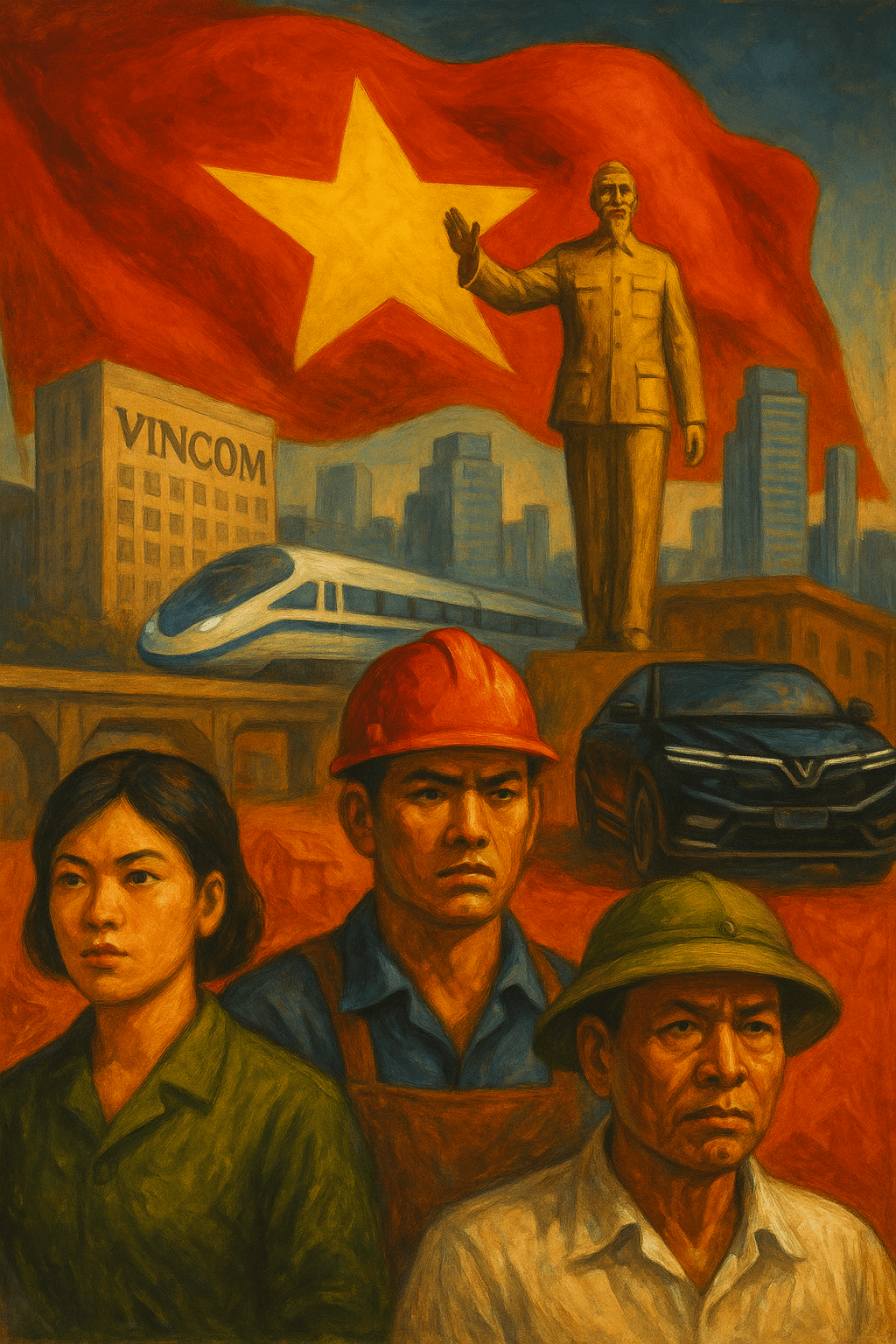
As Vingroup tightens its grip across Vietnam’s economic sectors, the contradictions of market socialism sharpen. But this isn’t surrender to capital—it’s a contested battlefield. The Party’s next move may determine whether the revolution advances or retreats.
By Prince Kapone | Weaponized Information
May 15, 2025
False Binaries and Manufactured Collapse
Leo Tran, a Southeast Asia-focused columnist for Asia Times, presents himself as a neutral observer of governance models. But scratch beneath the surface and you’ll find a familiar class allegiance: liberal technocracy dressed in regional expertise. Tran’s career straddles Western institutions—The Diplomat, Chicago Tribune, Kyiv Post—and his language reveals more than his citations. He measures political legitimacy in terms of “transparency,” “competition,” and “property rights”—bourgeois metrics cloaked in developmentalist concern. It’s not scholarship—it’s soft propaganda.
Asia Times, the platform carrying Tran’s piece, plays a similar game. Marketed as an independent, pan-Asian voice, its editorial line habitually upholds private capital as the motor of progress. Its contributors are stacked with investment strategists and political risk analysts, whose ultimate audience isn’t the working class—it’s asset managers. So when it comes to Vietnam, a socialist state navigating market terrain, the bias is built in: reform is good, regulation is suspicious, and socialism is always at risk of becoming “cronyism.”
That’s why the VinSpeed railway proposal becomes a narrative vehicle for deeper ideological work. Tran presents Vingroup’s bid to take over the $61 billion North–South high-speed railway project as a sign of creeping oligarchy. He names names: billionaire Phạm Nhật Vượng, Prime Minister Phạm Minh Chính, and Deputy PM Trần Hồng Hà—not to expose them as agents of global capital, but to imply a slippery slope from Party-led development to backroom deals. What’s missing? Any structural analysis. Any materialist account of the Party’s role in shaping, containing, or even leveraging these contradictions for socialist ends.
Tran highlights Vingroup’s proposal: state-backed funding for 80% of the railway, land clearance privileges, and the right to adjacent real estate development. His tone suggests scandal, not struggle. But what he ignores is key: this isn’t deregulation, it’s negotiation within a system that still places all strategic infrastructure under Party control. The CPV didn’t approve the deal. It didn’t privatize the railway. It suspended coverage, recalibrated messaging, and absorbed public feedback before reintroducing the issue with new parameters. That’s not collapse. That’s dialectical governance.
Most revealing is how Tran frames public reaction. He hints at “blowback” and “elite resistance,” but never names the forces organizing or responding to it. In Vietnam, mass opinion isn’t mobilized through U.S.-style ballots—it moves through forums, Party channels, and grassroots networks. What the West calls a PR crisis was, in this case, a form of socialist feedback—netizen accountability that forced state recalibration. But to Tran, it’s all proof that Vietnam is already capitalist. That’s the ideological sleight of hand.
Let’s be clear: there are real contradictions here. Vingroup has grown powerful. Private capital does wield influence. But the narrative Tran offers flattens these tensions into a binary: either pure socialism or total surrender. This is propaganda by omission, not analysis. The real story is more complicated—and more dangerous to empire: Vietnam is building socialism under global capitalism. And that story terrifies liberal ideologues more than any flashy railway bid ever could.
Socialism in Motion: Parsing the Facts, Naming the Silences
Let’s sift the material from the myth. Here’s what the Asia Times article does report: Vingroup’s VinSpeed subsidiary submitted a formal proposal to take over Vietnam’s North–South high-speed railway project—a $61 billion megaproject stretching the country’s length. The proposal requested the state cover 80% of the cost through a zero-interest loan, while VinSpeed would fund the remaining 20%. It also sought control of real estate development around the railway and the right to use public financing as operational capital. These are audacious terms by any standard. The backlash was immediate—and public.
Now for what wasn’t reported, or was buried between the lines. The proposal didn’t originate in a vacuum. It followed Resolution 68, the Party’s policy directive calling for enhanced private sector participation within a socialist-oriented economy. But Resolution 68 is not a blank check for privatization. It explicitly affirms the state’s leadership role, prioritizes public welfare, and frames private enterprise as a partner—not a replacement—for national development.
Tran offers no class analysis of who stands to benefit—or lose—should Vingroup’s proposal advance. He does not mention that land remains collectively owned under Article 53 of Vietnam’s Constitution, nor that state institutions like the Ministry of Planning and Investment must approve such proposals. He omits the fact that even large-scale private developments like VinFast’s EV expansion have been subjected to public audits, redirected by state ministries, or shuttered entirely if they breached national interest. The CPV retains veto power.
And what of Vietnam’s working class? Absent from the article. No mention of the 2019 Labor Code, which strengthened collective bargaining and improved protections. No analysis of the trade union restructuring project underway since 2020, which aims to bolster grassroots-level organizing. No engagement with the Party’s explicit five-year goal of raising rural living standards, reducing urban inequality, and expanding public education and healthcare.
Instead, Tran frames the controversy as evidence of Vietnam’s capitalist unraveling. But the facts—when grounded in a broader dialectical context—tell a different story. The Party is not surrendering control. It is testing boundaries, absorbing contradictions, and managing capital through a socialist political apparatus.
This is where the imperialist media apparatus falters: it sees contradiction and calls it collapse. But socialism, as history teaches us, is not a clean line. It’s a battlefield. And Vietnam is still fighting on that terrain—against market pressures, global capital, and internal deviations. Not as a capitalist country pretending to be socialist, but as a revolutionary project still walking the tightrope of transition under siege.
Between the Mass Line and the Market: Reframing the Debate
Let’s be clear: Vietnam did not spill blood defeating French colonialism and American imperialism to become a mall for billionaires. The Vietnamese Revolution was forged in fire—by peasants, workers, and guerrillas who fought not for luxury condos or privatized railways, but for sovereignty, land reform, and socialism. The proposal from Vingroup’s VinSpeed to essentially hijack the North–South railway project under a sweetheart public-private financing scheme is not just economically audacious—it’s ideologically dangerous. And yet, the uproar it provoked also reveals the living power of Vietnam’s revolutionary infrastructure.
That power is not just the Communist Party of Vietnam’s central planning apparatus. It’s the mass line: the dialectical feedback loop between Party leadership and the masses that forces course correction when capital oversteps. When Vietnamese netizens flooded online forums with criticism, when working-class voices questioned the state’s silence, when cadres behind the scenes moved to halt and reframe the proposal—this wasn’t a liberal democratic check-and-balance. It was socialism in motion.
Here’s the contradiction that must be grasped: a socialist-oriented market economy will necessarily produce tensions. Monopoly formation, elite accumulation, and speculative behavior will arise wherever capital flows freely. But that does not automatically signal neoliberal capture. The essential question is: who still holds the reins? And in Vietnam, it remains the Party.
That doesn’t mean the Party is beyond criticism. It means it’s still structurally capable of correction. Unlike neoliberal regimes that institutionalize corporate dominance as untouchable “market freedom,” Vietnam’s political structure still permits rupture, feedback, and intervention. The Vingroup case is not evidence of a lost cause—it’s evidence that the lines are still being drawn, and drawn publicly.
And that’s where revolutionaries across the world must recalibrate our gaze. We must refuse simplistic binaries: Vietnam is not some “neoliberal sellout,” nor is it a flawless vanguard state. It is a living contradiction—a socialist project navigating a world system built on capitalist coercion. The correct response is not dismissal, but solidarity. Not cynicism, but struggle.
Vietnam’s future—whether it deepens its socialist transition or slips toward comprador capitalism—will not be decided by Vingroup, nor by Western commentators. It will be decided by the Vietnamese working class. By farmers resisting land grabs. By students fighting for public education. By unionists organizing inside the very conglomerates the West fetishizes. And yes, by cadres within the CPV who remember that their loyalty is not to capital, but to the class that shed blood to build the nation.
Revolutionary Discipline, Not Reformist Surrender
The Vietnamese working class does not need lectures from the West about corruption or “crony capitalism.” They know the terrain. They live the contradictions. But what they deserve—and what the global left must provide—is revolutionary solidarity rooted in clarity, not condescension. The struggle in Vietnam is not a morality play. It is a real battle over the future of socialism in a world still dominated by hyper-imperialism.
So let’s speak clearly. If Vingroup’s ambitions are left unchecked, the result won’t be “growth” or “efficiency.” It will be platform feudalism: private ownership of infrastructure, rentier control of housing and transit, and algorithmic wage theft dressed up as modernity. But if that same working class mobilizes its institutions—its Party organs, trade unions, grassroots collectives—then the railway won’t be a corporate annex. It will be a battlefront.
Revolutionaries everywhere should watch Vietnam closely—not to sneer from afar, but to learn how contradictions play out under Party rule. We must:
- Uplift Vietnamese left voices: promote Marxist scholars, cadre critiques, and class-conscious workers resisting capital’s encroachment.
- Build transnational worker alliances: connect Vietnamese labor with movements in Cuba, Kerala, Venezuela, South Africa—places where the struggle against neoliberalism is daily and direct.
- Challenge Western capital flows: track imperialist bank and tech investment in Vietnam, and expose how financial piracy tries to dress itself in “development” language.
- Support mass education: translate revolutionary literature, organize study circles, and amplify anti-imperialist theory in Vietnamese diaspora communities.
Because Vietnam’s future is not a spectator sport. It is a live struggle. And what emerges from that struggle will shape the broader fate of socialism in the 21st century. If the line holds—if the Party asserts its mandate, if the masses demand accountability, if Vingroup is disciplined and not deified—then the Đổi Mới experiment may evolve into a model of truly socialist adaptation.
But if that line breaks—if the logic of capital colonizes the revolution from within—then Vietnam risks becoming what so many of us have seen before: a site of betrayal, not liberation. The stakes are enormous. The time to choose sides is now.
 Weaponized Information
Leave a comment