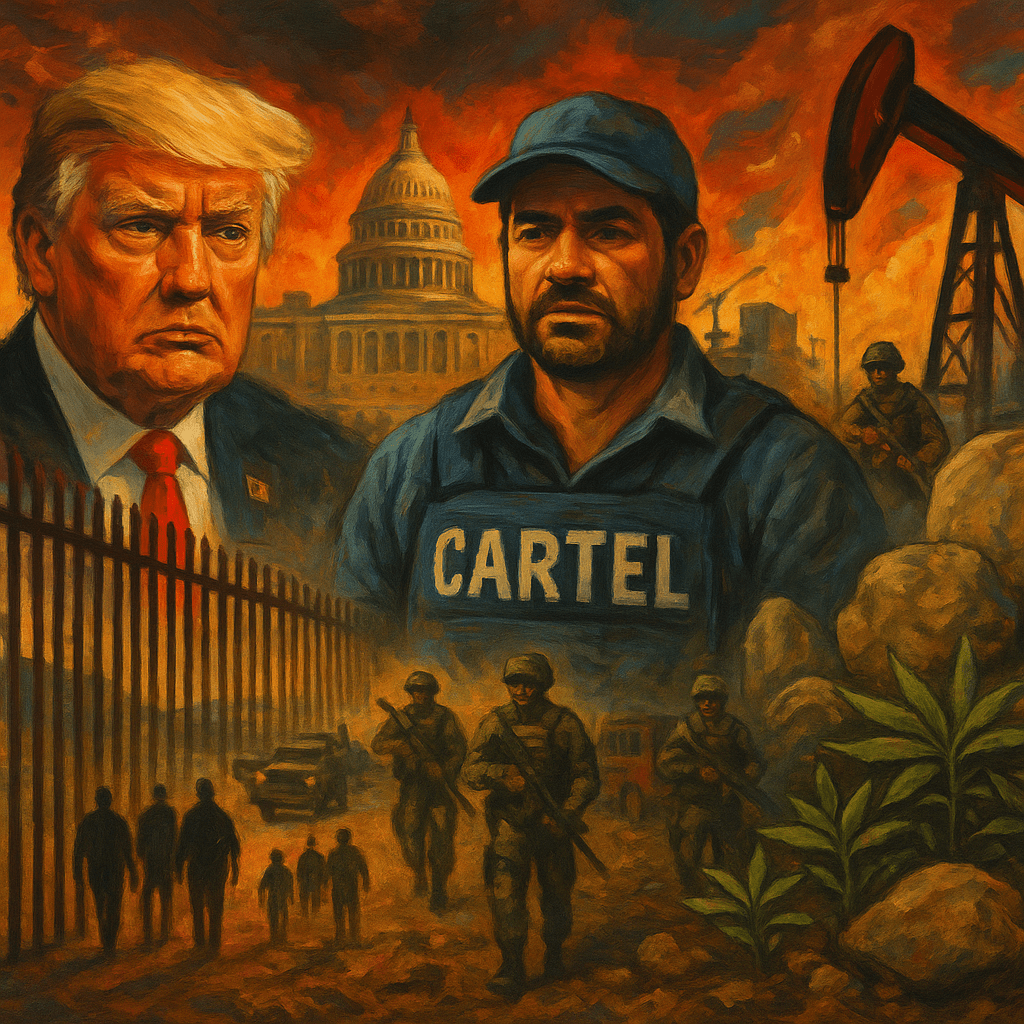
What looks like a plea bargain may be something far more dangerous: the quiet construction of a narco-paramilitary subcontractor for U.S. empire in the Western Hemisphere.
By Prince Kapone | Weaponized Information
May 14, 2025
Author’s Note: A Thesis in the Fog
Let’s begin with honesty. This is not a courtroom brief. It’s not a classified leak or a wiretap transcript. It’s a political thesis written from the outside—without subpoenas, without surveillance tools, without a desk in Langley or a mole in the DOJ. And that means one thing: we are working with fragments.
The events analyzed here are shrouded in secrecy by design. The cartel world does not issue press releases. The U.S. empire does not publish its shadow agreements. And the Associated Press? It only tells the part of the story approved for public consumption. So what we’re doing here is not asserting omniscience—we’re constructing a plausible theory from the patterns of imperial behavior that history has made all too familiar.
This is a thesis, not a revelation. A hypothesis drawn from the observable motions of capital, coercion, and coercive capital. It’s an attempt to map the contours of a hidden architecture, to name the choreography behind the curtain. Some details may later be confirmed, others disproved. That’s not the point. The point is to look at the structural logic behind the moves—to ask not just what happened, but why it fits the pattern it does.
If new facts emerge, we will revisit the analysis. But what won’t change is the foundation of our approach: that the U.S. empire, facing crisis, will always choose control over justice, secrecy over transparency, and collaboration with criminal power when it serves imperial interest. That’s not conjecture. That’s historical fact.
So read this not as prophecy, but as political reconnaissance. We don’t claim certainty—but we do claim vigilance. And in an age of information warfare, surveillance states, and corporate propaganda, vigilance itself is revolutionary.
I. Behind the Curtain: Who’s Writing the Script?
The article doesn’t carry a name, just “Associated Press.” And that’s by design. The Associated Press is one of the oldest and most trusted brands in American journalism—trusted not because it tells the truth, but because it tells the same story every empire needs told. Created in the age of slavery to syndicate dispatches favorable to the plantation economy, AP today acts like a stenographer for imperial power. Don’t let the boilerplate style fool you—this is not “objective journalism.” It’s ideological work.
You won’t find the author’s name on this piece because the author doesn’t matter. What matters is that the institution itself has long been an extension of the U.S. state, laundering the decisions of generals, prosecutors, and Wall Street warlords into the language of criminal justice and diplomacy. This piece is no exception. It reads like it came straight from a DOJ briefing room, touched up by a public relations team on loan from Langley.
The narrative is simple: a cartel boss flips, his family walks free, and the empire gets to pretend it’s cleaning up the streets. But even a half-awake reader can see the seams. 17 members of the Guzmán-Lopez family—heirs to the Sinaloa cartel throne—just walked across the San Ysidro border crossing with their luggage and their impunity intact. No arrests. No court dates. No coordination with Mexican authorities. Just a quiet handoff under the protection of U.S. federal agents. And AP treats it like a procedural footnote.
No mention of who authorized it. No investigation into why these family members—linked to one of the most powerful criminal organizations on earth—were granted safe passage into the United States. No questioning of how this squares with Trump’s public war cries about “narcoterrorists.” Instead, we’re given a tidy little morality tale: the good feds outsmarting the bad guys. What we’re not told is that the “bad guys” are being selectively protected by the same government that claims to be hunting them.
The amplifiers? Start with U.S. Attorney Adam Gordon, who rants about bringing the Sinaloa leadership to heel while quietly managing the logistics of their relocation. The DOJ plays both prosecutor and partner. Meanwhile, Trump’s inner circle—those managing the border, the military deployments, and the intelligence coordination—stay unnamed, which is the AP’s way of protecting their operational anonymity. But make no mistake: this isn’t journalism, it’s the imperial state writing its own script and signing someone else’s name to it.
What we’re looking at here isn’t just hypocrisy—it’s imperial doctrine. Divide and conquer, co-opt and contain. AP won’t call it that, of course. They’ll call it “law enforcement.” But the facts tell another story. While the poorest migrants are deported or caged for trying to survive, the elite heirs of the drug war are chauffeured into the empire like guests of honor. That’s not law. That’s logistics. That’s imperial choreography.
So before we even get to the geopolitics, let’s be clear: this article is an ideological smokescreen. It conceals more than it reveals. It launders a backroom deal into a tale of justice. And it does so with the cold professionalism of an outlet that has spent over a century doing exactly that. Now, let’s tear the veil off this thing and dig into what’s really going on beneath the surface.
II. What They Say, What They Hide: Extracting Facts from the Fog
Imperial propaganda always buries the truth beneath a mountain of narrative ash. Our task, as always, is to sift through the rubble, pull out the facts, and place them back in the hands of the people. Let’s begin with what the AP does report—before laying bare what they chose to omit.
- Fact #1: On May 9, 2025, 17 relatives of Ovidio Guzmán—son of Joaquín “El Chapo” Guzmán—crossed the U.S. border at San Ysidro with the cooperation of U.S. federal agents.
- Fact #2: The crossing was understood by Mexican officials as the product of negotiations between Guzmán and the U.S. Department of Justice, likely part of a plea deal.
- Fact #3: Mexican Security Secretary Omar García Harfuch confirmed the deal in a radio interview, noting Mexico was not informed in advance and had received no cooperation from U.S. authorities.
- Fact #4: U.S. Attorney Adam Gordon simultaneously announced sweeping narco-terrorism indictments against other cartel leaders and factions, especially naming the Sinaloa cartel.
Now, what wasn’t said?
- We don’t know who greenlit this deal. Was it the DOJ? Homeland Security? The White House? The CIA? All of the above?
- We don’t know the terms. What kind of cooperation did Ovidio offer that’s worth smuggling his whole family into safe haven?
- We don’t know what legal status the family now holds. Asylum? Witness protection? Temporary visas? Citizenship?
- We don’t know what role—if any—the Mexican government played in negotiating, objecting to, or approving this move. What we do know is that they were bypassed.
These omissions aren’t incidental. They’re structural. They point to something much deeper than a cartel plea bargain. They reveal an operational model we’ve seen before—just under different names.
Consider the contradiction at the heart of it: Trump and his regime wage rhetorical war against Mexican cartels, labeling them “terrorist organizations” and using them as justification for militarizing the border. But here we have the U.S. state—not just permitting, but facilitating—the unimpeded entry of the cartel elite.
This isn’t a glitch in the machine. It’s how the machine works.
The Guzmán family isn’t being prosecuted. They’re being repositioned. Installed. Absorbed. Perhaps as intelligence assets, perhaps as leverage over rival cartels like CJNG, perhaps even as the embryonic core of a U.S.-aligned narco-political apparatus within Mexico itself.
This echoes past imperial practice. In Colombia, the U.S. aligned with the Cali cartel to take down Escobar’s Medellín operation. In Afghanistan, the CIA brokered deals with warlords and heroin traffickers to control provinces. In Nicaragua, the Contras trafficked cocaine under CIA protection to finance death squads. The method is consistent: co-opt criminal structures, rebrand them as “partners,” and use them to discipline the unruly.
So why Sinaloa? And why now?
The Sinaloa cartel, especially under the leadership of Zambada-Guzmán and El Chapo’s lineage, has historically been more embedded with U.S. intelligence operations than any other faction. In 2011, Vicente Zambada Niebla testified in Chicago federal court that the DEA had forged a covert agreement allowing the Sinaloa cartel to ship drugs into the U.S. in exchange for intelligence on rivals. The U.S. never denied the substance of the allegation—only that “formal immunity” had not been granted.
Fast forward to 2025: that same cartel, now fragmented but still powerful, appears to be receiving direct logistical support from the U.S. government to safeguard its elite members. The DEA, DOJ, and possibly CIA are playing midwife to a restructured narco order. Not because they want to end the cartels—but because they want to manage them more efficiently.
And manage what, exactly? Not just drugs. The cartels today are deeply woven into the logistics of imperial capital. They control territory rich in lithium, water, oil, and Indigenous resistance. They dominate border economies, migrant smuggling routes, and informal labor markets. They terrorize peasant communities, dismantle communal governance, and kill organizers. In other words, they do the dirty work that the empire cannot always do itself.
This is the deeper context of the Guzmán deal. It’s not about justice. It’s about imperial engineering. And the border, in this case, is not a line of defense—it’s a calibration zone. A filter. A logistics checkpoint in the reordering of hemispheric control.
The cartel isn’t being dismantled. It’s being reprogrammed.
III. Reframing the Narrative: The Cartel Deal as Imperial Choreography
The cartel family walk across the border isn’t just a footnote in a plea bargain—it’s the quiet unveiling of a much bigger operation. To understand what’s really at stake, we have to step back and zoom out, away from the fog of “narcoterrorism” headlines and into the broader architecture of Trump’s hemispheric strategy. This isn’t about cracking down on drugs. It’s about recalibrating imperial control.
Trump is building something more sinister than a border wall. He’s building a technofascist border regime: a militarized, AI-policed, selectively porous frontier designed not to keep all people out, but to regulate who comes in and why. The poor and desperate? Expendable, deported, demonized. But the wealthy, connected, or useful—like the Guzmán dynasty? They’re granted safe passage. This isn’t hypocrisy. It’s imperial logistics.
We’re watching the real-time conversion of the Sinaloa cartel into a compliant, semi-official arm of U.S. regional strategy. Think of them as the next-generation Contras, only with better funding, more firepower, and less ideology. This is how modern empire works: it no longer colonizes with boots on the ground. It outsources, subcontracts, and co-opts existing criminal structures, turning them into black ops enforcement arms of foreign policy.
The timing matters. Mexico is moving cautiously toward a multipolar orientation—trading more with China, rethinking its energy sovereignty, even flirting with BRICS. López Obrador and now Sheinbaum have both tried, however modestly, to assert national dignity in the face of Yankee diktats. And while the Mexican state is still deeply compromised, these gestures of autonomy have set off alarms in Washington.
Trump’s answer? Restore imperial dominance without the burden of war. Reassert control over the hemisphere using chokepoints (like the BlackRock-dominated Panama Canal), mass deportation as labor policy, and now—narco-paramilitary partnerships. If Sheinbaum resists too hard, if Indigenous self-defense groups grow too strong, or if Mexico’s elite wavers in loyalty, Sinaloa becomes the blunt instrument to bring them back in line.
And let’s not forget the domestic angle. Trump’s base is addicted to border theater. Fentanyl panic, migrant caravans, cartel gunmen—it’s red meat for the MAGA crowd. By secretly striking deals with “friendly” cartel factions like Sinaloa, Trump can present a public image of cracking down, while privately securing cooperation to reduce drug violence inside U.S. borders. The cartel violence doesn’t stop—it just gets rerouted.
In exchange, Sinaloa consolidates power over the regional drug economy, wiping out rivals with U.S. legal and military cover. In effect, the U.S. is picking its favorite drug lord and betting the empire on his family.
This isn’t unprecedented. In Colombia, the CIA coordinated with Los Pepes and the Cali Cartel to assassinate Escobar and bring the drug war under imperial discipline. In Afghanistan, opium trade flourished under U.S. occupation—not by accident, but because heroin profits were deemed strategically useful. And now in Mexico, we see the same logic: partner with the “manageable” criminals to defeat the ungovernable ones. Turn cartels into client militias. Let them kill your enemies for you—activists, Indigenous leaders, union organizers.
The border becomes the hinge of this entire operation. On one side, militarized spectacle, biometric checkpoints, mass deportations. On the other, carefully curated cooperation with cartels, corporate investors, and compliant states. It’s a dual regime: terror for the poor, tolerance for the useful. And Sinaloa, reborn as imperial subcontractor, is its armed extension.
So no, this deal isn’t a fluke. It’s not some rogue DOJ decision. It’s a signal—like a drone overhead or a satellite scan. It tells us that Trump’s technofascism doesn’t stop at the border. It metastasizes, spills out, and engulfs entire regions. Mexico is the next front, not in a war on drugs, but in a war for hemispheric control—with narcos, financiers, and fascists shaking hands behind a curtain of propaganda.
The left must see this clearly: this is not just about drugs, or immigration, or Trump’s base. It’s about the remilitarization of the American hemisphere by covert means. It’s about the construction of a pliant, semi-privatized empire built on fentanyl profits, paramilitary terror, and Wall Street logistics.
The Guzmán crossing isn’t a story about crime. It’s a story about empire. And the sooner we understand it, the better we can fight it.
IV. Mobilization: From Exposure to Action
Now that the mask is off, what do we do? We don’t write op-eds begging the empire to be more consistent. We don’t appeal to the Department of Justice to investigate itself. We organize. Because the system isn’t broken—it’s working exactly as designed. And that system must be dismantled.
First, we must stand in firm and open solidarity with the forces already fighting this empire of death. The Indigenous militias of Michoacán and Guerrero. The peasant unions. The land defenders. The disappeared students of Ayotzinapa. The Zapatista communities still holding the line in Chiapas. These are not collateral damage in the cartel wars—they are the primary targets. And their resistance is our roadmap.
We also name names and map connections. BlackRock owns logistics companies operating at the Panama Canal and along Mexico’s energy corridors. U.S. firms profit off prison labor deporting migrants by the thousands. Big banks launder narco-money through “compliance departments” that turn a blind eye. And cartels—far from being rogue actors—operate more like franchisees of the empire’s dirty work.
Revolutionary media must play its part. Not as neutral commentators, but as weaponized instruments of truth. Use this story to build popular consciousness about how empire really functions—not through laws, but through deals. Not through peacekeeping, but through mercenaries in suits and ski masks. Reframe the “border crisis” as a war against the poor, not a crisis of enforcement.
Tactically, this means launching coordinated campaigns:
- Expose and boycott corporations profiting from mass deportation, prison logistics, and border surveillance.
- Pressure progressive and leftist Mexican and Latin American forces to denounce U.S. paramilitary manipulation and reassert real sovereignty against cartel colonization.
- Build cross-border solidarity networks between migrant justice groups in the U.S. and campesino and Indigenous resistance organizations in Mexico.
- Popularize revolutionary education around the Monroe Doctrine’s return under technofascism, linking Panama, Mexico, and the imperial “drug war” into one unified schema of control.
If we do not organize, the empire will. In fact, it already is. It is recruiting cartel elites, it is digitizing the border, and it is preparing to unleash mass repression under the banner of “national security.” And if we wait too long, we will not be next. We will be nothing.
So let us be clear: this is a call to action, not a lament. The U.S. empire is consolidating a hemispheric system of control—powered by cartel capital, privatized violence, and manufactured fear. Our task is to rupture it. From the borderlands to the barrios, from the trenches of Chiapas to the cell blocks of ICE detention centers, we must build a revolutionary front that rejects both the narco-state and the settler state.
No deals with death. No peace with empire. No trust in technofascism. Forward in solidarity with the colonized and the criminalized. For a free Mexico. For a free people. For a world beyond the reach of BlackRock, the CIA, and the Guzmáns alike.
 Weaponized Information
Leave a comment