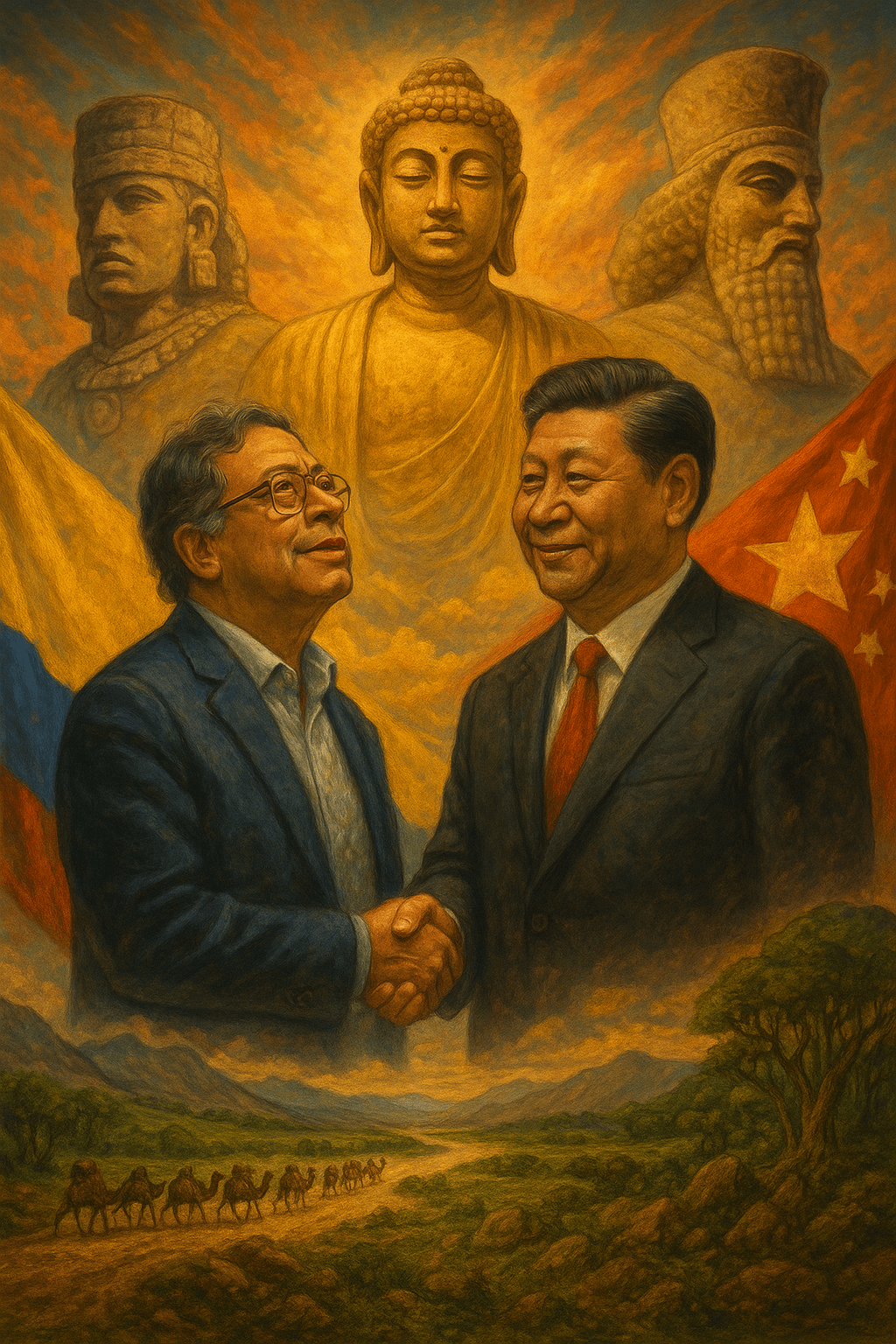
From “Clash” to Cooperation: Global South Sovereignty and the West’s Weaponized Silence
By Prince Kapone | Weaponized Information | May 13, 2025
I. The Sound of Silence: When the Empire Says Nothing, Listen Harder
When Colombian President Gustavo Petro stood in Beijing and called for a “dialogue among civilizations,” it was the kind of statement that should’ve made headlines from Bogotá to Brussels. But if you scanned the digital pages of The New York Times, Reuters, or Politico, you’d think it never happened. Not a peep. Not even a buried paragraph. The very idea that a Global South leader could reject the imperial “Clash of Civilizations” dogma and articulate a planetary vision rooted in peace, ecological cooperation, and mutual prosperity—it was too much. Too dangerous. So the imperialist media apparatus did what it does best: it vanished the story.
These aren’t passive omissions. This is cognitive warfare—silence as counterinsurgency. And the architects of that silence have names. Editors like Michael Stott at the Financial Times, who frames Latin America strictly through investor confidence and military alignments. Columnists like Ernesto Londoño, whose stint as a U.S.-approved storyteller at the New York Times reads more like an embassy newsletter than journalism. And shadowy “analysts” parked in think tanks like the Atlantic Council and CSIS, who scribble white papers about “Chinese influence” in Latin America while sipping IMF-funded cappuccinos in D.C.
Meanwhile, on the official diplomatic front, we see actors like Gabriel Boric performing the liberal tightrope—signaling “progressive values” to placate the youth, while never challenging the architecture of empire. U.S. Ambassador Francisco Palmieri floats across South America under the guise of “democracy assistance,” quietly coordinating USAID cyber programs that offer “digital literacy” while laying the cables of digital colonialism.
But this time, the propaganda isn’t in what’s said—it’s in what’s not. That’s the tell. The imperialist press reported on Petro’s trip to China, yes—but not the speech. Instead, they cast suspicious light on Colombia’s decision to join the Belt and Road Initiative, framing it as a betrayal of Western alliances, a geopolitical “pivot” that must be explained. Politico went so far as to headline Colombia’s move as “worrying” for U.S. hemispheric dominance—code for: “they’re slipping out of our grip.”
What they won’t admit is this: it’s not Petro’s presence in Beijing that threatens the empire. It’s his words. It’s his rejection of the vertical world order—built by colonial conquest, enforced by gunboat diplomacy, and preserved by hyper-imperialism. When a Global South president says civilization doesn’t have to mean conquest—doesn’t have to mean hierarchy, debt, and digital chains—that’s heresy. And heresy, to the imperial priesthood, must be buried.
So here we are. The “free press” says nothing, and that nothing is everything. That silence is structured. It’s intentional. It’s part of the imperialist recalibration now underway in the face of multipolarity—a recalibration that trades drone strikes for data cables, coups for credit ratings, and open lies for algorithmic omissions. And if you’re waiting for the empire to admit it, don’t hold your breath. The silence is the confession.
II. Excavating the Truth Beneath the Rubble of Empire
The truth, when it finally speaks, doesn’t always arrive with fireworks. Sometimes it comes through the voice of a president the empire calls a “left populist,” standing in Beijing beside leaders of China, Brazil, and Chile. Petro’s speech, reported faithfully by teleSUR, was a declaration—not just against the “Clash of Civilizations” thesis, but against the whole vertical scaffolding of global power. He called for a horizontal future. A civilization not defined by conquest, extraction, and walls, but by cooperation, connectivity, and life. He envisioned fiber-optic cables—not missiles—linking peoples across oceans. Energy grids—not drone bases—uniting continents.
What Petro proposed was simple, even obvious: decarbonize or die. But his solution was radically collective: Latin America and Africa working together to electrify the planet on clean terms, bypassing the Western banks, bypassing Washington’s sanctions, bypassing the old circuits of neocolonial extraction. He wasn’t begging. He wasn’t appealing to G7 charity. He was asserting what we call anti-imperialist sovereignty: the right of nations in the Global South to build, connect, and survive—without asking for permission.
But this vision doesn’t float in a vacuum. It emerges within a material context. Colombia, under Petro, just signed onto the Belt and Road Initiative (BRI), joining a global infrastructure corridor that is rapidly knitting together the developing world in defiance of U.S.-led unipolarity. The empire’s response? Smears, fear campaigns, and now—silence. The silence masks the panic. For decades, the U.S. treated Latin America as its “backyard,” a playground of coups and puppet regimes. But the ground is shifting. Even Colombia, one of Washington’s most reliable outposts, is turning.
Omitted from the imperial record: the fact that the “energy interconnection” Petro referenced has been blocked repeatedly—not by lack of technical capacity, but by foreign capital and domestic comprador elites afraid of regional integration. Omitted: that Latin America’s vast hydro and solar potential is more than enough to power large swaths of the planet—and that Global South decarbonization would bankrupt the Western carbon barons. Omitted: that fiber-optic connectivity proposed by Petro threatens the digital colonialism enforced by U.S. tech monopolies like Google, Meta, and Amazon.
And omitted above all: that the very concept of “civilization” being proposed here has nothing to do with Euro-American liberalism. Petro’s “civilizational dialogue” is not a plea for multicultural harmony. It’s a political, ecological, and material challenge to the current world system—a system defined by hyper-imperialism, where the Global South bleeds so the Global North can binge. That’s the context. That’s the threat. And that’s why the empire’s media chooses silence over distortion. Because to report Petro’s words honestly would mean telling the world that another civilization is possible. And that, comrades, is the one story the empire cannot afford to tell.
III. Reframing the Future: Civilization Without Conquest
Gustavo Petro’s call for a “dialogue among civilizations” isn’t some starry-eyed liberal kumbaya. It’s not a Davos-style plea for diversity at the dinner table of the colonizers. It’s a revolutionary break with the entire ideological architecture of the Western world order. Because what Petro is proposing—quietly, carefully, and with the weight of history behind him—is a civilizational realignment rooted in the material needs of the colonized world. A rupture. A refusal. A vision of power without plunder.
Let’s be clear: Huntington’s “clash of civilizations” was never an analytical thesis. It was a blueprint for empire—a way to naturalize war, sanctions, walls, and cultural supremacy as historical inevitabilities. It told the white world: you are the center, and the rest are threats. Petro flipped that script. He stood among nations smeared as subordinate, chaotic, or corrupt, and said: we are the future. And that future is horizontal. Not equal in rhetoric, but in infrastructure. Not “diverse” in slogans, but integrated in energy, communication, and cooperative survival.
What he’s offering is nothing less than a proletarian roadmap to planetary life. Decarbonization is not framed here as an elite green investment scheme—but as a South-South project of anti-imperialist sovereignty, where energy is not a commodity but a lifeline, and climate action is not dictated by the IMF but built by the working class. Fiber-optic cables are not just wires—they’re lines of epistemic rebellion, conduits of knowledge that bypass the neural network of cognitive warfare designed in Silicon Valley and Langley.
And Petro’s insistence that this new order be horizontal—that it be built not on vertical domination but mutual interdependence—is no metaphor. It is the practical negation of the verticalism that defines hyper-imperialism: supply chains that run from sweatshop to skyscraper, data flows that move from exploited user to billionaire algorithm, power grids that light up Wall Street while Blackouts darken Lagos. A horizontal order isn’t just new geometry—it’s a new political economy. And it begins in the South.
For the colonized masses, this vision is not abstract. It is an opening. A moment in which empire shows its cracks and humanity can finally breathe through them. What Petro articulates is not utopia—it is necessity. And the only reason it sounds radical is because we have been taught that cooperation, solidarity, and ecological harmony are fantasies. But war, extraction, and planetary collapse? That’s “realism.” The task now is to discard the hallucinations of empire and build, brick by brick, the infrastructure of planetary solidarity. Civilization, not as conquest—but as cooperation in struggle.
IV. From Words to Wires: Building the Future the Empire Fears
If Petro’s speech in Beijing marked a civilizational rupture, then our task now is to turn that rupture into revolution. This isn’t the time for applause from the sidelines. The future Petro outlined—of South–South cooperation, clean energy independence, and horizontal knowledge exchange—will not be gifted. It must be constructed through struggle, solidarity, and dual and contending power. And that begins with ideological unity.
We unite with this vision. Not out of romanticism, but out of material necessity. The Global South is not asking for a seat at the imperial table—it is building a new table altogether, carved from the wreckage of colonialism and wired for survival. That is what anti-imperialist sovereignty looks like. Not slogans, but cables. Not handouts, but grids. Not sanctions, but solar panels, batteries, and fiber-optic conduits of proletarian knowledge.
Already, material seeds of this future are sprouting. Energy exchange pilots between Bolivia and Kenya. Brazil’s work with South Africa and China to develop open-source educational platforms beyond the surveillance of Google and Meta. Indigenous resistance movements in Colombia and Ecuador blocking IMF-imposed energy privatization to preserve local control of wind and hydro projects. These are not isolated sparks—they are nodes in a growing mesh of rebellion.
So what must we do, comrades? First, amplify. The imperialist media apparatus has tried to erase this speech—so we must circulate it. Translate Petro’s words into every language of the oppressed. Print it in pamphlets, teach it in study groups, screen it in barrios and back alleys. Let the people know: the future isn’t being decided in Brussels—it’s being dreamed in Bogotá, built in Beijing, and wired through Bamako.
Second, organize forums of guerrilla intellectuals and community assemblies to study the proposals of a civilizational dialogue from the standpoint of proletarian and peasant struggle. Connect this to local contradictions: food sovereignty, energy access, digital surveillance, and militarized police repression. Draw the lines between the fiber cables Petro imagines and the prison bars our people still face.
Third, build. Support mesh network infrastructure projects in Latin America and the Caribbean. Fund energy sovereignty campaigns led by working-class communities. Create alliances between de-dollarization efforts in BRICS+ countries and mutual aid formations in the heart of empire. The “dialogue among civilizations” Petro calls for is not a seminar—it is a trench. It is where humanity will either rise together or perish apart.
Finally, expose the silence. Name the journalists, think tanks, and tech platforms that tried to bury this moment. Treat their omission as the ideological warfare that it is. Because every buried speech, every redacted proposal, every vanished vision from the Global South is a strike against memory. And memory, comrades, is the first weapon of the oppressed.
A new civilizational order is not just possible—it is already being assembled. Petro has pointed to the horizon. Now we must build the road.
 Weaponized Information
Leave a comment