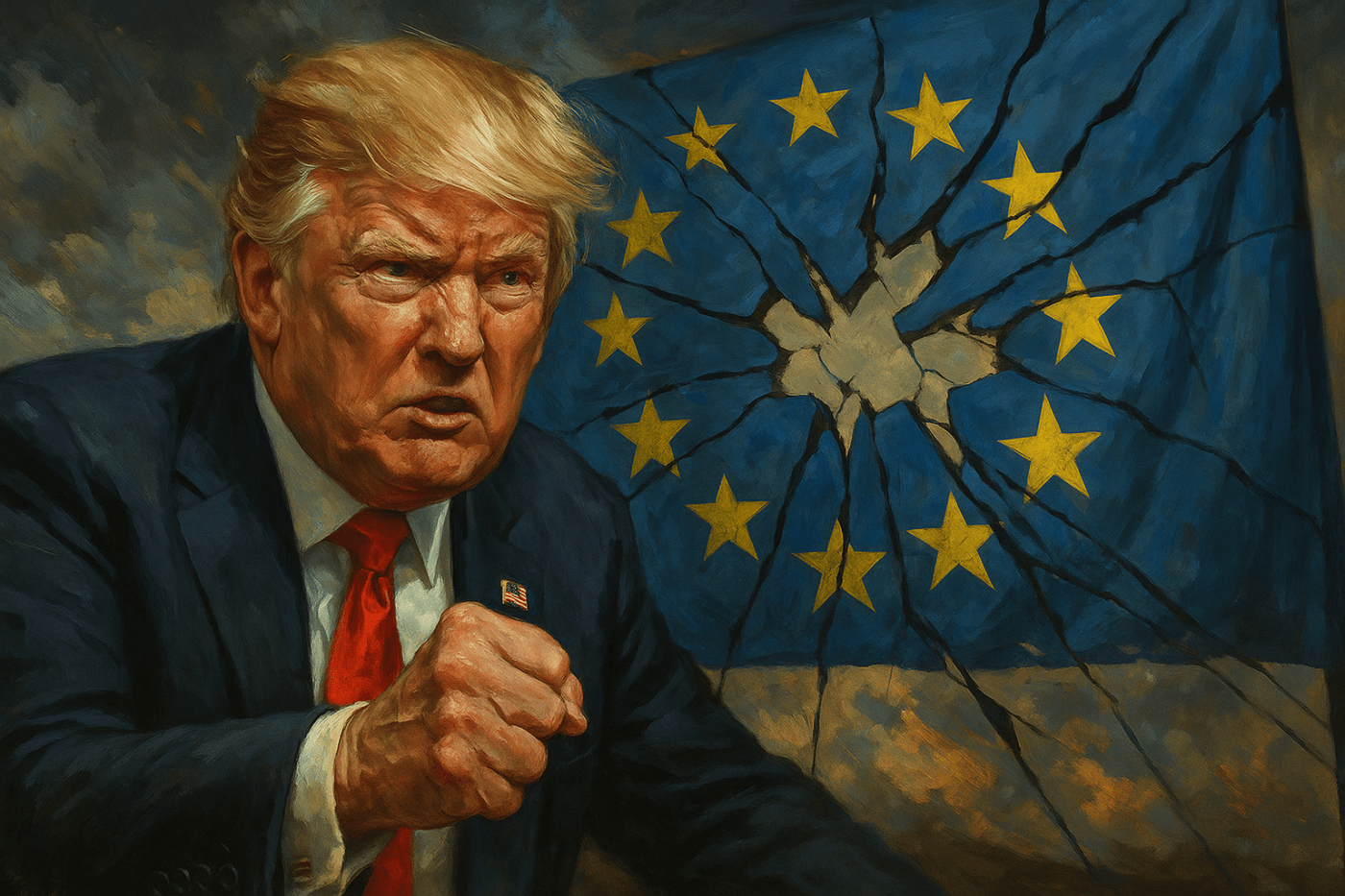
Trump 2.0’s tariff barrage against the European Union isn’t about trade imbalances—it’s about enforcing loyalty as the U.S.-led world order unravels. What they call protectionism is just hyper-imperial cannibalism in its next phase.
By Prince Kapone | Weaponized Information | May 12, 2025
I. The Empire Turns on Its Own: When Allies Become Enemies of Convenience
Axios calls it news. We call it narrative management. In this case, the outlet hands its megaphone to Trump 2.0—unfiltered and unchallenged—as he escalates his economic war on the European Union. April Rubin, the article’s lead writer, offers no analysis of imperial fracture or class interest. Instead, she presents Trump’s remarks as colorful policy debate, not the ideological artillery barrage that it is. Axios’ format of “smart brevity” isn’t journalism—it’s editorial stenography. Its job isn’t to explain contradiction. It’s to flatten it for consumption by managerial elites.
The real headline? Not that Trump issued new tariffs. Not that the EU threatened $100 billion in retaliation. The real headline is this: Trump said the European Union is “nastier than China.” And Axios treated it like a punchline. But that statement is political dynamite—because it names the crisis eating the heart of the imperialist triad. And it exposes the violent logic of U.S. empire: when allies drift, they become enemies. Not because they’ve changed, but because they’ve dared to act without permission.
Trump’s rhetoric doesn’t mean he favors China. It means Europe, a junior partner in global imperial management, is refusing to heel. The EU paused retaliatory tariffs in April, hoping for a diplomatic detente. Instead, Trump doubled down—accusing Europe of “subsidized healthcare,” “unfair trade,” and selling “13 million cars” to the U.S. while “we sell none in return.” Every claim is exaggerated. Most are false. But they serve a purpose: justify economic coercion, enforce subordination, and deflect blame for domestic decline onto foreign governments—especially the ones who are supposed to be obedient.
This is imperial recalibration by tantrum. It’s not just about steel, bourbon, or BMWs. It’s about hierarchy. Europe is being reminded that its status as ‘partner’ is conditional. Trump’s executive order to “cut drug prices” becomes the pretext to demand Europe pay more for healthcare—an absurd claim that the U.S. has been subsidizing the continent’s well-being. Axios prints it verbatim, never asking how global pharmaceutical monopolies operate or who profits from transatlantic price fixing. Because their job is not to interrogate empire. It’s to massage it through the news cycle.
In that role, they’re joined—though not named—by the usual suspects: Ursula von der Leyen, defender of Atlanticist capital and high priestess of NATO economic alignment. The U.S. Chamber of Commerce, Boeing, and Big Pharma execs all circle this conflict, sharpening their knives. This isn’t a policy dispute. It’s a disciplinary campaign. And the target isn’t China—it’s Europe, for flirting with disobedience in a moment of imperial decline. Trump’s line about Europe being “nastier” than China isn’t comedy. It’s a warning. And Axios dutifully delivers it, without context, without critique, without resistance.
II. From Bretton Woods to Breaking Ranks: The Collapse of Transatlantic Capital Unity
Strip away the posturing, and here are the facts: Trump has reignited a tariff war with the European Union. He claims the U.S. is “subsidizing” Europe’s healthcare and blames the EU for exploiting American pharmaceutical firms, selling cars unfairly, and taking advantage of “our generosity.” In retaliation, the EU has released a $100 billion tariff list for public comment—targeting U.S. bourbon, grains, vehicles, and aircraft. The European Commission paused earlier retaliatory tariffs hoping to avoid escalation. That restraint was met with Trump’s fist. As of now, the EU is preparing its counterpunch.
What Axios never says is that this is not about trade deficits. It’s about imperialist decay. Since World War II, the United States and Europe have functioned as two wings of the same beast: managing global capital under the banner of “free trade” and mutual security. From the Marshall Plan to NATO to the WTO, transatlantic institutions weren’t built on friendship. They were built to sustain U.S. hegemony under the illusion of alliance. Now that the U.S. economy is faltering—deindustrialized, indebted, and bloated with finance capital—it no longer seeks collaboration. It demands obedience. The EU’s sin isn’t betrayal. It’s hesitation.
Under Trump 2.0, that hesitation is punished. Tariffs become not just economic instruments, but weapons of loyalty enforcement. This isn’t a new Cold War—it’s a civil war within the empire. The so-called “imperialist triad” (U.S.–EU–Japan) is fracturing under the pressure of multipolarity, overaccumulation, and the rise of BRICS+. Europe, caught between a declining U.S. and a resurgent China-led alternative, is being forced to pick sides. And Trump is making that choice painful. “Pay more,” he demands—whether for drugs, cars, or geopolitical alignment. “Or else.”
The irony is rich. For decades, U.S. technocrats accused Global South states of “economic nationalism” anytime they sought self-sufficiency or sovereign development. Now Trump invokes the same logic—not for liberation, but to enforce imperial hierarchy. Europe, like the rest of the world, is learning what happens when an empire in decline turns inward: it eats its friends first. Axios calls it a trade dispute. But the deeper truth is this: the age of transatlantic unity is over. The center is not holding. It’s taxing its periphery.
III. The Tariff is the Whip: Economic Nationalism as Imperial Cannibalism
What the media calls a trade war, we call a structural convulsion. This is not about protecting “American jobs” or “leveling the playing field.” It’s about a dying empire clawing at its allies to reassert control. Trump’s tariff campaign isn’t strategy—it’s economic bludgeoning wrapped in nationalism. It’s the logic of hyper-imperialism turned inward. For decades, the U.S. extracted wealth from the Global South through debt, war, and trade liberalization. Now, with its hegemony cracking, it turns to the EU with the same tools: coercion, blackmail, and threat of collapse.
The reframing is clear: this isn’t a bilateral spat between equals. This is a hierarchy enforcement mission. Trump says Europe is “nastier than China” not because he believes it—but because Europe is expected to comply. When junior partners hint at independence—whether through digital regulations, green industrial policies, or rhetorical gestures toward China—they are met with financial warfare. The tariff is the whip. The press conference is the plantation meeting. The threat of $100 billion in retaliation? That’s the slave speaking back.
Trump’s framing of U.S. pharmaceutical corporations as victims of European “subsidies” is capitalist theater. These same firms offshore production, price-gouge insulin, and spend billions on lobbying instead of research. Their real grievance isn’t Europe’s healthcare—it’s the loss of monopolistic control. When Trump cries “America First,” he speaks not for workers, but for the oligarchs who fund his regime: Boeing, Pfizer, Raytheon, BlackRock. Their goal is not economic justice—it’s imperial monopoly by executive order.
And the EU? Far from a victim, it is a co-manager of global exploitation. But now it tastes a small dose of the same coercion it has helped inflict on Africa, Latin America, and Asia through IMF diktats and trade treaties. The contradiction is ripening: Europe’s bourgeoisie wants to keep its privileges without paying the tribute. Trump is saying: pick a side. This is how inter-imperialist conflict reenters history—not through military alliance rupture, but through tariff regimes, pharmaceutical extortion, and collapsing multilateralism.
The empire is not only losing control of the periphery—it’s losing control of itself. And as it tears into the EU, it opens space. Not for pity, but for revolutionary opportunity. If the imperial center can no longer feed its allies without violence, then the era of consent is over. What comes next is rupture—or ruin.
IV. From Retaliation to Rupture: Organizing Against the Empire’s Economic War
When imperial power lashes out at its own allies, that’s not strength—it’s panic. The trade war with Europe isn’t a glitch in global capitalism. It’s a preview of what happens when the empire starts feeding on itself. But for those of us organizing within that empire, this is not a moment to mourn alliance breakdowns—it’s a moment to escalate class struggle.
We’ve seen this before. In the 1970s, as U.S. inflation surged and the Bretton Woods system collapsed, American workers resisted austerity with wildcat strikes while European students and unions launched mass movements against NATO and neoliberalism. During the Iraq War, dockworkers in Italy and Britain refused to load U.S. weapons. In 2019, French workers torched Macron’s neoliberal pension schemes and declared solidarity with the Yellow Vests. And today, in Germany and the Netherlands, farmers and industrial workers are revolting against EU-imposed green austerity that protects capital while blaming labor.
What these struggles have in common is not nationalism—but resistance to being cannon fodder in capitalist crisis management. And now, U.S.-based revolutionaries have a role to play—not in choosing sides between rival imperial centers, but in building a movement that sabotages them both.
Concrete Tactical Actions:
- Expose the propaganda: Organize teach-ins and media campaigns that show how tariffs and “America First” policies enrich monopolies while squeezing workers in both the U.S. and Europe.
- Disrupt the profiteers: Target the corporations backing the tariff war—pharma giants, weapons firms, auto manufacturers—for direct action, boycott, and worker-led divestment.
- Link struggles across borders: Build joint labor campaigns with European unions resisting retaliatory layoffs and price hikes caused by the trade war.
- Reject economic nationalism: Forge an internationalist line inside U.S. organizing spaces that sees through the lie of “Buy American” and lifts up global class unity against all factions of capital.
- Frame the rupture: Position the collapse of the U.S.–EU alliance not as geopolitical tragedy but as an opening to break the architecture of hyper-imperialism—through strikes, mutual aid, and revolutionary agitation.
We’re not interested in saving NATO’s economy or defending Brussels’ technocrats. Our allegiance is to the exploited—whether they grow grain in Burgundy or build cars in Detroit. Let the empire’s partners turn on each other. We’re organizing for the day after the fall. The tariff war is empire in convulsion. Let’s make it birth revolution instead of reform.
 Weaponized Information
Leave a comment