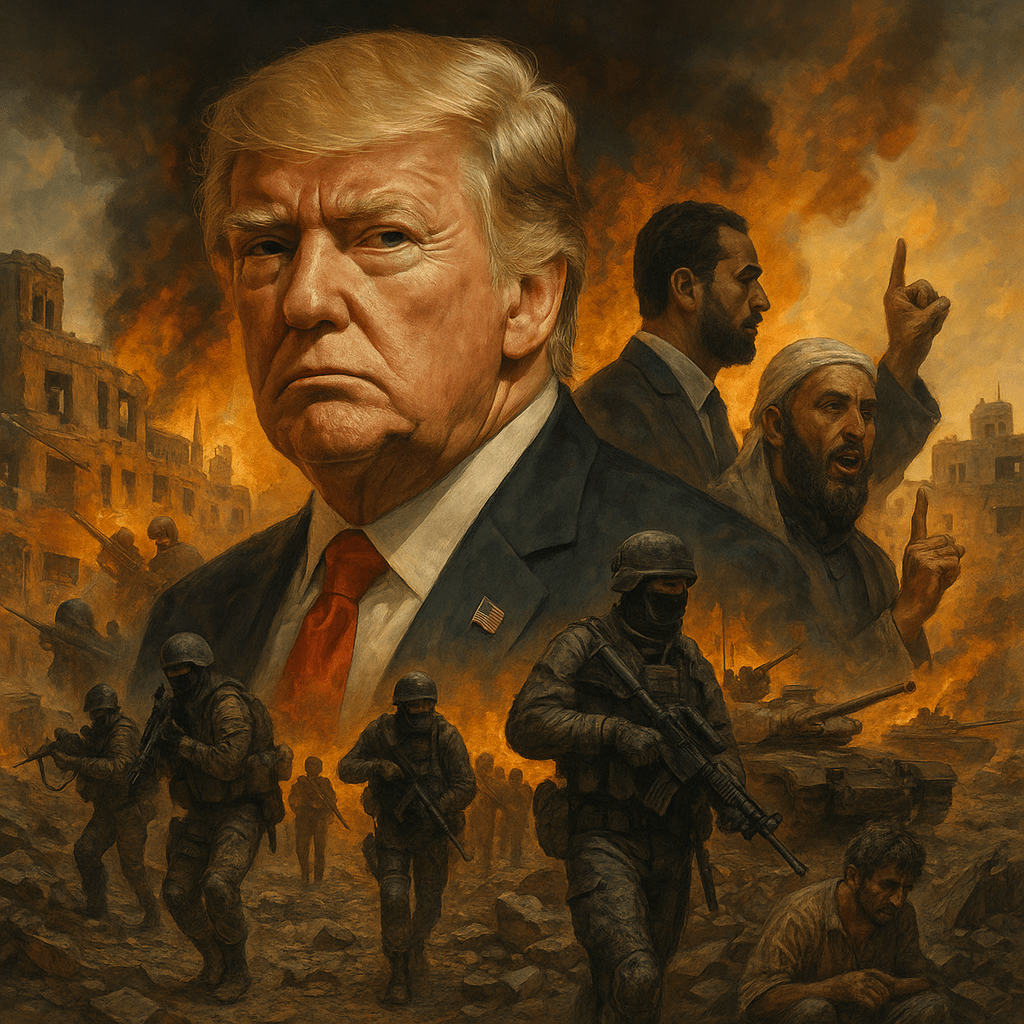
The empire’s latest chapter in Syria isn’t peace—it’s a hostile takeover by jihadist proxies in suits, backed by Gulf petrodollars, brokered by Wall Street, and blessed in Riyadh.
By Prince Kapone | Weaponized Information | May 13, 2025
I. What Empire Lifts, It Owns: The Propaganda Function of Sanctions “Relief”
Let’s start with the byline. Natasha Turak isn’t just any journalist—she’s CNBC’s embedded voice in the Gulf, a well-trained emissary of empire. Based in Dubai, fluent in French and Arabic, and with degrees from elite British institutions, Turak has spent her career in the warm orbit of capital and conquest. She reported for the Financial Times—an old hand at laundering Wall Street’s crimes—and now writes for CNBC, the media mouthpiece of NBCUniversal, which itself belongs to Comcast: a bloated monopoly at the heart of the imperial information complex. This isn’t a reporter bringing truth to the people. This is a court stenographer for empire, dressed in business-casual and stationed conveniently near the oilfields.
Her May 13 piece—“Trump says U.S. will remove all sanctions on Syria”—was not written to inform. It was written to disarm. It’s a propaganda operation in the style of all good imperial cover stories: erase the crime, soften the violence, recast the looters as liberators. The article frames Trump’s announcement at the U.S.-Saudi Investment Forum in Riyadh as a gesture of goodwill. It quotes him waxing poetic about “a chance at greatness,” painting Syria’s future in glitzy terms, as if what’s at stake is some magical reboot rather than the consolidation of a terror regime backed by U.S. dollars, Gulf oil, and Israeli airstrikes.
But look closer. There are tricks in every sentence.
First, the article talks about “lifting sanctions” as though it’s a Christmas gift from the empire. There is no mention of how those sanctions strangled Syria’s economy, blocked medicine and food, crippled hospitals, and sentenced tens of thousands of civilians to poverty, displacement, and death. There is no context—no history—just the benevolent hand of Trump lifting what he never should have imposed. The blockade becomes a favor, the crime rebranded as charity.
Second, Turak presents the new Syrian government—led by Ahmed al-Sharaa—as a blank slate. He’s “reformed,” we’re told. A fresh start. Never mind that this man was until recently Abu Mohammad al-Jolani, the face of al-Qaeda’s Syrian affiliate, responsible for sectarian massacres and public executions. Never mind that his regime came to power through a December 2024 offensive backed by U.S. and Gulf-funded militias who butchered their way into Damascus. These are not rebels. They are the hired knives of hyper-imperialism. But Turak says nothing of this. In her prose, a death squad becomes a “transitional government,” and mass murder is just an unfortunate backstory, easily forgiven when wrapped in Western suits and speaking contracts.
Third, the article frames this moment as a “chance to stabilize.” Stabilize what, exactly? The country’s been shattered—its sovereignty demolished, its infrastructure bombed to rubble, its people scattered. The United States did that. Turkey, Israel, and the Gulf monarchies did that. This isn’t stabilization—it’s imperial management. The U.S. couldn’t rule Syria directly, so it found someone who could wear the crown while holding Washington’s leash.
Fourth, and perhaps most telling, is what the article doesn’t say. There is no mention of the sectarian bloodletting unleashed by HTS against Alawites, Christians, and secular Arabs. No mention of the Israeli airstrikes that continue to hit Syrian territory. No mention of the economic gutting that will come next—the World Bank loans, the IMF austerity, the fire sale of Syria’s public assets to foreign investors. In fact, the article makes no mention at all of what comes after the sanctions are lifted—because empire prefers silence where it once preferred bombs. It’s the same strategy, just dressed in the language of diplomacy.
And so Turak, like so many in her class, does not ask why the sanctions are being lifted now. She does not ask who benefits. She does not ask why a man once deemed a terrorist is suddenly hailed as a partner. Because to ask those questions would be to reveal the whole playbook: war, destabilize, sanction, starve, collapse, install a proxy, lift the sanctions, then privatize everything in sight. This is not recovery. It’s recolonization with better marketing.
What we’re witnessing is not an act of peace. It’s an act of imperial recalibration. Trump didn’t lift the sanctions out of mercy—he lifted them to clear the way for business. For Gulf capital, for Western contractors, for the new Islamist regime that knows exactly who signed its paycheck. Turak’s job is to make that look like benevolence. And in that job, she succeeds. But not for us. Not for the working class. Not for the people of Syria. For them, this article is just another assault—this time on memory, on dignity, on the truth itself.
II. What They Say, What They Hide: Extracting Facts from the Fog
Imperial propaganda always buries the truth beneath a mountain of narrative ash. Our task, as always, is to sift through the rubble, pull out the facts, and place them back in the hands of the people. Let’s begin with what CNBC and Natasha Turak do report—before laying bare what they chose to omit.
Trump’s announcement in Riyadh that he would lift all sanctions on Syria wasn’t some act of benevolence—it was the ceremonial ribbon-cutting of a U.S.-installed proxy regime. He delivered the news at the U.S.-Saudi Investment Forum, a stage chosen as deliberately as the move itself. This came on the heels of the December 2024 regime change offensive that forced out Bashar al-Assad and installed Ahmed al-Sharaa, better known to the world as the ex–al-Qaeda commander Abu Mohammad al-Jolani. Trump’s timing made clear what this move really was: payment rendered to those who overthrew Arab nationalism in service of empire.
With rhetorical flourish, Trump called the lifting of sanctions a chance for Syria to “shine” and seek “greatness.” But we know the true weight of those sanctions: they strangled Syria’s economy, gutted its public infrastructure, and left its hospitals without medicine and its homes without heat. The sudden reversal isn’t an admission of guilt—it’s the unveiling of a new client regime. The empire has what it wants now: a pliant regime willing to play ball. Greatness? No. It’s capitulation packaged as progress.
Enter Ahmed al-Sharaa. CNBC’s article calls him a “reformed” jihadist, offering no evidence beyond his current role in the imperial script. This is not rehabilitation. This is rebranding. Once a target of U.S. drone campaigns, al-Sharaa is now president of Syria, not because he changed, but because he changed sides. He doesn’t serve the Syrian people—he serves the same imperial forces that once labeled him a terrorist. This is not redemption—it’s obedience repackaged.
The article lazily recites that Syria has long been listed as a state sponsor of terrorism since 1979, but never explains how the U.S. defines “terrorism,” or who gets to make that call. The irony is brutal: a government once demonized by Washington for backing Hezbollah and resisting Zionist expansion is now replaced with a regime led by an actual former al-Qaeda operative—and the same Washington that imposed crushing sanctions now sings the praises of Syria’s new rulers. That hypocrisy isn’t an error. It’s the architecture of imperial policy.
The reference to Syria’s civil war and the Islamic State insurgency is tossed in for context, but the real architects of that chaos—namely, the U.S., Turkey, Qatar, and Saudi Arabia—are never named. These are the same forces that pumped billions into sectarian militias and fanned the flames of destruction under the banner of “freedom.” Now they position themselves as benefactors, talking reconstruction while sharpening the blades of economic extraction.
What’s missing from the article is everything that matters. There is no mention of the sectarian massacres that accompanied HTS’s 2024 rise to power. No mention of how Alawite, Christian, and Druze communities were targeted and terrorized. No analysis of the U.S.-Gulf-Israeli axis that made this possible. And certainly no mention of the financial war already underway—the loans, the contracts, the conditionalities—set to recolonize Syria’s wreckage.
This event doesn’t stand in isolation. It is embedded in a larger imperialist recalibration—a playbook perfected through coups, puppet regimes, economic warfare, and media laundering. This is hyper-imperialism with all the updated firmware: outsourced violence, narrative warfare, and proxy governance that minimizes risk and maximizes control. Riyadh is the venue. CNBC is the script. HTS is the cast. Empire is the director.
The story we’re told is one of peace, transition, and rebirth. But behind every headline lies a funeral. The war on Syria didn’t end—it entered a new phase. No longer waged with bombs, it’s waged with contracts. No longer justified by terror threats, it’s justified by dreams of “development.” And unless we rip the mask off, empire will claim its latest conquest without firing another shot.
III. No Peace, Only Plunder: Reframing the Narrative from Below
The empire wants you to believe this is a new beginning for Syria. But it’s not a sunrise—it’s a noose. When Trump says Syria now has “a chance at greatness,” what he means is that the country has been sufficiently broken, beaten, and bent into shape. What Washington calls peace is the moment the resistance is too exhausted to fight back. What it calls progress is when the bombs give way to banks, and the bullets are replaced by IMF conditionalities.
Let’s be clear: this is not the lifting of sanctions for the sake of humanity. This is a strategic recalibration. The U.S. didn’t fail in Syria—it adapted. It didn’t walk away in defeat—it waited until the regime it wanted was firmly in place. And now, with al-Sharaa on the throne, the empire is moving from military to financial occupation. Syria is being recolonized—not through tanks this time, but through trade delegations, Gulf bailouts, and debt slavery in development drag.
The new regime is not a government—it is a shell. A storefront for imperial interests. Ahmed al-Sharaa is not a symbol of reform—he is a fig leaf sewn together from dead bodies and shredded flags. His past as a jihadist is not a liability to the U.S.—it’s a credential. He was willing to kill for power. Now he’ll govern to preserve it—for them. Not for Syria.
The corporate press will spin this as a pragmatic pivot. They’ll say, “Why not give the new Syria a chance?” They’ll say, “It’s better than endless war.” But they won’t say what this new Syria really is: a U.S.-approved, Gulf-funded puppet state that serves Israeli regional strategy, Western capital, and sectarian fragmentation as state policy. They won’t say that this “chance” is built on the graveyard of the Ba’athist state, the silencing of the working class, and the blood of the Axis of Resistance.
And they certainly won’t say that this was always the plan: break Syria, bankrupt it, and then hand the ruins to banks and strongmen who know how to smile for a Western audience. Syria’s new masters won’t wear fatigues—they’ll wear suits. They won’t wave black flags—they’ll sign trade agreements. But the logic is the same: exterminate resistance, discipline the poor, and sell sovereignty off by the square kilometer.
We must tell the story from the bottom up—not from Riyadh or Washington, but from Homs, Aleppo, and the camps in Lebanon and Idlib. From the eyes of mothers who lost children to drone strikes and now watch those same killers call it “stabilization.” From the workers whose unions were crushed, whose factories were looted, and who now face “reconstruction” plans written by foreign consultants. From the youth who survived war only to inherit an economy chained to World Bank ledgers.
This is not a miracle. It’s a managed collapse. It’s hyper-imperialism rewritten in transitional font. A proxy regime raised from the rubble, still dripping with sectarianism, now fitted with a Western PR team and diplomatic visa.
And still, the people resist. Because the contradiction hasn’t been resolved—it’s only been repackaged. The colonial contradiction still pulses beneath the surface. The debt, the sectarianism, the proxy wars—they’re all attempts to pacify a nation that once dared to dream of sovereignty. A nation that, despite it all, still remembers how to fight.
Our task is not just to expose the betrayal—but to keep alive the memory and the possibility of a Syria that is neither bombed nor bought. A Syria built not in the boardrooms of Riyadh or the embassies of Tel Aviv, but in the revolutionary consciousness of its workers, farmers, and exiled masses.
The regime may have changed. But the struggle hasn’t.
IV. Revolutionary Solidarity or Silent Complicity: The Mandate to Mobilize
We do not write to mourn Syria. We write to warn the world. Because what’s happening in Damascus is not just a betrayal of one nation—it’s a blueprint for many more. From Havana to Harare, from Caracas to Gaza, the empire’s message is the same: resist, and you will be starved, bombed, sanctioned, replaced, and finally “rescued” by those who destroyed you. This is the gospel of hyper-imperialism. And it will not stop unless we make it.
Our line must be clear and unflinching: we do not recognize the al-Sharaa regime. We do not confuse recolonization with peace. We do not accept “development” as a euphemism for debt bondage. And we reject every narrative—from the State Department to the liberal press—that tries to convince us this was ever about freedom.
This was about domination. This is about profits. This is about weakening the Axis of Resistance, fragmenting West Asia, and converting Syria into a pliable node in the imperial logistics chain. And we see it for what it is: counterinsurgency by capital. Zionist expansionism by proxy. Recolonization with a new face, but the same boot.
But imperialism doesn’t get the final word—we do. And it starts with revolutionary memory. We remember Syria not as a failed state, but as a sovereign one. We remember the bread lines during sanctions, the bombs over Aleppo, the women’s cooperatives in Rojava, the martyrs of Quneitra. And we remember who armed the terrorists, who dropped the bombs, who froze the assets, and who cheered when the rubble fell.
To the workers of the world, the students, the displaced, the militants in exile: the time to act is now. The occupation of Syria today is not just a crime against one people—it is a test run for global counterinsurgency. If we let this pass without resistance, the model will be replicated. Already, the vultures are circling Niger, Yemen, Sudan, Bolivia, and beyond.
So what do we do? We organize. Not as spectators of empire’s carnage, but as combatants for its defeat. Weaponized Information calls on all revolutionary formations to:
- Build campaigns exposing the imperialist recolonization of Syria—naming the banks, the think tanks, the Gulf compradors, and their Western patrons.
- Disrupt the narratives. Use social media, community education, guerrilla journalism, and cultural work to destroy the myth of “reform” in Syria. Turn every lie into a classroom. Turn every press release into a provocation.
- Mobilize against Gulf and Western economic institutions involved in Syrian debt restructuring, World Bank loans, and IMF oversight. Occupy. Boycott. Sabotage the pipelines of recolonization.
- Forge new networks of anti-imperialist sovereignty—linking movements in Palestine, Lebanon, Iran, Iraq, Yemen, and the global diaspora to resist the erasure of Syrian resistance.
- Defend memory. Archive the voices of resistance. Honor the martyrs. Teach the youth the history the empire buries.
Comrades, this is not just a Syria issue. This is a world issue. The death squads are being rebranded. The bombs are being reworded. The imperial presidency in the U.S. now dresses its conquests in suits and contract law. But the function hasn’t changed—it still kills. Just more quietly.
And so, we must not grow quiet either.
Every revolution begins with clarity. Let this be that moment. No illusions, no euphemisms, no apologies.
From Damascus to Detroit, from Gaza to Guerrero, we are the ones who must rise—not when it’s safe, not when it’s easy, but now.
Weaponized Information stands with the people of Syria—not with the empire that seeks to erase them.
 Weaponized Information
Leave a comment