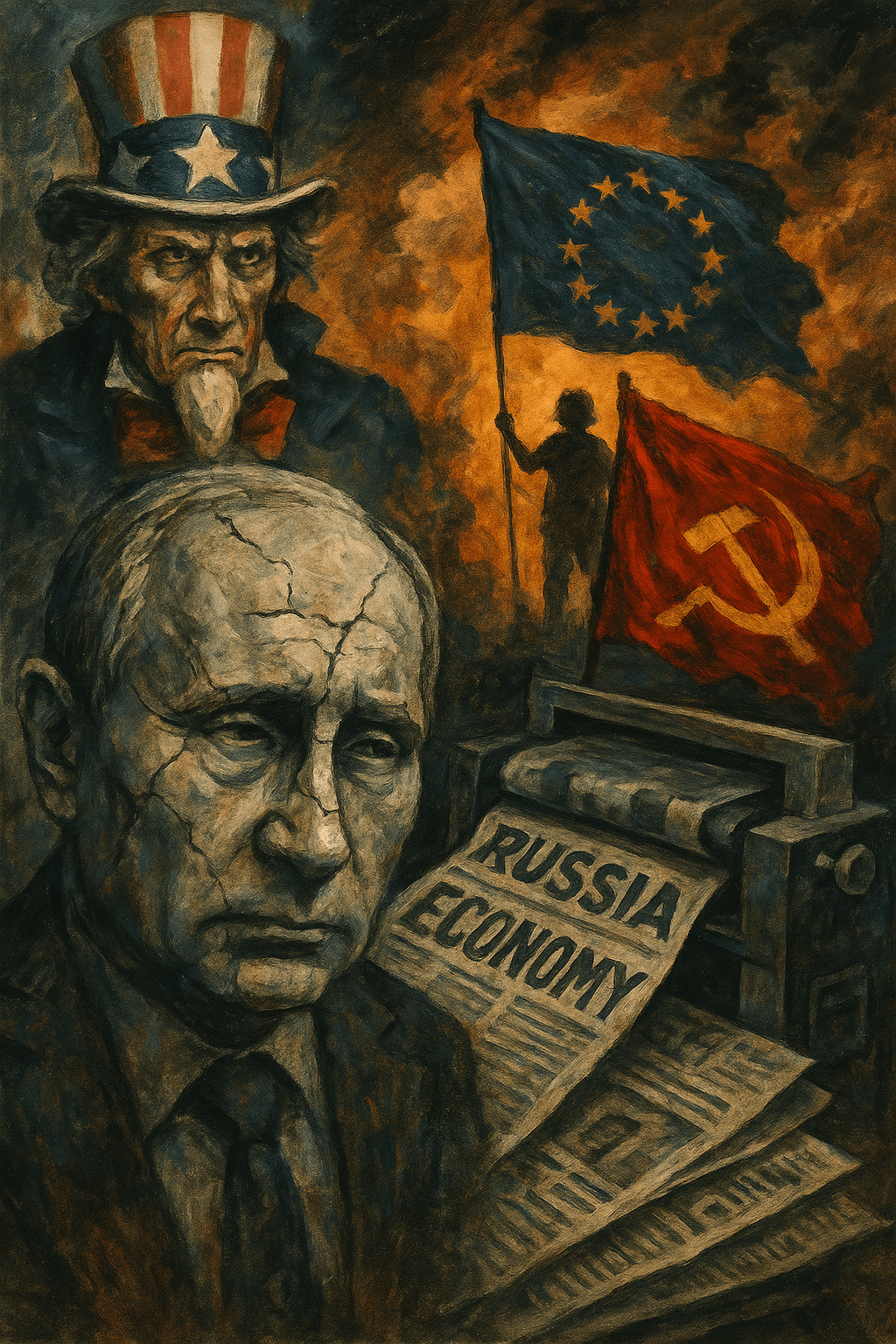
Brussels Isn’t Predicting Crisis in Moscow—It’s Manufacturing Consent for Its Own
By Prince Kapone | Weaponized Information | May 13, 2025
I. Reading Between the Ruins: How the Empire Writes Economic Fantasy
Jan Strupczewski is not some rogue freelancer misreading data in a Brussels café. He is the Deputy Bureau Chief of Reuters’ France and Benelux operation, stationed at the nerve center of the European Union. For two decades, he’s reported almost exclusively on EU economics, acting not as a watchdog but as a scribe of elite consensus. Before that, he sharpened his pen at Poland’s national TV news station before moving seamlessly into Reuters—now a core pillar of the imperialist media apparatus under the London Stock Exchange Group. Jan’s craft isn’t investigative rigor—it’s narrative stability. He’s been rewarded with three Reuters “Journalist of the Year” awards, all for stories that helped legitimize austerity, cushion the fallout from eurozone collapse, and sanitize EU policy. His background in literature—not economics—makes sense: his job isn’t to report reality, but to author it.
This most recent piece leans on the work of Torbjorn Becker of the Stockholm Institute of Transition Economics (SITE), who presented the report to EU finance ministers, and is backed in full by Valdis Dombrovskis, the European Commission’s Vice President and one of the continent’s chief austerity architects. Together, they form a coordinated messaging bloc to reassert narrative control over a conflict not going according to plan.
The SITE report—quoted uncritically by Reuters—argues that Russia’s economic data can’t be trusted, its inflation is higher than it admits, and its GDP growth is artificially inflated. But none of this is demonstrated with verified data—only speculative correlations and innuendo. Russia’s central bank interest rate is allegedly “too high” to match reported inflation, so the inflation must be wrong. No admission that high rates could also reflect wartime liquidity management or a proactive de-dollarization strategy. The rhetorical sleight of hand here is simple: Russia’s numbers don’t match Western models, therefore they’re false. It’s not analysis—it’s circular logic soaked in Cold War suspicion.
The article then suggests that Russia’s real fiscal deficit is “likely” twice what it reports because war spending is routed through state-aligned banks. But there’s no forensic accounting offered—just conjecture that war budgets must be bigger than the official numbers allow. This narrative moves from suggestion to certainty in three sentences, and by the time the reader hits the quote from Dombrovskis, the conclusion is treated as fact. That’s how cognitive warfare works—not through lies, but through orchestrated uncertainty weaponized into consensus.
And what is the function of this “economic fragility” storyline? It’s not to forecast collapse in Moscow—it’s to justify collapse in Brussels. The EU is preparing its populations for deeper war budgets, extended sanctions, and permanent austerity by insisting that the enemy is teetering on the edge. But the real instability lies at home: declining living standards, collapsing industrial output, and mass protest. In that context, the SITE report isn’t a warning—it’s a permission slip for escalation.
This isn’t journalism. It’s narrative management under conditions of imperialist decay. Reuters doesn’t challenge Becker’s framing because the goal isn’t truth—it’s alignment. Jan’s job isn’t to investigate whether the Russian economy is fragile. It’s to assure EU policymakers and Western investors that the war is working, that sanctions are biting, and that the whole house of cards won’t tumble before the next fiscal quarter. The article ends with no questions asked, no dissenting economists cited, and no reality acknowledged. Because reality—especially the resilience of economies outside the imperial core—is the one thing this system can’t afford to report.
II. Beneath the Narrative: What the Numbers Actually Say—and Don’t
Strip away the imperial spin, and we’re left with a few empirical bones. Russia reports a 3.6% GDP increase in 2023, followed by 4.3% in 2024—under conditions of total economic siege. It also reports an annual budget deficit of 2% of GDP. SITE and the EU Commission claim these numbers are unreliable, citing allegedly understated inflation and opaque war financing routed through the banking system. But even if we accept the report’s speculative logic, it still concedes that Russia’s macroeconomic framework has remained stable two years into total economic warfare. The question is not whether there are contradictions in the numbers—there always are in wartime economies—but what those numbers reveal when placed in the broader material context of the global system.
That broader context is one of multipolarity in motion. Russia has pivoted decisively away from the imperial core—diverting energy exports to China and India, shifting away from SWIFT, expanding BRICS+ settlements in yuan and rupees, and launching joint projects in Africa and Latin America. This isn’t “resilience” as a media buzzword—it’s anti-imperialist sovereignty in practice. And it’s not just about exports. Russia has used capital controls, domestic reinvestment schemes, and dual-currency reserves to weather one of the most aggressive sanction regimes in history. None of this is acknowledged in the SITE report, because none of it fits the script.
What’s also missing—utterly—is any comparison to the EU’s own structural fragility. Germany, the bloc’s industrial engine, is in de facto recession. French farmers are blockading highways. Belgian workers are striking over fuel costs. Italy faces record youth unemployment. And across the bloc, inflation remains stubborn, energy costs unstable, and political legitimacy in freefall. The eurozone’s supposed strength rests on debt-leveraged stagnation and NATO-backed discipline. If Russia’s 4.3% GDP is suspicious, what do we make of a eurozone that can’t break 1.2% despite being nominally at peace?
And the claim that Russia’s central bank policy rate “proves” inflation is understated? This deliberately ignores the fact that policy rates are not one-to-one reflections of inflation expectations. They’re political-economic tools. Russia’s rate hikes reflect strategic priorities: defending the ruble, preventing capital flight, suppressing speculative bubbles, and controlling war-era liquidity. Western central banks do the same, but with Wall Street whispering in their ears. To reduce monetary policy to a math error is not only dishonest—it’s colonial arrogance in technocratic dress.
SITE’s argument that “the fiscal stimulus of the war economy is unsustainable” mirrors old Cold War tropes used against Vietnam, Cuba, and even Roosevelt’s New Deal. But sustainability is not a number—it’s a relation of forces. And right now, the Global South is realigning those forces in ways that are undermining Western control over energy, logistics, finance, and political legitimacy. What’s unsustainable is not Moscow’s budget. What’s unsustainable is Brussels’ fantasy of empire without consequences.
III. Reframing Collapse: The Fantasy Is Brussels, Not Moscow
The SITE report—and Jan’s stenographic retelling of it—is not a window into the Russian economy. It’s a mirror reflecting the anxieties of the European ruling class. Because the real collapse they’re trying to mask isn’t across the border in Moscow—it’s inside the walls of Brussels. The Russian economy may be under pressure, but it has a political strategy, a financial alternative, and a growing network of multipolar trade partners. The European economy, by contrast, is a machine trapped in reverse: stagnant growth, declining industrial capacity, and an elite clinging to narratives it can no longer sell to its own population.
What terrifies the European Commission isn’t that Russia’s GDP numbers might be fake. It’s that they might be real. That despite sanctions, isolation, and war, a country outside their orbit is maintaining internal cohesion, expanding its international ties, and refusing to fold. That threatens not just policy—it threatens the entire epistemology of Western economic orthodoxy. It suggests there is life—and strategy—beyond the IMF, beyond the euro, beyond NATO.
In this context, SITE’s “analysis” functions as a form of cognitive warfare—an imperialist coping mechanism. It transforms contradictions in Russia’s economy into fatal flaws, while treating Europe’s structural decline as a technical hiccup. It pathologizes survival outside empire and normalizes collapse within it. It insists that opacity equals failure in Moscow, while opacity in EU budgets (e.g., off-books defense spending, shadow bailouts, energy subsidies) is just business as usual. The double standard isn’t accidental. It’s ideological.
From the standpoint of the global working class, the lesson is clear: the West isn’t collapsing because Russia is rising. It’s collapsing because it built its foundation on debt, war, and colonial extraction—and that model is breaking down. The real “fragility” is not Russia’s inflation—it’s the eurozone’s political legitimacy. The real opacity is not in Moscow’s banking system—it’s in the EU’s inability to explain to its people why food, fuel, and housing are becoming unaffordable while defense budgets balloon and NATO inches toward direct war.
Petro, speaking days earlier at the CELAC–China forum, offered a civilizational vision based on planetary cooperation and horizontal connectivity. The EU, meanwhile, offers spreadsheets, sanctions, and recycled Cold War mantras. One of these is the future. The other is the past, dressed up in think tank jargon. The real question isn’t whether Russia is hiding its collapse. It’s whether the West can admit its own.
IV. Mobilize the Truth: From Sanctions to Solidarity
If the SITE report is a script, our job is to flip the script. Not with counter-propaganda, but with revolutionary clarity. Because while Brussels fixates on phantom collapses in Moscow, workers from Marseilles to Munich are drowning in real ones: collapsing wages, soaring rents, shuttered factories, and the rising cost of staying alive. The real crisis isn’t economic misreporting in Russia—it’s the EU’s attempt to prop up a dying world order through war, austerity, and fear. And it’s time we said so, loudly and collectively.
The working class in Europe must not be seduced by narratives that blame a foreign economy for their suffering. These reports are not about understanding Russia—they’re about disciplining you. Justifying militarized budgets, digital surveillance, and wage repression. This is technofascist stabilization in real time: a regime of austerity, narrative control, and permanent war footing to preserve imperial cohesion while the ship takes on water.
Our first task is to expose the authors of this war narrative. Economists like Torbjorn Becker, bureaucrats like Valdis Dombrovskis, and journalists like Jan Strupczewski are not neutral figures. They are instruments of policy, functionaries of empire, scribes of managed perception. Call them what they are. Name them in forums, flyers, teach-ins, and street art. Let the people know who is managing the myths that keep the bombs falling and the prices rising.
Our second task is to build counterpower. Distribute people’s economic briefings that connect inflation to sanctions, food insecurity to fuel blockades, austerity to NATO’s war economy. Translate the contradictions in your own life into revolutionary consciousness. Host assemblies that link the propaganda of collapse with the collapse of propaganda. Connect with anti-war movements in Italy, Germany, and France—movements already confronting the material cost of the EU’s imperial recalibration.
Our third task is solidarity across borders. As Russia, China, and the Global South deepen anti-imperialist sovereignty through BRICS+ and South–South cooperation, we must forge connections from below. Build channels of digital education, labor exchange, and media between working-class movements inside and outside the imperial core. Reject the logic that we must fear nations resisting the West’s death grip. Recognize their survival not as a threat, but as a possibility.
Finally, let us reclaim the word “collapse.” The only collapse worth fearing is the one we allow to happen in silence: the collapse of memory, clarity, and revolutionary will. The empire is collapsing. Not with a bang—but with a narrative. Our task is not to believe it. Our task is to bury it—and build something that lives.
 Weaponized Information
Leave a comment