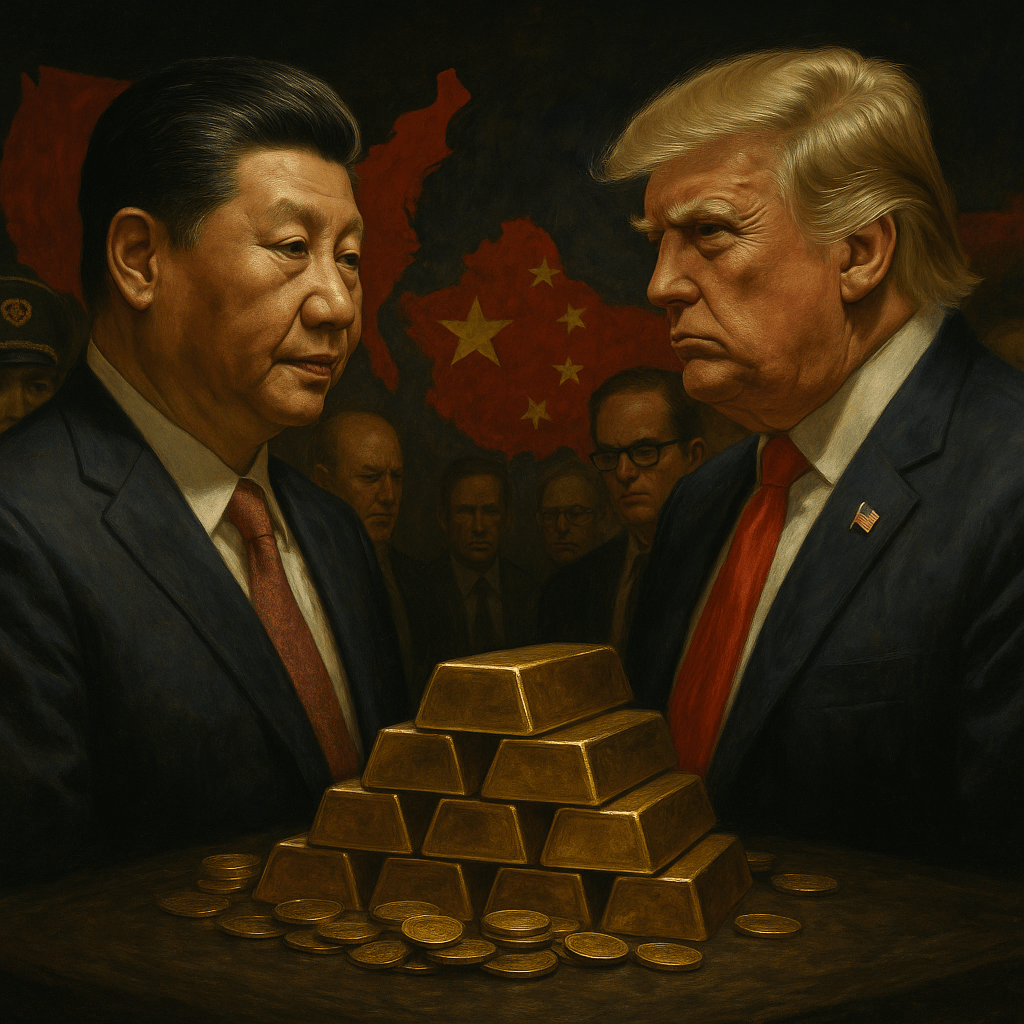
Behind the temporary pause in U.S.-China tariffs lies a desperate recalibration of imperial power—masking collapse with spectacle and turning the tools of economic nationalism into weapons of class discipline.
By Prince Kapone | Weaponized Information | May 12, 2025
CNBC as Counterinsurgency: Manufacturing Consent for Tariff Theater
This CNBC article, written by Kevin Breuninger, is not journalism. It’s PR for empire. It reads less like reporting and more like stenography with stock photos—a pre-chewed press statement passed off as analysis. Not once does it question the claims coming out of the Roosevelt Room. Not once does it verify whether China has actually “agreed to open up.” It simply echoes Trump’s words as gospel, expecting the reader to accept them as truth because they came wrapped in an American flag and delivered by a white man in a blue suit.
What’s being marketed here as a “breakthrough” is, in fact, a spectacle of imperial performance—cognitive warfare aimed at calming markets, confusing workers, and consolidating executive authority during a moment of intensifying global instability. Breuninger isn’t functioning as a reporter; he’s a middle manager in the ideological command chain of the imperialist media apparatus. His job is not to investigate power but to make it palatable. His words are a warm compress laid gently over the festering wound of American decline.
The characters at the center of this drama aren’t bureaucrats. They’re class war technicians. Scott Bessent, Trump’s Treasury Secretary, cut his teeth under the tutelage of George Soros—the vulture capitalist who eats foreclosed homes and calls it innovation. And Jamieson Greer, the U.S. Trade Representative, is a man who rotated out of Kirkland & Ellis—the legal armory of Wall Street—and into Boeing’s revolving door. These are not public servants. They are instruments of technofascist stabilization, strategically deployed to secure monopoly capital in a moment when the system itself is buckling under the weight of its contradictions.
Nowhere in the article is there any reference to the actual balance of forces on the world stage. There’s no mention of BRICS+, or of China’s strategic resilience as a socialist state operating within a hostile capitalist-imperialist world system. There is no contextualization of the broader crisis of supply chains, inflation, and imperial legitimacy that forced the United States into this temporary pause in the first place. Instead, we’re served a reheated Cold War fantasy in which the U.S. dictates terms and the rest of the world nods along. It’s laughable—but the laugh catches in your throat when you remember how many people are being economically strangled by this lie.
The article refers to the 90-day tariff suspension like it’s the Treaty of Versailles. In reality, it’s a tactical timeout—a moment for the empire to catch its breath as it tries to reorganize production, relocate dependency, and reimpose wage discipline. It’s not about trade. It’s about power. And what CNBC refuses to say outright is that this isn’t a victory. It’s a retreat disguised as resolve—a recalibration of empire, not a triumph of diplomacy. This is how imperialist recalibration looks in practice: not through peace treaties and multilateral consensus, but through fire-sale negotiations behind closed doors, dressed up in the language of stability for a public kept too exhausted to ask questions.
Breuninger mentions the fentanyl-linked tariffs and selective exemptions for sectors like steel and aluminum, but gives them no analytical weight. He doesn’t connect them to the ongoing war being waged against China’s sovereignty through the language of “illegal substances” and “national security”—both weapons in the arsenal of lawfare and cognitive warfare. These carve-outs are not policy details; they are pressure points. They show where the empire still hopes to leverage instability, where it believes it can extract concessions not through cooperation but through siege.
Perhaps most galling is the complete erasure of class. There is no mention of what these tariff fluctuations mean for workers on either side of the Pacific. No acknowledgment that U.S. labor is being crushed between inflation and stagnating wages, or that Chinese workers are the target of an imperialist squeeze designed to undermine one of the last major socialist economies on earth. The CNBC article portrays trade as a zero-sum chess match between two great powers. In truth, it’s a grindstone—grinding the working classes of both nations down while capital carves out new paths for domination.
This is the function of media under technofascism. It does not report—it disciplines. It does not inform—it inoculates. What we’re watching is not just bad journalism; it’s counterinsurgency through copywriting. It’s a textbook case of propaganda—a soft war on consciousness meant to stabilize a crumbling empire through myth, distraction, and the careful omission of anything that smells like material truth.
What the Truce Hides: Class War in a Different Uniform
The CNBC article dutifully parrots a few statistics: U.S. tariffs drop from 145% to 30%, China’s from 125% to 10%. Some tariffs remain—steel, aluminum, and so-called fentanyl-linked goods are still under pressure. There’s talk of “non-tariff barriers” being lifted, but no specifics. In capitalist journalism, vagueness is strategy. When the empire doesn’t know what it’s doing, its media just shrugs and calls it “negotiation.”
But here’s what it won’t tell you: the U.S. global supply chain was never built for prosperity. It was built for neocolonial extraction—to vacuum value from the Global South while isolating U.S. capital from domestic labor insurgency. The whole architecture was designed not to benefit working people but to discipline them: to move production offshore, gut unions, and turn industrial cities into opioid graveyards. That’s not a bug. That’s the blueprint.
Now the machine is seizing up. Container ships backlogged, semiconductors disrupted, inflation spiraling, the dollar being challenged from Shanghai to São Paulo. And so the empire pivots—not to rebuild, but to reposition. This tariff truce isn’t a peace offering. It’s a pressure valve. A 90-day reset to recalibrate the empire’s instruments of control, both abroad and at home. This is the choreography of imperialist recalibration—a pause not to heal contradictions, but to reformat them.
Meanwhile, China stands accused of “conceding” and “agreeing to open up.” But what exactly did it concede? The article offers nothing. That’s because China hasn’t capitulated—it’s maneuvering. Unlike the U.S., China still possesses state planning capacity, industrial sovereignty, and long-term development goals rooted in its socialist economic structure. It operates within a world system rigged against it, yes—but it does so without surrendering the commanding heights of its economy to imperialist monopolies. This is not “state capitalism.” This is survival under siege.
There is no acknowledgment that the U.S. initiated these tariffs in the first place—not for fairness, but for leverage. Tariffs have never been about justice. They are siege weapons in the arsenal of hyper-imperialism, used to extract concessions from sovereign economies that refuse to kneel. And in this moment, they’re also being used to manufacture the illusion of national rebirth—to convince a hollowed-out domestic workforce that empire is still strong, still sovereign, still capable of controlling the game. It isn’t. But it still controls the camera.
That’s why the “pause” is so important. It buys time. Not for diplomacy, but for consolidation. It allows U.S. capital to shore up monopolies, deepen its grip over domestic production zones, and fine-tune its digital enforcement infrastructure. Technofascist labor recalibration is the name of the game—rolling out AI-managed gig work, biometric tracking, and surveillance-enforced productivity to bring U.S. workers into alignment with the hyper-exploited labor conditions their bosses once outsourced abroad. The goal isn’t to revive industry. It’s to impose global South conditions inside the empire itself—without giving up the aesthetic of “America First.”
This is the sleight of hand: make it look like patriotism, feel like nationalism, and function like austerity. The “tariff truce” is not an act of peace—it’s an imperial adjustment, necessary because the old tools of domination are breaking down. This isn’t the end of globalization. It’s its mutation. Globalization 2.0 is being forged behind firewalls, wrapped in flags, and deployed as class war in a different uniform.
This Isn’t De-escalation—It’s Domestic Counterinsurgency
Let’s call this what it is: not a step toward peace, but a new formation of war. Not a trade agreement, but a tactical maneuver in the long game of technofascist stabilization. The so-called “tariff truce” has nothing to do with mutual respect, cooperation, or economic sovereignty. It’s not a negotiation between equals. It’s a pause—engineered by U.S. capital—to regroup, reframe, and repress.
The CNBC article floats this as stability. But to whom? For working-class families squeezed between rent hikes and food inflation, this is no truce. For global South producers locked out of capital markets by the U.S. sanctions regime, this is no opening. For Chinese planners managing national development under siege, this is not an olive branch. The only thing stabilized here is monopoly control.
This is not a break in globalization—it’s a reboot. The U.S. isn’t retreating from the global stage; it’s fortifying it. The state is building tariff walls not to protect workers, but to give breathing room to its flagship monopolies: Apple, Tesla, BlackRock, and the rest of the digital aristocracy. These aren’t casualties of the trade war—they are its generals. And their goal is simple: restructure supply chains to concentrate profit, discipline labor, and eliminate resistance before it emerges.
This is the deep structure of technofascism: a fusion of state, monopoly capital, and digital enforcement mechanisms designed to preempt class revolt. It speaks the language of “national interest” while delivering the spoils of war to capital. It waves the flag, then sends in algorithms and biometric ID scanners to enforce productivity quotas. It promises jobs, then replaces them with gig platforms and deportation raids. It tells white workers they’re being protected—while lowering the floor of labor conditions across the board.
Trade war, in this context, is not an alternative to globalization—it’s how empire manages its own decline. It’s how the ruling class buys time. It’s how they transform public confusion into private consolidation. The old neoliberal tools—free trade, WTO arbitration, investment treaties—no longer carry enough force. Now they need tariffs, sanctions, financial blockades, and digital policing to hold the line. And they call it policy.
Here’s the truth they won’t print: the real war is not between the United States and China. It’s between capital and labor. It’s between the monopoly core and the oppressed periphery. It’s between a decaying empire grasping for control, and a world increasingly unwilling to kneel. Whether you’re a dockworker in Long Beach or a rice farmer in Guangxi, the struggle isn’t national. It’s systemic. It’s global. It’s class war in the clothes of commerce.
And the media’s job is to disguise it. To make technofascist warfare look like economic diplomacy. To convince you that your suffering is strategic. That inflation is temporary. That rising prices are the fault of China, not the very monopolies whose record profits never seem to trickle down. This is what cognitive warfare looks like in the imperial core: distraction, misdirection, and the slow erasure of alternatives.
So no—this isn’t de-escalation. This is domestication. This is the empire turning inward, reinforcing itself against its own working class while projecting strength outward to hide its internal rot. This is the algorithmic management of imperial decline, masked in the language of strength. And unless we tear off the mask, we’re going to keep getting choked by a system that insists it’s just giving us a hug.
From Spectacle to Struggle: Organizing Beyond the Tariff Smokescreen
If the first three sections of this imperial puppet show are designed to confuse, disorient, and pacify, then our task is clear: rip the mask off the empire and organize against its next phase of domination. Because while CNBC tells us this is about stability, and Trump tells us it’s about sovereignty, and Wall Street tells us it’s about growth, we know the truth. It’s about control. It’s about recolonizing labor, resetting capital, and repressing any force that dares stand in the way of profit.
But we’re not starting from scratch. History’s on our side, even if the media isn’t. We’ve seen this strategy before: during NAFTA, during the WTO protests, during the offshoring bloodbath that gutted the Midwest and flooded the Global South with sweatshops. Every time the U.S. working class got restless, empire threw it a bone wrapped in a flag—and kicked it back in line. Now they’re doing it again. Only this time, the repression’s digital, the police are algorithmic, and the factories don’t come back—they come with surveillance drones and union-busting AI.
So what do we do?
1. Build Ideological Unity Across Borders
We reject both neoliberal globalization and its technofascist reboot. We unite with the anti-imperialist sovereignty of nations resisting U.S. domination—China, Cuba, Venezuela, the Sahel insurgencies, the BRICS+ bloc. These are not our enemies. They are fellow targets of empire, fighting to breathe outside the grip of the dollar, the drone, and the debt trap. We must say it clearly: the enemy is not China—it’s the system trying to starve, exploit, and deceive us all.
2. Practice Material Solidarity, Not Symbolic Posturing
That means more than hashtags and hot takes. It means studying past struggles—the Black labor revolts, the resistance to the Bracero Program, the mass uprisings against NAFTA and GATT. It means reconnecting with the radical memory that empire worked so hard to erase. And it means building bridges between U.S. workers organizing for better contracts and Global South movements resisting economic occupation. From Amazon warehouses in Alabama to copper mines in Zambia, we are part of one global struggle—even if our chains look different.
3. Turn Education Into Organization
Host teach-ins that break down what tariffs really mean: rent hikes, grocery price surges, and union-busting disguised as patriotism. Launch local campaigns that name the real beneficiaries of these deals—Apple, BlackRock, Boeing—and explain how “economic nationalism” is just monopoly capitalism with a red-white-and-blue paint job. Use every platform available—social media, churches, community centers, shop floors—to make this war legible. Because if people can’t name what’s happening, they can’t fight it.
4. Build Dual and Contending Power
We don’t win by voting for better managers of empire. We win by building autonomous institutions that serve our people, protect our labor, and speak our truths. That means worker committees, community mutual aid structures, political education hubs, tenant unions, tech cooperatives, and revolutionary media that expose the lies of corporate news. It means constructing new organs of power rooted in the needs of the people—not the algorithms of capital.
5. Seize the Digital Frontlines
We must fight cognitive warfare with proletarian cyber resistance. That means building secure, independent communications, popularizing counter-narratives, and learning to sabotage the digital command centers of imperial disinformation. The media war is real. And we’re losing it unless we step up. Weaponized Information is just one tool in this fight. We need thousands more.
This article began with a lie—Trump’s lie, CNBC’s lie, the lie that tariffs are about sovereignty. But it ends with a truth: the world is breaking out of unipolar empire, and the ruling class is terrified. The trade war is their way of buying time. The truce is their way of dressing up fear as strength. Let’s not waste another minute explaining or analyzing their panic. Let’s organize its defeat.
Because this isn’t just about tariffs. It’s about the future. And the future doesn’t belong to technocrats or trillionaires. It belongs to us.
 Weaponized Information
Leave a comment