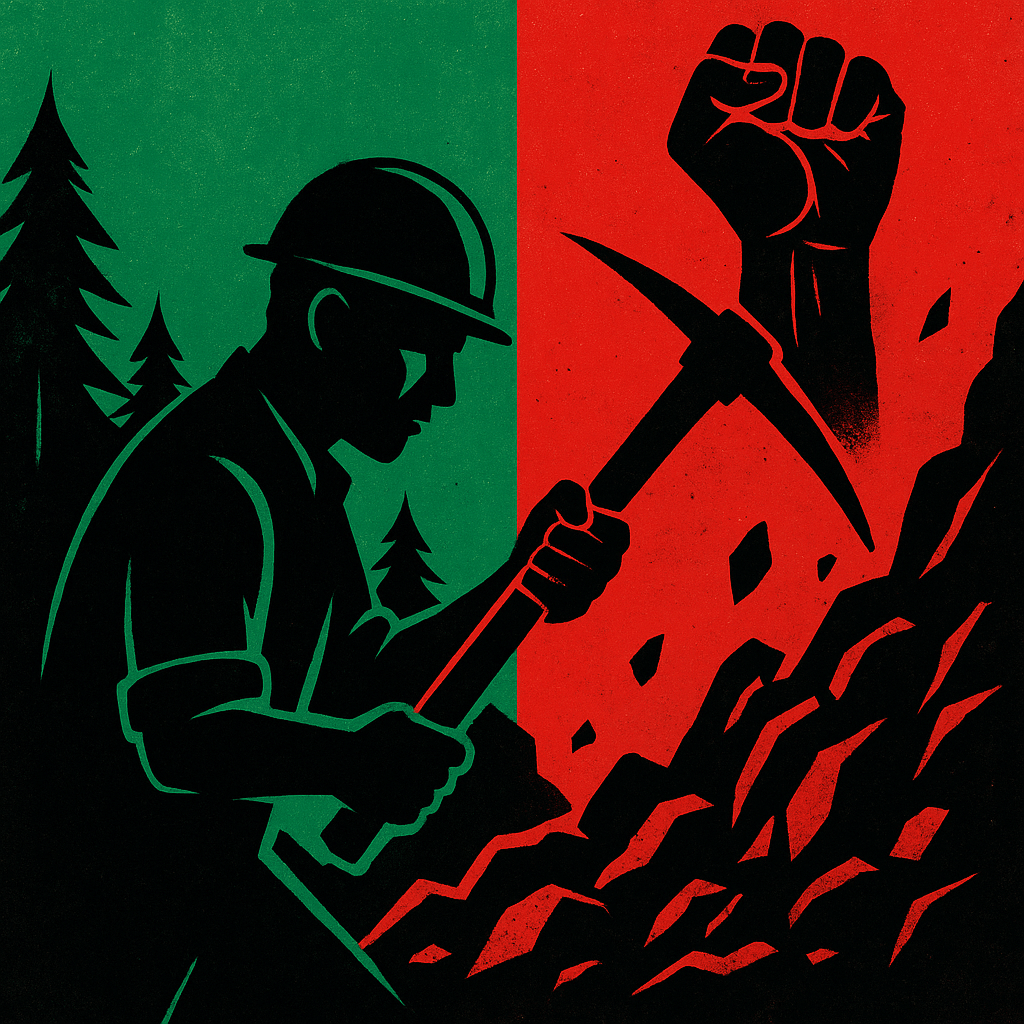
From climate slogans to cobalt slavery, the West’s “green revolution” is powered by colonial extraction and imperialist propaganda.
By Prince Kapone | Weaponized Information | May 10, 2025
The Imperialist Media Apparatus Paints the Mines Green
The Telegraph article that triggered this excavation is signed by a salaried propagandist of the British bourgeoisie. Let’s be clear: this is not journalism—it’s a narrative function of the imperialist media apparatus. The author serves capital with clean copy and a quiet conscience. They do not investigate power, they translate it. In this case, the task was to make Western tech’s dependence on Congolese blood minerals seem like an unfortunate, but manageable hiccup on the way to a climate-conscious utopia. The writing is fluent, professional, and deadly. Nowhere does it question the class structure that underpins the so-called “green revolution.” Nowhere does it name empire.
The Telegraph itself is not some plucky, independent voice of British conservatism. It is an appendage of financial capital. Owned by hedge fund and private equity interests with deep ties to the UK’s post-Thatcher class of oligarchs, the paper exists to reproduce the ideological architecture of the City of London. Its coverage of Congo—like its coverage of Ukraine, Gaza, Venezuela, or Sudan—serves a specific role: to launder imperial plunder through technocratic language. It doesn’t lie. It reframes. It presents neocolonial extraction as logistics, mass death as instability, and Western complicity as unfortunate complexity.
Whose hands are hidden in this article? Let’s name them plainly. Glencore, the Swiss-based mining conglomerate with a long history of operating in war zones and bribing officials, maintains major stakes in Congolese cobalt. Tesla and Volkswagen, eager to scale battery production, source lithium and cobalt through murky intermediaries. Apple and Samsung are no less implicated—child labor and militia-linked sourcing have plagued their supply chains for years. The World Bank continues to finance “mining reforms” that benefit foreign firms, not Congolese workers. And the IMF now bundles climate loans with structural adjustment policies that entrench dispossession. That’s the modern supply chain: NGOs on the front end, mercenaries and IMF technocrats on the backend. And at every node, profit.
The Telegraph’s story, like so many others, invokes “chaos” in the Congo as a kind of natural condition. It fixates on “instability,” “insecurity,” and “violence”—but never asks what created it. There is no mention of the 1996 U.S.-backed overthrow of Mobutu. No analysis of the $24 trillion in mineral wealth that has made the DRC a target of every imperial actor from Belgium to BlackRock. No historical accounting of Belgian genocide under King Leopold, or the long shadow of Cold War counterinsurgency that liquidated Patrice Lumumba and installed compliant comprador regimes. Instead, we get a disembodied narrative where disorder floats freely, unattached to political economy or imperial strategy.
This framing is not accidental—it is strategic. By presenting the Congo’s suffering as internal, tribal, or administrative, the article enables the West to pose as both savior and consumer. The Congolese become either corrupt administrators or helpless victims. Western actors, by contrast, are depicted as environmentally concerned stakeholders, awkwardly navigating difficult supply chains. This is cognitive warfare in its rawest form: the weaponized construction of ignorance. The reader is trained to see a “global challenge,” not a capitalist crime scene. They are told that more regulation is needed, not less extraction.
But the violence is not incidental to the supply chain—it is the supply chain. Cobalt doesn’t move itself. It is mined by child laborers, in pits controlled by militias, under contracts signed in Geneva, financed in New York, and regulated in Brussels. Every EV battery contains a fingerprint, and that fingerprint belongs to empire. This is necro-extractivism: the process of pulling life from the ground and death from the living, all in service of a system that cannot survive without consuming the bodies of the poor.
The article never once mentions ESG funds or the carbon offset market, where mining corporations greenwash their image by buying paper “credits” to erase real-world violence. Nor does it question why the transition to clean energy must follow the same colonial logistics that powered rubber, copper, and gold extraction for over a century. There is no structural break here—only a branding update. The same corporations that once built empires on enslaved labor and looted ore are now building “climate resilience” on the backs of ten-year-olds choking on dust.
This is how empire adapts. As fossil capital enters crisis, it doesn’t surrender—it recalibrates. The mining corridor becomes the green corridor. The settler-colonial infrastructure of plunder is not dismantled—it is digitized, legalized, and sanitized. From Congo to Bolivia, from Afghanistan to Argentina, we are witnessing an imperialist recalibration—a shift from extractive dependency under fossil capitalism to extractive dependency under green capitalism. But the logic remains the same: control the resources, discipline the workers, and extract the profit.
And the role of the media is clear. The journalist who wrote this story is not evil. But they are not innocent either. They are part of the ideological production line that turns corpses into data points, supply chains into moral dilemmas, and genocide into economic development. Their words help stabilize the narrative. Their omission is a kind of consent. They do not hold a rifle, but they do hold the pen that hides the bullet.
So when the Telegraph warns of “challenges” in Congo’s path to a net-zero future, we should recognize the deception. This is not a development problem. It is a plunder operation—rebranded for liberal palates and carbon-conscious investors. It is the same imperial death drive, now wearing a green mask. The mines are still full of bodies. The markets are still full of blood. And the empire is still cashing in.
From Shattered Villages to Silicon Valley: Mining Death in the Age of Decarbonization
Strip away the propaganda, and the core fact remains: the Democratic Republic of the Congo sits atop the largest known reserves of cobalt on Earth—an estimated 70% of global supply. Cobalt is an essential component in lithium-ion batteries used in electric vehicles, smartphones, and energy storage systems. Without Congolese cobalt, the West’s “green transition” grinds to a halt. The Telegraph acknowledges this, but without naming the cost: children digging tunnels with their bare hands; villagers displaced by mining concessions; militias controlling artisanal mining zones with the quiet approval of transnational capital. These aren’t unfortunate side effects. They are the logistical prerequisites of an empire in ecological crisis.
The article correctly identifies an increase in demand for cobalt as a result of climate targets set by the U.S. and EU. What it does not mention is that this demand has intensified a violent scramble in the Congo—one that mirrors the “resource wars” of the 1990s, but under the banner of sustainability. The world’s most dispossessed people are once again being conscripted into empire’s development scheme—not as beneficiaries, but as casualties. This is the material reality of necro-extractivism: an imperial process that feeds on death to create capital, cloaked now in the green costume of ecological concern.
What the article conceals is the broader system that links these violent extraction zones to Silicon Valley, Wall Street, and Brussels. These are not rogue operations run by isolated warlords. The mining sector in the DRC is dominated by firms like Glencore, whose operations reflect classic hyper-imperialist extraction, operating through offshore holdings and commodity futures markets to supply Western tech monopolies with cobalt and lithium. Alongside them are Chinese firms like China Molybdenum and Zijin Mining, which—though engaged in resource extraction—function within a fundamentally different framework: state-backed infrastructure-for-resources agreements, not imperial looting. While contradictions and abuses do exist, they are subject to PRC oversight and do not serve the same settler-capitalist system. Western firms extract to dominate. Chinese firms extract to build—a difference the empire works overtime to obscure.
The overwhelming majority of the cobalt extracted in the Congo is exported unprocessed. This is not accidental—it is structural. The DRC, though rich in minerals, has been kept in a state of enforced underdevelopment. As Walter Rodney made clear, colonialism doesn’t just steal resources—it actively prevents development so that extraction can remain cheap, violent, and externalized. This is the enduring colonial contradiction: the land is rich, the people are poor, and every attempt to reverse this is met with repression, destabilization, or economic sabotage.
The so-called “artisanal” mining sector is often invoked to suggest informality and chaos. But this too is propaganda. Artisanal mining—often a euphemism for child labor and unregulated digging—is an integral part of the global supply chain. It provides cover for corporate actors to distance themselves from direct exploitation while reaping its rewards. These zones are frequently controlled by armed groups who charge fees for access, collect rents, and enforce compliance. Many are backed, directly or indirectly, by local political elites and transnational fixers. It is a colonial-style concession system updated for the globalized age.
What’s absent from the Telegraph article—and from nearly all corporate media coverage—is any mention of how these patterns relate to the broader imperialist recalibration now underway. As fossil capitalism begins to erode under the weight of ecological crisis and diminishing returns, the empire is pivoting—not toward justice, but toward a different form of domination. Lithium, cobalt, and rare earth minerals are the new oil. And control over their extraction, transport, and refinement has become a central axis of 21st-century imperial competition. The U.S., EU, and G7 are all rushing to secure supply chains, not because they care about sustainability, but because they fear losing control to China, BRICS+, and emerging multipolar blocs.
In this context, the Congo is not a failed state. It is a successfully looted one. A state sculpted and disciplined by empire to function as an open vein—bled out through trade agreements, debt obligations, and militarized logistics. The article makes no mention of the World Bank’s decades of “infrastructure support” that built roads for mines but none for hospitals. It says nothing about the $10 billion lawsuit against Apple, Tesla, and Dell for child labor-related deaths. It ignores how Western governments use aid and military partnerships to preserve elite control over the mining zones. The silence is not incidental. It is ideological.
The use of “net-zero” as a moral framework is perhaps the most insidious part of this propaganda ecosystem. Climate concern becomes a justification for continued extraction. Emissions reductions are decoupled from justice. Carbon offsets replace reparations. And the green transition becomes, in effect, a hyper-imperialist strategy: a way for the Global North to sustain its overconsumption while outsourcing both the labor and the suffering. Congo is not transitioning. It is being transitioned—by force, by finance, and by lies.
And while the Telegraph won’t say it, we must: what is happening in the Congo is not accidental. It is not chaotic. It is not a regrettable side effect. It is policy. It is imperial design. It is the logical outcome of a system that treats the earth as dead matter and the colonized as fuel. Until this system is named and dismantled, there will be no justice—only battery-powered genocide.
Green Capitalism Is Still Capitalism: Congo’s Liberation Is the Only Just Transition
Let’s make it plain: there is no such thing as a just transition built on extraction. Not when the hands digging the cobalt are brown and bleeding. Not when the wealth still flows upward to tech billionaires while Congolese families are crushed under open-pit mines. What the West calls a “green future” is, for the Global South, just another variation of the same colonial script: loot the land, disappear the people, and call it development. It is not a deviation from capitalism—it is its logical next stage. Green capitalism is still capitalism, and its foundation is the same: imperial plunder enforced by militarized logistics and laundered through propaganda.
The solution is not better oversight, nor more ethical supply chains. It’s not “cleaner” mining or digital traceability platforms owned by the same corporations profiting from death. The only real solution begins with anti-imperialist sovereignty: the right of the Congolese people to control their land, their labor, and the wealth they produce. That means the expulsion of foreign mining firms. The nationalization of natural resources under public and democratic control. The reinvestment of that wealth into housing, health, education, and ecological repair—not into European stock portfolios and Silicon Valley patents.
We are told the problem is “lack of governance.” But Congo has been governed—for over a century—by imperial interests. From King Leopold to Glencore, from Belgian slave drivers to IMF technocrats, the nation has never lacked rulers. It has lacked liberation. And until that changes, every battery branded “clean” will be soaked in blood. The “net-zero” fantasy offered by the West is a bait-and-switch: a promise of decarbonization that never questions the power structures that caused the crisis. In place of fossil fuels, we now have lithium and cobalt. But the logic is the same. Extract, exploit, export. From colony to climate client, the Global South is always the sacrifice zone.
A real transition—one rooted in justice—would not reproduce the colonial division of labor. It would abolish it. It would mean degrowth for the imperial core, not new markets for electric SUVs. It would mean reparations, not carbon credits. It would mean the expropriation of green capital, not its subsidization. And it would require what we call revolutionary rupture: the dismantling of imperial power, not its rebranding. Because there is no sustainable empire. There is no ethical genocide.
Congo doesn’t need NGOs handing out solar lanterns. It needs land reform, demilitarization, and the right to develop outside the chokehold of Western banks. It needs schools instead of mines, tractors instead of helicopters, soil regeneration instead of hedge fund–backed ESG initiatives. And it needs solidarity—not pity, not charity, but political alignment with every movement worldwide that seeks to break the chains of hyper-imperialism and build a new world from the soil up.
The contradiction today is not between growth and sustainability—it’s between empire and humanity. Congo is not a site of environmental tragedy. It is a frontline in the global war for liberation. The children choking in cobalt dust are not victims of “supply chain failure.” They are casualties of the most advanced capitalist economy in human history. And the only transition worth fighting for is one that centers them—not as data points, not as sob stories, but as political agents in the struggle to reclaim the Earth itself.
The green mask is slipping. The liberal veneer is cracking. And underneath it all is the same old engine: capitalist accumulation through colonial violence. The only question now is whether we will let it run, or whether we will grind it to a halt—and build something human in its place.
Reparations, Not Carbon Credits: Toward Dual Power in the Belly of the Green Beast
There is no reforming this system. You cannot audit your way out of imperialism. You cannot decarbonize genocide. What’s happening in the Congo is not a policy error—it’s a class war, waged by finance capital against the African people. And it will not be ended by ESG consultants or net-zero declarations. It will be ended by struggle—organized, principled, and materially grounded in the interests of the oppressed.
We declare ideological unity with every Congolese movement fighting to reclaim the land from imperial plunder. From community cooperatives resisting forced displacement in Kolwezi, to youth formations exposing the role of foreign companies in labor trafficking, to pan-African militants articulating a vision of anti-imperialist sovereignty from Kinshasa to Bamako—these are not fragmented resistances. They are the frontlines of a world-historic battle for liberation. Their struggle is not local. It is planetary.
And those of us in the imperial core have responsibilities. Not to speak for the colonized—but to sabotage the machine that devours them. That means building campaigns to expose and disrupt Western firms profiting off Congolese blood. Target Tesla, Apple, Glencore, and every investment fund underwriting their operations. Disrupt their meetings. Expose their executives. Follow the money. And burn the myth of ethical mining to the ground. It means calling out universities and foundations invested in “green funds” built on necro-extractivism. It means naming and confronting the NGOs laundering this system through “development partnerships.”
We also call for the expansion of dual and contending power inside our own communities—institutions that do not depend on, or collaborate with, imperial resource regimes. This means building mutual aid infrastructure rooted in ecological repair, not donor dependency. It means politicizing climate organizing so it doesn’t become a lobbying wing for green capital. It means training revolutionaries who understand that there is no “green” without red: no sustainability without socialism, no ecology without expropriation.
Concrete tactics include:
- Expose ESG fraud: Publish independent research tracing cobalt, lithium, and nickel supply chains from Congo to final products. Name the companies, the financiers, and the politicians protecting them.
- Launch solidarity campaigns: Fundraise directly for Congolese resistance organizations—not NGOs, but mass-based movements resisting land grabs and resource theft.
- Proletarian cyber resistance: Use digital tools to disrupt the PR operations of greenwashing firms. Dox corporate actors. Jam supply chain software platforms. Leak documents.
- Popular education: Build curricula that teach the ecological consequences of imperialism—not abstract climate change, but concrete climate violence imposed on the colonized.
- Organize militant internationalism: Link Congo’s struggle to other extraction zones—from the lithium triangle in Latin America to uranium mining in Niger. This is one battle, fought on many fronts.
The Congolese people do not need sympathy. They need solidarity. They do not need more exposés. They need accomplices. The mines will not be shut down by policy memos. They will be shut down by revolutionary rupture. And we must be part of that rupture—not as saviors, but as comrades in a shared war against empire.
Let us remember: cobalt may power their devices, but it fuels our resistance. Every ounce of blood they shed to electrify their world is another reason to dismantle it. Empire painted the mines green. We see the red beneath. And we know which side we stand on.
 Weaponized Information
Leave a comment