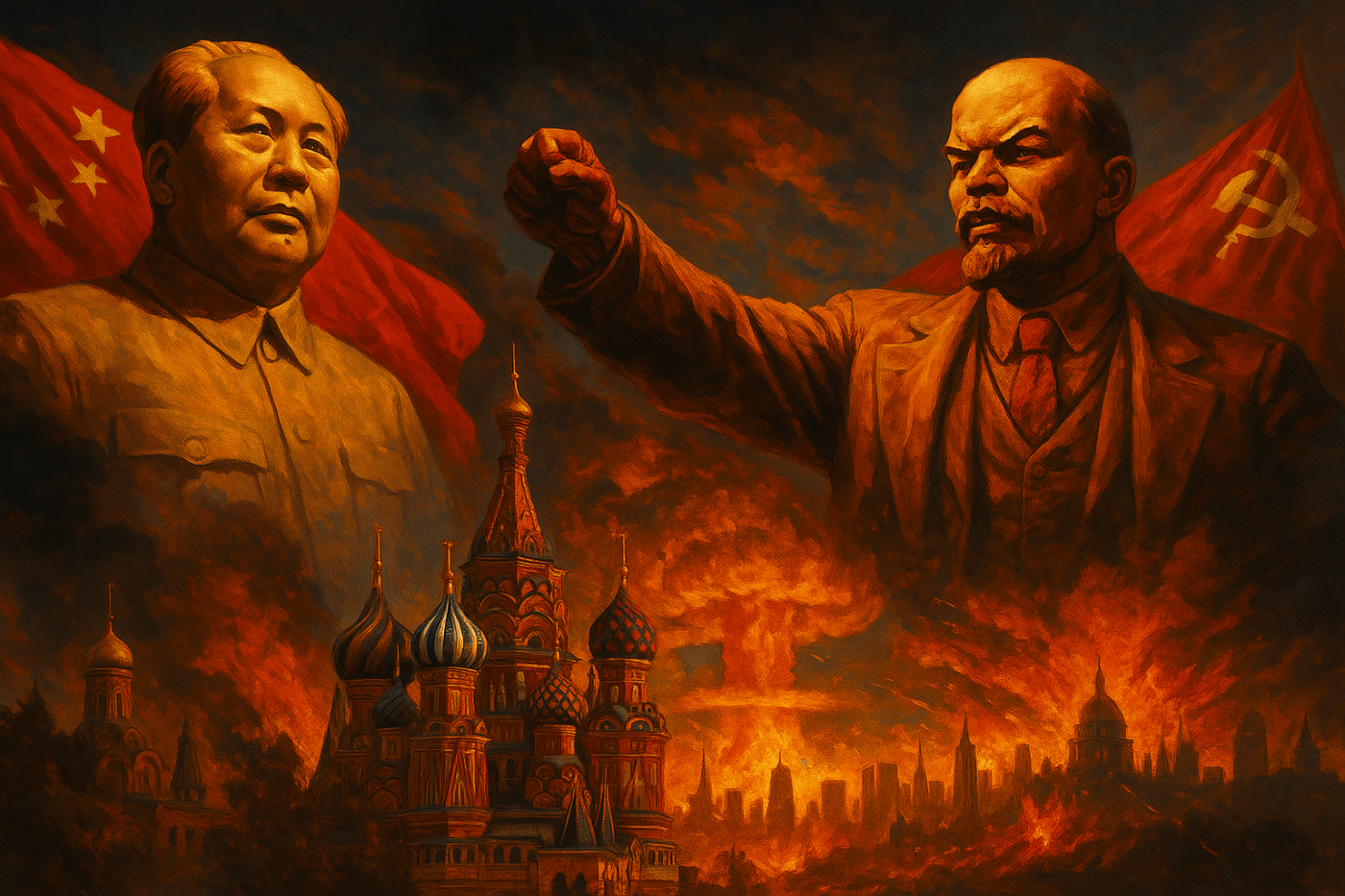
As the empire claws to preserve unipolarity, a strategic alliance rooted in sovereignty, multipolarity, and revolutionary memory charts a new global direction
By Prince Kapone | Weaponized Information | May 8, 2025
The View from the Ruins of Empire
In a world cracking under the weight of its own hypocrisy, two men meet not as tyrants, but as survivors—survivors of a system that has looted, bombed, sanctioned, and sabotaged them for decades. Xi Jinping and Vladimir Putin, standing shoulder to shoulder in Moscow’s Grand Kremlin Palace, didn’t just exchange pleasantries. They threw down a gauntlet. And the imperial press—led in this case by The Washington Post—immediately scrambled to pick it up, wipe it off, and return it to the Beltway with a sigh of moral disappointment.
The article in question bears no byline—it emerges from the machinery of U.S. consensus, likely shaped by national security editors and Cold War veterans posing as objective journalists. It’s produced by one of the flagship outlets of the imperialist media apparatus: WaPo, owned by Amazon’s Jeff Bezos, whose contracts with the Pentagon and CIA are as large as the egos of those who write under his payroll. The beneficiary of this narrative? The transatlantic ruling class whose authority is crumbling faster than the bridges in Flint, Michigan.
This isn’t journalism. It’s a eulogy for a dying empire.
What the article paints as an “authoritarian alliance” is actually a sober, historically grounded declaration of multipolar solidarity. Xi and Putin didn’t just shake hands—they signed a joint statement that called out the Golden Dome missile shield for what it is: a blueprint for strategic hegemony cloaked in the language of defense. They condemned “unilateral restrictive measures,” better known to the rest of the world as economic warfare, sanctions, and financial piracy. They pledged to resist the U.S.’s “dual containment” doctrine, which is just neocolonial-speak for divide and dominate.
The Post, of course, doesn’t quote the full joint declaration. It doesn’t examine the historical echoes of this meeting—how the Red Army and the PLA once fought fascism in tandem, or how Victory Day isn’t just a parade, but a living memory of resistance. No, the article sidesteps all of that to remind you that China’s trade “supports Russia’s war machine.” But what supports the U.S. war machine? The petrodollar? The sweat of Amazon workers? The taxes siphoned from your paycheck to fund endless drone wars and forever bases?
We are told that the U.S. is trying to “break Russia and China apart,” as if that’s a noble objective. What it really is—by the admission of its own imperial planners—is a desperate gambit to preserve a collapsing unipolar order. Trump, Rubio, Kellogg—they’re not diplomats. They’re crisis managers for a global empire in freefall.
And then comes the cognitive warfare. Terms like “neo-Nazism” are dismissed as Kremlin propaganda, while NATO’s support for Ukrainian Azov brigades is quietly omitted. Xi’s speech about multipolar cooperation is reduced to vague platitudes, while every Chinese move is framed as sinister duplicity. The Western press reads Chinese diplomacy like it reads the Quran—selectively, with suspicion, and always through the lens of its own guilt.
This isn’t just about China and Russia. It’s about the right of any people to exist outside the reach of Wall Street, Silicon Valley, and Langley. It’s about sovereignty. It’s about the colonial contradiction coming home to roost.
So when Xi and Putin call each other “dear friends,” don’t laugh. Listen. The empire hears it, and it’s terrified.
Part II: Strategic Stability in the Age of Decay
Take off the NATO goggles and clear the fog of Pentagon press releases, and what you’ll see is this: the Xi-Putin meeting wasn’t a villainous power huddle. It was a sober confrontation with the unraveling of U.S. supremacy. Through the din of Western slander, the joint statement from China and Russia reads not as provocation, but as a demand: respect sovereignty or brace for the world’s revolt.
Let’s ground ourselves in the material. China and Russia jointly condemned unilateral sanctions, the expansion of military blocs, and the so-called “Golden Dome” project—a dystopian vision of total missile dominance masquerading as defense. Behind the lofty talk of deterrence, Washington is planning for first strike capacity: a technofascist fantasy of global impunity through layered interception, orbital surveillance, and AI-driven targeting. Xi and Putin didn’t blink. They called it what it is: naked imperial aggression.
The statement pulls no punches. It maps the expanding U.S. architecture of coercion—forward-deployed bases, intermediate-range nuclear missiles, dual-use platforms operated by client states, and the weaponization of space through commercial proxies. While the U.S. frames this as defense of the “rules-based order,” Beijing and Moscow are clear: the rules are written by Wall Street, enforced by the Pentagon, and legitimated by the imperialist media apparatus. This is not security. It’s planetary blackmail.
Even more telling is the technological front. The statement outlines a matrix of warfare built on bio-labs, cyber weapons, and automated kill chains. It’s what we at Weaponized Information call technofascism: the merger of monopoly capital, digital surveillance, and military force into a seamless regime of control. AI is not being used to uplift humanity—it’s being fed into targeting systems. Space isn’t being explored—it’s being militarized. Biology isn’t being studied—it’s being modified for war.
This isn’t speculation—it’s documentation. China and Russia have laid out, with historical clarity and geopolitical rigor, how hyper-imperialism is escalating into something even more lethal: a final-stage capitalist order so desperate to preserve unipolar domination that it is willing to burn the future to hold the present.
And here’s the core contradiction: the very pursuit of “strategic invulnerability” is making the empire vulnerable. Every missile shield, every sanctions regime, every satellite war doctrine deepens the fracture lines between the imperial core and the Global South. And as multipolarity sharpens into a material force, the old levers of control begin to snap.
What we are witnessing is not just geopolitical alignment—it’s revolutionary realism. Russia and China aren’t positioning themselves as new emperors. They are anchoring a shift in historical gravity, away from coercive hegemony and toward a world where no nation is forced to sell its dignity for IMF scraps or beg for sovereignty from an empire that enslaves with dollars and drones.
This is the end of the beginning. The U.S. empire will not go quietly, but it will go. The architects of the Golden Dome may think they’ve built a fortress—but it’s already crumbling. And beneath its shadow, the soil of struggle is fertile.
Part III: Multipolar Earthquake, Imperial Collapse
While the empire spins tales of rogue authoritarians and “revisionist powers,” the real tectonic shift is happening beneath its feet. The joint statements and speeches from Moscow don’t signal a secret alliance to dominate the world—they’re a funeral procession for U.S. unipolarity.
Russia and China aren’t just condemning U.S. imperial policy—they’re mapping a new terrain where that policy no longer commands obedience. The ruble and yuan are replacing the dollar in bilateral trade. The Eurasian transport corridors are bypassing chokepoints controlled by NATO. Cultural exchange, technological collaboration, and military exercises aren’t just gestures of goodwill—they’re infrastructure for a world without imperial permission slips.
This is where the theory of imperialist recalibration meets its dialectical limit. Washington can’t recalibrate fast enough to offset the scale of systemic rupture. Each sanction on Russia drives it deeper into China’s orbit. Each tariff on Beijing accelerates BRICS+ de-dollarization. Every attempt to “un-unite” Moscow and Beijing only tightens the bond, not because of shared ideology, but because of shared necessity: survival in the crosshairs of empire.
And here’s the punchline: the so-called “rules-based order” can’t even enforce its own rules anymore. The imperial presidency of Trump 2.0 lurches from one crisis to the next, backed by a militarized dollar and the declining capacity to project force outside of drones and think tank op-eds. Even allies are hedging—France courts BRICS, Latin America turns to China, the Global South demands its share.
It is not that the empire has no clothes—it’s that the world has stopped pretending it’s dressed.
This is the beginning of strategic defeat. The question now is not whether unipolarity survives—it won’t. The question is: who will lead the world that comes next? The workers of the world, or the next generation of technocrats? The answer depends on how we respond now, in this moment of imperial freefall.
Part IV: From Ceremony to Strategy — Mobilizing a World Beyond Empire
This isn’t just about geopolitical shifts—it’s about revolutionary possibilities. As Putin and Xi shook hands beneath the Kremlin’s gilded domes, a new world order was not just discussed—it was rehearsed. But let’s be clear: revolutions aren’t built in press conferences. They are forged in the streets, the fields, the factories, and the liberation trenches of the Global South. So the question isn’t what Russia and China say in joint declarations—it’s what the people do with that opening.
We’ve seen this before. In the 1960s and 70s, the Bandung Spirit and Non-Aligned Movement carved out sovereign space amidst Cold War terror. In the 2000s, Venezuela, Cuba, Bolivia, and Zimbabwe rejected IMF chains and built new pathways of cooperation. And today, the Global South is rising again—from BRICS+ to the African Sahel, from Latin American trade blocs to Gulf states defying U.S. dictates.
This is the era of anti-imperialist sovereignty, and it demands action. Xi and Putin’s statements of multipolar solidarity must be met with mass mobilization from below. Here’s what revolutionaries, workers, and the oppressed can do now:
- Disrupt the Propaganda Machine: Sabotage the imperialist media apparatus. Expose how CNN, BBC, and Reuters manufacture consent for war. Use social media, street art, and community radio to amplify the counter-narrative of multipolarity and self-determination.
- Build Material Solidarity: Coordinate international campaigns to defend the sovereignty of Cuba, Palestine, Zimbabwe, Venezuela, Russia, China, and Iran. Send aid. Share tech. Fund grassroots education. Boycott sanctions regimes.
- Strike at the Heart: Target the Western war machine. Organize labor strikes against arms producers like Raytheon and Lockheed. Block arms shipments to NATO proxies. Occupy institutions tied to the sanctions architecture and financial piracy system.
- Expand Dual and Contending Power: Build local people’s assemblies, mutual aid networks, cooperative economies, and revolutionary media institutions that challenge the legitimacy of the settler-colonial state and imperial governance.
In Burkina Faso, revolutionary leaders are nationalizing resources. In Yemen, working-class Houthis have seized strategic chokepoints from U.S. naval supremacy. In Colombia, ex-combatants are building autonomous zones rooted in the dignity of the land. These are not footnotes—they are frontlines.
We must act not as spectators but as participants. The capitalist empire is desperate—firing sanctions, missiles, and algorithms in every direction. But desperation is not destiny. Every imperialist collapse opens a breach. What we plant in that breach will determine the world to come.
As the Victory Day banners fade and the final salutes echo across Red Square, remember this: history does not remember handshakes. It remembers ruptures. Let this be one.
 Weaponized Information
Leave a comment