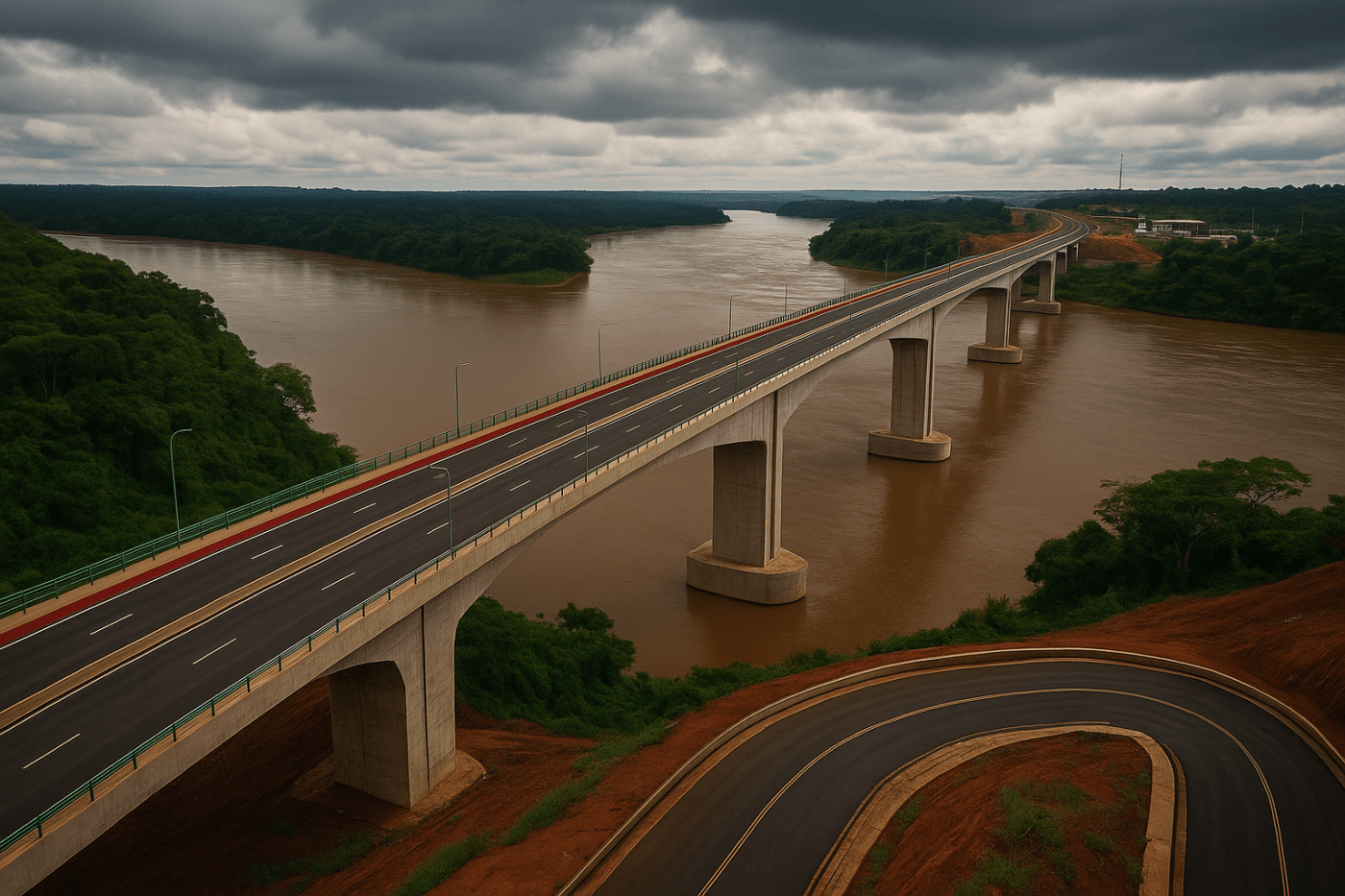
When Brazil and Paraguay built a bridge, Western media built a wall of silence. But this isn’t just a logistics project—it’s a battlefield between imperial extraction and South American integration under a rising multipolar order.
By Prince Kapone | Weaponized Information | May 9, 2025
Why the Empire Stays Silent: The Propaganda of Erasure
The absence of coverage speaks louder than the bridge itself. A massive infrastructure corridor—connecting the Atlantic coast of Brazil to the Pacific ports of Chile, with Paraguay as its geopolitical hinge—has quietly advanced without a whisper from the corporate press. No features in The New York Times, no segments on CNN, no reports in Financial Times or Bloomberg. Not even a token think tank op-ed. When Western media falls silent on a project of this magnitude, it is not oversight—it is ideology. It is censorship by omission.
This isn’t just a road. It’s a regional pivot. The Bioceanic Corridor promises to reroute South America’s logistics away from U.S.-dominated sea lanes, away from Panama Canal chokeholds, and toward a multipolar architecture of trade—stretching from Brazil’s agribusiness interior to Chile’s Pacific ports. It opens new pathways for continental integration, energy transport, rail development, and commodity circulation—most notably toward Asian markets. But to the editors and analysts of Washington and London, this project is politically inconvenient. Because it doesn’t serve their map.
What we see here is a clear case of cognitive warfare—a form of information control not through distortion, but erasure. The Bioceanic Corridor, backed by coordinated planning from Chilean, Brazilian, Paraguayan, and Argentine governments, represents the exact kind of regional development that undermines the myth of Latin American chaos and dependency. It signals political coherence, infrastructural ambition, and multilateral coordination—all things the imperial narrative cannot tolerate. And so: silence.
Meanwhile, those shaping the corridor’s direction are neither purely emancipatory nor wholly comprador. Among them:
- President Lula da Silva of Brazil, whose administration walks the tightrope between national-industrial development and capitalist conciliation. His support for the bridge signals strategic interest in South-South cooperation—but without rupturing neoliberal continuity.
- Chile’s Ministry of Transport and Foreign Affairs, which view the corridor as an opportunity to consolidate Chile’s status as a Pacific logistics gateway and trade hub for Asia-bound exports.
- Governors from Tarapacá, Antofagasta, and Mato Grosso do Sul, all of whom position themselves as regional brokers, promising growth while managing local discontent, often ignoring Indigenous consultation or ecological review.
And while Western capital has been notably absent from the public financing of the corridor, the infrastructure itself is not free from imperial logic. The project’s framing—“integration,” “development,” “security,” “connectivity”—mirrors the language used by institutions like the World Bank and IMF to advance extractivist megaprojects from the 1990s onward. But the silence surrounding this bridge suggests something else: the empire cannot openly critique what it cannot control. Better to let it pass unnoticed than risk legitimizing a multipolar alternative.
The Western media’s refusal to report is not neutrality—it is strategy. It is a refusal to acknowledge Latin American infrastructure beyond the binaries of crisis or corruption. It is an imperial script that erases anything that hints at self-organization, integration, or autonomy—especially if it bypasses Washington and Wall Street.
From the Atlantic to the Andes: Infrastructure as Battlefield
The Bioceanic Corridor is not a fantasy. It’s under construction—anchored in steel, asphalt, and transnational agreements. At the heart of this continental artery is the new bridge linking Brazil and Paraguay, a strategic node that connects Mato Grosso do Sul to the Chaco and beyond. From there, freight will cross Argentina and arrive at Chile’s northern ports of Antofagasta and Iquique—opening a direct overland route between the Atlantic and Pacific for the first time in Latin American history.
Officially, the project is being framed by governments and business leaders as a model of integration. The Chilean state calls it “a gateway for Chile, Paraguay, Argentina and Brazil to the Asian market.” Paraguayan and Brazilian officials speak of “unlocking interior economies,” while Chile’s Minister of Transport described it as “strategic infrastructure to position Chile as a reliable logistics partner to Asia.”
But the deeper truth lies not in official statements, but in the structure of the corridor itself. This is infrastructure carved into the flesh of the region—designed to transform sovereign geography into seamless commodity flow. The corridor will facilitate the movement of soy, lithium, iron ore, beef, and copper. It will link agroindustrial zones with ports, and mining districts with export terminals. And it will do so through “logistics hubs,” “free trade zones,” and “digital customs platforms”—buzzwords that often function as euphemisms for surveillance, deregulation, and labor precaritization.
Several facts must be extracted and re-situated in their proper context:
- Security planning is central. Chilean authorities are explicitly coordinating with militarized customs, police, and border control under the pretext of combating “organized crime.” This is a familiar pattern: every major trade corridor constructed under capitalism also becomes a corridor of surveillance and repression.
- The corridor bypasses existing multilateral institutions like MERCOSUR and UNASUR. It is being constructed through bilateral and sub-national agreements, favoring governors, technocrats, and private sector “public-private partnerships” (PPPs). This fragmentation makes grassroots oversight and public accountability extremely difficult.
- Chinese capital is present but not dominant—yet. While Chinese firms have invested in key segments of Latin American logistics infrastructure (especially ports), this project appears to be shaped primarily by regional interests. However, Chinese demand for South American commodities—especially lithium and copper—makes Beijing an indirect driver of corridor development.
This raises a contradiction: while the Bioceanic Corridor is being framed as a tool for South-South development, it also threatens to deepen regional dependency on commodity exports, transnational logistics chains, and infrastructure models rooted in neoliberalism. Chilean officials have already described the corridor’s success in terms of trade volume, customs throughput, and foreign investor confidence—not in terms of local sovereignty, ecological resilience, or Indigenous rights.
And yet, the corridor could be something else. If redirected by popular forces and sovereign planning, it could become a vehicle for a new continental integration—one that unites landlocked nations, weakens U.S. maritime chokehold over exports, and fosters infrastructural self-sufficiency among southern states. The challenge is not to reject the corridor outright, but to struggle over its meaning, its uses, and its governance.
It is here—within this contradiction—that the revolutionary task becomes clear. We must read these megaprojects not as good or bad, but as terrain. They are spaces of political, economic, and ideological contestation. They reflect class struggle on concrete stilts. And their future will be determined not by technocrats or financiers—but by who is organized enough to claim them.
Infrastructure Is Not Liberation—Unless the People Own the Road
The Bioceanic Corridor is not neutral. It is a class project masquerading as geography. But unlike the railroads built for British imperialism or the highways carved out by U.S. aid packages during the Cold War, this corridor exists in a different epoch—an epoch where imperial unipolarity is collapsing, and multipolar openings are emerging in its cracks.
We must name this corridor for what it is: a contested infrastructure. It can become a neocolonial export funnel—draining lithium, soy, and iron from South America to imperial ports. Or it can become the physical spine of a sovereign bloc—one that connects landlocked nations to each other, enables regional planning, and lays the groundwork for true integration. The road itself cannot decide. Only power can.
Right now, that power resides with regional elites, financial technocrats, and global investors. Public-private partnerships are managing customs. Corporate “logistics solutions” firms are installing tracking systems. And governors are promoting special economic zones that replicate the same extractivist logic the continent has struggled against for centuries. In this configuration, the corridor becomes a high-speed pipeline of dependency.
But the corridor’s very existence opens a different possibility: that infrastructure can be reimagined from below. That its nodes—bridges, ports, railways, highways—can be democratized and made accountable to the people who live and labor along its path. That it can shift from a vehicle of extraction to one of redistribution.
This is especially possible because the project is not led by the IMF, USAID, or Wall Street banks. Chinese capital plays a background role, but this is still a corridor planned and built by Southern states. Its future is not yet fully written. That’s what makes it dangerous to empire—and promising to us.
If popular forces take initiative now, the Bioceanic Corridor can be transformed into the circulatory system of a post-neoliberal Latin America. It can be used to bypass maritime chokepoints like the Panama Canal. It can connect Indigenous agricultural economies across borders. It can deliver goods to domestic markets before global ones. But this requires more than vision. It requires struggle.
It also requires clear ideological framing. We must reject liberal fantasies that treat infrastructure as savior. Roads do not liberate. Trains do not emancipate. Integration must be driven by sovereignty, planned by workers, and designed for use—not profit. Only then can concrete become a tool of freedom.
The Bioceanic Corridor, in other words, is a fork in the road. It can lead to hyper-imperialist logistics—surveilled, commodified, and enclosed. Or it can lay the groundwork for a different Latin America, one built not on trade balances and investor confidence, but on cooperation, production, and anti-imperialist autonomy.
To Take the Road, Take the Power: Toward a People’s Integration
The Bioceanic Corridor is a bridge—but only struggle can decide where it leads. The choice is not between megaproject or no development. The real choice is: who decides, who benefits, and who pays the cost? If left to the hands of technocrats and corporate-financial elites, this corridor will tighten Latin America’s subordination to global capital. But if seized by popular movements, it could become the infrastructural skeleton of a new anti-imperialist integration.
We declare total ideological unity with the peasant movements of Paraguay, the Indigenous land defenders of Brazil, the miners and port workers of Chile, and the anti-neoliberal currents rising once again across the Southern Cone. These are the real protagonists of Latin America’s future—not the politicians cutting ribbons or the banks underwriting concrete.
To seize the potential of the Bioceanic Corridor and prevent its capture by transnational capital, revolutionaries and anti-imperialists must engage the following tactical fronts:
- Popular Audit of Infrastructure: Launch investigations and public forums on the financing, ownership, and governance of every corridor segment. Expose who profits, who is displaced, and who is surveilled. Translate this knowledge into organizing campaigns and legislative pressure from below.
- Worker and Peasant Assemblies: Build binational and regional popular councils that link unions, small producers, logistics workers, and community organizations along the corridor route. These bodies must not merely protest—they must plan. Infrastructure cannot be decommodified unless the class that uses it controls it.
- Territorial Defense: Support Indigenous and campesino resistance against land seizures, environmental destruction, and border militarization. Map where the corridor cuts through sacred land, water sources, or ecosystems—and turn those sites into zones of organized defense and direct action.
- Anti-Imperialist Media Campaigns: Counter the silence of the imperialist media apparatus by creating videos, articles, podcasts, and murals that tell the true story of the corridor. Show its dual character: as both threat and opportunity. Build cultural power to match political analysis.
- South-South Solidarity and Policy Coordination: Pressure states to embed the corridor in new continental frameworks—linked to CELAC, ALBA, and future post-MERCOSUR institutions. Demand cross-border cooperation rooted in sovereignty and equity, not neoliberal competition.
This is not about being “for” or “against” the Bioceanic Corridor. It is about recognizing it as a historical rupture—one that can either deepen dependency or become a weapon against it. The choice will not be made in presidential palaces. It will be made in workshops, border towns, port unions, and land occupations. That is where Latin America’s future will be written—in struggle.
We say: Let the people drive the freight. Let the workers own the road. Let the region integrate itself—not into empire, but into liberation.
 Weaponized Information
Leave a comment