How the EU’s “independence” narrative conceals logistics imperialism, NATO militarization, and the global class war for energy sovereignty
By Prince Kapone | Weaponized Information | May 6, 2025
I. The EU’s “Energy Independence” as Propaganda of Omission and Framing
POLITICO’s coverage of the EU’s “final plan” to quit Russian energy isn’t just a story—it’s an ideological operation. The headline declares Europe’s quest for “energy independence,” while the article casts Brussels as a beleaguered protagonist courageously weaning itself from Moscow’s “blackmail.” But every paragraph betrays the real narrative: Europe hasn’t freed itself—it’s swapped Russia’s pipeline for America’s tanker fleet, embedding itself deeper into U.S. imperial logistics.
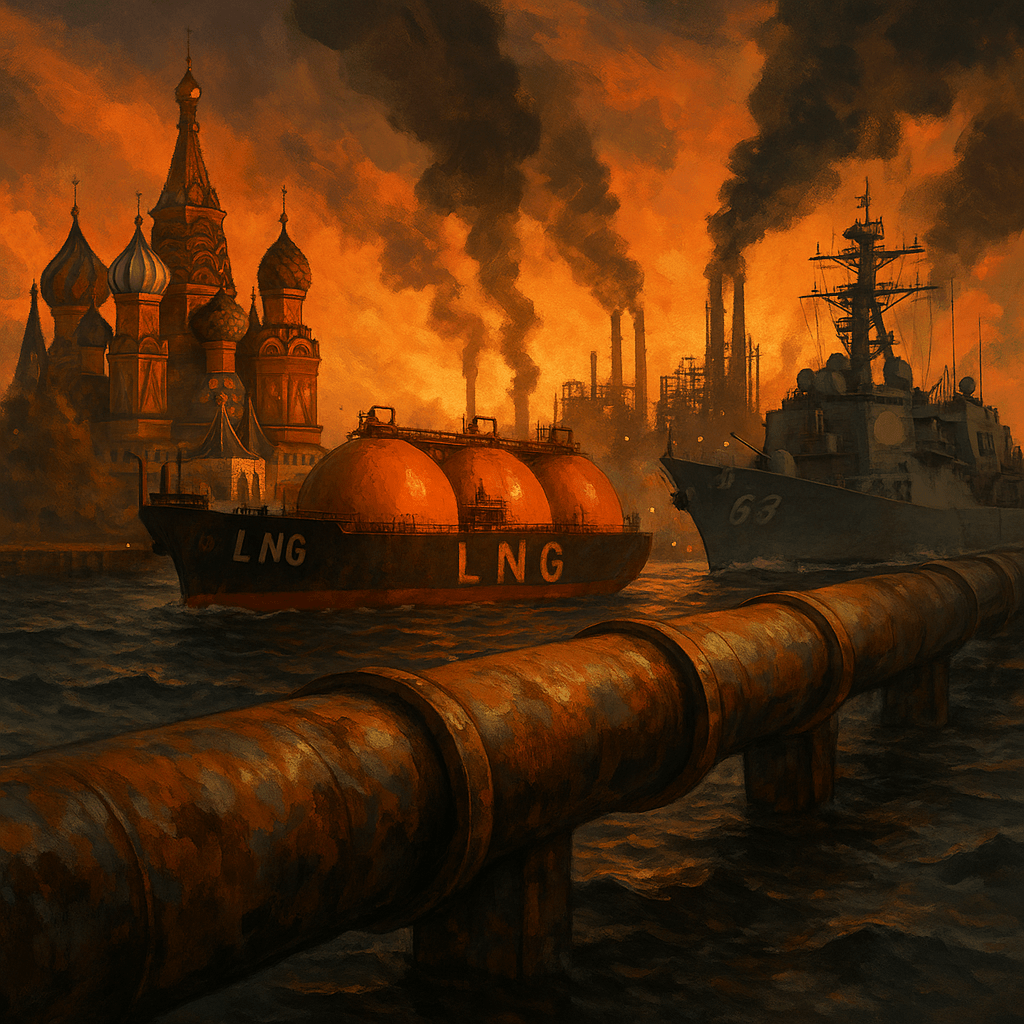
This is propaganda by framing: casting dependency as liberation, militarization as security, and price gouging as “market correction.” The EU’s pivot to U.S. liquefied natural gas (LNG) is framed as “diversification”—no mention that it transfers hundreds of billions in public funds straight into Chevron, Exxon, and Cheniere’s coffers. POLITICO quotes EU energy chief Dan Jørgensen warning of “economic blackmail” from Russia, yet ignores the NATO warships escorting LNG shipments into European ports, reinforcing an energy regime tied to Pentagon logistics.
Why omit these facts? Because omission is only half the weapon. POLITICO actively inserts a narrative scaffold: framing Europe’s energy realignment as an economic necessity, a technocratic inevitability, a path to “security.” Workers vanish; strikes disappear; NATO becomes an invisible actor. The market becomes the sole engine, abstracting the corporate profiteering, military protection, and working-class dispossession underlying the “roadmap.”
The framing delegitimizes resistance while laundering imperial logistics as neutral. There’s no space in POLITICO’s script for the refinery blockades in France, or Spanish dockworker actions against LNG terminals. No recognition of Nigerien protesters halting French uranium shipments. The working class doesn’t fit the narrative. Class struggle doesn’t map onto “energy independence.” It must be erased.
And this erasure isn’t accidental. It’s propaganda by omission—the flip side of framing. The article’s silences are ideological silences, burying the militarization of energy routes, the rent-seeking of U.S. fossil giants, and NATO’s enforcement of energy chokepoints from Africa to Asia. The headline says “independence,” but the body reads like an Exxon investor note.
Why does POLITICO assert this frame? Because imperial journalism isn’t here to inform—it’s here to police perception. It naturalizes corporate plunder as policy, militarized logistics as “security,” and worker resistance as an invisible disruption. It trains the imperial core’s audience to see an empire of tankers, pipelines, and sanctions as a “market-led transition.”
Beneath the myth of “energy independence” lies a logistics empire enforced by NATO, financed by Wall Street, and paid for by workers facing austerity and dispossession. And exposing that empire begins by excavating both what the imperial media omits—and what it actively constructs.
II. The Imperial Supply Chains Behind Europe’s Energy “Exit”
Strip away the ideological scaffold, and the EU’s so-called “energy independence” reveals itself not as liberation from control, but as a deepening submission to U.S.-led logistics imperialism. Europe did not shift from one empire to another—it was wrenched from a framework of negotiated interdependence with Russia and thrown into a militarized fossil regime enforced by Wall Street and NATO.
Before the escalation of the Ukraine conflict, much of Europe’s gas flowed through pipelines built on long-term contracts with Russia—state-to-state energy agreements free of warship escorts or financial blackmail. That infrastructure was dismantled not by markets but by sanctions, sabotage, and political coercion. The dependency that replaced it is not just costlier—it is imperial by design.
According to Global Witness, the EU paid a staggering 400% markup on U.S. LNG imports in 2023, funneling over €200 billion into American fossil monopolies. While Brussels touts “diversification,” it is militarized and financialized: over half of U.S. LNG cargoes arrive under NATO escort. This is not a market solution—it’s a geopolitical enforcement regime.
Ports like Rotterdam and Marseille now serve dual purposes as LNG hubs and NATO naval outposts. Pipeline projects like EastMed, and a new wave of regasification terminals, lock Europe into decades of dollar-priced fossil contracts, severing the energy autonomy it once had with Russia. NATO’s energy doctrine extends across the Mediterranean and West Africa, militarizing routes from Algeria, Nigeria, and Qatar. This is not an exit—it is an enforced dependency under U.S. command.
And the ecological cost? Hidden under greenwashed ESG labels and “climate transition” rhetoric. Europe’s pivot to U.S. and Qatari LNG fuels new fracking booms across Appalachia and the Permian Basin, displacing Indigenous and Black communities while exporting pollution and dispossession back onto the Global South. As Tricontinental’s Hyper-Imperialism report makes clear, imperial logistics dressed in green are still imperial at their core.
Simultaneously, Europe’s domestic grid becomes a site of internal repression. Smart meters, algorithmic billing, and automated shutoffs discipline the poor through data-driven austerity. NATO’s “energy security” doesn’t stop at the border—it penetrates the household, enforcing obedience at the level of the socket and the flame.
These facts are nowhere in POLITICO’s framing. There is no acknowledgment that the shift from Russian gas to U.S. LNG represents a descent from negotiated cooperation into imperial capture. No mention that privatized infrastructure, enforced by the military, has replaced public energy policy. No hint that this is not a story of transition, but one of surrender to empire.
This is not energy strategy. It is class war operationalized through ports, pipelines, and power grids. And as refinery workers strike, dockworkers resist, and climate rebels blockade terminals, the real battle line comes into view: not Russia vs. Brussels, but the proletariat vs. imperial energy infrastructure that extracts, encloses, and militarizes every flow it touches.
III. From Imperial Dependency to Multipolar Energy Sovereignty
If POLITICO’s omissions conceal the logistics of empire, our task is to reveal the map—and then redraw it. Europe’s energy “exit” is not independence; it is a rebranding of dependency, shifting from negotiated trade with Russia to militarized subjugation under U.S.-led fossil monopolies. The antidote is not a market correction within the imperial system—it’s a revolutionary rupture: severing the West’s imperial energy chains, reclaiming infrastructure, and building dual power rooted in sovereignty and survival.
Across the multipolar world, that rupture is already in motion. While the EU locks itself into dollar-denominated LNG contracts under NATO protection, a bloc of sovereign states—Russia, China, Iran, Venezuela, Algeria, and others—are forging energy corridors outside the chokehold of SWIFT, sanctions, and U.S. military logistics. These are not empires in the Western sense, but post-colonial and semi-peripheral states asserting independence from the global architecture of capitalist-imperialism built by Europe and extended through its settler outposts.
Russia’s role in Europe’s past energy system was based on long-term contracts, pipeline interdependence, and geopolitical balancing—not on imperial military coercion or speculative profiteering. Unlike the U.S., it did not impose dollar pricing, warship escorts, or regime-change threats to secure its energy exports. The severing of Russian energy ties was not a liberation from empire, but a forced realignment under Western coercion—NATO’s energy arm twisting Europe into higher-cost, militarized dependency.
But sovereignty cannot be delivered from above. It must be built from below—by workers, communities, and movements reclaiming the infrastructure of life. The French refinery blockades, Ende Gelände occupations, and Marseille LNG protests are not marginal actions. They are converging frontlines in a global class war, where the ports and terminals of the Western empire become contested terrain.
Each strike that halts refinery operations, each dock that refuses to unload a tanker, is a material rupture in the Western imperial grid. When Indigenous and Black communities resist fracking in Appalachia and Texas, they are not confronting just capital—they are resisting the logistical machinery of the Western imperial order, which sacrifices life for profit and enforces subordination through militarized infrastructure.
This reframing makes the contradiction plain: not Russia vs. Europe, but the working class vs. the Western imperial energy regime. Whether the fossil fuel flows are condemned or praised matters less than whether they serve empire or sovereignty—whether they feed Wall Street or insulate sovereign development.
To reject the false binary between “bad Russian gas” and “good American LNG” is to reclaim clarity. Only one of these comes wrapped in warships, sanctions, and corporate lock-ins. The other came through negotiated state-to-state relations disrupted by imperial escalation. The real horizon lies beyond both options: in proletarian energy sovereignty, multipolar solidarity, and the decolonization of infrastructure itself.
Europe’s future does not belong to ExxonMobil, TotalEnergies, or NATO. It belongs to the workers occupying terminals, the dockworkers blocking tankers, and the peoples of the Global South resisting neocolonial extraction. From Marseille to Caracas, from Rotterdam to Lagos, an insurgent energy map is taking shape—one that refuses to labor for empire and dares to construct a liberated future on our own terms.
IV. Shutting Down the Imperial Energy Grid, Building Proletarian Power
If the energy grid is the circulatory system of Western imperialism, then every refinery, terminal, and pipeline is a chokepoint waiting to be disrupted. The struggle for energy sovereignty isn’t a diplomatic summit in Brussels or an OPEC quota in Vienna—it is a global insurgency against infrastructure that enforces capitalist domination. Our task is clear: disrupt the Western imperial grid, sever its lifelines, and build dual and contending power that reorients energy flows toward survival, sovereignty, and socialist reconstruction.
We do not appeal to governments for liberation—we organize to take it. From the picket line to the port blockade, from sabotage of extractivist infrastructure to the seizure of grid governance, every act of refusal becomes a weapon. Each coordinated disruption weakens the fossil backbone of Western empire. Each node of self-organization stitches together the fabric of a new, multipolar energy order.
Redline Energy Campaigns: Publish investigative maps exposing the linkages between EU LNG terminals, NATO naval stations, and U.S. military logistics. Document where Western energy flows intersect with colonial occupation. Example: “Rotterdam Port: NATO’s Gas Fortress.”
People’s Embargoes: Organize militant flotillas and port actions to blockade LNG tankers at key imperial nodes—Marseille, Rotterdam, Le Havre. Take inspiration from Nigerien uranium mine shutdowns and align with Global South resistance against extractive imperial flows.
Occupy & Disrupt: Expand the Ende Gelände model. Target gas terminals, fossil fuel hubs, and corporate headquarters with coordinated shutdowns. Fuse anti-imperialist, antifascist, and ecological resistance into a single insurgent praxis. Demand nationalization, demilitarization, and redirection of infrastructure to community control.
Strike for Sovereignty: Coordinate worker actions at refineries, ports, and utilities across Europe and the Global South. Link wage struggles to demands for public, decommodified energy control. Forge alliances between European industrial workers and frontline communities resisting neocolonial extraction.
Build Dual Power: Form local energy councils to collectively govern microgrids, solar cooperatives, and essential supply infrastructure. Disconnect communities from imperial rate regimes. Prioritize life, not profit. Rewire the system from below.
We reject the false promise of “green capitalism” and NATO-certified energy “security.” U.S. LNG is not a liberation fuel—it is colonialism with a climate badge. The EU did not escape Russian energy; it was forced into Washington’s toll booth. The logic of fossil capital continues to sacrifice Indigenous lands, working-class households, and Global South sovereignty on the altar of imperial profit.
Our solidarity must be insurgent, internationalist, and rooted in rupture. From the oil fields of Nigeria to the terminals of Hamburg, from the frack zones of Vaca Muerta to the energy rebels of Marseille, the lines are being drawn. This is not about energy policy—it is a war over infrastructure. And the infrastructure is vulnerable.
The Western imperial grid will not fall by reform. It will fall under the weight of blockades, strikes, occupations, and collective refusal. The crisis is global. The time is now. The only question is how soon we fight—and how deeply we build.
Because as the old grid cracks and the Western empire falters, a new world is already being traced: by the workers who refuse to power empire, by the communities who reject their sacrifice, and by the movements that dare to seize the grid itself and rewire it for liberation.
That world belongs to us. The grid belongs to us. Let’s take it back.
 Weaponized Information
Leave a comment