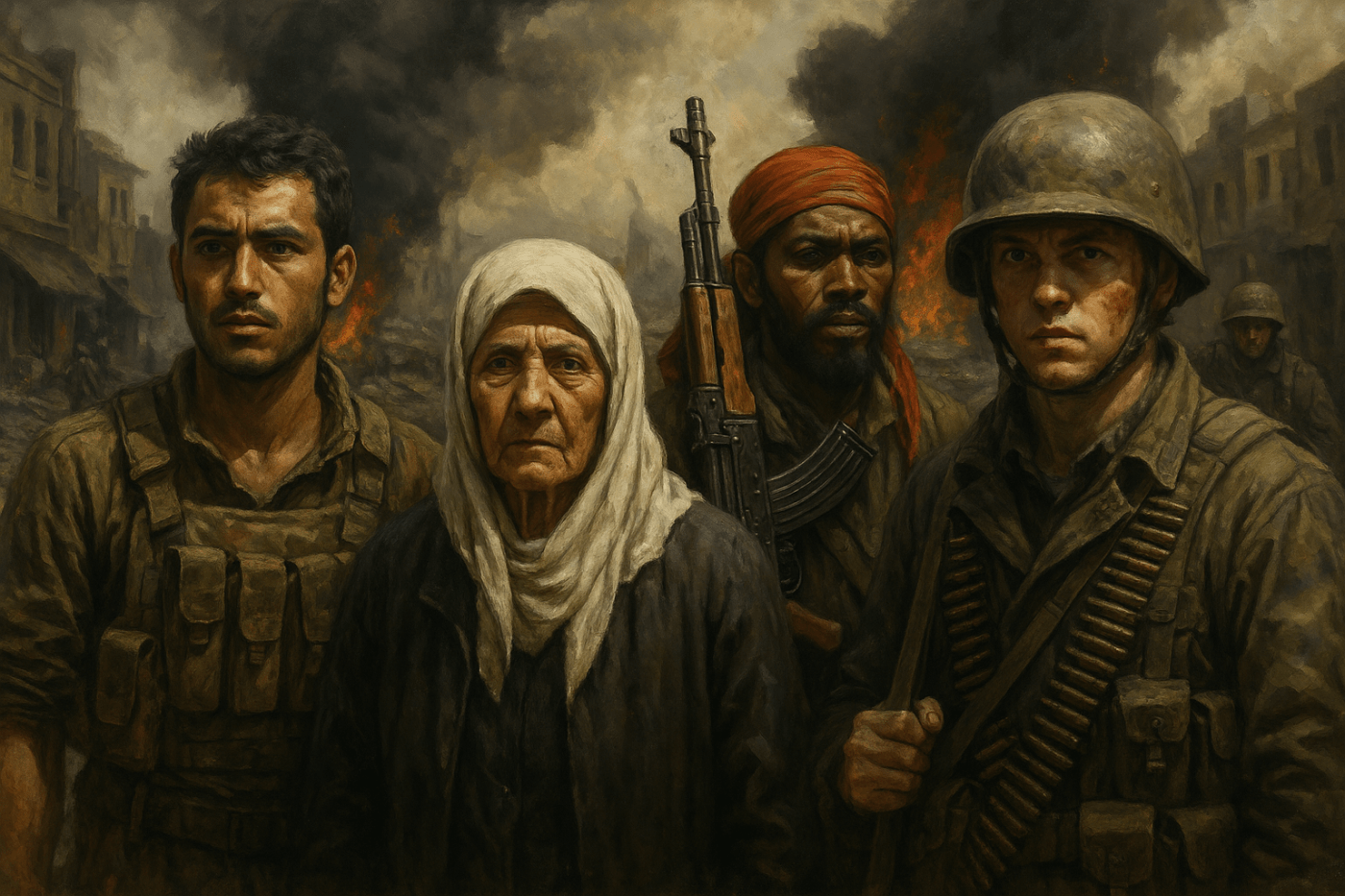
From Nazi fugitives to Ukrainian collaborators, tracing the unbroken chain of fascist counterinsurgency in the service of empire
By Prince Kapone | Weaponized Information
May 5, 2025
The Silence of the Archive: What the Declassification Omits
Argentina’s declassification of nearly 1,850 files on Nazi escape routes after World War II has been heralded by mainstream outlets like The Times of Israel as a moral victory, a belated triumph of transparency that supposedly closes a sordid chapter in history. But as with all imperial archives, the gesture conceals more than it reveals. Beneath the headlines praising the Simon Wiesenthal Center’s advocacy and President Javier Milei’s cooperation lies a deeper silence—a refusal to interrogate the geopolitical, economic, and ideological systems that enabled these ratlines, and worse, continue to recycle fascist power under new imperial configurations.
The Times of Israel positions the declassification as a straightforward unveiling of truth, a bureaucratic correction after decades of secrecy. Yet it conspicuously omits the Vatican’s pivotal role in orchestrating these escape routes. Figures like Bishop Alois Hudal, operating under the auspices of the Vatican Refugee Commission, provided direct assistance to Nazis like Adolf Eichmann and Franz Stangl, issuing false identity papers under the guise of “charity.” This was no accident of misplaced humanitarianism; it was a calculated deployment of Vatican infrastructure to salvage fascist cadres—not merely from Allied retribution, but from the threat of revolutionary socialism rising across postwar Europe. The Church’s collaboration with fascism, grounded in its own anticommunist fervor, disappears entirely from the sanitized official narrative, leaving a hollow moralism in its place.
Equally absent is the role of the International Committee of the Red Cross, whose travel documents facilitated the flight of thousands of war criminals. These passes, issued under humanitarian pretexts, were stamped with Vatican references and funneled through Italy’s ports, allowing Nazi officers to evade justice with bureaucratic ease. It wasn’t negligence—it was structural complicity, woven into the institutional architecture of postwar Europe’s reactionary stabilization.
The article’s silence extends further still: no mention of Franco’s Spain as a critical hub where fascist networks collaborated with Argentine Cardinal Antonio Caggiano to shepherd Nazis into Latin America; no acknowledgment of the Swiss banks that laundered Nazi loot and quietly financed these journeys. The “ratline” wasn’t a rogue operation—it was a transnational conspiracy binding fascist, clerical, financial, and imperialist interests across continents.
Even Israel’s role is flattened into a moral binary. The same state that captured Eichmann in 1960 later recruited ex-Nazis like Otto Skorzeny as Mossad assets. The Operation Damocles affair, where Israel turned to Nazi scientists for missile development while publicly prosecuting others, is scrubbed from the narrative. In this omission lies the ideological function of the archive: to selectively remember, to mobilize memory in service of imperial legitimacy, and to erase the structural continuities between fascism and the capitalist-imperialist order it served.
By positioning the declassification as closure, the article masks the archive’s living function as a technology of imperialist memory management. It occludes the inconvenient truths that fascism was never simply a German pathology, nor a historical aberration—it was a coordinated imperial strategy for suppressing revolutionary movements and safeguarding capitalist extraction. And as Israel wages genocide in Gaza today, armed by the very militarist infrastructures incubated in these Cold War ratlines, the archive’s silence is not mere oversight—it is ideological warfare.
The Imperial Web: Ratlines, Counterrevolution, and the Geopolitical Continuum
While mainstream narratives frame Argentina’s ratlines as a peculiar Latin American phenomenon, isolated from global structures, the historical record reveals something far deeper: an imperial web spanning Europe, the Americas, and the Middle East, bound together by anti-communism, fascist collaboration, and capitalist restoration. The Nazis who fled to Argentina were not merely fugitives—they were strategic assets in a broader project of counterrevolution, their migration a transfer of expertise, ideology, and repression from the collapsed Third Reich into new theaters of imperialist management.
Spain, under Francisco Franco, was a critical node in this network. Franco’s fascist regime sheltered Nazis like Charles Lescat, who collaborated with Cardinal Antonio Caggiano to coordinate refugee pipelines into Argentina. These were not mere acts of ideological solidarity; they were geopolitical calculations aimed at preserving reactionary bulwarks against the rising tide of leftist and anti-colonial movements in Latin America. Through Spain’s ports and embassies, a fascist underworld connected Europe’s defeated regimes to the emerging Cold War architecture of repression in the Western Hemisphere.
Switzerland, too, played an indispensable role—not only as a neutral bank but as an active facilitator of financial laundering. Nazi loot, funneled through Swiss accounts, financed the relocation of war criminals and later underwrote the financial networks sustaining Latin America’s military dictatorships. The ratline wasn’t merely a path for bodies—it was a flow of capital, expertise, and counterinsurgency knowledge, underwriting the imperialist repression that would culminate in Operation Condor decades later.
Here the lines blur between the ratline and the CIA’s Operation Rollback, which sought to weaponize fascist networks against communists worldwide. Figures like Klaus Barbie epitomized this transition: the “Butcher of Lyon” smuggled through Vatican and Red Cross ratlines into Bolivia, where he became a CIA asset training death squads and torturers. This continuity is no coincidence—it’s the logical trajectory of imperialism’s counterrevolutionary imperative, repurposing fascist personnel for Cold War dirty wars.
And woven into this history is the Croatian Ustaše network, aided by Franciscan clergy like Krunoslav Draganović, which ferried war criminals like Ante Pavelić into South America. These networks did not dissolve—they fused into the broader counterinsurgency matrix that linked European fascists, U.S. intelligence, and Latin American juntas. The ratlines were a bridge from Nazi genocide to Operation Condor’s political disappearances, a continuity of colonial repression under new flags.
Meanwhile, Israel’s selective engagement with ex-Nazis—recruiting some like Skorzeny while prosecuting others like Eichmann—embodied the moral contradictions of a settler-colonial state aligned with Western imperialism. As Israel armed Argentina’s junta during the Dirty War, while touting its Nazi-hunting credentials, it revealed the imperial realpolitik beneath the rhetoric of Holocaust memory. The archive, again, functions to mask these contradictions, privileging narratives of isolated “bad actors” over systemic collusion.
In this geopolitical context, Argentina’s ratlines cannot be understood as a national aberration or a South American anomaly. They were integral to the reconfiguration of fascist power under U.S.-led imperialism, embedding Nazi cadres into the global counterinsurgency machine that would terrorize anti-colonial and proletarian movements from Santiago to Saigon. The declassified documents are but a sliver of this system—revealing the names but not the networks, the fugitives but not the financiers, the routes but not the regimes they sustained.
Reframing the Narrative: From Isolated Escapes to Imperial Continuities
The mainstream framing of Argentina’s ratline revelations positions the story as a moral drama of isolated complicity, a national stain to be washed clean through exposure. But the reality demands a deeper reckoning: the ratlines were not an aberration—they were a structural function of imperialist recalibration, preserving fascist cadres as instruments of counterrevolutionary violence. The Nazi fugitives who fled to Argentina were not “rogues on the run”; they were integrated into a transnational architecture of repression, forged by U.S.-led imperialism’s strategic fusion of anti-communism and capitalist restoration.
Consider Israel’s contradictory role: prosecuting Eichmann while recruiting ex-Nazis like Otto Skorzeny as Mossad assets; performing the theater of “never again” while selling arms to Argentina’s military junta during its Dirty War against leftist dissidents. The very state that claims the mantle of Holocaust justice embedded itself in the same imperialist circuits that recycled fascism as a bulwark against decolonization and socialism. This isn’t hypocrisy—it’s the operational logic of a settler-colonial, imperialist ally adapting fascist methods for its own expansion and survival.
The Simon Wiesenthal Center, heralded as moral guardians of Nazi accountability, plays a key ideological role in this process. By focusing exclusively on individual Nazi fugitives, it abstracts their crimes from the structural forces that protected, recruited, and redeployed them. It weaponizes Holocaust memory to legitimate Zionist colonialism, turning genocide remembrance into an ideological shield for the ongoing genocide in Gaza. Even as Israel bombs hospitals and starves children, the global media amplifies the Wiesenthal Center’s pursuit of archival justice—never asking how the lessons of fascism apply to today’s settler-colonial violence.
Meanwhile, the Vatican’s complicity remains sanitized in dominant narratives. The files will name men like Bishop Hudal, but omit the systemic role of the Vatican’s Refugee Commission in producing false identities under the banner of charity. Likewise, the Red Cross’s issuance of travel papers to thousands of Nazis is reduced to “oversight” rather than embedded institutional collaboration, reflecting an imperial humanitarianism that protects power while masquerading as neutrality.
The ratlines also expose the material continuity between fascism and global capitalism. The Swiss banks that laundered Nazi gold became conduits for funding Latin American juntas. The Nazi bureaucrats and scientists who fled Europe became advisors to CIA-backed regimes, engineers of torture chambers, trainers of death squads. Figures like Klaus Barbie didn’t vanish—they evolved into assets of Operation Condor, exporting Nazi expertise into the imperialist counterinsurgency campaigns of the 1970s. This isn’t just a historical echo; it’s the living infrastructure of imperialist violence, stretching from the camps of Auschwitz to the desaparecidos of Buenos Aires to the rubble of Gaza today.
And that infrastructure didn’t stop with Operation Condor. Its legacy flows through the blood-soaked battlefields of the present, nowhere more visibly than in Ukraine, where the U.S., Canada, and NATO openly arm, fund, and legitimize neo-Nazi militias like the Azov Battalion and broader ultranationalist movements. The rehabilitation and glorification of Ukrainian fascism is not an accident—it is a continuation of imperialism’s reliance on fascist formations as shock troops against socialist, anti-colonial, and anti-imperialist forces. The same Western powers that decry fascism in theory now fuel its resurrection in practice, celebrating SS veterans in parliaments while sanctioning solidarity with Palestinian and anti-imperialist struggles. The ratlines didn’t close—they metastasized into NATO supply chains, IMF austerity packages, and information wars that whitewash fascism as “democracy’s last defense.”
This contemporary alliance exposes the moral bankruptcy of imperial anti-fascism, which criminalizes Palestinian resistance while financing fascist battalions in Ukraine, turning Banderites into “freedom fighters” and Zionist settler militias into “self-defense.” The same ideological alchemy that laundered Nazi war criminals into Cold War assets is now laundering modern fascists into imperial proxies—against Russia, against Palestine, against the Global South’s multipolar defiance.
As the Argentine files are released, what remains hidden is the archive of imperialism itself: the role of the CIA in protecting ratlines under Operation Rollback; the Vatican’s prioritization of anti-communism over postwar justice; the capitalist class’s transnational interest in retaining fascist managers of labor and repression; and today, the sponsorship of fascist paramilitaries in Ukraine as instruments of Western hegemony. These absences are not accidents. They are deliberate silences that preserve imperialism’s immunity while displacing blame onto corrupt individuals or deviant nations.
Reframing the ratlines means refusing this individualized morality play and recognizing their place in the broader imperialist project of counterrevolution. It means connecting the declassified files not just to Eichmann or Mengele, but to the global systems that absorbed their expertise, protected their mobility, and redeployed their violence against the wretched of the earth. It means seeing today’s genocide in Palestine, and the fascist normalization in Ukraine, not as historical anomalies but as continuations of the fascist-imperialist alliance forged in the ashes of WWII—alliances that the Simon Wiesenthal Center will never prosecute, because they are the empire’s chosen crimes.
In exposing these continuities, we assert that fascism is not an accident or aberration of capitalism. It is capitalism’s violent resolution to crisis, colonial revolt, and proletarian insurgency. And until the imperialist system that shelters, redeploys, and reincarnates fascism is overthrown, the ratlines will remain open—not only across the Atlantic, but across every border where empire defends its dying rule with terror, deception, and genocidal force.
Revolutionary Reckonings: Toward a Global Anti-Fascist, Anti-Imperialist Praxis
If the ratlines expose anything, it is that fascism was never simply defeated in 1945—it was rebranded, relocated, and redeployed as a weapon in imperialism’s global arsenal. The files from Argentina, the archives of the Vatican, the silence of the Simon Wiesenthal Center, and the glorification of Ukrainian Nazis in NATO capitals are all chapters in the same unfinished book. The question facing us is not how to “close” the ratlines, but how to confront the system that keeps them open: the imperialist world order that reproduces fascism as crisis management, counterinsurgency, and ideological enforcement.
This reckoning demands a revolutionary anti-fascist praxis—not confined to prosecuting the ghosts of the past, but committed to dismantling the living fascist infrastructures of the present. It means refusing the imperialist monopolization of Holocaust memory while standing unequivocally with the colonized and occupied—from Gaza to Haiti, from the Mapuche territories to Chiapas, from the favelas of Brazil to the refugee camps of Syria. Anti-fascism cannot be separated from anti-imperialism; the battle against fascist resurgence must also be a battle against the empire that sponsors, shelters, and instrumentalizes it.
The historical continuities of fascism demand an internationalist response. Just as Nazi torturers trained Latin American death squads, and just as Ukrainian Banderites are trained and armed today by NATO, so too must our resistance be coordinated across borders, linking the struggles of the colonized, the working class, the dispossessed, and the persecuted. The unmasking of the ratlines is not just an archival achievement—it is an invitation to forge new solidarities, to connect the disappeared of Argentina’s Dirty War with the disappeared of Palestine, to connect the victims of Klaus Barbie’s Bolivian death squads with the victims of Azov Battalion’s pogroms against Donbas civilians.
We must also reclaim memory from the imperialist narrative managers. The same Western states that prosecute aging Nazis while nurturing new fascists must be exposed for their ideological laundering of genocide: turning Israeli apartheid into “self-defense,” turning Ukrainian neo-Nazis into “freedom fighters,” turning NATO’s proxy wars into “democratic struggles.” Against this imperialist propaganda machine, we must practice weaponized counter-memory, excavating and mobilizing suppressed histories as ammunition in the global class war.
This is not merely an intellectual task. It is a material one. From the streets of Buenos Aires where mothers of the disappeared still march, to the streets of Nablus where children dodge settler bullets, to the trenches of Yemen where Ansarallah blockades Zionist ships in solidarity with Gaza, the fight against fascist imperialism is alive. Every act of decolonial resistance, every insurgent refusal of empire’s genocidal order, is a living repudiation of the ratlines. And every anti-imperialist victory tightens the noose around fascism’s reanimated corpse.
Let us be clear: fascism will not be defeated by trials, archives, or moral condemnation alone. It will be defeated by revolutionary rupture—by the overthrow of the imperialist system that births it, nurtures it, and exports it. Until that rupture, the ratlines remain not just historical facts, but active conduits of imperialist terror. And our task, as anti-imperialist, anti-fascist revolutionaries, is to tear them up by the roots, and salt the earth from which they grow.
 Weaponized Information
Leave a comment