By Prince Kapone | Weaponized Information
April 30, 2025
Part I: Beneath the Branding Lies the Empire
Al Jazeera’s latest breakdown on U.S. household manufacturing peels back the shiny plastic label of “Made in America” to reveal a startling truth: nearly everything Americans consume is produced abroad. In their detailed audit of over 100 common domestic goods, they find that the U.S. produces only 30% of its own kitchen appliances, 16% of its furniture, and an abysmal 3% of its clothing. For a nation that loves to wrap itself in red, white, and blue, its homes are dressed in the labor of the Global South.
While Al Jazeera does an admirable job cataloging these figures and highlighting the myth of U.S. manufacturing resurgence, their analysis stops short of excavating the imperial structure that makes this myth possible. The problem is not just that America imports too much. The problem is that the United States has built a global economic order where it doesn’t have to produce for itself—because it commands the labor, land, and lives of others.
This is not a mere trade imbalance. This is global colonialism rebranded as supply chain management.
For over a century, the U.S. has outsourced production to poorer nations while maintaining monopoly control over finance, tech, logistics, and war. It doesn’t grow its own cotton; it bombs the countries that do. It doesn’t stitch its own clothes; it funds the police states that enforce the stitching. “Made in America” isn’t a reality—it’s a marketing gimmick designed to stoke nationalism while concealing dependence on hyper-exploited labor abroad.
The American dream is draped in foreign thread. And beneath that thread is blood, coercion, and empire.
Part II: The Global Plantation Economy
To understand why so little is “Made in America,” we must look beyond tariffs and trade policy into the heart of the global economic system built by empire. The United States is not simply a nation of consumers. It is the command center of a global plantation economy—one where production is systematically outsourced, value is extracted from the periphery, and profits are hoarded at the imperial core.
This is not an accident of globalization. It is the design of it. The same ruling class that gutted American industry in the 1970s and 1980s under neoliberalism did not simply “move jobs overseas.” They recalibrated the entire global division of labor, assigning the Global South to endless production and extraction while the Global North specialized in management, finance, and control. The empire’s elite didn’t just stop building things—they started owning everything.
Factories closed in Detroit, Pittsburgh, and Cleveland not because production was obsolete, but because capital found cheaper labor, fewer regulations, and greater returns abroad. The logic of capital demands it. The U.S. became the world’s landlord, financier, and enforcer—not its workshop. That role was assigned to Bangladesh, Vietnam, Mexico, China, and dozens of other nations locked into low-wage industrial servitude.
Under this model, the U.S. imports finished products and exports inflation, debt, military bases, and cultural hegemony. American consumers live atop a vast pyramid of suffering they are never meant to see. Their shoes stitched in Indonesia. Their smartphones assembled in Shenzhen. Their coffee beans picked by children in Honduras. The price tags may be invisible, but they’re paid in blood.
It is no surprise, then, that the largest corporations in the U.S. aren’t manufacturers but logistics firms, e-commerce giants, financial predators, and tech monopolies. Amazon, BlackRock, Microsoft, Apple—these are not producers; they are extractors, facilitators, and data miners. The imperial economy no longer requires the production of value onshore. It just needs global control over those who still do the producing.
This is what the collapse of “Made in America” really reveals: that American prosperity has never been self-made. It was made in sweatshops. It was made under dictatorships propped up by U.S. foreign policy. It was made by generations of colonial and neocolonial violence, disguised as trade. This is not the failure of U.S. capitalism. It is its logical, imperial conclusion.
Part III: MAGA as Mirage: The Great Deception of “Reshoring” and the Return of Colonial Labor Discipline
Trump’s MAGA gospel promised the return of American greatness—factories roaring back to life, steel forged in Pittsburgh again, “good jobs” resurrected for the forgotten middle class. But peel back the patriotic spectacle, and you find something much colder, much older: not a renewal, but a restructuring. Not prosperity, but discipline. Beneath the bluster lies the same imperial logic that has always governed U.S. capitalism: colonial extraction, labor repression, and racialized terror—only now, turned inward on the empire itself.
Al Jazeera’s reporting exposed how little of the American household is actually made in America, but what they miss—what liberal journalism always misses—is that this dependency wasn’t an accident. It was imperial design. U.S. capitalists didn’t simply offshore production because it was cheaper; they offshored it because imperial domination made it possible to extract cheap labor, raw materials, and compliance abroad. Now, as that global order frays—China refusing subservience, BRICS+ asserting sovereignty, supply chains breaking under geopolitical fractures—the U.S. ruling class is scrambling to reshore production under new, harsher terms.
But here’s the catch: they’re not bringing back the high-wage union jobs of the postwar boom. They’re bringing back the sweatshop. The “reshored” economy Trump trumpets is a return not to prosperity, but to a domesticated version of the global south’s exploitation. The goal is to recreate third world conditions inside the imperial core—to make American workers as cheap, disciplined, and disposable as the laborers their bosses once exploited abroad.
Mass deportations, border militarization, anti-migrant terror: these aren’t side policies. They are the linchpin of the new domestic colonial order. By purging migrant labor, flooding workplaces with fear, and smashing wages across sectors, the ruling class clears the ground for a recalibrated labor market—one where unions are broken before they form, solidarity is strangled in its crib, and workers, both migrant and settler, are driven into a new regime of surveillance, precarity, and hyper-exploitation.
Trump’s MAGA isn’t a rebellion against globalization—it’s a desperate bid to salvage U.S. imperial dominance by turning the empire inward. If they can no longer dominate the periphery, they will build a periphery inside the metropole. The “made in America” dream is just a marketing gimmick masking this pivot: the factories they plan to reopen won’t offer dignity, they’ll offer chains.
This is technofascist labor recalibration in action. A restructuring driven by imperial decline, designed to preserve capital accumulation through repression and internal recolonization. And it is not aimed solely at the migrant. It is aimed at every worker not sitting at the imperial table.
The American middle class—the settler labor aristocracy that once secured its privileges through complicity in colonial and imperial domination—now finds itself in the crosshairs too. Trump’s economic promises are not about restoring their prosperity, but about coercing their submission. They are being drafted into the same precarious plantation economy that the U.S. ruling class has long imposed on the Global South.
In the end, the MAGA fantasy is not a path back to greatness. It is a roadmap to internal colonialism. A recalibration of the settler colony’s labor regime to adapt to the empire’s shrinking horizons. And unless we organize across these false borders—across race, citizenship, and nation—the machinery of technofascist terror will crush us all, migrant and settler alike, under the boot of imperial survival.
Part IV: Seeds of Resistance in the Belly of the Beast
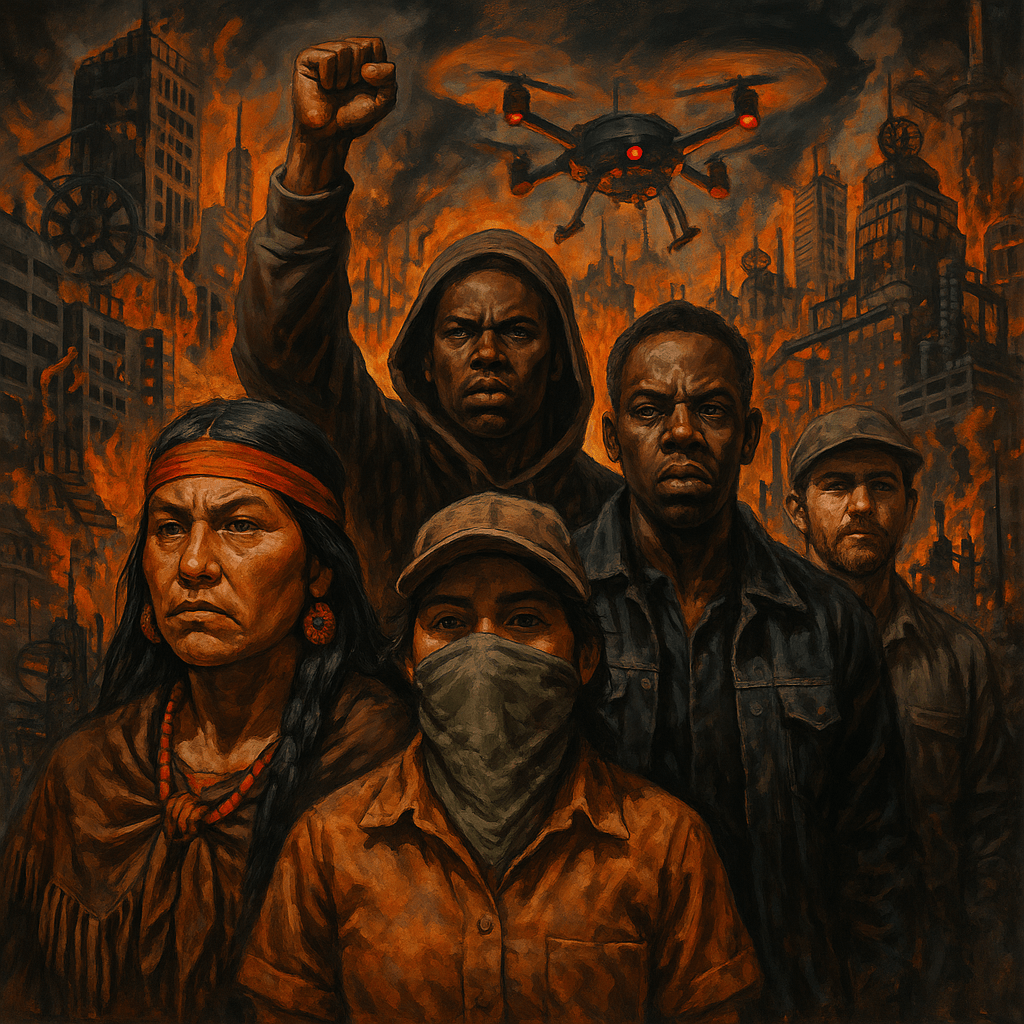
Against the rising tide of technofascism, there are forces stirring inside the empire—small, embattled, fractured, but undeniable. If Trump’s recalibration project aims to terrorize and atomize the working class into obedience, these movements point to a different future: one built from the ground up, through autonomous institutions, revolutionary solidarity, and material resistance.
In the Deep South, the Jackson-Kush Plan offers a roadmap of dual power, where Black working-class communities organize cooperatively to reclaim land, build worker-owned enterprises, and exert democratic control over local governance. Though under siege from state repression, it remains a beacon of what prefigurative struggle can look like under settler capitalism’s heel.
The Uhuru Movement, despite facing FBI raids and the imprisonment of the Uhuru 3, continues its uncompromising work building institutions of economic self-determination, fighting for reparations, and advancing the struggle for Black national liberation. Its endurance under state persecution exemplifies the necessity of revolutionary political discipline in the face of imperial counterinsurgency.
Chicanx and Latinx revolutionary formations are mobilizing in the shadows of Trump’s deportation machine—organizing sanctuary networks, defending immigrant workers, and linking struggles against mass deportation with broader fights against wage theft, exploitation, and racialized repression. Their defiance reminds us that borders are prisons, and every act of solidarity across them is an act of liberation.
Palestinian liberation activists have also transformed U.S. streets into battlegrounds of international solidarity, connecting anti-Zionist struggle with anti-imperialist organizing at home. From campus encampments to port blockades against Israeli arms shipments, these militant actions fracture the bipartisan consensus underwriting genocide abroad and repression at home.
And no resistance inside the settler empire can be complete without centering the ongoing Indigenous struggle for land, sovereignty, and decolonization. From the Land Back movement to pipeline blockades, from treaty fights to direct occupations of stolen land, Indigenous nations continue to assert their right to exist, govern, and reclaim what settler colonialism has stolen. Their resistance is not symbolic; it is materially grounded, historically anchored, and existentially vital. Without the liberation of Native nations, no real decolonization—or defeat of technofascism—is possible.
But these scattered flames of struggle need to converge. Technofascism cannot be fought in silos. It requires what Fanon called a new humanism—a solidarity forged not through slogans alone, but through shared material struggle against a common enemy. The OG comrade Dhoruba Bin Wahad has called for a new United Front Against Fascism. We need more than protests; we need infrastructure. We need more than outrage; we need strategy. We need to connect these insurgent nodes into a network capable of both survival and offense under an increasingly militarized and surveilled regime.
This moment demands a program of coordinated material solidarity: support for political prisoners, underground support for migrants, community defense training, worker militancy, abolitionist organizing, mutual aid linked to political education, and a relentless exposure of the empire’s crimes. It demands alliances that cut across lines of race, nation, and sector—not by flattening differences, but by uniting under the banner of the oppressed against the oppressors.
If the white ruling class seeks to recalibrate the economy through terror, we must recalibrate the struggle through organization. If they turn the empire inward, we must turn the empire against itself. If they seek to fracture the working class, we must forge solidarity sharper than their knives.
The seeds of resistance are here. The question is whether we will water them—or watch them be scorched by the coming fire.
 Weaponized Information
Leave a comment