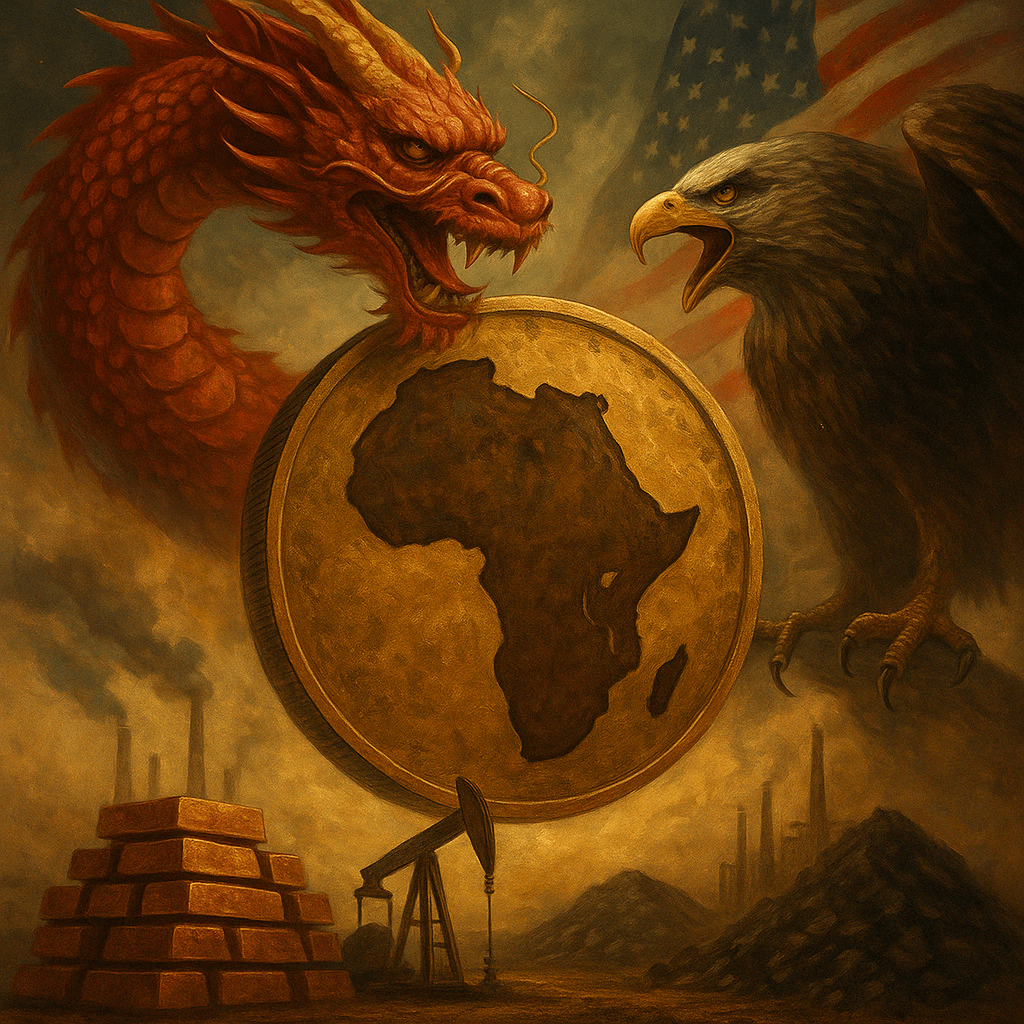
China needs what Africa has. The U.S. wants to stop it from getting it. But beneath the geopolitical chess match lies a deeper question: who do Africa’s resources serve—foreign capital or the African people?
I. The Empire Is Cracking, But the Scramble Ain’t Over
Africa’s soil has always attracted foreign boots, bankers, and businessmen. The empire that once stole people now steals lithium, cobalt, and copper. But the flags have changed. The U.S., bleeding power, is desperate to keep its grip on the continent. And China, rising fast, needs Africa’s raw materials to keep its factories humming.
This ain’t the Cold War. There are no good guys in suits. Just different models of power—one built on centuries of colonial plunder, the other trying to climb out of underdevelopment without becoming the monster it once fought.
II. China’s Dilemma: Grow or Betray?
Let’s be real. China’s industrial engine is running hot. It needs oil from Angola, copper from Zambia, cobalt from the Congo. The Belt and Road isn’t charity—it’s logistics. Ports, rails, and energy lines that make sure resources move east.
But to their credit, China hasn’t rolled in tanks or demanded IMF-style austerity. Its policy talks about mutual benefit, non-interference, win-win. And in many cases—especially compared to the West—it delivers.
Still, contradictions bite. You can’t build socialism at home while playing capitalist abroad forever. Chinese firms sometimes act like any other transnational company—cutting corners, breaking labor laws, partnering with corrupt elites. The question is: can China hold the line against the gravity of empire? Or will it be pulled into the same old game?
III. Uncle Sam Isn’t Dead—He’s Just Rebranding
The U.S. isn’t watching this from the sidelines. It’s throwing elbows. AFRICOM is expanding. Propaganda outlets call China a “neocolonial threat.” Trade reps and generals parade through West Africa with promises and bribes. This is hyper-imperialism: the outward face of U.S. technofascism, flexing its muscles where it can’t afford to lose.
Washington knows it can’t out-build China—but it can disrupt, destabilize, and discredit. It can turn African leaders into clients, pit countries against each other, and flood the region with soldiers and sanctions. It can smear every road and port China builds as a trap—while offering no alternative but debt and occupation.
IV. What About the African People?
Here’s the part nobody likes to ask: what do African workers and farmers get out of all this?
When China builds infrastructure, it often creates real benefits—schools, power grids, highways. Compared to the scorched-earth economics of the West, it’s a breath of fresh air. And insofar as it supports food production, industrial capacity, and sovereign development, it can and does represent the material interests of the African masses.
But no external partner—however well-meaning—can substitute for mass struggle. And China is not immune to profit. When labor is exploited, when environments are destroyed, when elites pocket the gains, it’s the people who suffer.
The African comprador class—the same one that welcomed colonizers and IMF reps—now rolls out the red carpet for foreign capital, whether it comes in Mandarin or English. They are the bottleneck between African labor and African liberation.
V. Revolutionary Non-Alignment or Neocolonial Reboot?
Multipolarity is a terrain—not a solution. It gives us space, yes. It weakens the empire’s chokehold. But without revolutionary leadership from below, multipolarity becomes a game of flag-swapping.
We need a new non-alignment—one rooted in class struggle, not diplomacy. One that builds worker-owned industries, not just port deals. One that uses South-South cooperation to break dependency, not reinforce it.
If China wants to walk that road with us, good. But it has to walk behind the masses, not ahead of them.
VI. The Chain Is Real. So Is the Hammer.
Africa’s resources made the modern world—but its people are still hungry. That’s not a natural condition. That’s theft. Theft by colonialism, by neoliberalism, by capitalism in every flag and accent.
The question isn’t who gets Africa’s cobalt. It’s who owns the mine. Who decides what gets built with it. Who eats.
China, the U.S., the EU—they all have strategies. The African working class needs one too. And it starts by turning the mines, the fields, and the ports into weapons of liberation—not just lines on a trade map.
 Weaponized Information
Leave a comment