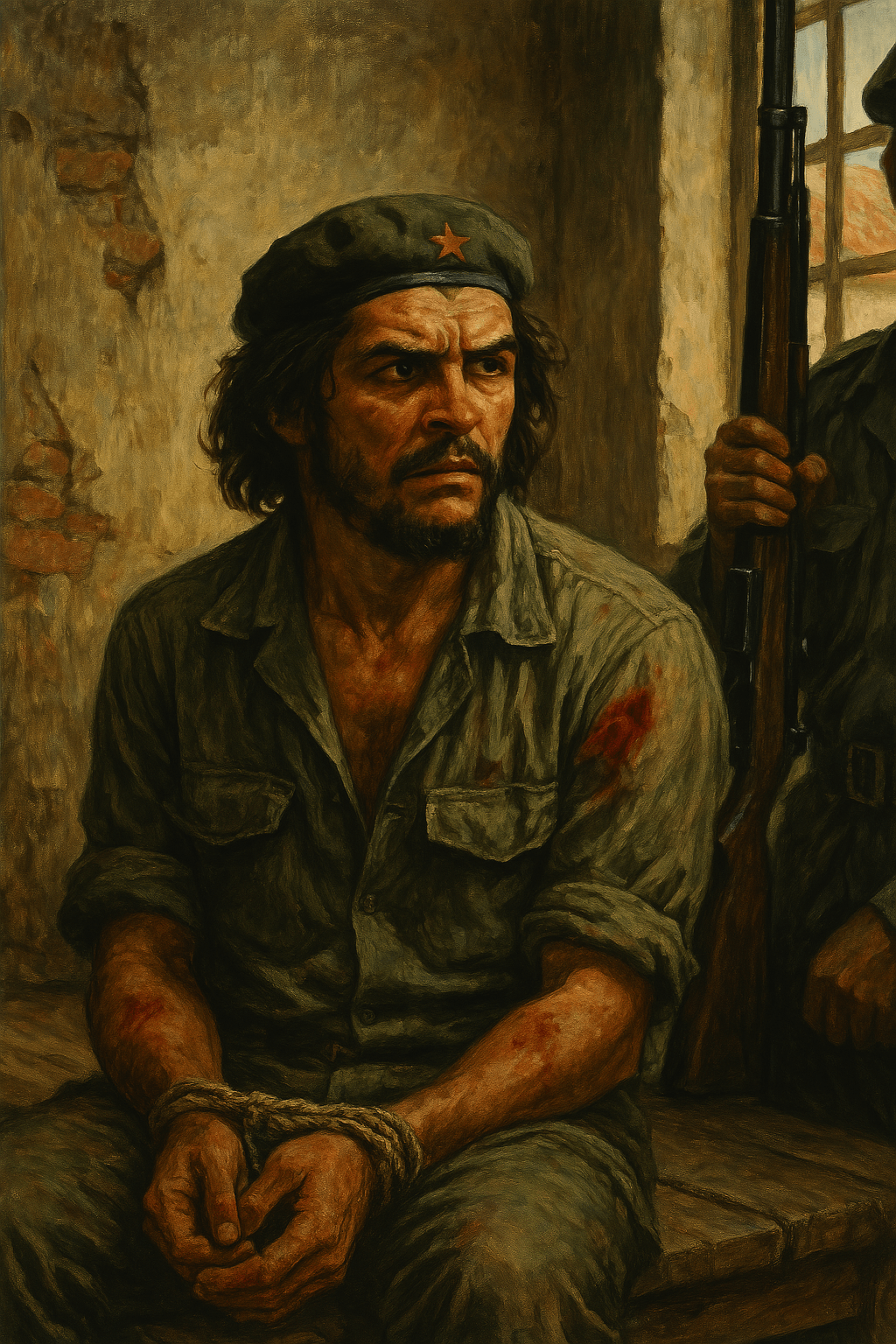
Not a Brand, But a Blueprint
Ernesto “Che” Guevara has been commodified into irrelevance—his image plastered on t-shirts, reduced to aesthetic rebellion, stripped of his revolutionary essence. But Che was no icon. He was a militant internationalist, a Marxist strategist, and a doctor of liberation whose life was a synthesis of theory and fire.
Born in Argentina, radicalized across Latin America, forged in the fires of Cuba, and martyred in Bolivia, Che was never confined by borders. He believed in the world revolution—not as romantic aspiration, but as historical necessity. In this vision, he shared deep affinities with Frantz Fanon. Both men saw the liberation of the wretched not only in political terms but as the creation of a new human being—forged in struggle, dignity, and solidarity.
Che’s politics tended toward the Maoist and Third Worldist camp. He rejected Soviet bureaucratism and capitalist compromise. He pushed for collectivization, moral incentives, and voluntary labor. He wanted socialism not only as a new system of production, but as a transformation of consciousness.
Che Guevara was no icon. He was a revolutionary blueprint—and to follow him is not to wear his face, but to sharpen his sword.
Part I: From Medicine to Marxism, From Argentina to the Andes
Che Guevara’s journey did not begin in revolution—it began in medicine. As a young medical student in Argentina, he rode across Latin America on a motorcycle, documenting the poverty, disease, and misery that plagued the continent. What he witnessed was not simply misfortune—it was structured abandonment. He began to connect the symptoms to the system: imperialism, capitalism, and class.
In Guatemala, Che saw the U.S.-backed coup that overthrew Jacobo Árbenz for attempting agrarian reform. It was a turning point. He concluded that reform was impossible under empire. Only armed struggle could break the grip of exploitation.
By the time he met Fidel Castro in Mexico, Che was not simply a doctor—he was a revolutionary in formation. He joined the July 26th Movement not for nationalism, but for socialism. He believed that Cuba’s liberation could be the spark for a continental insurrection.
In the Sierra Maestra, Che became more than a fighter. He was a teacher, a disciplinarian, and an ideologue. He wrote military manuals, taught political education, and experimented with egalitarian practices in camp. War, for Che, was not just destruction—it was construction. A new humanity was being born in the crucible of guerrilla struggle.
He emerged from the Cuban Revolution as a commander, a minister, and a symbol—but he was never content with state power. His eyes turned outward.
Che’s journey from medicine to Marxism was driven by a refusal to treat symptoms when the world was sick with systems. He diagnosed imperialism as a disease—and vowed to eradicate it with the scalpel of revolution.
Part II: Revolutionary Internationalism and the Ethics of Insurgency
Che Guevara was not a Cuban nationalist. He was a world revolutionary. For him, the Cuban Revolution was not a destination—it was a launching pad. He saw no contradiction between love of one people and commitment to the liberation of all peoples. His was an ethic of insurgency rooted in solidarity, not borders.
After the revolution, Che served as Minister of Industries and President of the National Bank. But even in office, he remained a combatant. He criticized bureaucracy, opposed Soviet economic models, and championed the idea that socialism had to be rooted in new values—sacrifice, equality, voluntary labor, and the moral incentives of a revolutionary people.
But Che was restless. He knew the survival of Cuban socialism depended on the expansion of the global struggle. He traveled to Africa to support the Congolese resistance. He advised liberation movements from Algeria to Guinea-Bissau. He called for “two, three, many Vietnams”—a global strategy to bleed imperialism by turning the periphery into a battlefield.
Che’s internationalism was not just geopolitics—it was moral. He believed revolutionaries had a duty to fight where the struggle was most urgent, not where it was most comfortable. His decision to leave Cuba was not escape—it was elevation. He believed the revolution had to be mobile, contagious, global.
He died in Bolivia in 1967, betrayed and executed by CIA-backed forces. But he died trying to do what he always believed was necessary: to bring fire to the cold heart of empire.
Che’s ethics were not rooted in statecraft, but in solidarity. He lived and died for a vision of internationalism where no people would be free until all were free.
Part III: The New Man and the Struggle to Become Human
Che Guevara was not only a guerrilla and theorist—he was also a visionary of the human condition. Like Fanon, he believed that colonialism and capitalism did not just exploit the body—they disfigured the soul. The liberation struggle, then, was not only political. It was existential. It was about becoming fully human.
Che’s notion of the “New Man” was not utopian fantasy. It was a revolutionary anthropology. He believed that socialism had to do more than nationalize industries or redistribute wealth—it had to transform the consciousness and character of people forged in oppression. The revolutionary subject had to unlearn selfishness, hierarchy, racism, and alienation, and instead cultivate solidarity, sacrifice, discipline, and love.
He saw voluntary labor not as propaganda, but as pedagogy—training the masses in a new ethic of dignity and cooperation. He believed that material incentives alone would reproduce capitalist logics. Revolution had to shape not only conditions but character.
Like Fanon, Che understood that the colonized could not simply inherit the world as it was—they had to make a world anew. The New Man, in his eyes, was not born—but made in struggle, forged in contradiction, and tested in battle.
This vision was demanding. It required humility, persistence, and risk. It invited criticism, especially from more orthodox Marxists. But Che insisted that without a revolution in values, socialism would wither into managerialism. The New Society had to be built by New People.
Che’s dream was not of power, but of transformation. He believed in the guerrilla not only as a fighter—but as the embryo of a future humanity, free from exploitation, domination, and alienation.
Part IV: Death, Distortion, and the Return of the Real Che
Che Guevara was executed in a Bolivian schoolhouse in 1967, his body displayed like a trophy, his hands severed as proof of death. But what empire killed in flesh, it failed to bury in meaning. Che did not vanish. He mutated—first into a legend, then into a logo.
Capitalism did what it always does to dangerous revolutionaries: it commodified him. His image—beret, stare, bold lines—became a global brand, emptied of politics, sold in shopping malls, worn by those who may never read a single word he wrote. His defiance was aestheticized. His politics were amputated.
But Che’s real legacy cannot be sold. It must be studied. Lived. Struggled with.
He was not perfect. He could be rigid, romantic, even doctrinaire. His military tactics in Congo and Bolivia were flawed. But these failures were not signs of vanity—they were signs of fidelity. Che did not retreat to safety. He moved toward the fire.
He died not as a Cuban official, but as a global revolutionary—betrayed not by his ideals, but by the inability of the world to match them. His death was not defeat—it was martyrdom. And like all martyrs, his memory belongs not to the past, but to the future.
Today, in every movement that fights exploitation, dares to imagine socialism, and believes in the revolutionary transformation of humanity, Che walks again. Not as an icon. But as a comrade.
 Weaponized Information
Leave a comment